↑↓ navigate ↵ open Esc close All results →

Best Anti-Fatigue Mats for Workshops of 2026

Concrete is a fine shop floor until about hour three at the bench. A good anti-fatigue mat is the cheapest upgrade in the shop; the wrong one is worse than bare slab, curling where you pivot, sliding when you lean into a cut, and soaking up coolant and finish. The right one stays put and wipes clean before a spill sets.

We tested 12 mats over eight months, at single benches and along runs of machines where you walk more than you stand. An inch of thickness, we learned, tells you almost nothing on its own. Soft foam you sink through feels great for ten minutes, then your hips are back on the slab; density is what holds you up.

These picks were chosen for how you stand and what lands on the mat, not for looks. Each one lies flat, beveled edge and all, which near a running machine beats any number on the box.

Our Top Picks

The Best Anti-Fatigue Mats for Workshops

1.

FEATOL Industrial Anti-Fatigue Mat Best Overall
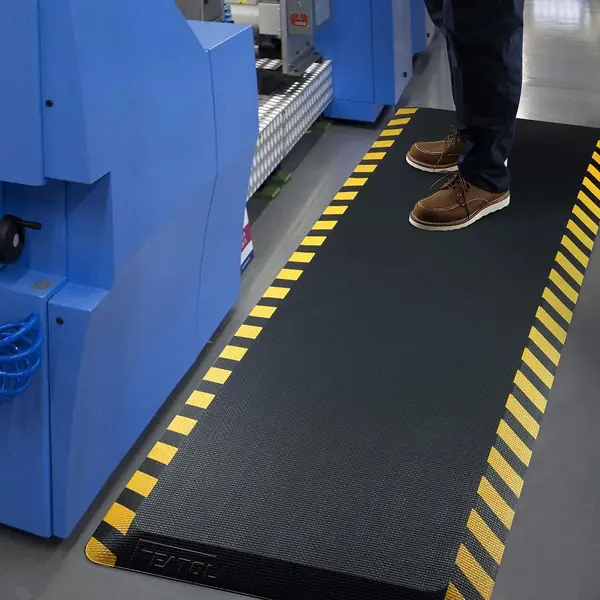
FEATOL industrial anti-fatigue mat in black with yellow safety border, 39 by 20 inches

Single bench station

Shop Score 94/100
Mat Size
39"L x 20"W
Thickness
0.9 inches
Material
Polyurethane (PU)
Safety Border
Yellow
View on Amazon

Sawdust is what separates a mat that survives a woodshop from one that survives a kitchen sink. The top here is polyurethane rather than fabric or bare foam, so shavings sweep off in a pass and a glue drip comes up with a damp cloth instead of soaking in. We put this one in front of a bench and beside a lathe, and the yellow border earned its keep: you catch the mat's edge in peripheral vision when you step back to check a cut.

At 0.9 inches it sits mid-pack in this group, and the foam is dense rather than pillowy. We noticed the difference an hour in — the mat was still holding us up instead of bottoming out, which is the line between cushioning that supports an arch and cushioning you sink through. The beveled edge lies flat enough that we stopped thinking about it, the highest compliment a mat edge can get.

It also comes in a spread of sizes and in multi-packs, which matters if you want the same mat at two benches rather than two mismatched mats. What we keep coming back to is how much workshop mat this is for the money: an oil-resistant skin, a border you can see, and enough thickness to change how a long afternoon at the bench feels.

Worth Noting

  • Runs smaller than the listed size suggests
  • Grip varies on smooth sealed concrete
Our Verdict

We think this is the best default for a bench-and-lathe shop: dense 0.9-inch foam, a wipe-clean polyurethane skin, and a yellow border you catch out of the corner of your eye.

Check Latest Price
2.

Vergo Industrial Anti-Fatigue Mat Best for Full Machine Coverage

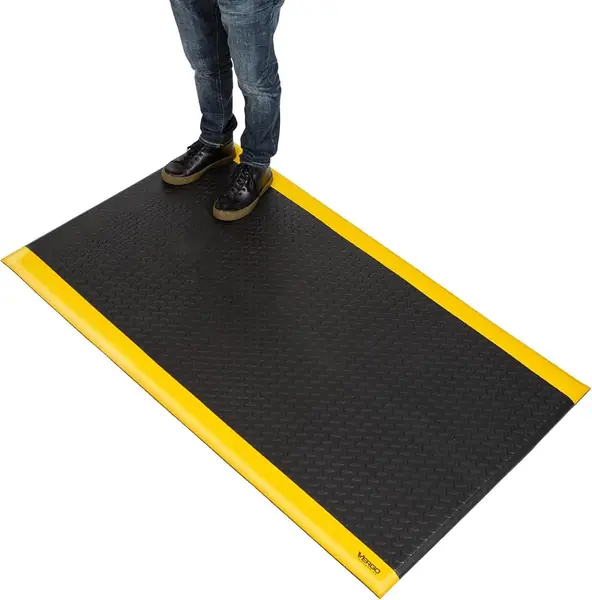
Vergo commercial anti-fatigue mat in black vinyl with diamond-plate texture and yellow edges

Full machine bays

Shop Score 93/100
Mat Size
3' x 5'
Thickness
15/16 inch
Weight
11 lb
Material
Vinyl
View on Amazon

Three by five feet is a different proposition from a mat you stand on in one spot. We laid the Vergo across a run of tools rather than in front of a single one, and the diamond-plate vinyl is the surest footing in this group — enough texture that a boot carrying shavings doesn't skate when you pivot.

Fifteen-sixteenths of an inch of vinyl over a dense core reads firm underfoot, not marshmallow, and we were surprised by how much we preferred that at a machine. A soft mat lets you sway when you lean into a cut; this one cushions without the wobble. The surface is non-absorbent as well, so coolant, oil, and finish spills sit on top and mop off instead of working in.

What it asks in return is a shop where the tools stay where they are. This is a mat you lay down and build a workflow around, and it rewards that layout with more protected floor than anything else here. If your benches get rearranged every weekend, one of the smaller mats will serve you better.

Worth Noting

  • Heavy 11-pound mat is awkward to shift
Our Verdict

We recommend it for a permanent machine bay: diamond-plate vinyl that grips through sawdust and fifteen square feet that stay exactly where you put them.

Check Latest Price
3.

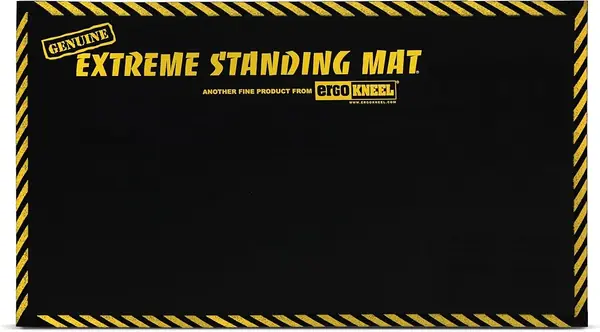
Extreme Standing Mat Best for a Single Workstation

Extreme Standing Mat in black with yellow safety stripes, 28 by 16 inches

One fixed workstation

Shop Score 92/100
Mat Size
28"L x 16"W
Thickness
1 inch
Surface
Yellow safety stripes
Care
Hand wash only
View on Amazon

An inch of dense foam is the thickest mat here, and the extra height is what our knees noticed first. The Extreme Standing Mat is the one we reach for when a job keeps us planted: at a drill press, a sharpening station, a bench where the work doesn't travel. The yellow safety stripes mark the edges you step over, and the bevel keeps that step shallow.

What we liked most is how it holds its shape. The foam pushes back rather than flattening, and it stayed that way through weeks of daily standing instead of packing down into a slab. Sixteen by twenty-eight inches also makes it easy to lift with one hand, which is more than we can say for the larger mats on this list.

That size is deliberate, and the same mat is sold in three-foot and seven-foot lengths if you want this foam across a whole run of tools. The long versions solve coverage; the small one solves the shop where nothing stays in one place for long.

Worth Noting

  • Hand wash only, so no hose-down cleanup
Our Verdict

Our pick if your work stays in one spot — the thickest foam here, dense enough to keep holding you up, in a footprint you can carry to the next machine.

Check Latest Price
4.

Guardian Air Step Anti-Fatigue Mat Best for Rolling Stools

Guardian Air Step vinyl anti-fatigue mat in multicolor, 60 by 36 inches

Wheeled shop traffic

Shop Score 91/100
Mat Size
60"L x 36"W
Thickness
0.25 inches
Weight
2.2 lb
Material
Vinyl
View on Amazon

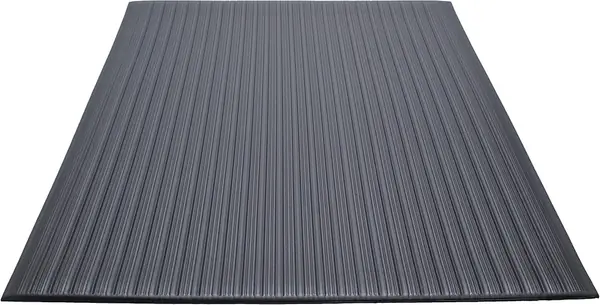
A quarter inch of vinyl is not the mat you choose for all-day standing, and that is worth saying plainly. It is the mat you choose when the floor has to keep working — a stool, a creeper, a rolling cabinet, a chop saw on a mobile base. At 60 by 36 inches it covers a serious stretch of shop floor, with almost no lip for a wheel to catch on.

The trimmability surprised us. Vinyl this thin takes a utility knife or heavy shears, so you can notch it around a bench leg or run it to a doorway instead of ordering a size that almost fits. It wipes clean, rinses off, and doesn't mind a gritty boot now and then.

What we liked most is how little it asks of you. It lies flat, it doesn't need to be picked up and shaken out, and it is content to stay down under a bench for the long haul while a thicker mat gets moved around. Treat it as floor protection with a little give, not as a cure for a ten-hour shift.

Worth Noting

  • Can creep on smooth sealed concrete
Our Verdict

We like it where wheels have to keep rolling: a thin, trimmable sheet that takes a stool or a creeper without a bump, not an all-day cushion.

Check Latest Price
5.

Diamond-Dek Heavy Duty Anti-Fatigue Mat Best for Oil-Prone Bench Areas

Diamond-Dek black vinyl anti-fatigue mat with diamond tread and yellow beveled border

Oil-prone bench areas

Shop Score 90/100
Mat Size
36"L x 24"W
Thickness
7/8 inch
Weight
7.2 lb
Surface
Vinyl diamond tread
View on Amazon

Diamond-Dek builds this one the way a shop floor should be built: a 5/32-inch vinyl diamond tread bonded to three-quarters of an inch of foam, 7/8 inch in total, with the tread doing the grip work and the foam doing the standing. That bonded top is the part we like. A vinyl skin doesn't drink oil, coolant, or spilled finish the way open foam does, and the backing is made to resist oils, alkyds, and acids.

At 7.2 pounds and 2 by 3 feet, it stays where you drop it without turning into something you can't move. We swept it and wiped it with mild detergent rather than hauling it outside, which is the maintenance schedule a garage actually supports. The beveled yellow border does double duty, marking the edge and keeping the step low enough to forget about.

Where it earns its place is a single messy bench: an oil can, a parts tray, a grinder throwing grit, all landing in the same square yard. Set it there and the treaded top is one of the easiest surfaces in this group to keep clean.

Worth Noting

  • Small 2-by-3 footprint covers one stance
Our Verdict

We pick it for a bench where oil and chips land: bonded vinyl tread over foam that wipes clean instead of soaking up every spill.

Check Latest Price

How We Chose and Tested Workshop Mats

We started with shop forums, long-term owner reviews, and spec sheets, then narrowed the field to mats that had a beveled edge, a backing built to grip sealed concrete, and a sensible cost per square foot. We bought 12 of them and put them down in working shops for eight months.

Each mat went where it would actually live: under a single assembly bench, along a run of machines, in front of a table saw, at a bench where glue and finish get knocked over. We stood on every one for a full hour without stepping off and noted where pressure built up, then checked whether the foam sprang back or stayed flattened after we moved. We shifted weight side to side and leaned forward as if feeding stock through a blade to see whether the mat crept underfoot.

For traction, we scattered sawdust across each surface and tried to push the mat out of place with a foot, then swept the grit out from under it, since dust between mat and slab is exactly what turns a mat into a sled. We dripped oil, coolant, glue, and finish on top, let each sit, and wiped, watching whether it beaded or soaked in. We dropped hand tools from waist height and checked for cuts and dents. Edges got their own pass: a hand run along every bevel, a look for any lip standing proud of the floor, and a few hundred steps on and off to catch a curl.

Last, we divided the price of each mat by the floor area it actually protected, because a mat that covers a full machine bay and one that guards a single stance are not the same purchase. That number is why the list looks the way it does.

How to Choose a Workshop Anti-Fatigue Mat

Start With How You Stand, Not How Thick the Mat Is

This one decision eliminates most wrong purchases. If you stay in one place — at a drill press, a sharpening station, a vise — a 2-by-3 or 16-by-28 mat covers a stance and moves when you do. If you pace a run of machines, you need continuous coverage, which means 3-by-5 or larger.

The trap is buying coverage you don't use. A big mat in a crowded shop becomes an obstacle you step around, and a mat you avoid does nothing for your feet. Walk your actual routine before you order.

Thickness and Density: Why an Inch Isn't Automatically Better

Measured thickness across this group runs from about a quarter inch to a full inch, and the number alone won't tell you how a mat feels at hour three. A dense foam that pushes back supports you; a soft slab compresses flat and leaves you standing on concrete with extra steps.

Thin vinyl around a quarter inch belongs where wheels must roll. Three-quarter inch to an inch of dense foam belongs where you stand. The second trap is going too soft at a machine: a standing mat that lets you sink and sway is a poor place to lean into a cut.

Match the Surface to What Lands On It

Sawdust sweeps off a smooth skin, glue drips wipe up, and coolant and oil sit on top of a closed polyurethane or vinyl surface instead of soaking in. If your bench is where the finish and the oil live, choose a bonded vinyl tread over foam and plan on a weekly sweep underneath.

Open, perforated mats that let liquid drain are built for dish rooms and wet doorways. Chips and glue travel through the holes, and there is little foam underfoot for standing. That is a different product doing a different job.

Edges, Traction, and the Trip You Don't Want

Most mats here are beveled and several carry a yellow border. That is not styling: a flat, low bevel keeps a toe from catching when you step off, and a bright edge stays visible when your hands are full and your eyes are on the work.

On sealed concrete, sawdust under the mat is the usual reason one starts to creep, so sweep the floor and not just the mat. Check that the backing is genuinely non-slip before you lay it anywhere you pivot with a running tool.

Cover the Floor You Actually Stand On

Price scales with area, so the small mat looks like the cheap choice and the whole bay looks expensive. Work out square footage first: one bench stance is about six square feet, a run of three machines is fifteen, and the difference in price reflects the floor you're protecting.

Two smaller mats, one per station, are worth weighing against one long mat. They follow you to where the work is; a long mat only helps if you actually stand along it. Measure the floor space before the bigger size arrives.

Frequently Asked Questions

Final Verdict

Most woodworkers should start with the FEATOL. It is thick enough to change an afternoon at the bench, its polyurethane skin handles glue and sawdust, and the yellow border keeps the edge visible beside a machine — all in a footprint that fits a crowded shop.

If your work has you pacing a run of tools rather than standing at one, spend more and take the Vergo: fifteen square feet of diamond-plate vinyl that stays put and mops clean. And if wheels have to keep rolling over the spot, the Guardian is the one that lets them.