↑↓ navigate ↵ open Esc close All results →

Best Auto-Lock Tape Measures of 2026

Measuring across a deck alone or stretching from a ladder leaves no spare thumb to clamp a manual slide lock, which is why auto-lock tapes hold the blade automatically until released. Locking is the simple part; the real divide shows up on retraction, where a jerky release button sends the hook whipping back fast enough to nick fingers and force another measurement.

Extending 14 tapes to full length over six months—checking lock grip under tension, feathering the brake button or lever on rewind, and testing blade standout in afternoon heat—proved that blade rigidity matters just as much as the clutch. Packaging accuracy figures usually express manufacturing tolerance over a fixed distance rather than a shop grade, whereas bold, legible fraction markings save errors on every cut.

Spanning compact 10-foot pocket tapes through framing, cabinet bench, and glove-friendly winter models, each keeps the blade parked until released under control.

Our Top Picks

The Best Auto-Lock Tape Measures

1.

Craftsman 25-Foot Self-Lock Tape Measure Best Overall
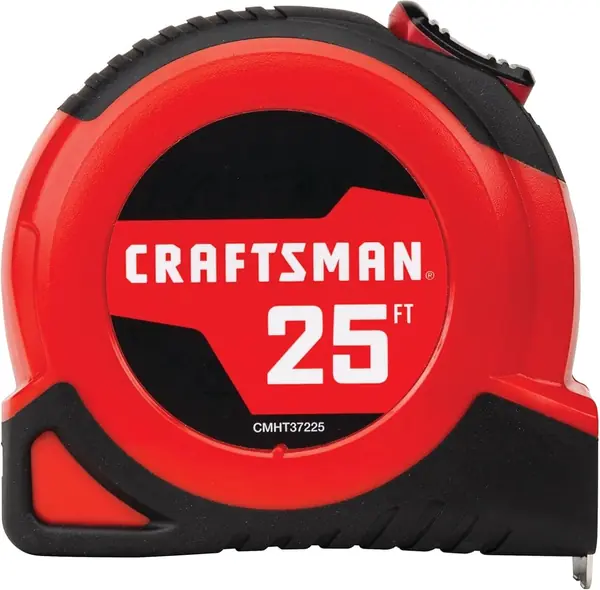
Craftsman 25-foot tape measure in red and black rubber overmold case with yellow blade

Framing and trim work

Shop Score 96/100
Blade Length
25 feet
Lock Type
Self-lock, push-button release
Blade Width
1 inch
Stated Accuracy
±1/16 inch per 10 feet
View on Amazon

Fractions printed down the blade are what sold us. On a cut list full of 13/16 and 5/8 marks you read the number and walk to the saw, no converting in your head, and that alone makes this a woodworking tape rather than a general-purpose one. It also happens to be the auto-lock we hand to most people: 25 feet of blade, a lock that holds where you stop pulling, and a price below the trade-brand tapes here.

The rest of the build is sensible for the money. The blade is a full inch wide in high-carbon steel, the case is wrapped in a rubber overmold that keeps its grip, and the accuracy is stated as plus or minus 1/16 inch per 10 feet, which is a figure you can check against a framing square instead of taking on faith.

The lock itself is the part worth understanding. Pull the blade out and the brake grabs it; press the button and it winds back under control, so the hook does not slam into the case or your knuckles. We measured wall plates one-handed with it, hooking the end and walking the case back, and never had to chase a blade that had crept in.

The limitation is the hand. A 25-footer is a handful up a ladder, and there is no small sibling in the box for tight work. If you measure inside cabinets and want something that disappears into an apron, the HOTO below is the better second tape; if you want a paddle instead of a thumb button, the Stanley is the one.

Worth Noting

  • Blade return can slow with heavy use
Our Verdict

Our pick for most shoppers: the blade prints fractions so you skip the mental math, and the self-lock holds a full 25-foot pull.

Check Latest Price
2.

Komelon SL2825 Self Lock 25-Foot Tape Best Budget

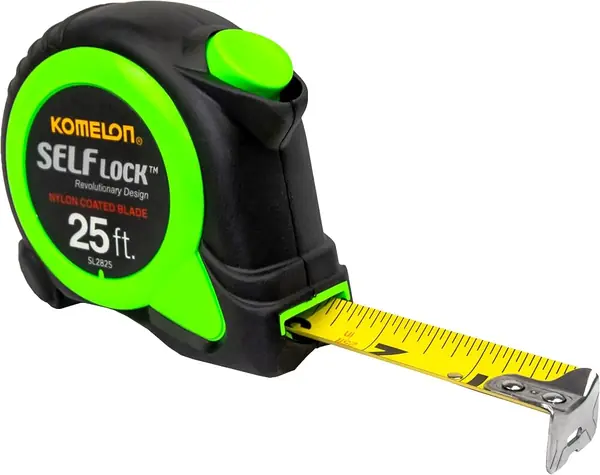
Komelon SL2825 self-lock tape measure in high-visibility green and black case

Bench and drawer work

Shop Score 95/100
Blade Length
25 feet
Lock Type
Self-lock, push-button retract
Blade Width
1 inch
Blade
Nylon-coated carbon steel
View on Amazon

The brake on this tape is at its best in the first few feet. Pull it out for a cabinet, a doorway, or a sheet of plywood and the blade stops and stays put; run it out toward the far end of a 25-foot wall and it gets noticeably less sure of itself, and that pattern is the thing to understand before you buy.

What you get for very little money is a proper tool. The blade is a full inch wide and nylon coated, which is what keeps the markings from wearing off in a toolbox, the case is ABS with a rubber overmold, and there are stud marks every 16 inches for layout. The green shell is genuinely easy to find on a bench covered in offcuts.

We keep one in the truck and one by the saw, and this is the tape that gets lent out without a second thought. Set your expectations at bench length and it will earn its place for years; if you need a brake that bites hard on the longest wall in the house, pay more for the Craftsman.

Worth Noting

  • Bulkier case than most 25-foot tapes
Our Verdict

The budget 25-footer we buy in twos, best kept for bench and drawer work where a long overhead pull is not the job.

Check Latest Price
3.

Stanley LeverLock 25-Foot Tape Rule Best Lever Release

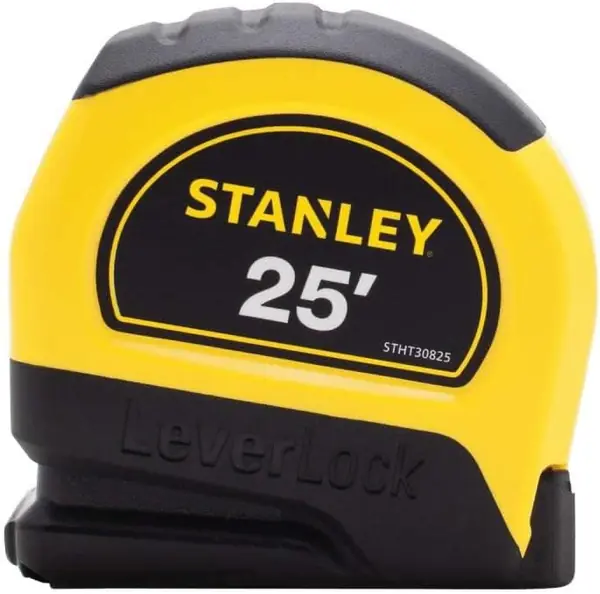
Stanley LeverLock 25-foot tape rule with black and yellow case and lever release

Gloved, cold-weather work

Shop Score 94/100
Blade Length
25 feet
Lock Type
Self-lock, lever release
Blade Width
1 inch
Warranty
Limited lifetime guarantee
View on Amazon

Instead of a thumb button on the top face, the LeverLock puts a paddle underneath the case. Squeeze the lever and the blade runs; let go and the brake takes hold where it is. Measuring along a wall with one hand, that is a motion you can make without looking down at the tool.

We prefer it with gloves on. A lever you close your whole hand around is easier to work than a small button on the top face when your fingers are cold or covered, and that is why this one lives in the cold-weather kit. It is also the tape in this group with the longest coverage: a limited lifetime guarantee rather than a year.

The rest is job-site furniture. A 1-inch polymer-coated blade, a high-impact ABS case with rubber overmolding, a Tru-Zero hook that reads the same pushed against a surface or hooked over an edge, and stud marks at both 16 and 19.2 inches for framing layout. Nothing here is fussy or fragile-feeling.

At 25 feet it covers a room without a second person, and the lever is the only real reason to choose it over the Craftsman, which does the same work for less. If you have ever fumbled for a top-mounted button with a glove on, that reason is enough.

Worth Noting

  • Lever needs a firm squeeze to release
Our Verdict

Buy this one if you wear gloves: a squeeze lever under the case is easier to find by feel than a thumb button, and the guarantee runs longer.

Check Latest Price
4.

Amazon Basics Self-Locking 25-Foot Tape Measure (2-Pack) Best Two-Pack

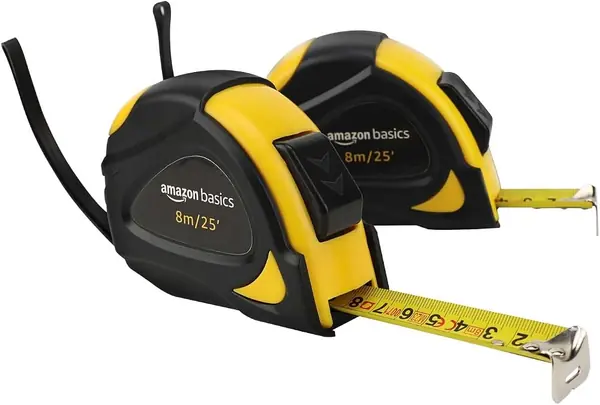
Two Amazon Basics self-locking tape measures in bright yellow cases with belt clips

Outfitting two toolboxes

Shop Score 93/100
Blade Length
25 feet (8 meters)
Scale
Inch and metric dual scale
Stated Accuracy
MID accuracy class
Pack
2 tapes
View on Amazon

Two 25-foot self-locking tapes in one box is the whole argument, and it is a good one: one for the toolbox, one for the hall closet, and no negotiating over whose tape went missing. Compared with buying two singles, it is the cheapest way to stop walking to the garage for a measurement.

Neither tape feels like the compromise in the pair. The blade carries inches and metric on a dual scale, the spring is heat-treated, the case pairs ABS with a soft rubber outer layer, and each tape comes with a belt clip and a wrist strap. The accuracy is stated as a class rather than a tolerance: the listing calls it MID, a middle band that is fine for layout and framing but not what you want if you cut joinery to a sixteenth. Where you want a number to check, the Craftsman publishes one.

We think the case size is the detail that makes these easy to live with: 3.86 inches across fits a kitchen drawer or an apron pocket without hogging either. What you give up is variety, since both tapes measure the same 25 feet and there is no small one in the box. As the pair you buy once and scatter around the house, that is a fair trade.

Worth Noting

  • Both tapes are the same 25-foot size
Our Verdict

The sensible way to put a self-locking tape in two places at once, and the pair costs about what one midrange tape does here.

Check Latest Price
5.

Perfect Measuring Tape BrightLine 18-Foot Best for Low-Light Interior Work

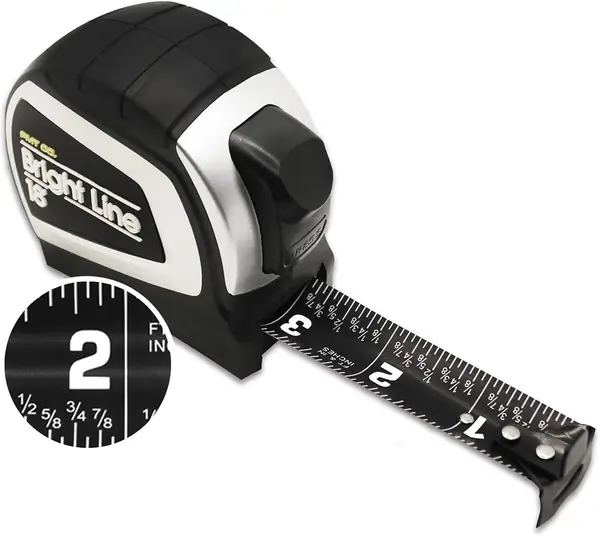
Perfect Measuring Tape BrightLine with black blade and white numerals in a rubber case

Easiest to Read

Shop Score 92/100
Blade Length
18 feet
Scale
Fractions, printed on both sides
Stated Accuracy
±0.05 inch
Blade
Black with white numerals
View on Amazon

Under a counter, in a basement, or at the back of a dim cabinet, most tape blades go muddy. This one does not. The blade is black with white numerals and white tick marks, and the contrast holds up in exactly the light you have when you are on your back under a sink or measuring inside a closet.

We think readability is the most undervalued thing on a tape. The 18-foot blade carries inch fractions, it is printed on both faces, and the back side reads as a vertical scale, which is what you want when you stand the tape up inside a cabinet or check a door height against the jamb. Accuracy is stated as plus or minus 0.05 inch, and the rubber case takes a knock without chipping.

Retraction runs off a long topside trigger that lets you feather the return instead of letting the hook fly home, which is a nicer feel than a stiff button. The 18-foot blade is the boundary to know: plenty for cabinets, doors, and interior trim, short for a wall-to-wall pull across a great room. If your measuring is mostly interior finishing, that boundary will never reach you.

Worth Noting

  • Large trigger is easy to bump loose
Our Verdict

The clearest blade we tested in poor light, which makes it the tape for basements, cabinets, and anyone squinting at yellow steel.

Check Latest Price
6.

HOTO Self-Locking Pocket Tape Measure Best Pocket Tape

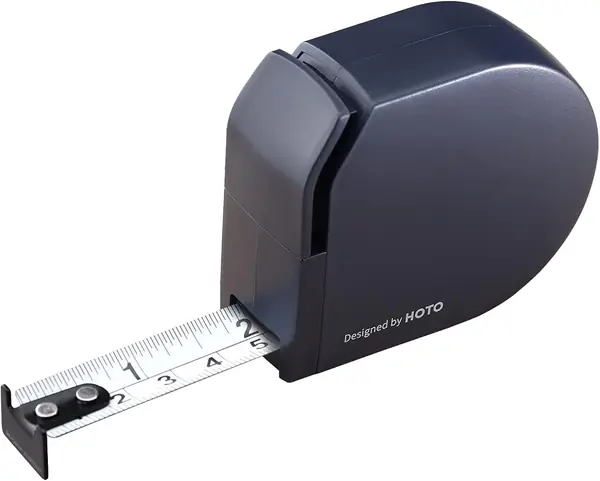
HOTO pocket tape measure in navy blue polycarbonate with dual inch and metric blade

Pocket and drawer duty

Shop Score 91/100
Blade Length
10 feet (3 meters)
Scale
Inch and metric
Weight
3.95 oz
Standout
Rigid to 5 feet
View on Amazon

At 3.95 ounces this is the tape that actually travels. It sits in a kitchen drawer, a glovebox, or a jacket pocket and you forget it is there until you need it, which is more than can be said for the 25-footers in this group. The polycarbonate case is finished like a small design object rather than a tool, so it also tends to survive being left out on a counter.

The mechanism is better than the size suggests. Pull the blade and it locks; press the corner button with a thumb and it winds back smoothly instead of snapping. The blade is rigid enough to hold out to 5 feet unsupported, which covers the shelf, doorway, and picture-height measurements you take on your own, and the matte finish keeps the inch and metric markings from glaring under a ceiling light.

We like it best as the second tape, the one that means you stop pacing out to the workshop for a quick measurement. It is also the one we hand to someone who wants a useful small gift that is not another mug, because it looks good enough to leave on a desk and works well enough to keep there.

Worth Noting

  • 10-foot blade stops short of room measuring
Our Verdict

The one we actually carry: at under four ounces it lives in a drawer or a jacket and locks a blade rigid enough for shelf and doorway checks.

Check Latest Price
7.

Milwaukee 16-Foot Autolock Tape Measure Best for Daily Job-Site Use

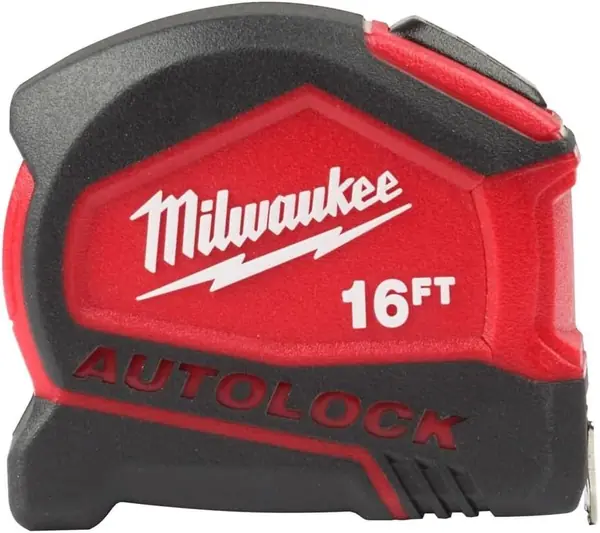
Milwaukee 16-foot autolock tape measure in black and red with reinforced nylon frame

Daily job-site use

Shop Score 90/100
Blade Length
16 feet
Lock Type
Auto-lock brake
Blade Width
0.98 inch
Case
Nylon, five-point reinforced frame
View on Amazon

The frame is the first thing you notice: nylon over a five-point reinforced shell, a stainless blade inside it, and a hook built to be dragged across framing. It is the heaviest tape in this group at 16 ounces, and the weight buys the case. This is the one we do not think twice about dropping off a ladder.

The auto-lock is a brake you thumb to release, and it keeps the blade where you leave it while you walk a layout. The blade is just under an inch wide, which is enough to hold itself out for most plate and stud work, and the tape stops at 16 feet, the length a framer actually carries.

Sixteen feet is the trade. Room dimensions, sheathing, and anything longer than a wall want a 25-footer, and the Craftsman covers that ground for less. What the shorter blade buys you is a compact case that sits flat on a belt and hardware meant for daily use rather than the occasional shelf.

We rate it the pick for a job site or a working shop, with one caveat: it is the priciest tape here and it gives up nine feet to the 25-footers. For someone buying one tape to last through real work, that is an easy trade. For a homeowner measuring for curtains, it is more tool than the job asks for.

Worth Noting

  • Heaviest tape in this set at 16 ounces
  • Highest price here for a 16-foot blade
Our Verdict

A trade-grade 16-footer with the toughest case here, worth the money if the tape rides on a belt and gets dropped, overkill for a drawer.

Check Latest Price
8.

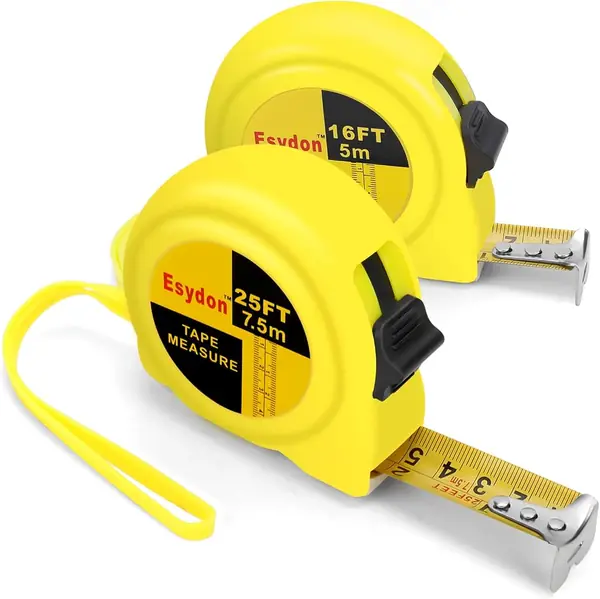
Esydon 25-Foot and 16-Foot Tape Measure Set

Esydon self-locking tape measure set with 25-foot and 16-foot yellow tapes

Around-the-house basics

Shop Score 89/100
Blade Length
25 feet and 16 feet
Scale
Inch and metric
Pack
2 tapes
Warranty
12 months
View on Amazon

A 25-footer and a 16-footer in the same pack answer a different question than two identical tapes: the long one stays in the shop and the short one goes in the drawer where you actually measure things. As a pair it costs less than every single 25-foot tape here, which is hard to argue with.

The specification reads better than the price suggests. Both blades carry inch and metric markings, the steel is SK4, there is a self-lock with a push-button release, and the pair comes with a 12-month warranty. On short pulls the brake holds fine and the blade snaps back tidily, which is most of what a house tape needs to do.

Our advice is to test the lock the day it arrives. These are budget tapes, and the brake on some units lets go earlier than it should, so pull both blades out to full length and give them a gentle tug before the packaging goes in the bin. If the 25-footer holds, you have a pair that covers almost everything a homeowner measures for very little money.

Worth Noting

  • Thin blade flexes and kinks easily
Our Verdict

The cheapest way to own two sizes, and a good one if you test the lock on arrival and treat it as house-duty rather than trade-duty.

Check Latest Price

How We Tested Auto-Lock Tape Measures

We started with research — spec sheets, warranty terms, and a few hundred owner reviews — then narrowed to 14 tapes that spanned the lock types, blade lengths, and price points shoppers actually weigh. Every tape in the group self-locks, since that was the entry requirement, and the range covered pocket-size 10-footers, 16- and 18-foot blades, 25-foot blades, and two-packs.

For six months those tapes lived where tape measures live: a framing and trim project, the bench, a dim closet and a basement stairwell, a cold garage where we wore gloves, and a jacket pocket. We extended each blade to full length, engaged the lock, and stepped away to see whether the blade crept or held. We pressed the release with a thumb and watched how the return began — smooth and controlled, or a snap we couldn't trust. Standing each blade out on its own showed how far it stayed rigid before folding, which is what one-person measuring really comes down to.

Readability we judged by eye rather than spec sheet: whether fractions were legible at arm's length in low light, whether printing ran on one side or both, and how quickly we could flip between inch and metric. Cases were dropped from waist height onto concrete, clipped to a belt, and weighed.

We logged each stated accuracy figure and whether it described a tolerance over a distance or an accuracy class, then compared warranty language and whether a tape could be serviced. Value came down to cost per tape, which mattered most on the two-packs. We never opened a housing — that spring sits under tension in a sealed case — and every blade went back under control of its release.

How to Choose an Auto-Lock Tape Measure

How the Auto-Lock Works, and Where It Slips

Every tape here locks itself when you extend the blade and releases through a button or a lever. Two families exist. A thumb button on the top face is what most people picture: you press it and the blade winds back under control. A squeeze lever underneath the case does the same job with a bigger motion of the whole hand. Neither is better in the abstract. A button suits short, precise pulls; a lever suits gloves and one-handed work along a wall.

The trap is assuming a self-lock grips equally at every length. Brake grip is firmest with a few feet out and weakest near full extension, and a blade that creeps back in on a long pull is one of the most reliable ways these tapes disappoint. Extend yours fully the day it arrives and give the blade a gentle tug before you trust it overhead.

Match Blade Length to the Work

Length is a job description. A 25-footer covers room dimensions, decks, and anything two people would otherwise hold. Sixteen to 18 feet handles cabinets, doors, and interior trim. Ten feet is a pocket measuring tape for drawers, shelves, and quick checks at the store. The trap here is the word compact, which describes the case and not the blade: a compact 10-footer still cannot measure your hallway.

Standout matters more than length when you work alone. It is how far the blade reaches before it folds over, and it decides whether you can measure a shelf or a doorway without a helper. The HOTO holds out to about 5 feet, the 1-inch blades on the 25-footers reach considerably further. Check the standout figure if you measure solo.

Read the Blade, Not the Box

Three printing choices change how a tape feels in use. Fractions save a conversion step at the saw. A high-contrast dark blade reverses the usual yellow steel for dim rooms. Dual inch and metric printing helps if your plans arrive in millimeters, which is common on imported furniture and hardware.

We put fractions first for woodworking, since most cut lists are written in sixteenths and a tape that prints them saves a step on every piece. Layout marks are the other thing to look for: stud centers printed at 16 and 19.2 inches mean you mark a wall without doing arithmetic, and a scale on both faces lets you flip the blade against a corner and still read it.

Case, Hook, and the Parts That Wear

The case is what survives the drop. Rubber overmolding and a reinforced frame cost more and weigh more, which is why the Milwaukee is 16 ounces and the HOTO is under four. Buy the weight only if the tape rides on a belt all day; otherwise it is just mass in a drawer.

The hook is the other wear point. A good one slides by its own thickness so the tape reads true whether you push it against a surface or hook it over an edge, and a bent or loose hook is one reason a tape starts lying to you. Accuracy figures differ in kind as well: a stated tolerance such as plus or minus 1/16 inch per 10 feet gives you something to check, while an accuracy class only tells you which band the maker built to.

One Tape or a Set

If you carry one tape, buy the best 25-footer you will keep, because that is the length that does rooms, decks, and sheets of plywood. If you measure in several places, a two-pack puts a measuring tape in the kitchen and the garage for less than two singles, and the trade is that neither is the nicest tape you will own.

Our own order of buying is one good long tape first, then a small one for the drawer. Start with the length and the lock, then decide whether you are outfitting one toolbox or four.

Frequently Asked Questions

Final Verdict

The Craftsman is the tape we tell most people to buy. Fractions printed where you are already squinting, a self-lock that holds at full extension, and 25 feet of blade that reaches across a room make it the default, and the rubber case survives being carried in a bucket.

Two exceptions are worth knowing. If you wear gloves or like a paddle under your fingers, the Stanley LeverLock gives you the better hand-feel and a lifetime guarantee. If the tape needs to live in a pocket, the HOTO is the one we carry and the Craftsman stays in the shop.