↑↓ navigate ↵ open Esc close All results →

Best Cordless Right Angle Drills of 2026

The first time you need a right-angle drill, you're usually already in trouble: a stud bay too shallow for a standard chuck, a cabinet base with three inches of clearance, a hole that has to go through a rim joist overhead. A regular drill won't fit. What these tools fix is reach — a head set at 90 degrees to the body so the bit goes where the motor can't.

I borrowed one for a weekend of blocking and spent the first hour working out which way it wanted to be held — the part the catalogs skip. We put 11 cordless right-angle drills through eight months of cabinet installs, deck framing, and overhead soffit work to see which earn a spot in the bag.

Two things surprise first-time buyers. Some of these ship as bare tools, a steal if you own that battery platform and a false economy if you don't. The other is how much head shape and weight matter overhead: a stubby head gets into the gap, but a long body still leaves the motor banging the stud.

Our Top Picks

The Best Cordless Right Angle Drills

1.

Milwaukee 2415-20 M12 Right Angle Drill Best Overall
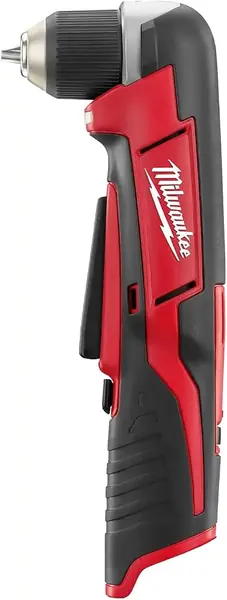
Milwaukee 2415-20 M12 cordless right angle drill in black and red, bare tool

Tight-space drilling and driving

Shop Score 93/100
Tool Weight
2.3 lb
Max Torque
100 in-lb
Head Height
3.75 in
No-Load Speed
0 to 800 rpm
View on Amazon

A 3.75-inch head is the whole argument. That is the room this drill needs at the corner of a cabinet or alongside a stud, and it is the tightest of the compact tools on this page. We kept reaching for it overhead for a second reason: at 2.3 pounds it is the lightest drill here, and holding it up while you line a screw up stops being a chore.

The chuck is what we appreciated most. A spindle lock holds the arbor so the single-sleeve ratcheting chuck opens and closes without a key, which means you can swap a bit one-handed in a spot where a chuck key would never fit. The 100 in-lb tells you what the tool is for: pilot holes through cabinet stock, hinge screws, drawer slides, hardware. Push a 1-inch bit through a stud and you will feel the motor give up ground — that is the job for the Hole Hawg further down.

It arrives as a bare tool, so the listing buys the drill and nothing else, which is a fair trade on the M12 platform and less so from a standing start. What we noticed in use was the extended paddle switch running along the body: a thumb or a finger finds it depending on how your hand fits the space, which is more than most triggers in this class offer. The built-in light throws a spot exactly where the bit is going.

Worth Noting

  • Single speed tops out at 800 rpm
  • No brushless motor
Our Verdict

We recommend the 2415-20 to anyone who drills and drives inside cabinets and between studs: it has the smallest head and the lightest body of the compact tools here.

Check Latest Price
2.

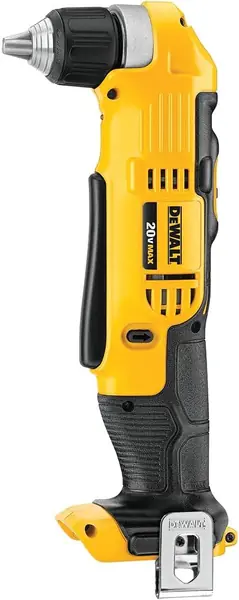
DEWALT DCD740B 20V MAX Right Angle Drill Best for Speed and Bigger Bits

DEWALT DCD740B 20V MAX right angle drill in black and yellow, tool only

Tight-space drilling

Shop Score 92/100
Tool Weight
3.3 lb
Chuck Size
3/8 in
Speed Ranges
0-650 / 0-2000 rpm
Front-to-Back Head Length
4.0 in
View on Amazon

The extra weight buys a 20-volt motor with two speed ranges, the top one turning 2,000 rpm — about two and a half times the top speed of the M12. That second gear is why we hand this one to anyone whose tight-space work is drilling rather than driving: pilot holes in a corner, a hole saw in a stud bay, small holes through a drawer box. At 3.3 pounds it is a pound heavier than the Milwaukee, and overhead that pound shows up by the third hole.

The head measures 4.0 inches front to back, and the 3/8-inch ratcheting chuck has a deep hex pocket so a 2-inch bit seats all the way down and gives back some of the reach the head costs you. What we liked most is the multi-grip trigger: it wraps over the top of the body, so you can hold the tool like a flashlight, like a pistol, or down on the battery depending on how cramped the space is. In a drawer box it is the head measurement, not the battery, that decides whether you can reach the screw.

Worth Noting

  • Motors have burned out under sustained heavy loads
  • Bare tool; battery and charger sold separately
Our Verdict

Buy the DCD740B if you already run 20V MAX packs and want two gears and a 2,000-rpm top end; we think it is the fastest compact option here for drilling.

Check Latest Price
3.

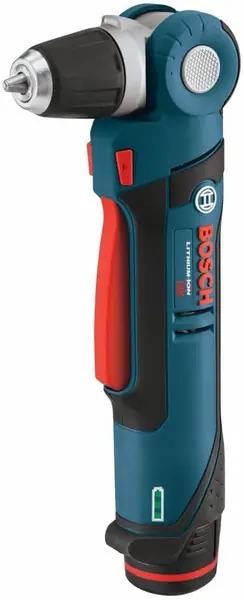
Bosch PS11-102 12V Max Right Angle Drill Kit Best Kit

Bosch PS11-102 12V right angle drill kit in blue with battery and charger

Awkward angles

Shop Score 91/100
Max Torque
115 in-lb
Speed
1,300 rpm
In The Box
2.0 Ah battery and charger
Head Positions
5, from 90 to 180 degrees
View on Amazon

Five detents between 90 and 180 degrees make this the only tool here that is not locked at a right angle. Set it at 90 to slip into a stud bay, then swing it toward 180 and the body lies almost parallel to the bit — which is how you drive a screw into the back corner of a drawer or under a sink where a fixed head needs another couple of inches of clearance.

The rest is a 12-volt driver with 1,300 rpm, 115 in-lb, a 3/8-inch auto-lock chuck you open with a twist, and a variable-speed trigger with a motor brake so the bit stops when you let go. We found it happiest with cabinet hardware, drawer slides, and pilot holes in trim. The included pack is a 2.0 Ah cell; a small battery and a 12-volt motor are fine for intermittent work and less fine for an afternoon of driving, so plan on a spare if this becomes your everyday tool.

Where the PS11 earns its place is the combination: the only pivoting head in the group and the only one that arrives ready to run. For a shop that is not already committed to a battery platform, that makes it the lowest-friction way to put a right angle drill/driver in the box, and the 12-volt Bosch packs it uses are shared across the rest of the Bosch 12V line. It will not out-drill the DEWALT, and it is not meant to.

Worth Noting

  • Single-speed gearbox with no low range
Our Verdict

We point first-time buyers to this kit: it is the only pick here that arrives with a battery and charger, and its pivoting head reaches angles a fixed 90-degree tool cannot.

Check Latest Price
4.

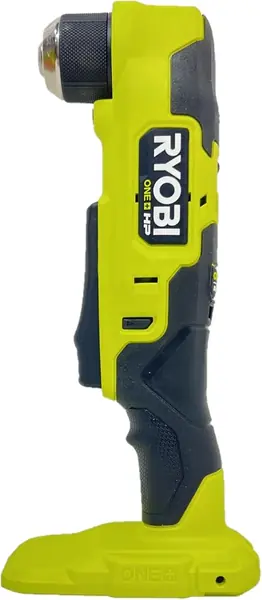
RYOBI ONE+ HP 18V Brushless Right Angle Drill Best Torque for the Size

RYOBI ONE+ HP 18V brushless right angle drill in black, tool only

ONE+ owners

Shop Score 90/100
Tool Weight
2.9 lb
Max Torque
350 in-lb
Speed Ranges
0-450 / 0-1,700 rpm
Head Length
3.6 in
View on Amazon

If there is a stack of ONE+ batteries in your garage, the arithmetic here is easy. The brushless motor is rated at 350 in-lb with two speed ranges — 0-450 for driving, 0-1,700 for drilling — and the head measures 3.6 inches. That is more torque than either 12-volt tool in this guide, and it is the number that decides whether a spade bit walks through a stud or stalls in one.

What settled it for us is that Ryobi did not trade away the low gear to get there. Starting a screw in softwood in the low range is controllable rather than snatchy, and the high range has the speed to drill. At 2.9 pounds it sits between the two 12-volt tools and the DEWALT, which is about right for something you hold overhead while you find a stud, and the short head means you are not paying for that torque in clearance.

Worth Noting

  • Bare tool; ONE+ battery and charger not included
Our Verdict

For anyone already on the ONE+ platform this is the one we name: 350 in-lb of brushless torque in a 3.6-inch head, for less than most of the tools here.

Check Latest Price
5.

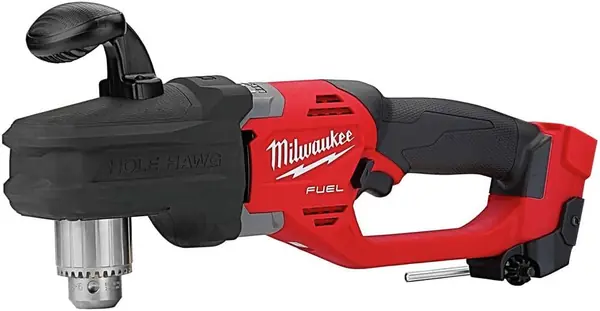
Milwaukee 2807-20 M18 FUEL Hole Hawg Best for Rough-In Hole Boring

Milwaukee M18 FUEL Hole Hawg right angle drill in red and black, tool only

Rough-in hole boring

Shop Score 86/100
Tool Weight
7.7 lb
Chuck Size
1/2 in
Max Speed
1,500 rpm
Drilling Capacity (Wood)
2.63 in
View on Amazon

At 7.7 pounds the Hole Hawg is the heaviest tool here by a wide margin, and that mass is the point: it is what keeps a 2-5/8-inch self-feed bit turning through a stud instead of stalling halfway. This is a two-handed tool, and the 1/2-inch chuck is the reason — nothing else in this guide will take a bit that big.

Milwaukee builds it for rough-in: boring studs for wire and pipe, running a stack, punching through top plates at 1,500 rpm. The head is the trade-off in a crowded bay, where it takes up room a 12-volt head would give you, so it is at its best on open wall runs rather than inside a finished cabinet.

We keep it on this list for the one thing it does better than anything else here: hole boring. If your tight-space work is wire and pipe, the weight is the price of the capacity and you will be glad of it. If it is cabinets and hardware, put this down and pick up the M12 — the smaller drill reaches those fasteners sooner and will not tire your arm out doing it.

Worth Noting

  • Head is bulky around pipes and framing
Our Verdict

We keep the Hole Hawg on the list for one job — boring big holes through studs and plates; at 7.7 pounds it is a two-handed tool, not a cabinet drill.

Check Latest Price

How We Chose and Tested Cordless Right-Angle Drills

We started by gathering every cordless right-angle drill we could find across the major battery platforms, then filtered on the specs that actually separate them: head height and front-to-back reach, torque and speed range, chuck size and type, stated capacity in wood and metal, and whether the tool ships bare or with a battery and charger. Anything that couldn't hold a 3/8-inch bit shank or reach past a nail plate was out. That left 11 drills, and we ran them for eight months.

They went where the work is: base cabinets against a wall, blocking between deck joists, overhead soffit panels, and a plumbing rough-in in a 16-inch stud bay with a nail plate crowding one side. We taped each head's height and front-to-back length, then test-fit every drill in that same bay instead of trusting the spec sheet. All of it happened with eye protection on, a fresh bit, and both hands on the tool — we stayed well clear of the arc the handle would swing through if a bit bound.

Power and speed got judged on real cuts: a hole saw through doubled 2x, a self-feed bit in a rim joist, and a long run of pilot holes for cabinet screws, all kept inside each tool's stated capacity. We noted where the trigger fell when we were reaching around a corner and whether a bit could be swapped one-handed in gloves. Battery life got timed in hole-saw cuts until the tool quit, weight got checked on a scale with the battery in, and after eight months of dust and daily use we could tell which motors still ran smooth and which had gone wheezy.

How to Choose a Cordless Right Angle Drill

The head decides, not the motor

The number that matters is how much room the head needs from the bit back to the body. A tool can be light and short overall and still have a head that will not fit between a drawer box and a wall, so hold the measurement you care about against the actual gap. Between studs you have about 14½ inches of bay; inside a cabinet, the depth of the box is your limit.

This is also where right-angle adapters lose. The adapter body and its second chuck sit in exactly the clearance you were short of, so you gain an angle and lose the reach you were chasing.

Match torque and speed to the bit you turn

The compact tools here run from 100 to 350 in-lb, and that spread decides what a drill can do. Around 100 in-lb is a pilot-hole and screw-driving tool; 350 in-lb will pull a spade bit through a stud; anything bigger wants a dedicated borer with a 1/2-inch chuck.

A low gear matters as much as peak torque, because it is what lets you start a screw without stripping the head. If you mostly drive, weight the low range. If you mostly drill small holes, weight the top rpm.

Treat weight as an overhead-work spec

Two-and-a-bit pounds and seven-and-a-bit pounds are different tools, not different grades. If the work is above your shoulders — ceiling boxes, overhead cabinets, blocking between joists — the 12-volt class is worth the lost power, because you hold the tool up while you line the bit up.

If the work is at chest height and the holes are big, mass steadies the tool instead of fighting you. Handle one before you buy if the store allows it; balance in the hand matters more than the number on the page.

Bare tool or kit

Most of these ship as bare tools, priced without a battery or charger. That is a bargain if you are already on that platform and a trap if you are not, since a pack and a charger can cost about what the drill does. Count what you already own before you compare.

If the answer is nothing, a kit is the cheaper way in, and the Bosch PS11-102 is the only pick here that includes both a battery and a charger.

Chucks and bit changes

In a tight space you change bits by feel, so the chuck matters more than it does on a bench drill. A spindle lock or an auto-lock collar lets you open the chuck one-handed; a deep hex pocket in a 3/8-inch chuck lets a short bit seat fully, which buys an inch of reach.

Stubby bits are the other half of the equation, since a shorter bit gives back clearance the head just won. Check the chuck's capacity against the shanks you already own before you order.

Frequently Asked Questions

Final Verdict

Most people should buy the Milwaukee 2415-20. It has the smallest head of the compact tools here, it weighs 2.3 pounds, and its spindle-lock chuck lets you change a bit where nothing else fits — for cabinet, drawer, and hardware work, that combination is the whole job.

Buy the Bosch PS11-102 instead if you do not already own a battery platform, since it is the only pick that arrives ready to run and its pivoting head reaches angles the Milwaukee cannot. If you are on ONE+ and want more torque in the same short body, the Ryobi is the better fit.