↑↓ navigate ↵ open Esc close All results →

Best Roller Stands for Woodworking of 2026

Once the far end of a long board tips off the back of a saw table, gravity pulls the kerf shut against the blade and forces a single operator into a losing wrestling match. An outfeed roller stand cures that sag cheaply by supporting long stock level with the cast iron — provided the frame stays planted rather than creeping across the concrete.

Nine months of positioning 12 single and paired stands behind table saws, beside miter stations, and across a sloped garage floor surfaced two traps hidden on retail boxes. Listed weight ratings often quote a combined pair capacity rather than one stand's limit, and minimum lowered height proves far more decisive than maximum reach when matching shorter contractor saw tables.

Compact folding frames, multi-ball heads for wide sheet goods, built-in edge guides, and heavy-duty timber supports make up the seven stands below, each holding its locked elevation without sliding mid-pass.

Our Top Picks

The Best Roller Stands for Woodworking

1.

SHALL Folding Roller Stand 2-Pack Best Overall
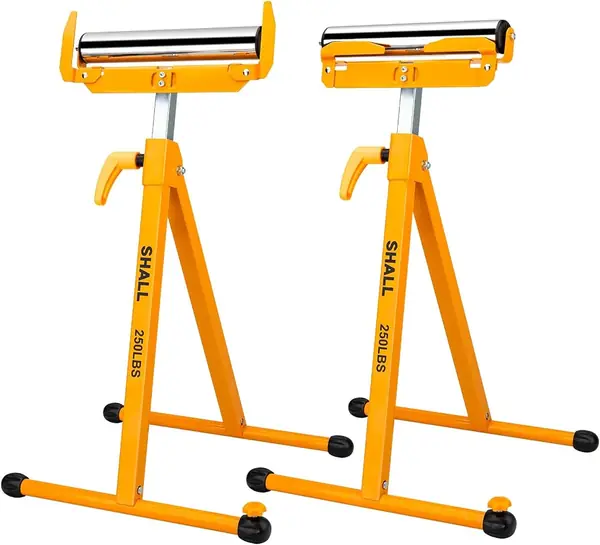
SHALL yellow folding roller stand pair with chrome steel roller and tripod legs

Table saw infeed/outfeed

Shop Score 90/100
Height Range
27.8 to 43 inches
Load Capacity
250 lb per stand
Stands Per Pack
2
Roller Width
11.5 inches
View on Amazon

Two stands, not one, is the honest starting point for a long rip: a board needs support on the way in and on the way out, and most listings make you buy twice. SHALL sells the pair with 250 pounds of capacity per stand, a 27.8- to 43-inch height range, and an 11.5-inch polished steel roller, and that combination is what made it our top pick — it covers a contractor saw's table, a benchtop planer, and a miter saw station without asking you to choose between them.

The square telescoping column with rounded edges gives the height lock something flat to grip, so the head stays where you set it, which is the part that matters when you are feeding a board and cannot watch the stand. An eccentric foot spins down to take up the gap on a slab that is not level — the difference between a stand that rocks and one you forget about. Folding is a single motion, and the pair hangs on a wall hook.

Where this pair stops: 250 pounds per stand covers boards, plywood, and assembled frames, not a stack of green timbers or steel pipe, which is the heavy VEVOR stand's territory. What we appreciate most after living with them is that nothing about the pair calls attention to itself, which is the highest compliment for a stand whose job is to disappear while you cut.

Worth Noting

  • Caps out at 250 pounds per stand
Our Verdict

We made this pair our top pick: two stands, 250 pounds each, a 43-inch top, and a fold-flat frame at the lowest price in the group.

Check Latest Price
2.

WORKPRO Folding Roller Stand 2-Pack Best for Smooth Feeding

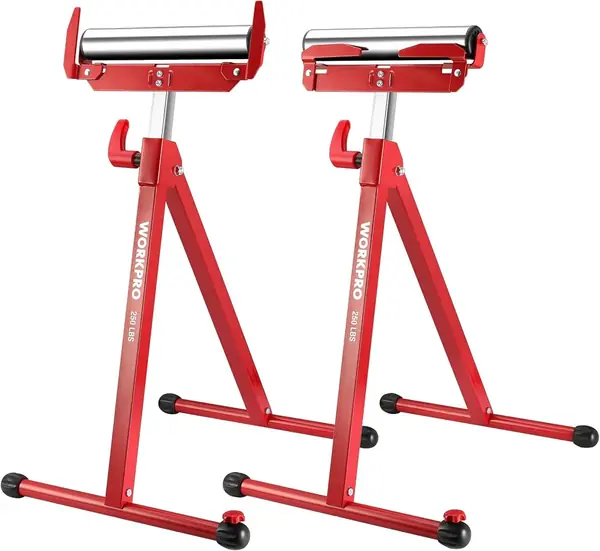
WORKPRO red folding roller stand pair with ball-bearing roller head and edge guides

Sheet goods

Shop Score 89/100
Height Range
27 to 43 inches
Load Capacity
250 lb
Stands Per Pack
2
Roller Type
Ball bearing
View on Amazon

The head is the reason to look here. WORKPRO builds an 11.5-inch roller on ball bearings, and a heavy sheet of plywood starts moving with a push instead of a heave — noticeable when you are alone and the panel is wider than the saw's table. Each stand carries 250 pounds, adjusts from 27 to 43 inches, and folds flat.

Edge guides on either side of the roller are the detail we appreciate most. They stand up like small curbs and keep a wide panel from sliding off the back while your eyes are on the blade. The frame folds in one motion, and at 250 pounds a stand it handles plywood and assembled frames without complaint.

Between this pair and our top pick, the choice comes down to the roller: ball bearings make a heavy panel easier to start and keep moving, and that is worth the extra money if you regularly break down sheet goods on your own. On narrower stock the two feel much the same, and the price difference is easier to justify on a saw that sees panels every week.

Worth Noting

  • Base can shift under an off-center board
Our Verdict

We point anyone feeding heavy sheet goods here, because the ball-bearing roller starts a panel moving with a push instead of a heave.

Check Latest Price
3.

BORA PM-2700 Adjustable Conveyor Roller Stand Best for Long Boards

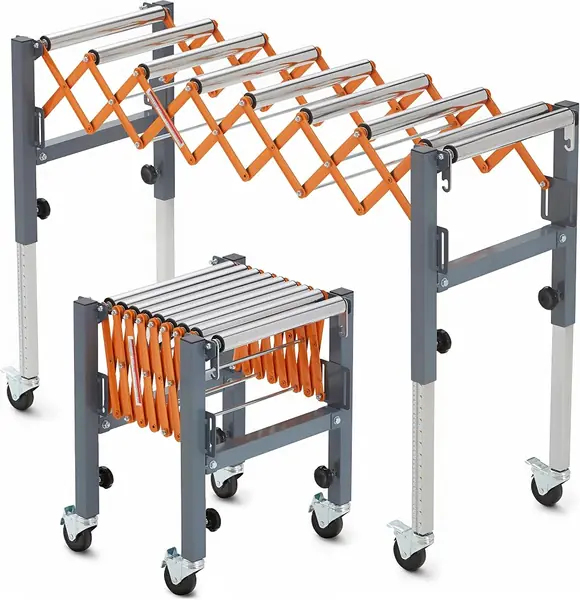
BORA PM-2700 orange expandable conveyor roller stand with locking casters

Long board runs

Shop Score 87/100
Height Range
23 to 36 inches
Load Capacity
300 lb
Weight
44.7 lb
Length Range
14.75 to 50 inches
View on Amazon

Every other stand here touches a board along one roller. This one carries it across a span: the frame telescopes from just under 15 inches to 50 and holds a 300-pound load on a bed of conveyor rollers, which is what you want when a 10-foot board comes off the saw and the far end has nowhere to land.

Each leg adjusts on its own, so the frame levels on a floor that slopes toward a drain, and the locking casters roll it from the saw to the assembly table and hold once you step on the locks. Built-in hooks let you link two units into a longer line, and the frame flexes slightly to follow a small angle without fighting the board.

We treat it as the specialist of the group. The price is several times what a good folding pair costs, and for ordinary board work the SHALL pair does the same job with less floor space. Roll a sheet of plywood across this once, though, and the single-roller stands start to feel like a compromise.

Worth Noting

  • Caps at 36 inches, short of tall benches
  • 44.7 pounds keeps it in one spot
Our Verdict

We recommend this conveyor when one stand between two points is not enough: it carries a board across a span and rolls where you need it.

Check Latest Price
4.

VEVOR Heavy Duty Roller Stand Best for Heavy Loads

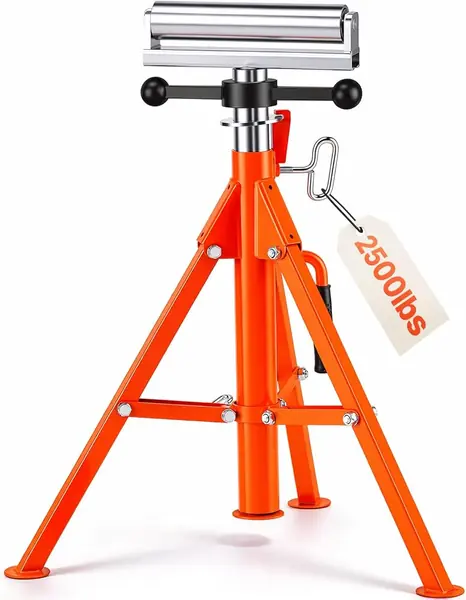
VEVOR orange and black heavy-duty roller stand with triangular folding base

Heavy stock

Shop Score 86/100
Height Range
27.6 to 52 inches
Load Capacity
2500 lb
Weight
29.1 lb
Base
Triangular, three-leg
View on Amazon

Two thousand five hundred pounds is the rating, roughly ten times what the folding pairs claim, and the build explains why: a wide triangular base, three legs, and just over 29 pounds of steel that sits on the floor rather than perching on it.

Height runs from 27.6 to 52 inches on a T-handle, the tallest range in this group, which matters when a planer rides a mobile base or you stand tall at the bench. The screw-drive column lets you dial a height in rather than hunt for a pin hole, and the base folds flat against the upright when the job is done.

What we did not expect to like: the three-point stance. A tripod is never perfectly level on a garage slab, but three legs mean it does not rock, and the wide span keeps the load over the center. Reclaimed timbers, slab offcuts, and steel pipe all sit on it without the base walking.

What we came away with is that the rating is not marketing. The base, the column, and the folding brace all point at the same job, and a stand that does not shift is worth the floor it takes up when a heavy board is moving across it.

Worth Noting

  • One stand per order, so a pair costs double
  • 29.1 pounds is a two-hand carry
Our Verdict

Our pick for the heaviest stock: a 2,500-pound stand that reaches 52 inches and does not shift when a slab moves across it.

Check Latest Price
5.

VEVOR 4-in-1 Roller Stand Best Multi-Function Stand

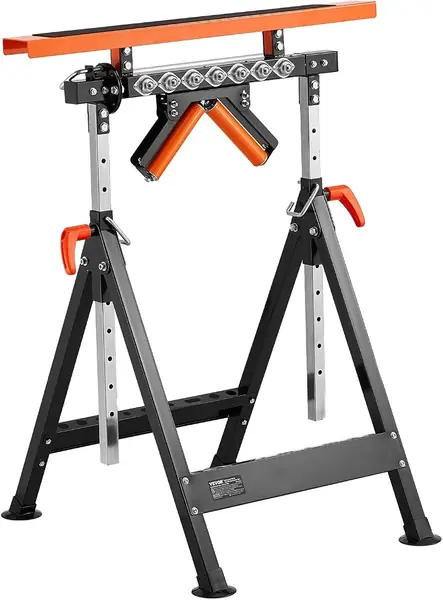
VEVOR black 4-in-1 roller stand with multi-directional roller head and rack

Mixed shop work

Shop Score 85/100
Height Range
33 to 50 inches
Load Capacity
440 lb
Stands Per Pack
1
Roller Head
Roller, ball, and V-support
View on Amazon

Round stock, wide panels, and a long board each want different support, and this head gives you three: a polished roller for straight feed, a set of multi-directional ball rollers for a panel that has to move sideways, and a V section that centers a dowel or a pipe. There is a small rack in the works too, for the offcuts you keep reaching for.

The column adjusts from 33 to 50 inches on a twist-lock handle, chrome plating keeps the roller slick, and the 440-pound capacity covers sheet goods and thick stock with room to spare. The triangular frame folds flat when the bench needs the space back.

We like it for the shop that never settles into one job: pipe on the chop saw one day, plywood on the table saw the next. The 33-inch floor of the height range is the catch, since it will not drop to a band saw's table, and the extra modes mean a moment of deciding which one you want. After the first week the switching stops being a decision and becomes habit.

Worth Noting

  • Starts at 33 inches, above band saw tables
Our Verdict

We chose it for the shop that changes jobs often: one stand that feeds a roller, ball, or V-support under the work.

Check Latest Price
6.

WEN 4289-2 Adjustable Roller Stands Best for Solo Saw Work

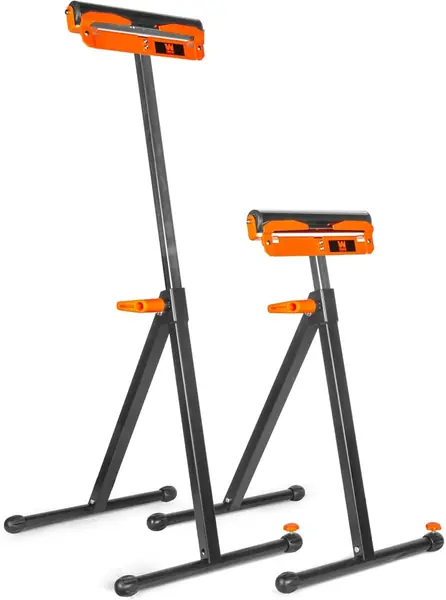
WEN red adjustable roller stand pair with edge guides and folding legs

Solo saw work

Shop Score 84/100
Height Range
27 to 43 inches
Load Capacity
250 lb per stand
Warranty
2 years
Edge Guide
Up to 11.5 inches wide
View on Amazon

The edge guides are what set this pair apart: two uprights on the roller head hold a board up to 11.5 inches wide from walking off the side, which matters most when you are alone at the saw and the offcut side is the one you cannot see. Each stand carries 250 pounds and adjusts from 27 to 43 inches, and the pair comes with a two-year warranty that is unusual at this price — the reason we kept it in the running.

Both stands fold into a narrow bundle that stores on a shelf or hangs on a wall, and the adjustment knob on the foot takes up the wobble on an uneven slab. For a bench that sees weekend projects rather than daily production, that is enough stand.

Assembly is straightforward — legs, feet, column, head — but the legs bolt to cross-bar feet, and that joint is the part we watch. Give the bolts a check after the first few sessions and they stay put. The design is honest rather than clever, which is what we want from a stand holding the far end of a two-by-ten.

Worth Noting

  • Leg-to-foot bolts need checking after the first few sessions
  • Built for weekend shop work rather than daily production
Our Verdict

We keep this pair in the roundup for its edge guides and two-year warranty, both rare on a folding stand.

Check Latest Price
7.

EZUVITA 2-Pack Folding Roller Stands

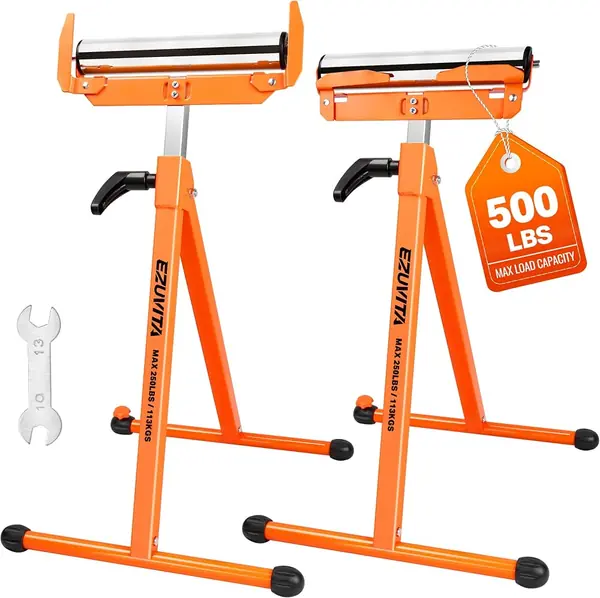
EZUVITA orange folding roller stand pair with chrome rollers and fold-flat edge guides

Miter saw station

Shop Score 83/100
Height Range
28 to 43.5 inches
Load Capacity
500 lb total
Roller
Polished chrome
Edge Guides
Fold-flat
View on Amazon

On paper this pair sits right beside our top pick: 500 pounds of total capacity, a 28- to 43.5-inch height range, smooth chrome rollers, and fold-flat edge guides on both stands. The eccentric feet are the detail that made us look twice, since they let you level a stand on a slab that slopes toward a floor drain.

What we like best is that the guides fold down flat rather than standing up permanently: a curb that helps with a wide panel is in the way when you slide a sheet on from the side. The twist-lock handle on the column is easy to find with a hand full of lumber, and the orange frame is hard to lose in a cluttered shop.

The 43.5-inch top is the highest of the folding pairs here, which matters if you work at a bench built for a tall frame. If the guides turn out to be the feature you use most, you will not miss anything the pricier pairs add.

Worth Noting

  • Height starts at 28 inches, favoring taller workbenches
Our Verdict

We rate its fold-flat edge guides and 43.5-inch top, a spec sheet that matches our top pick almost line for line.

Check Latest Price

How We Tested Roller Stands

We built the shortlist from specs before we read a single review: the low end of each stand's height range against the machines it would serve, capacity listed per stand versus per pair, roller type and width, whether an edge guide came in the box, and how small it folded. That narrowed a long list to models we could actually get our hands on, spread across a few price bands.

Twelve stands, some sold alone and some in pairs, went through nine months of real shop work. They sat behind a contractor table saw ripping eight-foot boards, beside a miter saw station handling twelve-foot trim, and under sheet goods riding on ball-bearing rollers. Since shop floors are rarely flat, we also ran them on a garage slab that slopes toward the door and out on the driveway apron.

Every stand got the same routine. We set the roller just below the saw's table surface, centered the load over the base, and watched whether stock caught, lifted, or wandered. We locked the height, leaned on the roller head, and checked afterward whether the setting had crept. We pushed a board sideways to see if the base walked or tipped, spun each roller by hand to feel for flat spots and grit, and came back at the end of the nine months to check joints and roller play for wobble.

Setup and teardown we timed solo, then carried each stand to a shelf to see how it stored and how much room it ate. Value came down to what arrived in the box against the price band, since a second stand or an edge guide changes that math quickly. We never loaded a stand past its listed per-stand capacity, and we noted which ones made that limit easy to respect.

How to Choose Roller Stands for Woodworking

Start With the Low End of the Height Range

A contractor table saw's table sits around 34 inches off the floor, a benchtop planer lower, and a band saw lower still, so the figure that limits a stand is the bottom of its range, not the top. Write down the table height of every machine you plan to feed before you shop, then check both ends of the numbers.

Our folding pairs run roughly 27 to 43.5 inches and cover most of a small shop. The multi-function stands start around 33 inches, which is comfortable at a full-height bench and useless beside a band saw.

One Stand or Two?

A single stand saves money and handles the tail end of a short board, but once stock runs past six or seven feet the far end drops and the cut goes crooked. Two stands, one at the infeed and one at the outfeed, are the honest answer for sheet goods and long rips, and the multi-packs are usually the cheaper way to get there.

Read the capacity figure carefully. A 500-pound headline can mean a pair of 250-pound stands rather than one 500-pound stand, and that changes what you can put on it.

Pick the Roller Head for Your Stock

A plain steel roller is all a straight rip needs, and it takes almost no upkeep. Ball bearings reduce the effort of starting a heavy panel and show up as a smoother feed when you are alone with a sheet of three-quarter plywood.

Multi-directional ball or V heads earn their place when stock arrives at an angle, when you spin a panel to trim the second edge, or when you push round stock across a chop saw. Each step up adds hardware to keep clean and a moment of deciding which mode you want.

Match the Base to Your Floor

A tripod with an adjustable eccentric foot is the lightest way to cope with a slab that slopes toward a drain; a wide triangular base with real weight is the answer when a heavy board swings. Neither is better in the abstract — match it to what you cut.

Locking casters belong on a stand you move between machines. The BORA conveyor rolls from the saw to the assembly table and locks in place, while a light folding stand moves easily and can walk easily, so keep the load centered and the legs fully spread.

Storage, Weight, and Setup

Folding is not a marketing line if your shop shares space with a car. A pair of folding stands hangs on a wall hook; a 45-pound conveyor stays where you park it, which is fine if it lives beside the saw and a nuisance if it does not.

Assembly on the folding pairs is a matter of bolting four legs and a head together, and it takes one sitting. We still check every bolt after the first few boards, because a stand that shifts under load is worse than no stand at all.

Frequently Asked Questions

Final Verdict

We recommend the SHALL two-pack as the default: support at both ends of a board, 250 pounds per stand, a 27.8- to 43-inch range that suits a table saw and a benchtop planer, and a frame that folds onto a wall hook, all for the least money in this group.

Step up to the BORA PM-2700 if your stock runs past eight feet and you want continuous support instead of a single contact point, or to the VEVOR heavy-duty stand if you feed slabs and pipe more often than lumber.