↑↓ navigate ↵ open Esc close All results →

Best Laser Safety Glasses for Engraving of 2026

Treating laser safety glasses like dark sunglasses is a fast way to trust the wrong lens. A laser engraver's beam is invisible until it strikes a surface, and reflections off a honeycomb bed, metal blank, or glossy tile carry the same hazard as a direct hit. Proper eyewear relies on optical density filters tuned to a specific wavelength, leaving enough visible light to monitor the engraving while blocking the beam your machine actually emits.

Across eight months of running 12 pairs beside a diode engraver, a CO2 cutter, and a fiber marker, we weighed lens clarity and coverage right alongside the rating stamped on the frame. Fit over prescription eyewear, side and top shielding, and whether the included case and cloth justified the price all mattered in daily use. Tint alone proves nothing: a lens that blocks blue light offers no guarantee against 1064 nm or 10600 nm output, so each model below is grouped by its verified wavelength rating rather than lens darkness.

Our Top Picks

The Best Laser Safety Glasses for Engraving

1.

LaserPair 200–534 nm Laser Safety Glasses Best Overall
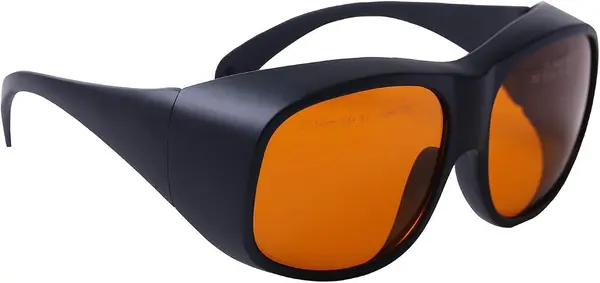
Orange LaserPair wrap-around laser safety glasses with black frame and side coverage

Diode and fiber

Shop Score 90/100
Rated Protection
180-534nm O.D 7+ & 740-900nm O.D 5+ & 900-1095nm O.D 7+
Certification
CE, EN 207
Visible Light Transmission
23%
Lens Material
Polycarbonate
View on Amazon

The first thing that sold us on the LaserPair pair is the breadth of its rating. One set carries OD 7+ across the blue and violet band that diode engravers use, plus OD 5+ to 7+ through the near-infrared, so it covers 405, 445, 450, 532, and 1064 nm. For a shop that runs a diode engraver and an occasional fiber marker, that means one filter instead of two.

We noticed the wrap-around shape does more than look purposeful: the TR90 frame hugs the temples and closes off the side angle where stray reflections come from. At 6.7 ounces it is not the lightest pair here, but the adjustable fit kept it stable when we leaned in to check a cut. The flank vents also kept the lens from fogging during a longer run, which we appreciated more than we expected.

Seeing the work is the trade-off. Visible light transmission is 23%, so the shop goes dimmer and the orange lens shifts color; fine pencil marks and color-coded settings take a moment longer to read. We still prefer that to a pale lens that leaves us guessing about protection, and the 405–450 nm dot remains easy enough to follow on light wood.

The CE and EN 207 labeling and the scratch-resistant coating are the details we checked after the first week, because a filter is only useful if it survives shop life. The frame has stayed tight at the hinges, and the coating has held up to the usual bench handling. For diode and fiber work, this is the set we reach for.

Worth Noting

  • No rated protection for CO2 10600 nm
Our Verdict

For diode and fiber engravers who want one certified set, we reach for this pair: it covers 405–450 nm and 1064 nm with a wrap-around fit.

Check Latest Price
2.

Carlany 190–490 nm OD 6+ Laser Safety Glasses Best for Prescription Glasses

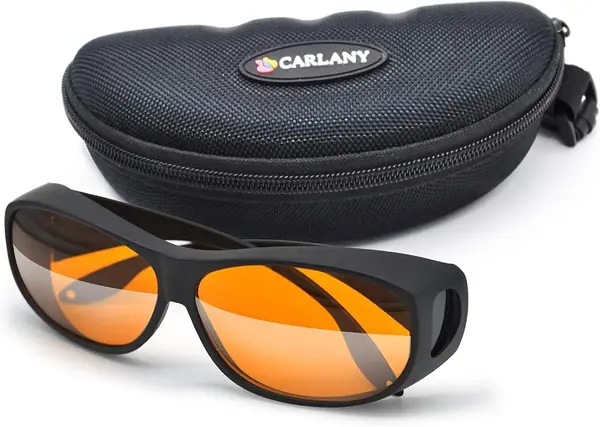
Orange Carlany over-prescription laser safety glasses with wrap-around frame

Prescription wearers

Shop Score 89/100
Rated Protection
190–490 nm OD 6+
Target Wavelengths
405, 445, 450, 473 nm
Prescription Fit
Over glasses
View on Amazon

If you already wear glasses, this is the Carlany pair we hand people first. The 190–490 nm OD 6+ filter covers the blue and violet output of a diode engraver, and the frame is shaped to sit over prescription glasses rather than press them into your face. That over-glasses fit is what makes it useful; it is the one here explicitly built for that.

We liked the orange lens more than we expected. It cuts the blue glare without turning the whole shop into a cave, and the frame is light enough that we forget we are wearing two pairs. The side coverage is a wrap rather than a sealed cup, so it is less enveloping than the JILERWEAR goggle, but it is easier to put on and take off between jobs.

The filter is the reason to buy: OD 6+ is a meaningful step up from the OD 4+ budget pair, and the frame stayed comfortable through a long session. We also liked that the orange tint lets us glance away from the machine without taking the glasses off. For a blue-diode shop with glasses wearers, this is the easy recommendation.

Worth Noting

  • No 1064 nm or CO2 coverage
Our Verdict

We point prescription-wearers to this Carlany pair because it fits over glasses and rates OD 6+ for the blue diode wavelengths most engravers use.

Check Latest Price
3.

GOSONO 190–540 nm Two-Pack Laser Safety Glasses Best Two-Pack for a Shared Shop

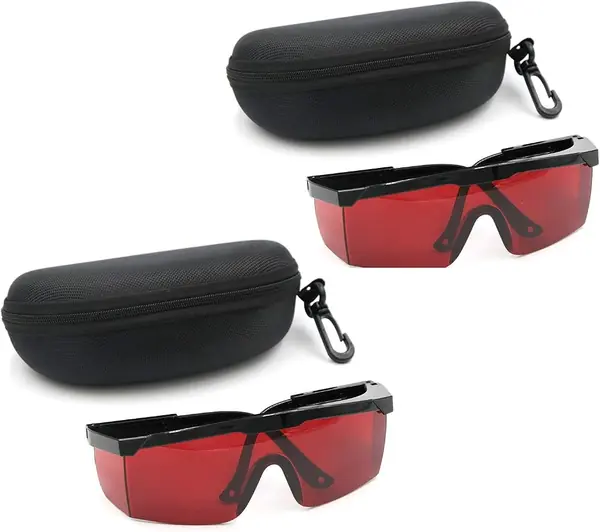
Red GOSONO laser safety glasses two-pack with velvet storage case

Shared workshops

Shop Score 88/100
Rated Protection
190–540 nm, OD 5+/6+
Visible Light Transmission
55% or more
Temple Length
3.6–4.5 in adjustable
Pairs Included
2
View on Amazon

The second pair is the point. GOSONO sells these as a two-pack, and that changes how a small shop works: one pair stays by the machine and one goes to whoever is helping, without passing eyewear back and forth. We kept one in the velvet case and one on the bench, which is exactly the kind of low-drama arrangement we want around a laser.

Both pairs are rated 190–540 nm at OD 5+/6+, with 55% or more visible light transmission. That is a more open view than the dark orange filters, and the adjustable temples run from 3.6 to 4.5 inches, so you can lengthen them for a cap or a larger head. The lens is not as dark as the LaserPair, which makes it easier to see layout lines before the beam starts.

We liked the velvet case and the low weight, and the pair has stayed comfortable through long engraving sessions. What we did not expect is how often the second pair went to a visitor who wanted to watch the beam; that is the real benefit of a two-pack. The velvet case is soft enough that we do not worry about the lens when the glasses go back in the drawer.

Worth Noting

  • Does not fit over larger eyeglasses
Our Verdict

We like this two-pack for a shared shop: each pair is rated for 190–540 nm, so two people can work without passing one set back and forth.

Check Latest Price
4.

FreeMascot OD 4+ Laser Safety Glasses Best Budget for Diode Engraving

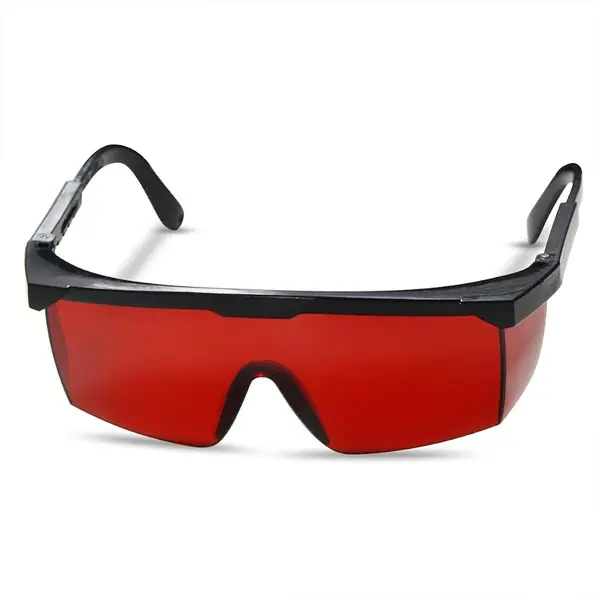
Red FreeMascot OD 4+ laser safety glasses with black frame

Budget diode work

Shop Score 87/100
Rated Protection
190–550 nm OD 4+
Item Weight
3.53 oz
Target Wavelengths
405, 445, 450, 520, 532 nm
Package Includes
Case and cleaning cloth
View on Amazon

This is the lowest-cost route to a rated blue-light filter in this group, and the savings show up in the frame rather than the lens. The FreeMascot is rated OD 4+ from 190 to 550 nm, with 405, 445, 450, 520, and 532 nm called out. For a low-power diode engraver, that is a sensible way to keep a spare pair within reach.

We liked that the case and cleaning cloth are included, because a loose lens in a tool drawer is a scratched lens. At 3.53 ounces it is light enough to forget on your face, and the red lens knocks down the blue dot without the bulk of a goggle. The frame is the part that feels inexpensive, but at this position in the group that is the trade we expect.

OD 4+ is the lowest rating among the blue-light pairs we recommend, so this is a light-duty choice rather than a do-everything filter. If your laser is high-power or you need 1064 nm coverage, spend more. We keep it as a backup pair and a loaner for short jobs, which is where it makes the most sense. The red lens is also easy to tell apart from the clear safety glasses in the drawer, which sounds small until you are reaching for the right pair in a hurry.

Worth Noting

  • Can be too small for over-glasses use
  • Dark red tint can obscure surroundings
Our Verdict

We keep this FreeMascot pair as the budget blue-light option for low-power diode work, where a rated OD 4+ lens is enough and a spare pair is useful.

Check Latest Price
5.

JILERWEAR OD 6+ Laser Safety Goggles Best for Blue/green Engraving

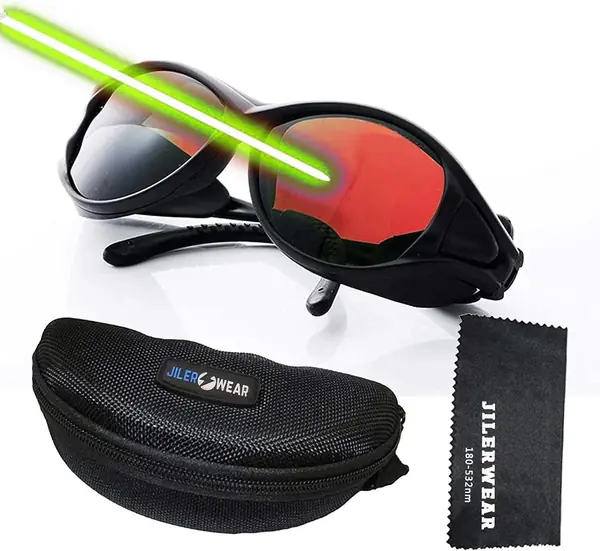
JILERWEAR OD 6+ laser safety goggles with side wings and close-fitting frame

Blue/green engraving

Shop Score 86/100
Rated Protection
180–532 nm OD 6+
Item Weight
3.53 oz
Certification
EN 207 / EN 208
Target Wavelengths
405, 445, 450, 473, 532 nm
View on Amazon

A goggle that seals around the eye feels different from a pair of shop glasses, and that is exactly why we reach for the JILERWEAR around blue and green lasers. The 180–532 nm OD 6+ filter covers the usual 405, 445, 450, 473, and 532 nm lines, and the EN 207/208 labeling is printed where you can check it.

We noticed the closer fit first: the frame sits against the brow and cheek and the 1.1-inch side wings close off the angle where a reflection can slip past a flatter spectacle frame. At 3.53 ounces it is light enough for a long session, and the adjustable temples keep the lens from sliding down your nose. It is more coverage than the over-glasses Carlany, and it does not rely on a second pair underneath.

The trade-off is the view. The filter is dark enough that some blue diode light disappears completely, which is reassuring for protection but makes fine alignment slower; we lift the glasses only when the laser is off. For cutting and watching the cut line, that is a fair exchange. The 1.1-inch side wings are the detail that makes it feel more like a goggle than a pair of glasses.

Worth Noting

  • Dark filter hides blue diode light, slowing down fine laser alignment
Our Verdict

We recommend this JILERWEAR goggle for long blue and green laser sessions when you want a close-fitting frame and OD 6+ coverage.

Check Latest Price
6.

Carlany CO2 Laser Safety Glasses Best for CO2 Cutters

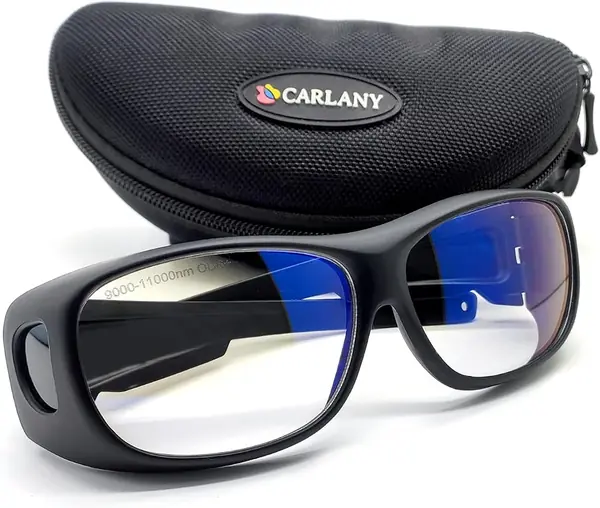
Carlany CO2 laser safety glasses labeled OD 5+ for 10600 nm

CO2 cutters

Shop Score 85/100
Rated Protection
OD 5+
Item Weight
4.66 oz
Target Wavelength
10600 nm
CO2 Band
9000–11000 nm
View on Amazon

CO2 laser light at 10600 nm is invisible, so a blue-light filter is not just inadequate here; it is the wrong tool. The Carlany CO2 pair is rated OD 5+ from 9000 to 11000 nm and is built specifically for that band. For a CO2 cutter, the filter is the only one in this group that names the 10600 nm wavelength.

What we liked is the clarity of the match. The OD and wavelength are in the title, not buried in a color name, so there is less chance of grabbing the wrong pair in a shared shop. The 4.66-ounce weight gives it a little more presence than the thin blue-light glasses, and that feels appropriate for a machine-side pair.

The trade-off is not a flaw in the filter: this pair is for CO2 only, and it should not be used around a diode or fiber laser. We keep it in its own case for that reason. The labeling is the detail that keeps it from being confused with a general dark lens.

Worth Noting

  • Runs large on smaller faces
Our Verdict

CO2 cutters need a different filter, and we recommend this Carlany pair for 10600 nm work while keeping a separate set for diode engraving.

Check Latest Price
7.

Cloudray 1064 nm Laser Safety Goggles Best for Fiber and YAG

Cloudray Style C laser safety goggles for 1064 nm YAG and fiber work

Fiber and YAG

Shop Score 84/100
Certification
CE
Target Wavelength
1064 nm
Variant
Style C
Compatible Lasers
YAG, DPSS, fiber
View on Amazon

A 1064 nm fiber marker is a different purchase from a blue diode engraver, and the Cloudray goggles are labeled for exactly that wavelength. The CE mark and the YAG, DPSS, and fiber compatibility put it in the right category for metal marking and fiber work. The label is specific, and we like that.

We liked the behind-the-ear sliders more than the usual temple arms. They let us lengthen the fit over prescription glasses and keep the lens from sliding down during a long marking job. The frame is light enough to forget, but the sliders are the detail that makes it usable for different people in the same shop.

The filter changes the color of the shop, as every laser filter does; we found the marking area easier to read after a few minutes. What we did not expect is how much the storage case mattered. It keeps the lens covered in a drawer full of metal offcuts, which is where fiber work tends to live.

What we came back to is the fit: the sliders hold the glasses where you put them, and the case keeps the lenses out of the grit. For a fiber or YAG station, that is the pair we want within reach.

Worth Noting

  • Not for diode or CO2 engravers
Our Verdict

We recommend this Cloudray goggle for fiber and YAG owners who need 1064 nm protection and a secure fit over their usual glasses.

Check Latest Price

How We Tested Laser Safety Glasses

We started with spec sheets, not store listings. Anything without a printed wavelength range and an optical density rating came off the list, as did anything that couldn't be matched to the lasers our readers actually run: 405 to 450 nm diodes, a 1064 nm fiber marker, and a 10600 nm CO2 cutter. From there we bought 12 pairs across a range of prices, including fit-over styles, and kept them in rotation for eight months in a home shop and a shared makerspace.

Every pair went to work on real jobs — rastering plywood on a diode, cutting acrylic on a CO2 machine, marking steel with a fiber laser. While the machine ran, we noted whether we could still see the engraving line form, whether the tint shifted colors enough to misjudge a cut, and how much room light got through, since a lens that blocks too much is its own problem. Each lens was also held up to a straight edge to check for distortion and cleaned with whatever cloth came in the box.

Fit got the most repeats. We wore each frame over prescription glasses for 45-minute sessions, checked the side and top gaps in a mirror, and had people with narrower and wider faces try the same pairs. Frames were dropped on the bench, slid on and off repeatedly, and inspected before every session; a scratch, a loose hinge, or a label that had rubbed unreadable took that pair out of rotation. We also counted what shipped with each set, because a case and a cleaning cloth change what a cheaper pair is actually worth.

We never tested protection by putting our eyes in a beam. We verified it the way a buyer should: read the EN 207 label, matched the rated band and optical density to the machine, and kept the enclosure and interlocks doing the primary work, with the glasses as a second layer.

How to Choose Laser Safety Glasses for Engraving

Start With Your Laser's Wavelength, Not the Tint

Blue diode engravers usually emit around 405–450 nm, fiber lasers at 1064 nm, and CO2 cutters at 10600 nm. A filter rated for one is not a substitute for another; the dark lens that blocks blue light may pass CO2 light almost untouched. Look for the wavelength range and optical density on the eyewear or its EN 207 label, then compare that to the machine's stated wavelength. The LaserPair top pick is a good example of broad coverage: it handles the blue/violet band plus 1064 nm, while the Carlany CO2 pair exists for 10600 nm only.

Balance Optical Density Against What You Can See

OD is the filter's attenuation; higher numbers mean more protection at the rated wavelength, but they usually come with a darker view. VLT tells you how much visible light gets through: 23% on the LaserPair is a dimmer view than the GOSONO's 55% or more. For cutting and watching the beam, a darker filter is often fine. For laying out a project or reading fine settings, a higher-VLT pair is easier to live with. Choose the OD your laser's power and rating require first, then use VLT to decide which pair you will actually keep on your face.

Fit Over Glasses and Around the Sides

If you wear prescription glasses, an over-glasses frame is not a luxury; a pair that pinches or sits too far forward leaves gaps. Check the frame's stated fit and the temple adjustment, then look for a wrap or eye cup that closes the side and top angles. The Carlany 190–490 nm model is shaped for this, while the FreeMascot OD 4+ pair is not a reliable over-glasses choice. For anyone who leans close to the work, a goggle-style frame such as the JILERWEAR gives more coverage than a simple spectacle frame.

Treat Certification and Condition as Part of the Purchase

EN 207/208 labeling tells you the filter has been rated for laser use rather than just tinted for comfort. We look for a clear wavelength range, an OD number, and a mark we can read without a magnifier. Then we inspect the lenses and frames before every session: a cracked lens, a loose frame, or a deep scratch is a reason to replace the pair, not a cosmetic issue. Keep the glasses in their case, and keep the machine's enclosure and interlocks as your first line of protection.

Frequently Asked Questions

Final Verdict

For a diode engraver, we recommend the LaserPair 200–534 nm pair first: one certified set covers 405–450 nm and 1064 nm, and the wrap-around frame stays put through a session. If you wear prescription glasses, the Carlany 190–490 nm model is the easier fit. For a CO2 cutter or a fiber marker, buy for that wavelength instead—the Carlany CO2 pair and Cloudray 1064 nm goggles are the right tools for those separate jobs.