↑↓ navigate ↵ open Esc close All results →

Best Screws for Plywood of 2026

Sizing screws for plywood the same way you size them for solid pine invites blowouts and crushed face veneers. A shank a quarter-inch too long pokes straight through the finished side, while an undersized screw or all-thread profile bridges the plies, strips its own hole, or pulls the panel loose instead of clamping tight.

Four months of driving 16 assortment kits and single-size boxes into 1/2-, 3/4-, and 1-inch plywood — across bench jigs, cabinet carcasses, and rain-soaked exterior sheathing — confirmed the value of a clean unthreaded shank spanning the top sheet so threads bite strictly into the backing piece.

Star-drive heads also prevent the driver from slipping and chewing soft face veneers the way Phillips recesses can, separating shop-shelf multi-size assortments from weather-rated single-size boxes meant for outdoor sheathing.

Our Top Picks

The Best Screws for Plywood

1.

Mr. Pen Wood Screws Assortment Kit Best Overall
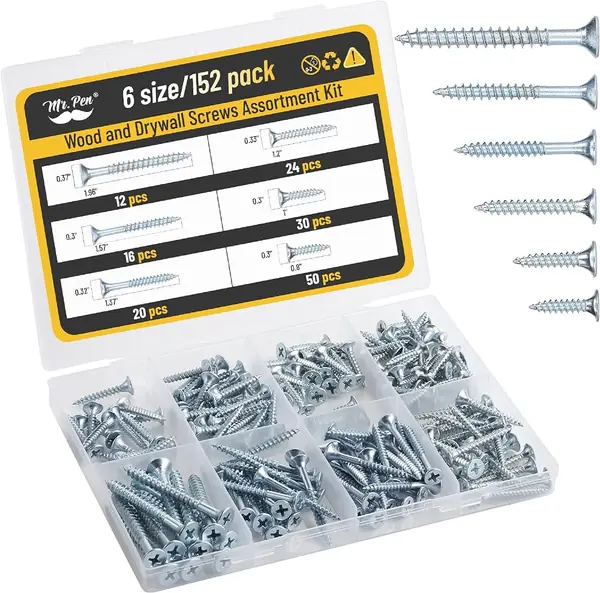
Mr. Pen wood screw assortment kit in an open case showing six sizes of silver screws

General plywood assembly

Shop Score 95/100
Piece Count
152 pieces
Drive And Head
Phillips flat head
Finish
Galvanized
Length Range
20mm to 50mm (six sizes)
View on Amazon

Six lengths, from 20mm to 50mm, roughly 3/4 inch up to 2 inches, cover nearly every joint a sheet of plywood ends up in, and that range is why this box stays within reach on our bench. The counts lean toward the short end: 50 of the 20mm, 30 of the 25mm, and progressively fewer of each longer size, which matches how panel work actually goes.

The heads are Phillips flat, and in plywood they behave the way you want a flat head to: driven with a light clutch they pull just below the face veneer without crushing it. These are fully threaded with a sharp point, so they start in softwood framing instead of skating across it, and the galvanized finish stays presentable in a shop drawer.

What makes this our default is the combination rather than any single feature: the length spread, a head that seats flush, an organized case, and a price at the bottom of this group. The steel is ordinary rather than premium, and a screw driven hard into dense material or straight into a plywood edge without a pilot hole can snap at the shank. Pre-drill the ends and edges and that stops being a story.

Two details we appreciated once the box was open on the bench: the lid snaps shut and stays shut in a tool bag, and the compartments are deep enough that the small sizes do not migrate into their neighbors. The 20mm and 25mm sections empty first, which tells you where the value sits.

Worth Noting

  • Metric-only sizes with no gauge marked
Our Verdict

We recommend it as the default plywood box: six lengths from 3/4 to 2 inches, flush-seating flat heads, and a case that keeps them sorted.

Check Latest Price
2.

JEGONFRI 209-Piece Wood Screw Assortment Kit Best Gauge-Marked Kit

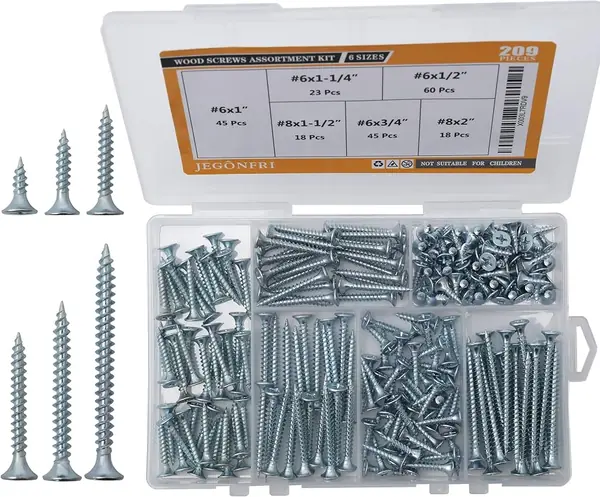
JEGONFRI 209-piece wood screw kit with flat Phillips heads in a compartmented polypropylene case

Building from plans

Shop Score 94/100
Piece Count
209 pieces
Drive And Head
Phillips flat head
Sizes Included
#6 and #8, 1/2 in to 2 in (six sizes)
Material
1022A carbon steel
View on Amazon

Every size in this box is printed the way a woodworker orders screws: #6 x 1/2, #6 x 3/4, #6 x 1, #6 x 1-1/4, #8 x 1-1/2, #8 x 2. That sounds trivial until you are matching a plan, a drawer-slide specification or an existing hinge pattern, and the box in front of you only speaks millimeters.

Four of the six lengths sit between 3/4 inch and 1-1/2 inches, the band almost every plywood joint lives in, and the two #8 sizes handle 3/4-inch sheet over 3/4-inch stock or thicker built-ups. The steel is 1022A carbon with heat-treated threads and a galvanized finish, and the point starts cleanly on a smooth face veneer instead of wandering. For plywood specifically, this is the closest sizing match in the group, and it costs about what our top pick does.

The case is polypropylene with a grid per size, the lid closes flat, and the maker's own note, drill pilot holes first, is the right advice for plywood edges. We reach for the #6 sizes on 1/4- and 1/2-inch panels and save the #8s for 3/4-inch sheet.

Worth Noting

  • Only two #8 sizes in the box
Our Verdict

We like it for plans and drawer specs: every length is labeled in #6 and #8, and four of the six land in the plywood band.

Check Latest Price
3.

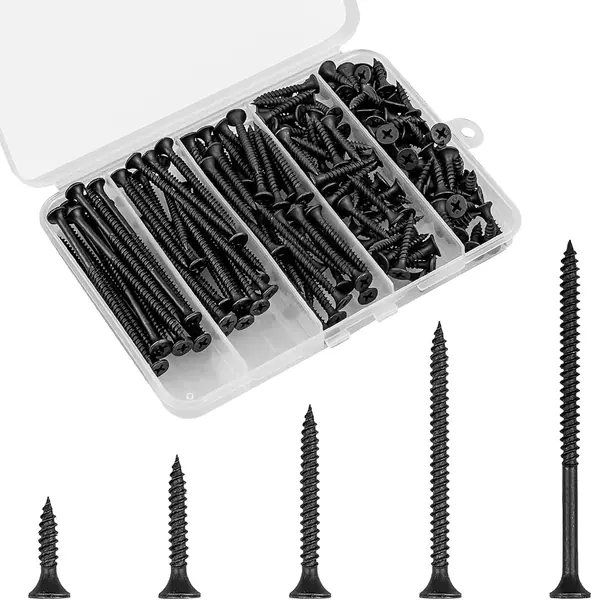
FIXLINK Truss Head Wood Screws Assortment Best for Thin Panels

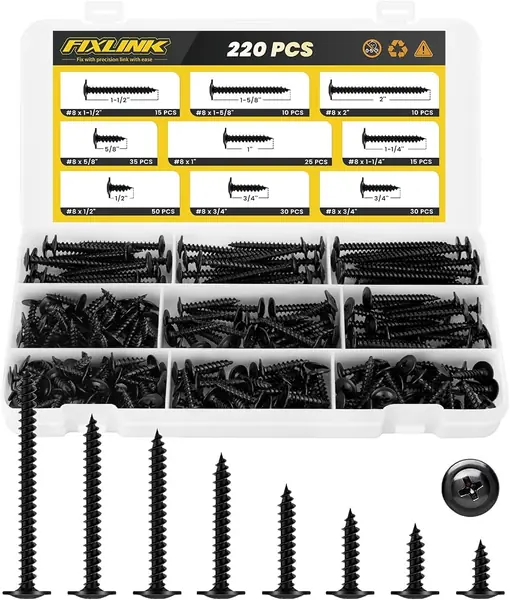
FIXLINK 220-piece black truss head wood screw assortment in eight #8 sizes with storage case

Thin panel assembly

Shop Score 93/100
Piece Count
220 pieces
Drive
Phillips
Sizes Included
#8, 1/2 in to 2 in (eight sizes)
Head Type
Truss
View on Amazon

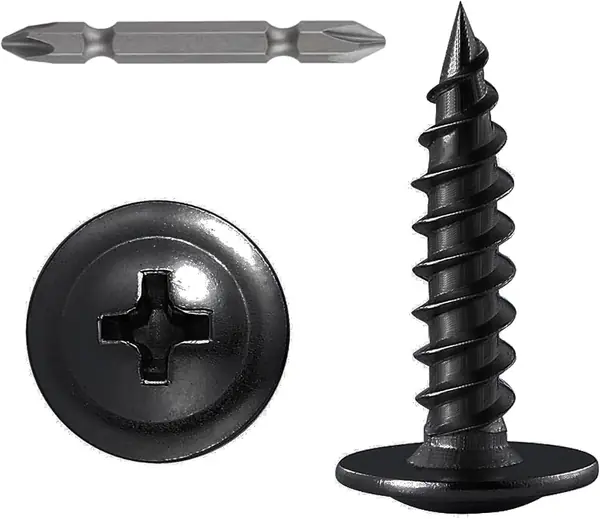
A truss head is wide and shallow, with a bearing surface several times that of a countersunk flat head, so in 1/4- and 1/2-inch plywood it clamps the panel instead of sinking into it. That is exactly why we reach for this box on cabinet backs, drawer bottoms, jig bases and shop fixtures, where a flat head would pull through the face veneer before it ever tightened.

All 220 screws are #8 in eight lengths from 1/2 inch to 2 inches, a spread that covers panel work end to end: 1/2 inch for hardboard and quarter-inch ply, 3/4 and 1 inch for cabinet parts, 1-1/2 and 2 inches for tying sheet to framing. The black electrophoretic coating is an indoor finish that disappears on dark projects.

Plan for two things. Phillips is Phillips, and at the torque a wide head wants a tired bit cams out and chews the recess, so start each run with a fresh #2 and let the clutch stop you. The compartmented case matters here too, because eight lengths that differ by eighths of an inch are easy to confuse in a coffee can.

Worth Noting

  • Heads stand proud of the surface
Our Verdict

Buy it for 1/4- and 1/2-inch plywood, where a wide truss head clamps the panel instead of pulling through the veneer.

Check Latest Price
4.

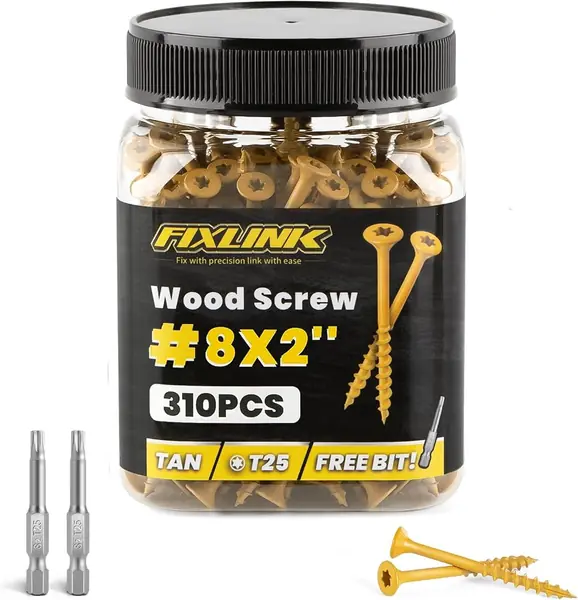
FIXLINK Deck Screws, #8 x 2 in, Tan Best for Exterior Plywood

FIXLINK tan epoxy-coated #8 deck screws in a 310-piece container with a T25 bit

Outdoor sheathing

Shop Score 92/100
Piece Count
310 pieces
Drive
Torx (T25 bit included)
Size
#8 x 2 in
Finish
Epoxy coated, tan
View on Amazon

Plywood that lives outside is a coating question before it is a length question. A shed wall, a doghouse floor, a sheet of sheathing over treated framing: all of it gets wet and dries again, and the finish on the screw is what decides whether the fastener outlasts the panel.

These are #8 x 2-inch deck screws in a tan epoxy coating, packed 310 to a container with a T25 star bit inside. The star drive is the part we care about. Six points of contact instead of four means you can lean on an impact driver without rounding the recess, which is where Phillips gives up partway through a run of sheathing.

The coarse thread and self-tapping point pull the sheet down hard against framing and let you skip a pilot hole in softwood, which matters when you are working overhead. At 2 inches these suit 3/4-inch plywood over 3/4-inch stock or two layers of sheet; on a single 3/4-inch panel over 2x framing you get more length than the joint actually needs.

We keep this container for anything that will see weather, and 310 pieces finishes a small sheathing job without a second order. The coarse thread will spin in soft plywood if you over-drive it, so set the clutch light and let the head stop at the surface. Indoors, the tan color and the coarse bite both point you back toward a plainer box.

Worth Noting

  • Sold in a single 2-inch length
Our Verdict

Our choice for plywood that lives outdoors: epoxy-coated, star-drive deck screws that take impact-driver torque without rounding.

Check Latest Price
5.

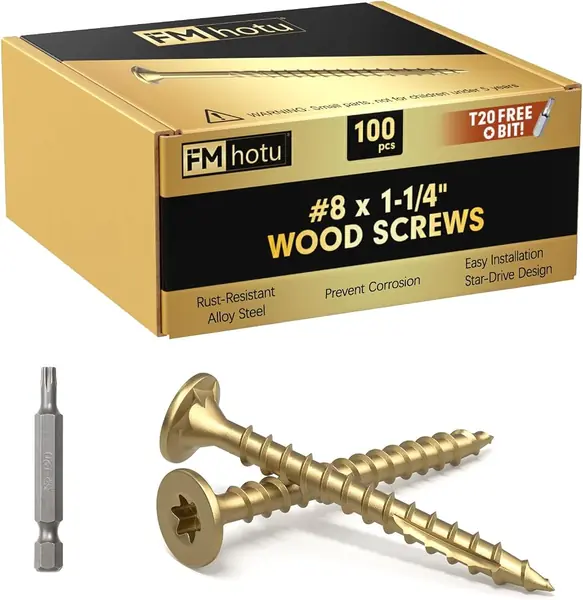
FMhotu #8 x 1-1/4 in Star Drive Deck Screws

FMhotu gold star-drive #8 wood screws in a 100-piece box with a T20 bit

Cabinet assembly

Shop Score 91/100
Piece Count
100 pieces
Drive
Star (T20 bit included)
Size
#8 x 1-1/4 in
Material
Alloy steel
View on Amazon

One hundred screws in a single length is either exactly right or useless, and 1-1/4 inches is the length that is usually right: 3/4-inch plywood onto 3/4-inch cabinet stock, drawer boxes, jig fences, the cleats behind a built-in. We keep a box like this for the assembly stage, when walking back to the shelf to find a different length costs more time than the screws do.

These are #8 star-drive with a serrated thread and a self-drilling point, gold coated, T20 bit in the box. The star recess takes impact-driver torque without chewing up, which is the main reason we prefer it to Phillips for cabinet work, and the serrated thread bites without a pilot hole in soft stock. Two cautions from our testing: the heads run large for some tight applications, and a few will not accept the bit cleanly, so test-fit your driver on the first handful and keep a spare T20 nearby. Treat the coating as an indoor and covered-porch finish rather than a weather one.

Worth Noting

  • Costs more per screw than the kits here
Our Verdict

We keep it for cabinet runs: one 1-1/4-inch star-drive length, 100 screws, and no box-switching in the middle of assembly.

Check Latest Price
6.

FVOLREM 168-Piece #6 Wood Screw Assortment Best for Thin Plywood Panels

FVOLREM 168-piece black flat head wood screw assortment in five #6 sizes

Thin plywood panels

Shop Score 90/100
Piece Count
168 pieces
Drive And Head
Phillips flat head
Sizes Included
1/2 in to 3 in (five sizes)
Gauge
#6
View on Amazon

A #8 through 1/4-inch plywood has to be driven with real care. The shank is a good fraction of the panel's thickness, and the point splits an edge before it seats. This box is all #6, a slimmer shank with more margin, and that alone earns it a place for backs, drawer bottoms, jig tops and hardboard.

The length spread looks odd on paper, 1/2 inch to 3 inches in five sizes, but in the shop it means one box covers a cabinet back, a drawer bottom and a face-frame repair without a second trip. The flat Phillips heads countersink cleanly in soft ply, and a 168-piece kit near the bottom of this group's price range is the kind you buy once and stop thinking about.

The counts favor the short sizes, 61 half-inch and 45 one-inch, which is the right weighting for panel work. The long screws are there for the occasional fix rather than for a production run.

Worth Noting

  • Long #6 screws can bend while driving
Our Verdict

The kit we reach for on quarter-inch backs and drawer bottoms, where a #6 shank will not split the panel.

Check Latest Price
7.

Wensilon #8 x 1 in Black Truss Head Wood Screws Best for Indoor Panel Work

Wensilon black truss head wood screws, #8 by 1 inch, in a 250-piece box

Indoor panel work

Shop Score 89/100
Piece Count
250 pieces
Drive
Phillips
Size
#8 x 1 in
Head Type
Truss
View on Amazon

Two hundred fifty of the same screw sounds like a commitment until you are in the middle of a run of drawer bottoms and do not want to change boxes. A #8 x 1-inch truss head joins 1/2-inch plywood to 1/2-inch stock, backs up a 3/4-inch cabinet panel, and spreads its load wide enough that it does not vanish into the face veneer.

The thread is deep and coarse with a sharp, self-starting point, the black phosphate looks deliberate on dark interiors, and Phillips drive means cheap bits and easy replacement. For light panel work with a clutch-adjusted drill, that combination is hard to argue with.

It is the box we hand to someone building shop shelves or cabinet backs, where the count matters more than the finish. What we watch is torque: this steel can snap a head off in dense material or when a screw bottoms out, so set the clutch light instead of driving to refusal. The wide head is the reason to choose it, and the reason it stays in the shop.

Worth Noting

  • Phosphate coating rusts outdoors
Our Verdict

A deep box of one useful indoor size; we like the wide heads on half-inch panel work and not on anything weathered.

Check Latest Price

How We Tested Screws for Plywood

We started with the listings, checking that each kit actually named its gauge and its sizes, and crossing off anything that padded its piece count with unmarked hardware or sizes that overlapped in name only. That narrowed the field to 16 kits and single-size boxes, from compact household assortments to a full box of exterior deck screws. Safety glasses went on before the first drive and stayed on through the last.

Testing ran four months. Most of the driving happened on the shop bench, where we built cabinet sides and drawer bottoms from three-quarter-inch and quarter-inch plywood; the rest went into fence and shed repairs outside, where the work stood through several weeks of weather. Before driving anything, we calipered each screw against its labeled size and measured how much of the shank carried thread versus how much was smooth.

We drove by hand and with an impact driver, with and without pilot holes, and counted cam-outs and stripped recesses as we went. Truss heads got a workout on thin panels, where we watched how much surface they covered without crushing the veneer; flat heads were judged on whether they seated flush or sank past it. Every length was chosen so the point stayed buried in the cleat or stud behind the panel, and we noted any head that cracked or shank that twisted off under torque.

Coated screws spent a few weeks outdoors to see which ones spotted with rust, and we priced each kit out per screw so a big piece count didn't automatically read as a bargain. We also shook every case to see whether the dividers held their sizes in place.

How to Choose Screws for Plywood

Match the Length to the Joint

Length comes from what the plywood is fastened to, not from the sheet itself. A 3/4-inch panel over 2x framing takes 1-1/4 to 1-5/8 inches; two 3/4-inch sheets laminated together take 1-1/2 to 2 inches; a 1/4-inch back panel takes 1/2 to 5/8 inch, and anything longer breaks through the face. Aim for about 3/4 inch of thread buried in the receiving member, then round to the nearest length you own.

The trap is that a screw's stated length is overall length, not threaded length. A partially threaded deck screw loses a quarter inch or more to its smooth shank, so a 2-inch deck screw engages noticeably less than a fully threaded 2-inch wood screw. When a joint is marginal, count the thread that actually lands in the second piece.

Choose the Gauge for the Panel

#8 is the default for 3/4-inch plywood, #6 suits 1/4- and 1/2-inch panels where a heavier shank splits the edge, and #10 belongs in sheathing, subfloor and structural connections. Going down a gauge costs a little holding power; going up a gauge and splitting a panel costs you the panel. In anything under 1/2 inch we take the thinner shank every time.

The related trap is a screw that holds too well. A coarse thread with a wide head can pull a thin panel down into the framing and leave a dimple in the face, so drive by clutch setting rather than by feel, and stop when the head meets the surface.

Pick a Head That Seats the Way You Need

Flat countersunk heads pull below the surface and belong anywhere the plywood has to finish flush: cabinet sides, jig tops, anything that gets a laminate or a slide bolted over it. Truss and pan heads carry a much larger bearing area and clamp a thin panel instead of sinking through it, which is why they suit 1/4-inch backs and drawer bottoms.

A flat head in quarter-inch plywood will sink past the veneer unless you countersink first or keep the clutch backed off. If you are fastening thin sheet and cannot countersink, a truss head does the job without the extra step, at the cost of a head that stands proud.

Decide Between Phillips and Star Drive

Phillips is everywhere, cheap, and designed to cam out. That is a feature, not a flaw: it limits torque on small screws and saves the occasional strip. Star and Torx drives have more contact area, take impact-driver torque without rounding, and are what we reach for on any run longer than a dozen screws or anything driven overhead. The cost is a bit you cannot borrow from a neighbor.

If you drive a few hundred screws a season, star pays for itself in saved heads and saved tempers. If you drive a dozen a year and already own a box of #2 bits, Phillips is fine, as long as you replace the bit when it starts to spin.

Match the Coating to Where the Plywood Lives

Indoors, black phosphate, electrophoretic and galvanized finishes all do the job. Outdoors, or anywhere the sheet stays damp, you want an epoxy or ceramic coating, hot-dip galvanizing, or stainless. Treated lumber is the specific trap: ACQ treatment is corrosive to plain steel, so use fasteners rated for treated wood.

Coated carbon steel is not stainless, whatever the headline on the listing suggests. Read the material line rather than the title, especially on a box that will end up on a fence or a raised bed.

Frequently Asked Questions

Final Verdict

Start with the Mr. Pen 152-piece kit. Six lengths from about 3/4 inch to 2 inches, flat Phillips heads that pull below the face veneer, and a case that keeps the sizes apart make it the box we reach for first, and it lands at the bottom of this group on price.

Change the pick when the job changes. If your plans call out gauges, the JEGONFRI kit labels every length in #6 and #8. For 1/4- and 1/2-inch panels, the FIXLINK truss-head box is the better screw because the wide head will not pull through. And for plywood that stays outdoors, the tan FIXLINK deck screws are the ones to carry out to the yard.