↑↓ navigate ↵ open Esc close All results →

Best Self-Centering Drill Bits of 2026

A spring-loaded guide sleeve looks simple on a blister pack, yet sleeve play and spring tension decide whether a cabinet door closes flush or binds on the frame. When a sleeve seats squarely in a hinge countersink, the bit drills dead center; when the collar wobbles on its shaft, screws pull the leaf crooked before the door ever hangs.

Testing 14 sets across three months of hanging new cabinet doors, rehanging old hardware, and swapping bits between quick-change chucks and standard drills separated clean-tracking kits from loose ones. Sizes #6, #8, and #10 handle nearly all residential hinge work, making shank fit and spare bit availability far more useful than a padded piece count.

A stiff spring loosens with break-in, whereas a sloppy sleeve stays off-center from the first pilot hole to the fiftieth.

Our Top Picks

The Best Self-Centering Drill Bits

1.

Bosch CC2430 Self-Centering Bit Set Best Overall
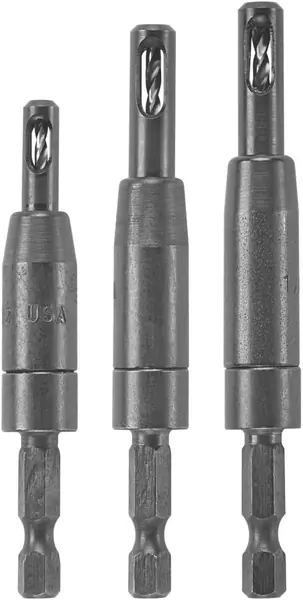
Bosch CC2430 three-piece self-centering drill bit set with black oxide bits

Cabinet hinge installation

Shop Score 93/100
Shank
1/4-inch hex
Pieces
3
Bit Sizes
#6, #8, #10
Material
Alloy steel
View on Amazon

Three sizes cover most cabinet hinges, and that is why the Bosch CC2430 set is the one we reach for first. The No. 6, No. 8, and No. 10 bits match the hinge screws on standard cabinet doors, and the 1/4-inch hex shank clicks into a quick-change chuck without re-chucking. We kept it in the drill through a run of door and drawer hardware and appreciated not hunting for a second bit every time the screw size changed. The Clic-Change system is the practical part: one-handed swaps, less downtime.

We paid close attention to the guide sleeve because that is where a self-centering bit earns its name. The spring-loaded sleeve seats in the countersink and stays square while the bit starts, and the sleeve finds the recess without skating. Sawdust can collect in the guide after a few holes; a tap and a brush clear it. We also liked that the bits are replaceable, which matters when a small drill eventually dulls.

Against the Snappy set, the Bosch gives up the two extra sizes and the wider coverage. What it keeps is the combination most cabinet work needs: the common screws, a quick-change shank, and a guide that stays put. The extra sizes matter when you move into larger hardware, but they are not what most hinge jobs ask for.

Worth Noting

  • Small bits can snap under side load
Our Verdict

For most cabinet and hinge work, we trust the Bosch set to center a pilot hole without fuss, and its three common sizes cover the screws you actually use.

Check Latest Price
2.

Snappy 5-Piece Self-Centering Set Best for More Sizes

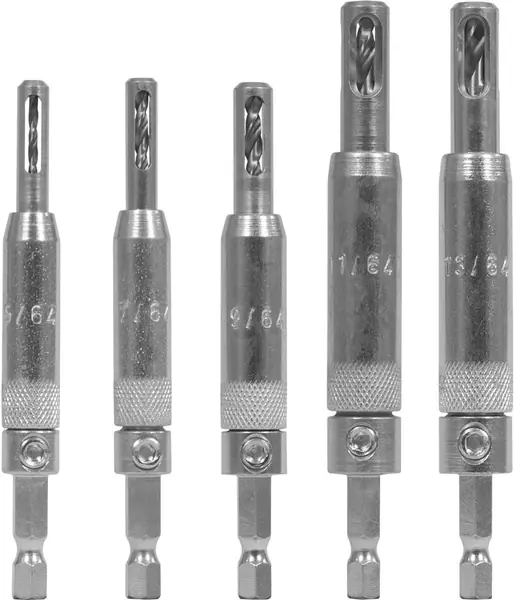
Snappy five-piece self-centering hinge drill bit set with hex shanks

Mixed hardware installs

Shop Score 91/100
Shank
1/4-inch hex
Pieces
5
Bit Sizes
5/64 to 13/64 inches
Material
High-speed steel
View on Amazon

The Snappy set asks more than the three-bit sets here, and the reason is range: five bits from 5/64 to 13/64 inch instead of the usual three. That spread covers cabinet hinges, drawer slides, and larger hardware without adding a second set. The two smallest sizes handle small screws; the larger three take over when the hinge plate or slide calls for more. If your work is mostly standard cabinet doors, you are paying for sizes you may not use.

We were impressed by the cut quality in hardwood. The high-speed steel bits start cleanly and leave a pilot hole that lets the screw pull the hinge tight without splitting. The 1/4-inch hex shank and included 1/8-inch hex key make bit changes straightforward, and the U.S.-made claim is a real point of pride for a shop tool. We also liked that the set is compact enough to keep in a drawer rather than a dedicated case.

Where the Snappy earns its premium is the mixed-hardware job. When a cabinet run has different hinge sizes or a drawer slide with a larger screw, the extra bits save a trip to the toolbox. For a simple set of No. 6, No. 8, and No. 10 hinges, the Bosch does the job for less. The Snappy is the set we keep for the projects that do not fit one size.

Worth Noting

  • Bits can break under heavy use
Our Verdict

We reach for the Snappy set when a project mixes hinge sizes, because its five bits cover more hardware than the three-bit sets here.

Check Latest Price
3.

Trend Quick Release Drill Bit Guide Set Best for Quick-Change Chucks

Trend three-piece quick-release drill bit guide set with hex shanks

Impact-driver hinge work

Shop Score 89/100
Shank
1/4-inch hex
Pieces
3
Bit Sizes
No. 6, No. 8, No. 10
Material
High-speed steel
View on Amazon

A quarter-inch hex shank and a quick-release collar distinguish the Trend set from the three-bit Bosch and General options. The set includes No. 6, No. 8, and No. 10 bits, the three sizes that cover standard hinge screws. The shank is made for quick chucks and impact drivers, so it moves between tools without an adapter. That matters on a cabinet install where one tool drills and another drives.

The spring-loaded guide retracts smoothly and stays square as the bit enters the hinge hole. We liked that the guide comes apart for cleaning and bit replacement; a dry brush and a few seconds are enough to clear packed sawdust. The body is compact, so it fits close to a hinge leaf without the chuck rubbing. We also noticed the bits start without a lot of pressure, which helps on painted doors where you do not want the guide to mar the finish.

We came back to the Trend set for impact-driver work because the hex shank seats without slop and the guide stays aligned through the drive. It is not the widest set here, and it does not include spare bits, so treat the three as the working set. For hinge and lock faceplates, that is a sensible trade: fewer pieces, less sorting, and a guide that is easy to keep clean.

Worth Noting

  • Three-bit set covers fewer sizes than wider kits
  • Includes no spare replacement drill bits
Our Verdict

We like the Trend set for quick-change chucks and impact drivers, where its clean spring action and three common sizes earn their place.

Check Latest Price
4.

General Tools 290ST Hinge Bit Set Best for Door Hinges

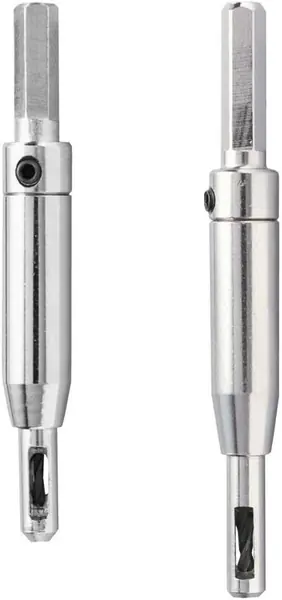
General Tools 290ST two-piece self-centering hinge bit set in metal

Door hinge work

Shop Score 88/100
Shank
Straight
Pieces
2
Bit Sizes
7/64 and 9/64 inches
Screw Sizes
No. 5 to No. 10
View on Amazon

The General Tools 290ST covers two sizes: 7/64 inch for No. 5 and No. 6 screws, and 9/64 inch for No. 8 and No. 10. Those are the screws on most residential door hinges and many cabinet hinges. The shank is straight, so it goes into a standard three-jaw chuck rather than a quick-change chuck.

The depth is adjustable, which helps when hinge plates sit at different thicknesses. The spring-loaded guide finds the countersink and holds the bit steady with very little fuss. The small body fits close to the knuckle of a hinge, and light pressure kept the guide from leaving a ring on a painted door.

For a single door or a small cabinet job, two bits are enough. The straight shank is also easier to keep in a standard chuck without an adapter, and the compact size stores in a small drawer. If you need the No. 6 bit or quick-change convenience, the Bosch set is the better fit.

What sells us on the General set is the lack of fuss: no case to open, no extra bits to sort, and a guide that does the one job. It is the set we hand to someone who wants to rehang a door without buying a full kit. For a one-off repair, that simplicity is worth more than a wider range.

Worth Noting

  • Only two bit sizes limit hardware coverage
Our Verdict

We keep the General Tools set for door hinges, where two well-centered sizes and simple depth adjustment are all the job needs.

Check Latest Price
5.

FiLwW Self-Centering Drill Bit Set Best Budget Set

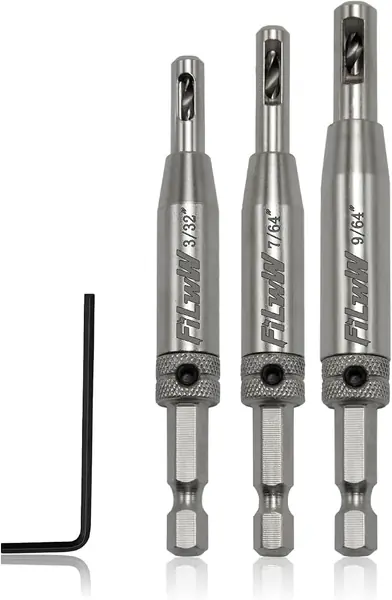
FiLwW three-piece self-centering drill bit set with silver finish

Occasional cabinet work

Shop Score 87/100
Shank
1/4-inch hex
Pieces
3
Bit Sizes
3/32, 7/64, 9/64 inches
Material
High-speed steel
View on Amazon

The FiLwW set sits at the bottom of the price range here, and it still covers the three screw sizes most cabinet hinges use: 3/32, 7/64, and 9/64 inch for No. 6, No. 8, and No. 10 screws. The 1/4-inch hex shank fits a quick-change chuck. For a small cabinet door or a drawer front, that is the basic kit without the extras. The bits are short and compact, so the drill sits close to the work.

We used the FiLwW set for light cabinet work and were satisfied with the centering. The spring-loaded guide retracts cleanly, and the bits arrived sharp enough to start without a punch on softwood. The guide can pack with chips on MDF, but a tap clears it. We also liked the compact size, which makes the set easy to keep in an apron pocket between holes.

Against the Bosch, you give up the Clic-Change bit changes and the wider size coverage, but the lower price leaves room for a spare set, which is a sensible hedge. The guide is easy to clear, and the compact shape fits into tight cabinet corners. For a small run of doors, those are the trade-offs that matter.

Worth Noting

  • Not built for daily production work
Our Verdict

The FiLwW set is our budget pick for occasional hinge work, with three sharp sizes that center well without a big outlay.

Check Latest Price
6.

EZARC 14-Piece Self-Centering Set Best for Cabinet Project Kits

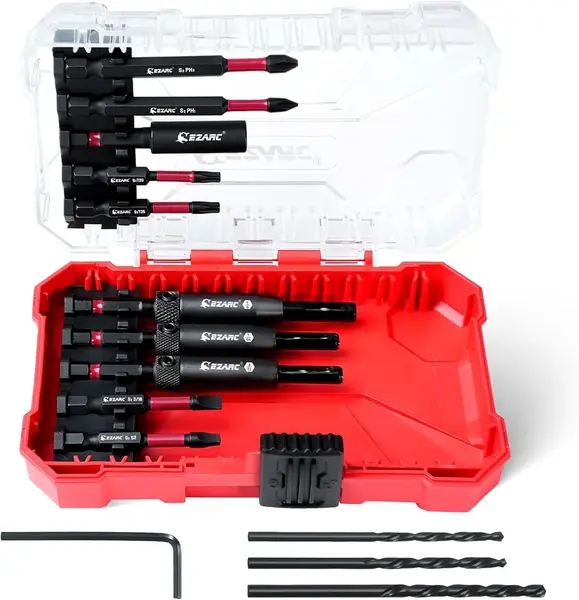
EZARC 14-piece self-centering drill bit set with storage case

Cabinet project kits

Shop Score 86/100
Shank
1/4-inch hex
Pieces
14
Replacement Bits
3 HSS
Self-centering Sizes
#6, #8, #10
View on Amazon

Open the EZARC case and you get three self-centering bits, three spare high-speed steel drills, a magnetic holder, and a set of driver bits. The self-centering sizes are No. 6, No. 8, and No. 10, so the kit covers standard cabinet and door hinge screws. The case keeps the small pieces together, which matters when you are moving between a drill and a driver on a cabinet run. It is more of a project kit than a bare set of VIX bits.

We found the beveled guide seated well in countersunk hinge holes and the spring returned fully between holes. The knurled locking screw makes bit changes easy, and the extra drills mean a dull bit does not end the session. The dual side openings clear sawdust, though the guide still needs a brush now and then. We liked the magnetic holder for keeping the driver bits close.

What keeps the EZARC kit in also-consider rather than a runner-up is the set screws: they can loosen during hardwood runs, so we check them before each session. The self-centering bits are good, but they are not the equal of the Bosch in our hands. The extras are the reason to buy: one case covers drilling, countersinking, and driving for a cabinet project.

Worth Noting

  • Set screws can loosen during hardwood drilling runs
  • Self-centering action trails top-tier bits like Bosch
Our Verdict

We like the EZARC kit when one purchase has to cover self-centering bits, spare drills, and a case for cabinet projects.

Check Latest Price
7.

jiuoici 3-Piece Self-Centering Set Best for Small Hinge Jobs

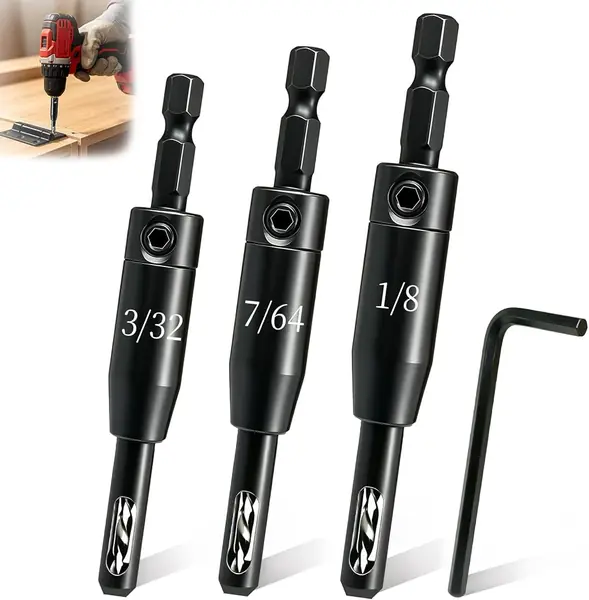
jiuoici three-piece self-centering hinge drill bit set with black finish

Small hinge jobs

Shop Score 80/100
Shank
1/4-inch hex
Pieces
3
Bit Sizes
3/32, 7/64, 1/8 inches
Material
HSS 4341
View on Amazon

For a short run of hinge holes, the jiuoici set is small enough to keep in a drawer and cheap enough to treat as a starter. It includes 3/32, 7/64, and 1/8 inch bits on a 1/4-inch hex shank, so it covers small hinge screws and fits a quick-change chuck. The black finish is easy to spot in a crowded bit drawer, and the compact body lets the drill sit close to the work. It is a simple three-bit set without extras.

We liked the compact size and the way the guide seated on small cabinet hinges. The spring-loaded sleeve centers a pilot hole cleanly when the bit is sharp and the drill runs slow. The bits are not as refined as the Bosch or Snappy, and the set is best for light work. For a single cabinet door or a drawer box, it does the job without a big commitment.

The jiuoici set costs less than the FiLwW, and it feels like it: the finish is simpler, the sizes are fewer, and the body is lighter. What it has is a low-risk price and a small footprint for occasional use. If you drill hinges every week, step up to a set with better springs and spare bits. The small footprint is the real advantage: it lives in a drawer and comes out for the odd hinge.

Worth Noting

  • Bits can break under heavy use
  • Spring can stick between holes
Our Verdict

We keep the jiuoici set for small hinge jobs, where its three sizes center well if you run the drill slow and don't expect daily-shop life.

Check Latest Price

How We Tested Self-Centering Drill Bits

We started with the sizes and shanks that actually turn up in cabinet hardware, then narrowed by guide-sleeve design, spring action, bit material, spare bits, and whether the set came in something that would keep it organized between jobs. Fourteen sets came home with us, from bare three-piece kits to full project kits with spare bits and a storage case, and every one went to work for three months.

Most of the testing happened on a run of shop-built cabinet doors and drawer fronts and on a rental kitchen's worth of doors that needed rehanging, with mixed hardware installs on the side. We marked center points on scrap maple, drilled ten holes per bit, and measured how far each hole landed from the mark; we also gripped each sleeve and tried to rock it, then watched whether the guide crept while the bit spun. Bits went into both a quick-change chuck and a standard drill to see which shanks held.

To judge sharpness and wear, we counted holes in oak-faced plywood until a bit began to smoke or drift off center, clearing chips as we went and running everything at low speed. We pulled the battery out of the drill before every bit change and sleeve adjustment, and timed how long a swap took. In between, we cleaned sawdust out of the sleeves, checked whether the depth stop met the hinge leaf the same way twice, and read the size markings at arm's length under shop light.

Not everyone drills fifty hinges a year, so we also handed sets to people doing one small cabinet project and watched whether the case kept the spares findable. Price went into the score only after we knew how many of a set's sizes we actually reached for.

How to Choose Self-Centering Drill Bits

Match the Bit to the Screw and Hinge

Start with the screw, not the drill. A No. 6 hinge screw usually takes a bit around 3/32 inch, No. 8 around 7/64 inch, and No. 10 around 9/64 inch; many sets label the bits by screw number instead. The guide sleeve also has to fit the countersink in the hinge plate. Too small and it drops through; too large and it rocks. For standard cabinet doors, a three-bit No. 6, No. 8, and No. 10 set covers most of the work. Check the hinge maker's pilot-hole spec before drilling a finished door.

Check the Shank Against Your Drill

Most self-centering bits use a 1/4-inch hex shank that drops into a quick-change chuck or an impact driver. A straight shank is for a standard three-jaw chuck. The trap is assuming every hex bit is impact-rated: if you drive hinges with an impact driver, confirm the bit is intended for impact use, and keep the speed low. We prefer hex for cabinet work because it swaps between a drill and a driver in seconds. A straight-shank set such as the General Tools 290ST is fine if you keep one drill set up. Seat the shank fully before you start.

Look at the Guide Sleeve and Spring

The centering comes from the sleeve, not the drill point. A good sleeve has a bevel that seats in the hinge countersink, enough spring tension to stay extended, and a smooth retraction that does not bind. A flat-bottom sleeve or a weak spring lets the bit walk, which is the failure we care about most. Test the sleeve by hand before the first hole: it should return fully and feel snug, not gritty. This is the part of a VIX bit that matters most. Keep the side openings clear so chips do not pack the guide.

Plan for Wear and Replacement

Self-centering bits are small cutting tools, and the drill wears faster than the guide. Replaceable bits and a spare or two matter more than a fancy case if you drill often. Check that the set uses standard-length bits or includes replacements, and tighten any set screws before a run; a loose screw lets the bit slip and throws off depth. Clean sawdust from the sleeve with a dry brush. If a bit snaps, replace it rather than grinding a new point on a shortened bit. For occasional use, a budget set is fine; for daily cabinet work, buy the better guide and spare bits.

Frequently Asked Questions

Final Verdict

We recommend the Bosch CC2430 set for most cabinet and door hinge jobs. Its three common sizes, quick-change hex shank, and steady guide make it the easiest set to live with, and it covers the screws you meet on standard hinges without making you sort through a dozen pieces. If your work regularly includes larger or unusual hardware, the Snappy five-piece set earns its premium for the extra sizes. For a one-off door rehang, the General Tools 290ST is the simpler, cheaper choice.