↑↓ navigate ↵ open Esc close All results →

Best Shop Stools for Garage and Workshop Work of 2026

A shop stool looks interchangeable in a catalog until a long afternoon at the bench exposes a two-inch height mismatch. Sit too low and shoulders hunch over the work; perch too high and heels dangle mid-reach, while swivel casters trade quick rolling across concrete for a tippy feel the moment a wrench requires real leverage.

Assembly and six months of daily garage use across 12 stools quickly separated solid shop furniture from short-lived seats. Plush foam collapsed by week three where firmer cushions kept their support, and frames whose bolt holes lined up cleanly on the first try stayed noticeably more rigid under load.

Seat-height range deserves the closest look on the spec sheet: a 21-inch roller fits wheel and brake work down low, whereas standing-height benches need taller travel and an under-seat tray reachable without twisting.

Our Top Picks

The Best Shop Stools for Garage and Workshop Work

1.

MaxWorks 80771 Pneumatic Roller Seat Best Overall
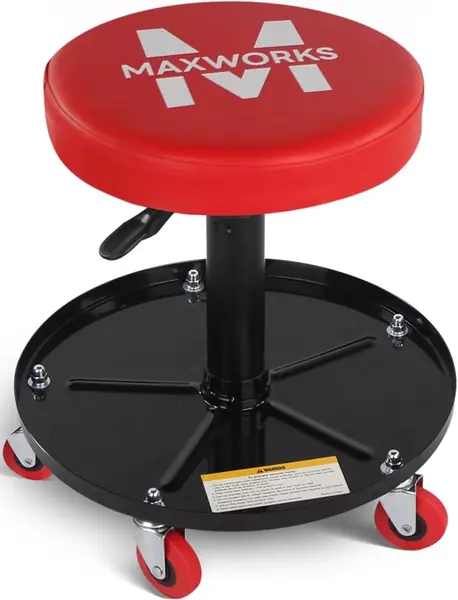
MaxWorks 80771 pneumatic roller seat with five casters and round tool tray

Low garage work

Shop Score 95/100
Weight Capacity
300 lb
Seat Height Range
15 to 20 inches
Casters
5 swivel
Tool Tray
15.25 inches
View on Amazon

The 15-to-20-inch seat height is the first thing we check on a garage stool, because it decides whether you can work at a wheel or a low shelf without hunching. The MaxWorks 80771 gets that range right, then adds five 2.5-inch casters and a 15.25-inch tray under the seat. That combination is why it is our top pick for the kind of low, mobile work that fills most home garages, and why it doubles as a mechanic stool.

The seat is a thick vinyl cushion, not a hard pan, and the low center of gravity keeps the stool feeling settled when you lean toward a fender. We like the tray more than we expected to: it holds fasteners, a rag, and the wrench you are using without sending you back to the bench. The five-caster base also moves in any direction, which matters when you are circling a car instead of working in a straight line.

The 300-pound capacity is solid for this group, though it is not the highest here; the WORKPRO is rated to 330. The bigger limitation is the height itself: at 15 to 20 inches, this is a low roller, so it will not put you at a 36-inch workbench. For bench work, the DEWALT is the better shape. What keeps us coming back is the balance of range, stability, and useful details; the stool is light enough to move out of the way, and the simple tray wipes clean without fuss.

Worth Noting

  • 300 lb capacity is below the 330 lb pick
Our Verdict

We recommend it as the default low rolling stool: the 15-to-20-inch seat, five casters, and built-in tray cover the garage-floor jobs most people buy this for.

Check Latest Price
2.

DEWALT DXSTAH025 Adjustable Shop Stool Best for Workbenches

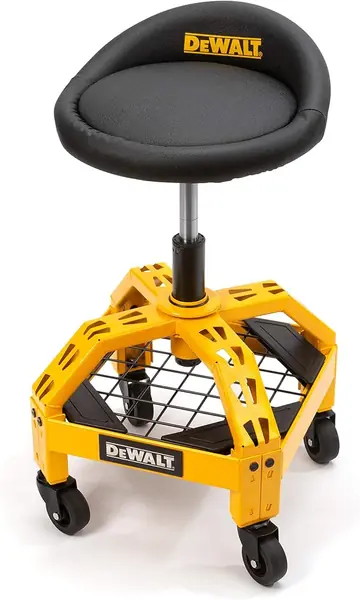
DEWALT DXSTAH025 yellow and black adjustable shop stool with wire shelf

Workbench seating

Shop Score 94/100
Weight Capacity
300 lb
Seat Height Range
22.5 to 26.75 inches
Storage Shelf
Wire grid
Wheels And Feet
Both included
View on Amazon

A 22.5-inch lowest setting tells you what the DEWALT DXSTAH025 is for: a standard workbench, not a wheel. The seat climbs to 26.75 inches, so it puts you above a 36-inch bench rather than below it. We think that makes it the best bench stool in this group, provided you are not also trying to sit at a low car.

The wire shelf is the feature we did not expect to care about. It holds a tray of fasteners or the tools you are cycling through, and it keeps them off the floor without adding a cabinet. We also like that DEWALT includes both casters and nylon feet. Roll it around the shop, or plant it at the bench and use the feet; that flexibility is rare here.

The casters are the weak spot. They can feel reluctant when you are seated, especially on a gritty floor, and the stool is not as free-rolling as the low rollers. The nylon feet solve that if you work in one spot, and the wide base makes the trade worth it for bench work. The 300-pound rating and powder-coated steel frame give it a substantial feel, but we keep it in the bench category because the 22.5-inch lowest setting is too high for wheel work.

Worth Noting

  • Casters can roll stiffly on gritty floors
Our Verdict

We like it best for a standard workbench, where the 22.5-to-26.75-inch seat and wire shelf keep tools close without turning the floor into a obstacle.

Check Latest Price
3.

FreekyFit Shop Stool with Backrest Best with Back Support

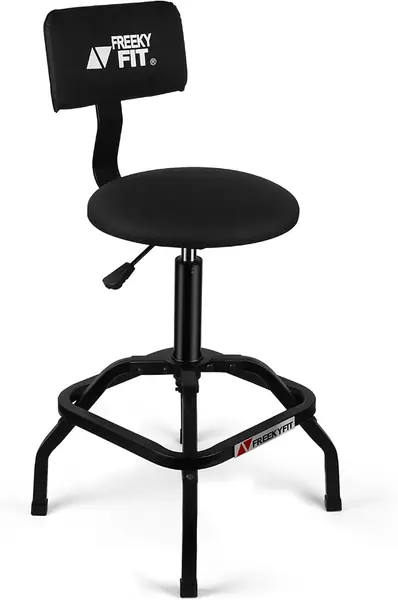
FreekyFit black adjustable shop stool with backrest and footrest

Long bench sessions

Shop Score 93/100
Weight Capacity
300 lb
Seat Height Range
24.49 to 30 inches
Seat Diameter
14.96 inches
Backrest Height
6.69 inches
View on Amazon

Back support is rare on a shop stool, and the FreekyFit makes it the main event: a 6.69-inch backrest and a footrest sit above a 24.49-to-30-inch pneumatic seat. That is a bench-height stool, not a low roller, and the shape tells you it is built for longer sessions at a table or workbench.

The 14.96-inch PVC seat is wider than most here, and the cushion has enough thickness to keep the frame out of your legs. We choose it when the work involves sitting still and reaching across a bench, because the backrest lands in a useful spot and the footrest gives you something to brace against. The 360-degree swivel helps you turn without getting up.

Assembly is the catch. The holes in the legs and mount can need encouragement, so leave the bolts loose until everything lines up, then tighten. That is a setup hassle rather than a long-term performance problem. The stool also does not roll; it swivels in place. For a bench where you stay put, that is fine, but it will not replace a castered roller for moving around a car.

The 300-pound rating is competitive, and the backrest is the reason to pay more than a plain bench stool. We like the PVC cover for a shop because it wipes clean and does not hold dust the way fabric does. If you need to travel across the floor, look at the MaxWorks or DEWALT instead; if you need to stay comfortable at one bench, this is the one we reach for.

Worth Noting

  • No casters, so it stays at one bench
Our Verdict

We choose it when back support matters most: the tall backrest, footrest, and 24.49-to-30-inch range make long bench sessions easier.

Check Latest Price
4.

GEARWRENCH 86992 Adjustable Swivel Shop Stool Best for Tall Benches

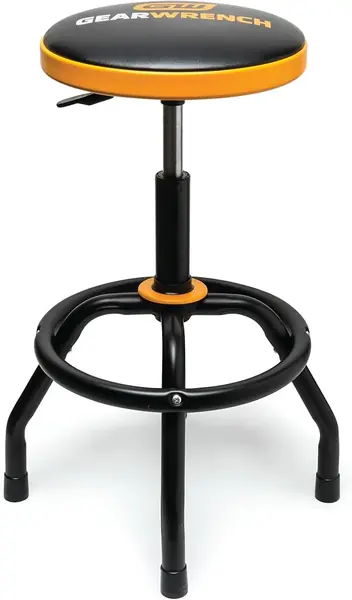
GEARWRENCH 86992 black adjustable swivel shop stool with round padded seat

Tall workbenches

Shop Score 92/100
Weight Capacity
225 lb
Seat Height Range
26 to 31 inches
Swivel
360 degrees
Seat Material
Solvent-resistant padding
View on Amazon

The 26-to-31-inch range puts the GEARWRENCH 86992 in tall-bench territory, where a 24-inch stool leaves you hunched over a welding table. We like it for that narrow job: it is a stable, simple seat with a solvent-resistant pad and a 360-degree swivel, not a rolling garage roller.

The seat material is the detail that suits a fabrication shop. It wipes down after oil or solvent, and the padding is firm enough to stay comfortable without feeling squishy. The air-shock lever adjusts the height in the same range as the DEWALT but starts higher, so it is for a tall bench or a standing-height task. The base is stable, and the swivel helps you reach across a table without dragging the stool.

The 225-pound capacity is the lowest here, and that is the first thing to check. If you are near that limit, the WORKPRO gives you 330 pounds, though it is a stationary stool. The air shock is the other long-term question; it can lose pressure over time, so a stool that will not hold height is the failure to watch. We treat that as a condition to check rather than a certainty. For a lighter user at a tall bench, the cleanable seat and stable base are worth the trade.

Worth Noting

  • 225 lb capacity limits heavier users
  • Air shock can lose pressure over time
Our Verdict

We reach for it at a tall bench: the 26-to-31-inch range and solvent-resistant seat suit welding and fabrication, with a 225-pound limit to check first.

Check Latest Price
5.

WORKPRO Heavy Duty Hydraulic Shop Stool Best Standing-Height Seat

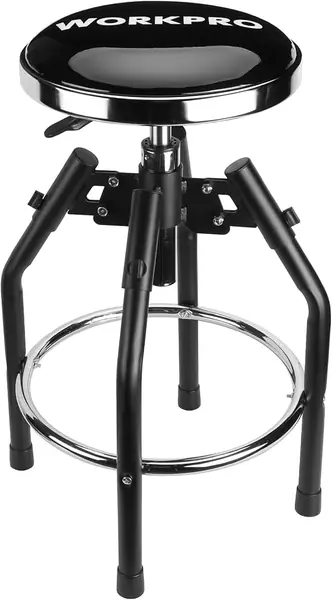
WORKPRO black hydraulic shop stool with round padded seat and chrome frame

Standing-height bench work

Shop Score 91/100
Weight Capacity
330 lb
Seat Height Range
29 to 33.86 inches
Swivel
360 degrees
Seat Diameter
13.78 inches
View on Amazon

At 29 to 33.86 inches, the WORKPRO W112010A sits at standing-height bench level, a range that most rolling stools here cannot reach. That makes it a different tool from the low rollers: you use it at a tall bench or a counter, not at a wheel.

The hydraulic lever moves the seat through that range, and the 360-degree swivel lets you turn across a bench without getting up. We like the 13.78-inch seat for perch work, and the 330-pound capacity is the highest here. The chrome frame and black pad look more like a garage bar stool than a mechanic's roller, which is exactly what it is. The hydraulic cartridge is the long-term question; it can lose pressure after months of use.

There are no casters, so this is a stationary stool. That is a limitation if you need to travel across a shop, and it is the reason we keep it out of the top spot for general garage work. If you work at one tall bench, the fixed base is actually a benefit: no drift, no caster maintenance, and a stable perch. The 330-pound rating gives it more margin than most, and the simple seat is easy to wipe down.

Worth Noting

  • No casters, so it stays at one bench
Our Verdict

We recommend it for standing-height bench work, where its 29-to-33.86-inch hydraulic range and 330-pound capacity beat most of the rolling stools here.

Check Latest Price
6.

BIG RED TR6350 Pneumatic Rolling Mechanic Stool Best for Detailing and Wheels

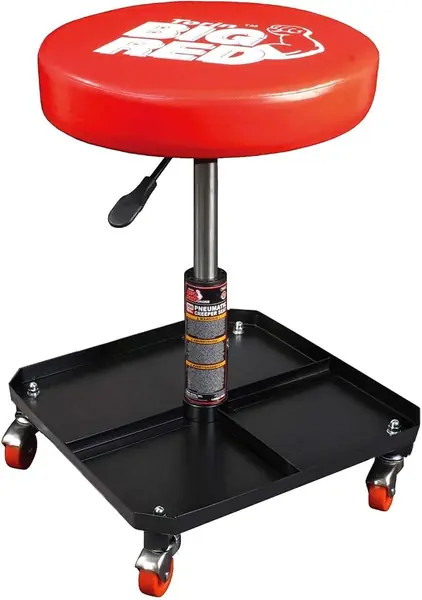
BIG RED TR6350 red pneumatic rolling mechanic stool with segmented tool tray

Detailing and wheels

Shop Score 90/100
Weight Capacity
250 lb
Casters
4 swivel
Height Adjustment
4.5 inches
Maximum Seat Height
21 inches
View on Amazon

The feature that sets the Torin BIG RED TR6350 apart is the large segmented tray under the seat, a useful place to sort fasteners while you work. We like it as a premium low roller: the tray is bigger than the simple pans on the MaxWorks and WEN, and the padded vinyl seat is comfortable for detailing and wheel work.

The 4.5-inch adjustment takes the seat up to a 21-inch maximum, so it sits in the same low-work territory as our top pick. The four casters roll smoothly on a smooth garage floor, and the stool is light enough to move out of the way. The vinyl cover wipes down after oil or polish, which matters on a detailing stool.

The 250-pound capacity is the main compromise. If you are near that limit, the MaxWorks or DEWALT gives you 300 pounds for a similar low or bench role. The four-caster base is also a little less planted than the five-caster MaxWorks when you lean hard. For a lighter user who wants a bigger tray and a padded seat, those trade-offs are easy to accept, and the Torin remains the low roller we choose when the tray matters.

Worth Noting

  • 250 lb capacity is below the 300 lb picks
Our Verdict

We keep it as the premium low roller for detailing, with a large segmented tray and a wide padded seat, though heavier users should step up to a 300-pound model.

Check Latest Price
7.

WEN 73012T Pneumatic Rolling Mechanic Stool Best for Low-Cost Garage Work

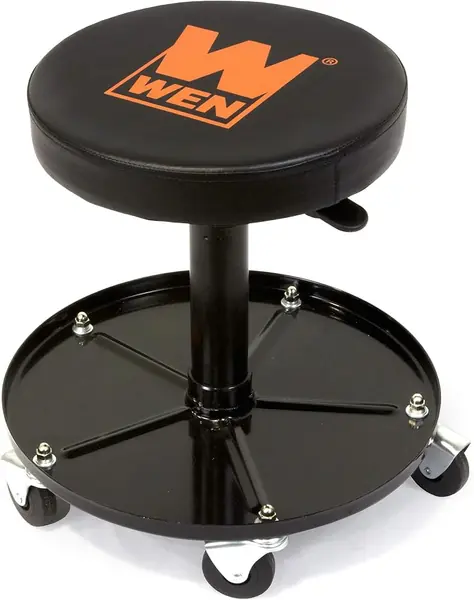
WEN 73012T pneumatic rolling mechanic stool with five casters and onboard tool tray

Low-cost garage work

Shop Score 89/100
Weight Capacity
300 lb
Seat Height Range
15 to 20 inches
Casters
5 at 2.5 inches
Tool Storage
Onboard
View on Amazon

The WEN 73012T follows the same formula as our top pick: a 15-to-20-inch pneumatic seat, five 2.5-inch casters, and a tray underneath. That is a sensible shape for garage-floor work, and the WEN executes it without extra complexity.

The vinyl padding is thick, and the onboard storage keeps tools and small parts close while you roll around a car. We see it as a solid low-cost alternative to the MaxWorks, with the same 300-pound capacity and a similar five-caster base. The tray is simpler, so it is easier to wipe out but less useful for sorting fasteners.

The long-term wear is the open question. The design is simple, and the stool does not add a backrest or a tall bench range, so it stays in the low-work lane. If you need to sit at a 36-inch bench, the DEWALT or FreekyFit is the better shape. If you need a basic roller for wheels and low projects, the WEN covers it, and the casters, height range, and tray are the parts that matter.

Worth Noting

  • Low seat height won't suit tall benches
Our Verdict

We see it as a straightforward low-cost roller: 15-to-20-inch height, five casters, and a basic tray for garage-floor jobs.

Check Latest Price

How We Tested Shop Stools: Six Months, Twelve Seats, One Garage Floor

We started by researching every shop stool we could find with a published weight capacity, a stated seat height range, and either casters or feet, then narrowed the field to 12 stools spanning low roller seats up to standing-height perches. Each arrived unassembled, so we built them with whatever tools came in the box, timed the job, and noted whether the bolt holes lined up on the first try. A stool that fought us during assembly rarely got better afterward.

Testing ran six months in a working garage and a home workshop. We measured each stool's real seat height range with a tape instead of trusting the box, then set them beside low cars on jack stands, a standard workbench, and a tall assembly bench. Every stool was loaded only up to its own rated capacity, on level concrete with the base fully supported, and never used as a step; we rocked side to side to check for flex and wobble.

We cycled the pneumatic and hydraulic lifts through repeated height changes to see whether they held their setting or slowly sank, and noted which swivel seats spun smoothly and which developed a grind. Casters were rolled over bare concrete, expansion joints, and rubber matting, watching for flat spots and for how the stool tracked when we pushed off.

Comfort got the longest test: two-hour stretches of sanding, wiring, and sorting parts, paying attention to whether padding bottomed out and whether a backrest landed where it should. We filled every tray and shelf with real tools and checked whether we could reach them without leaving the seat. Assembly, sturdiness, and value counted as heavily as specs — a stool had to justify itself against the others in its range.

How to Choose a Shop Stool

Match the seat height to the work

Height is the first specification to settle, because a stool that is 6 inches off leaves you hunched no matter how good the cushion is. Low roller seats such as the MaxWorks sit at 15 to 20 inches and suit wheels, lower shelves, and detailing. For a standard 36-inch workbench, a seat around 24 to 27 inches is a better starting point; the DEWALT covers 22.5 to 26.75 inches, and the FreekyFit goes to 30. If you work at a tall fabrication table or standing-height bench, the WORKPRO's 29-to-33.86-inch range is the one to check. The trap is buying a barstool height because it looks like a shop stool; measure the work first, then the seat.

Weight capacity and stability

A stated weight capacity is a limit, not a comfort rating. Look for margin above your weight, especially if you lean or carry tools. The MaxWorks and DEWALT are rated to 300 pounds; the WORKPRO goes to 330, while the GEARWRENCH stops at 225. A five-caster base on a low roller spreads the load and feels more planted than a four-caster base, but base width matters too. We prioritize a wide stance and a low center of gravity over a high number alone. If you are near a stool's limit, choose the next capacity up rather than testing the margin.

Casters, floors, and movement

Rolling is a convenience only if the casters suit your floor. A 2.5-inch caster rolls easily on smooth concrete and can hang on grit or a lip, while a larger wheel handles debris better. Five casters on a low roller give you a stable footprint and easy travel; four casters are simpler but can feel tippier when you lean. If you stay at one bench, a stationary stool with a swivel is more stable and less likely to drift. The DEWALT ships with both casters and nylon feet, which is the most flexible setup here. Check the floor where you will use it before choosing a roller.

Comfort and support for long sessions

Long sessions change the priorities. A backrest and footrest do more for your back than an extra half-inch of foam, which is why the FreekyFit is our pick when you plan to sit for hours. A vinyl or PVC seat wipes down after oil or paint, and a padded seat with a rounded edge is less likely to cut into your legs. If you move constantly, a low padded roller is the better tool; if you park at a bench, spend the money on support. We do not treat a backrest as a luxury on a bench stool; it is the difference between a productive afternoon and a sore one.

Tool storage and setup

Tool trays are more useful than they look, especially on a low roller where you are sorting fasteners or keeping a wrench within reach. A segmented tray such as the Torin's helps separate parts; a simple round tray on the MaxWorks is easier to wipe out. Check that the tray does not reduce legroom or catch on the floor when you roll. Assembly is the other practical detail: most stools go together with basic tools, but alignment can be fussy. Leave the bolts loose until every hole lines up, then tighten.

Frequently Asked Questions

Final Verdict

For most garage-floor work, we recommend the MaxWorks 80771. Its 15-to-20-inch seat, five casters, and 15.25-inch tray put you at wheel height and keep fasteners close, and its 300-pound rating covers more users than the 250-pound low rollers. If you work at a standard bench, choose the DEWALT DXSTAH025 instead; its 22.5-to-26.75-inch range and wire shelf make better use of a 36-inch bench. For long sessions with back support, the FreekyFit is the one we reach for.