↑↓ navigate ↵ open Esc close All results →

Best Staple Guns of 2026

A staple gun looks like a one-job tool until the work gets real: house wrap flapping in the first gust, a chair seat that won't hold its fabric. What fixes those is a gun that sinks staples flush at the depth you set, without denting the face of the work, and does it a few hundred times without cramping your hand.

The first decision isn't brand or price — it's what you'll feed the tool. A pneumatic gun wants a compressor and hose trailing behind you, a cordless one wants a battery platform, and a manual one wants your grip, over and over, for an hour. We tested 14 staple guns over nine months, and the gaps showed up fast: weight by the fiftieth staple, how quickly a jam clears, and the cost of a box of refills.

Staple families don't cross over, so check that a gun takes the staples sold at your hardware store in the leg lengths you need. Set the depth before the first staple; pine and hardwood want different force. Not every gun suits every job, but each one here drives a staple where you aimed it.

Our Top Picks

The Best Staple Guns

1.

Milwaukee M12 2447-20 Crown Stapler Best Overall
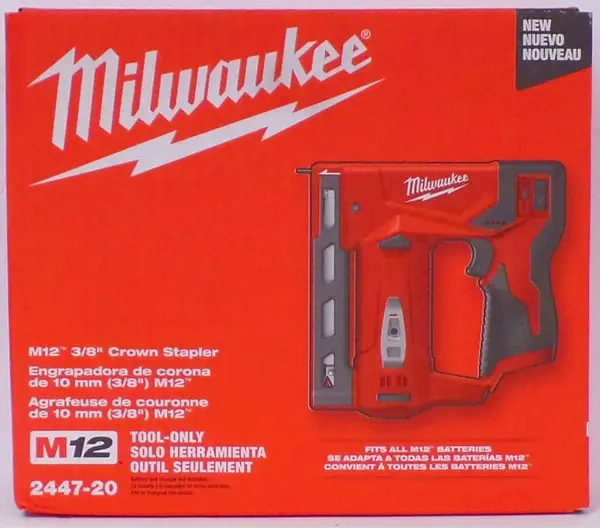
Milwaukee M12 cordless crown stapler in red and black with a compact body

All-around cordless work

Shop Score 95/100
Weight
3 lb
Staple Type
3/8 in. flat crown, 1/4-9/16 in. legs
Power Source
Milwaukee M12 battery
Runtime
Up to 1,500 staples per charge
View on Amazon

Overhead work is where a cordless stapler justifies itself: insulation between joists, house wrap above your reach, a run of sheathing with nothing to trip over. The Milwaukee is 7.25 inches long and 3 pounds with an M12 battery aboard, short enough to fit between framing and light enough to keep pointing up after the novelty wears off.

We came away most impressed by how little the trigger asks of you. The squeeze is short and light, the power adjustment lets you dial the drive down for thin material and up for hardwood, and staples set at a consistent depth instead of stopping halfway. The trigger also switches between sequential and contact actuation — contact for a fast run of sheathing, sequential for a chair seat where a stray staple costs you fabric.

The staple diet is the trade. It takes 3/8-inch crown staples with legs from 1/4 to 9/16 inch, so it wants upholstery, insulation, and sheathing work rather than T50 strips or brads. If your projects live in that range — and most upholstery and weatherproofing does — the diet is a feature rather than a limitation.

For anyone already on the M12 platform, this is the tool that retires the hand stapler. The belt hook keeps it within reach on a ladder, the nose finds its way into a corner, and a charge is rated at up to 1,500 staples, which is more than most weekend projects will ever ask for.

Worth Noting

  • Bare tool, battery sold separately
Our Verdict

We recommend the M12 to anyone who wants one stapler for upholstery, insulation, and sheathing with no hose in the way — it is the tool we reach for first.

Check Latest Price
2.

Arrow PT50 Pneumatic Staple Gun Best Pneumatic

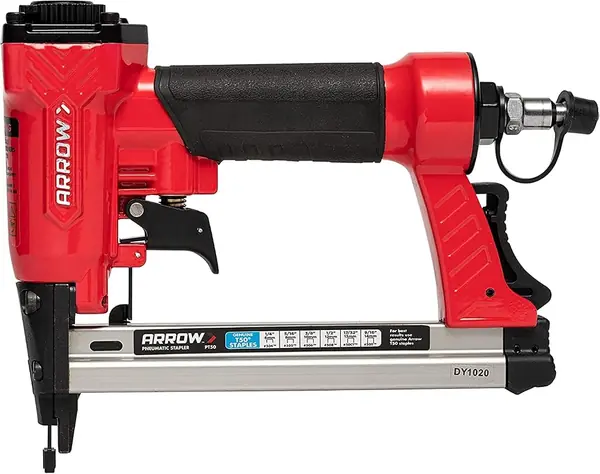
Arrow PT50 pneumatic staple gun in red with an overmolded grip and exhaust cover

Insulation and wrap

Shop Score 94/100
Weight
1.4 lb
Staple Type
Arrow T50, 1/4-9/16 in. legs
Lubrication
Oil-free
Air Pressure
Up to 100 psi
View on Amazon

One and a quarter pounds before you add a fitting: the PT50 is the lightest powered staple gun here, and that number is the whole case for air. Hold a gun overhead long enough to wrap a wall and the gap between this and a three-pound cordless is the gap between finishing the roll and calling it a day.

Bump fire is what we appreciated most. Hold the trigger and tap the nose against the work and the PT50 fires as fast as you can move your arm, which is the mode for sheathing, house wrap, and webbing across a sofa frame. The contact safety means it won't fire until the nose is pressed against something, and that is what makes the speed tolerable.

It runs off a home compressor at up to 100 psi, needs no oil, and takes the full T50 range from 1/4 inch to 9/16 inch — staples you can buy at any hardware store and most lumberyards. The exhaust cover rotates so you can point the blast away from your face, a detail that sounds like a footnote until the first time you need it.

The long haul is where it gives ground. Ours ran clean, but misfires can show up after a day of steady use, and the mechanism that holds the strip is the part to watch. For a homeowner running a few hundred staples at a time, the weight and the price make that an easy trade; for a crew that lives on one gun, the Milwaukee is the safer buy.

Worth Noting

  • Needs an air compressor and hose
Our Verdict

The PT50 is the pick for anyone who already owns a compressor: the lightest way to fire T50 staples in bulk, at a price that leaves room for staples.

Check Latest Price
3.

RYOBI ONE+ P317 Crown Stapler Best Cordless Value

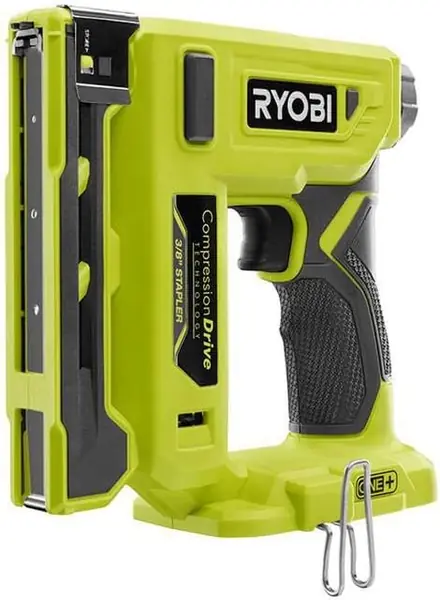
RYOBI ONE+ 18V cordless crown stapler in green with a depth adjustment dial

Big outdoor runs

Shop Score 93/100
Weight
3.5 lb
Staple Type
3/8 in. crown
Power Source
RYOBI ONE+ 18V battery
View on Amazon

If there is already a row of green 18-volt batteries in your shop, the P317 is the less expensive way into a cordless stapler, and it doesn't act like the cheap option. Load a strip, set the dial, and it drives staples into material a hand gun would bounce off.

That dial is the part we appreciated. Matching the drive to the material — sheathing, foam board, a plywood chair seat — is a twist away, and on 2x8 framing with plastic sheeting it drove staples flush rather than leaving them proud. The old electric staplers either sank the staple or stood it up; the adjustment is how this one avoids both.

Cordless weight is the tax. With a battery aboard it is a 3.5-pound tool and a long overhead run makes that known, though it is still less work than a manual gun over the same wall. The trigger is easy, and the body is maneuverable enough to follow a curve of sheathing without the nose fighting you.

It is a 3/8-inch crown stapler, the same staple family as the Milwaukee, so neither cordless gun here will eat a T50 strip. For insulation, sheathing, fence wire, and upholstery, that is the right staple — and at this end of the cordless market it is the value pick of the two.

Worth Noting

  • Battery and charger sold separately
  • Jams can lock the magazine solid
Our Verdict

We point budget-minded shoppers to the P317: it drives staples flush, adjusts by dial, and costs less than our top pick on a battery platform you may already own.

Check Latest Price
4.

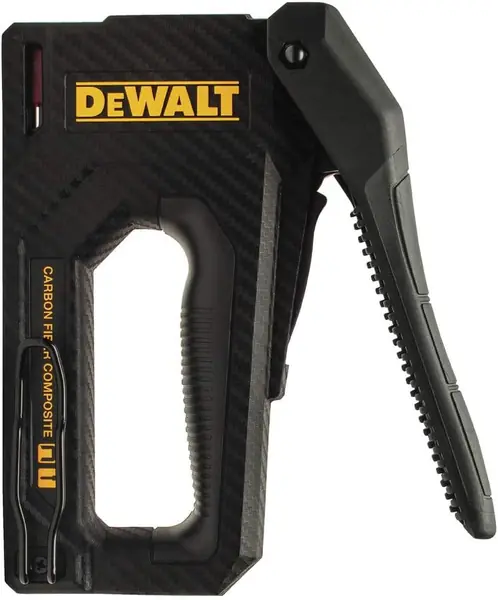
DEWALT DWHT80276 2-in-1 Tacker Best Manual

DEWALT carbon fiber 2-in-1 tacker with a bottom-load magazine and low-fastener window

Long manual sessions

Shop Score 92/100
Body
Carbon fiber composite
Magazine
Bottom-load
Fasteners
Staples and brads
Fastener Capacity
180
View on Amazon

This is the manual stapler that doesn't punish your hand, and we think the carbon-fiber body is why. It comes in at roughly half the weight of a traditional steel tacker, and the trigger was reworked to cut the effort of each squeeze, so a long run of staples feels like a long run of stapling rather than a grip contest.

The difference shows up partway through a job, when a chrome gun starts to feel like a brick and this one doesn't. Staples set flush, the bottom-load magazine is quick to refill, and the low-fastener window lets you see the strip running out before you dry-fire a dent into the face of the work.

It is a 2-in-1 tacker, so it takes brads as well as staples — a small thing until you are fastening thin stock and don't want a staple crown showing. It also sinks staples into pine and plywood without asking you to lean on it, which is not something every manual gun here can say.

What it isn't is a production tool. A hand-powered drive and a 180-fastener magazine mean somebody running thousands of staples a day still wants air or a battery. For furniture, crafts, and repairs around the house, it is the least tiring manual gun we used.

Worth Noting

  • Pricier than a basic steel stapler
Our Verdict

For anyone who wants a manual stapler and has tired hands, we recommend this one — light, easy to squeeze, and comfortable through an entire project.

Check Latest Price
5.

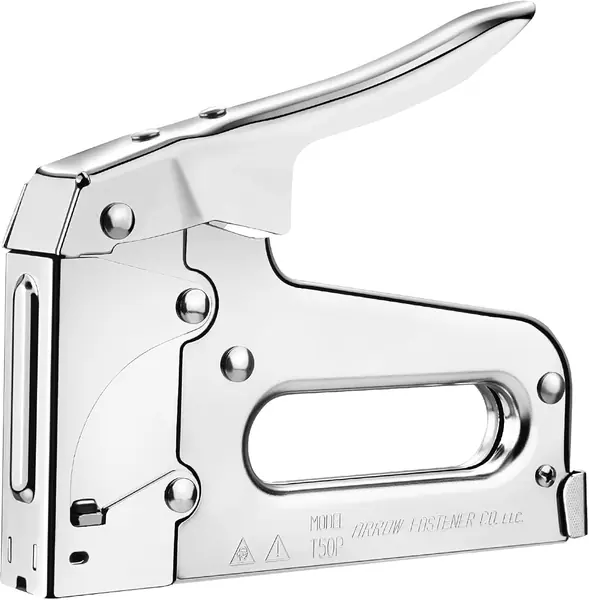
Arrow T50 Heavy-Duty Staple Gun Best for Budget Heavy-Duty Work

Arrow T50 manual staple gun with a chrome steel body and rear-load magazine

Budget heavy-duty work

Shop Score 91/100
Staple Type
Arrow T50, 1/4-9/16 in. legs
Body
Chrome-plated steel
Length
6.5 in.
Warranty
90 days
View on Amazon

The T50 staple is the reason this gun is still on shelves: five leg lengths from 1/4 inch to 9/16 inch, sold at every hardware store and lumberyard, cheap enough to buy two boxes at a time. The gun is almost secondary to that.

What the money buys is a chromed steel body hardened in a 1,500-degree furnace, a rear-load magazine with a viewing window, and a high-leverage handle. It feels like a tool that has stayed the same for decades because the shape works, and the window takes the guesswork out of knowing when to reload.

The squeeze is the honest catch. Drive staples into hardwood for any length of time and the leverage handle stops feeling like leverage; for insulation, drop cloths, and a couple of chair seats it is fine, but for a full day of upholstery our DEWALT pick is the kinder tool.

Longevity is the other variable: some of these run for decades and others fail early, so buy it as a tool rather than an heirloom and keep the receipt. It is the least expensive of the heavy-duty guns here, and the staple supply is the reason it stays in the conversation.

Worth Noting

  • Chrome body gets heavy overhead
  • 90-day warranty is short
Our Verdict

We still recommend the T50 for anyone who wants a real heavy-duty gun cheaply — just expect to use two hands on hardwood.

Check Latest Price
6.

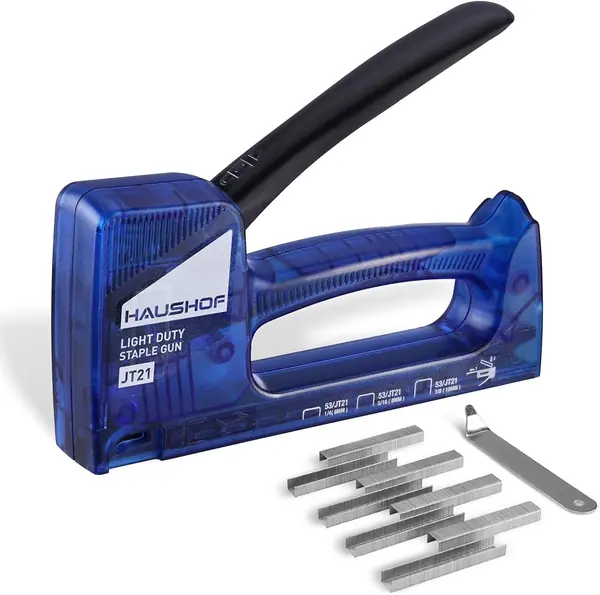
HAUSHOF Light Duty Staple Gun Best for Craft and Fabric

HAUSHOF light duty staple gun in blue transparent plastic with a rubber grip

Craft and fabric

Shop Score 90/100
Weight
9.5 oz
Staple Type
JT21, 1/4-3/8 in. legs
Body
Plastic and rubber
Includes
800 staples and a remover
View on Amazon

A craft stapler, not a builder's stapler — that is the whole review of the HAUSHOF, and it is a compliment rather than a knock. It takes JT21 staples in 1/4-, 5/16-, and 3/8-inch legs and it is happiest on shelf paper, window screen, fabric, and canvas stretched over a frame.

For those jobs it is a pleasure. It weighs under 10 ounces, the wide rubber handle doesn't dig into your palm, and the box holds 800 staples plus a remover so you can start the same afternoon. We like it for the same reason we like a light hammer: you reach for it without bracing for the effort.

Ask it for anything structural and it stops. A 3/8-inch staple into oak will bend or sit proud rather than seat, and leaning on the handle doesn't change that. Keep it for the kitchen drawer and the classroom, and buy one of the T50 guns for anything that has to hold.

Worth Noting

  • Plastic body flexes under hard use
Our Verdict

Keep this one as a second stapler for crafts, screens, and classroom jobs — not for anything that has to hold weight.

Check Latest Price
7.

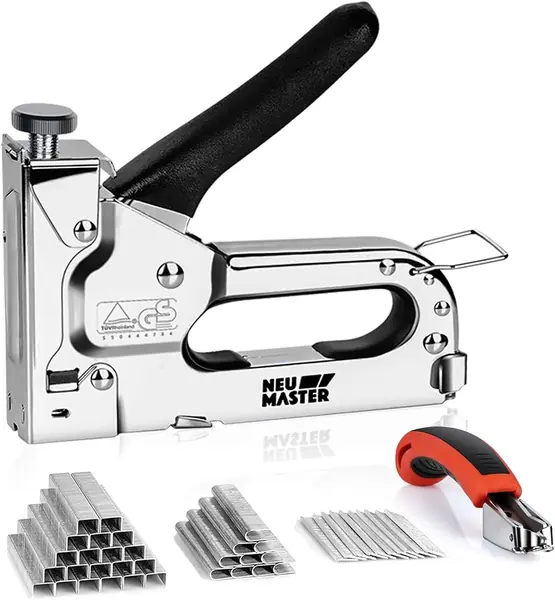
NEU MASTER NHT0050 3-in-1 Staple Gun Best for First Upholstery Jobs

NEU MASTER 3-in-1 manual staple gun in chrome-plated steel with a top adjustment knob

First upholstery jobs

Shop Score 89/100
Weight
2 lb
Body
Chrome-plated steel
Includes
2,000 staples and a remover
Staple Types
5/16, 3/8, 1/2 in.
View on Amazon

Two thousand staples and a remover come in the box, which is the honest reason to look at this one. It is a full starter kit rather than a gun you have to outfit, and the extras are the kind you actually use — a remover saves more upholstery than any feature on the tool.

It takes three staple sizes up to 1/2 inch, the knob on top lets you dial the drive down for fabric and up for pine, and the chrome-plated body feels more substantial than the rest of the package. Loading is bottom-load and quick, and the whole thing weighs two pounds.

Where it slips is consistency. Staples that set cleanly in pine can bend in a denser scrap, and the drive is not as even as the more expensive guns here. Longevity is the other gamble: ours held up, but a tool at this price can quit early, and that is the trade for the money.

As a first kit it earns its place. You get a steel gun, three staple types, and a remover in one box, and it will tell you whether upholstery is work you enjoy before you spend real money on a tool. If the answer is yes, the DEWALT or the Milwaukee is waiting.

Worth Noting

  • Handle needs a firm push
  • Adjustment knob can drift mid-project
Our Verdict

We recommend it as a first upholstery kit when the project is one chair: complete, cheap, and good enough to tell you whether you like the work.

Check Latest Price

How We Tested Staple Guns

We started with more than 60 staple guns and narrowed them by specs, price, and staple availability — a gun is only useful if the fasteners it takes are stocked within driving distance. That left 14 models spanning manual, pneumatic, and battery power. We ran them for nine months on jobs we'd have done anyway: re-covering six dining chairs and the underside of a sofa, hanging house wrap and insulation batts on a garage wall, tacking carpet at the stair edges, stringing wire fencing, and stapling cabinet backs and craft fabric.

For each gun we counted jams per hundred staples and timed how long a clear took — on the pneumatic models we disconnected the air supply before opening anything up. We drove into pine, oak, and MDF to see whether a depth dial held its setting between materials or needed readjusting, and checked whether staples sat flush or crushed the face of the fabric. We wore eye protection whenever we drove into knotty stock, kept our hands behind the nose, and weighed each gun empty and loaded before running it in half-hour stretches to see where fatigue set in.

Reload speed got its own tally: how many staples a magazine held, how fast a refill went, and how many we drove before a battery swap. We tracked cost per staple, compared what shipped in the box — staples, a remover, a case — and kept every gun in rotation for the full nine months to see which ones loosened, misfired, or quit.

How to Choose a Staple Gun

Start With the Power Source

Manual guns are cheap, quiet, and always ready, but every staple comes out of your shoulder. Pneumatic guns are the lightest and fastest for volume, and they need a compressor and hose — the tool's price doesn't include the air. Cordless splits the difference: no hose, around three pounds in hand, and a battery that may already be in your charger.

If you own a compressor, the pneumatic case is strong and the Arrow PT50 makes it for you. If you don't, price a compressor before you commit, and add a battery and charger to any bare cordless tool before you compare it to a kit.

Match the Staple to the Tool

Two numbers decide whether a staple gun is useful to you: the crown width and the leg length. Arrow's T50 strip, JT21, and the 3/8-inch crown the cordless guns use are different platforms, and one tool will not eat another's staples.

Heavy duty on the box is marketing; the strip on the shelf is the fact. Read the leg range before you buy, and pick up a box of the longest staple the gun takes so you can test it in scrap before it meets a chair.

Weigh the Squeeze Against the Run

A staple gun's real cost shows up in your forearm. Overhead work — insulation, house wrap, a ceiling — is where a 1.4-pound pneumatic feels nothing like a three-pound cordless or a steel manual gun, and where a hard squeeze turns an afternoon into a two-day job.

If most of your stapling is overhead or in batches, pay for light weight or a light trigger. If it is a dozen staples on a picture frame, buy on price and put the money into staples.

Set the Depth Before You Start

Soft pine and hardwood want different amounts of drive, and adjustable power — a dial, a knob, or a regulator at the compressor — is what lets one gun do both. Without it you either leave staples proud or crush the material.

Test on a scrap of the actual stock before you start, and press the nose flat against the work every time you fire. Most staples standing up are a technique problem rather than a tool problem.

Think Past the First Project

A quick-release magazine and a jam path you can clear without tools matter more than they sound, because the staple that jams is usually the one in the middle of a run. Keep strips straight and the magazine clean.

Then look at what you are left with: a steel body, a warranty you can read, and a staple you can buy locally are worth more than a few dollars saved. Staples themselves are cheap — the tool is the expense.

Frequently Asked Questions

Final Verdict

For most people, the Milwaukee M12 is the staple gun to buy: no hose, no compressor, a light trigger, and staples that set flush in sheathing, insulation, and upholstery. It is the one we reach for first.

If you already own a compressor and shoot staples by the thousand, the Arrow PT50 is lighter and faster for less money. If you want a manual gun that won't wear out your hand, the DEWALT is the one — and if the job is one chair, the NEU MASTER kit has everything in the box.