↑↓ navigate ↵ open Esc close All results →

Best Threaded Inserts for Wood of 2026

A threaded insert fails in two predictable ways: either the body spins inside the wood as soon as a bolt tightens, or the pilot hole blows straight through the finished face of a board. When properly seated, that small sleeve turns soft, stringy grain into machine threads you can assemble and take apart repeatedly.

Driving 14 packs of inserts into pine, plywood, MDF, oak, and maple over four months—mostly on furniture repairs and stripped table-leg plates—made one rule clear. The insert itself rarely causes the failure; matching the pilot drill, body length, and driving method to your stock thickness decides whether the joint holds.

Sizing the insert around the machine bolt you already own prevents loose fits, whether a build calls for flush or flanged seating, hardwood or softwood threads, single-size packs, or boxed assortments that ship with the right bit and drive key.

Our Top Picks

The Best Threaded Inserts for Wood

1.

PGMJ 1/4"-20 Threaded Inserts, 80-Pack Best Overall
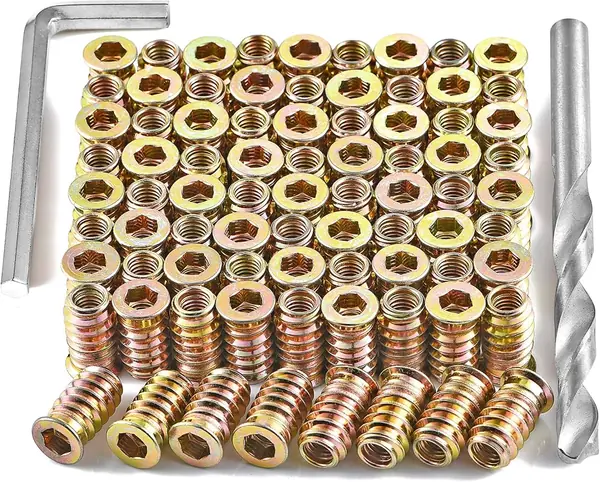
PGMJ zinc-plated 1/4-20 threaded inserts with a 9mm twist drill and hex key

Furniture assembly

Shop Score 94/100
Quantity
80 pieces
Thread Size
1/4"-20 (UNC)
Insert Length
20 mm
Included
9.0 mm drill bit and 6 mm hex key
View on Amazon

The pilot bit is what puts this box at the top of our list. A 1/4-20 insert with a 10.5mm body wants a hole a few tenths off anything in a standard drill index, and the kit throws in a 9.0mm twist drill sized for it. That one inclusion removes the step where most threaded-insert jobs go wrong, because a hole a hair too large leaves the insert spinning under load instead of biting.

Eighty pieces is a working quantity rather than a sample. It is enough to fit out a bench, build a router jig, and handle a few repairs before you think about reordering. The 20mm bodies are the long option in this group, and in leg stock, aprons, and thick jig material that extra length turns into noticeably more engaged thread.

Driving them is uneventful in the way you want. The 6mm socket takes the included key, the external protrusions cut in as the insert draws down, and in pine jigs and plywood fixture plates they seated square and stayed put through repeated assembly and disassembly. That is the whole promise of an insert: a joint you can take apart and rebuild without the hole loosening up.

Set against the other picks here, you are trading a little clearance for depth and a much larger count. Against the kits that bundle screws, you are trading convenience for hardware you choose yourself. For a shop that goes through inserts steadily, both trades go our way.

Worth Noting

  • 20mm body is long for 3/4-inch stock
Our Verdict

We point most shoppers here: 80 zinc inserts, the 9.0mm pilot bit they actually need, and a 6mm key in a single order.

Check Latest Price
2.

Taiss 1/4"-20 Insert and Bolt Kit, 64 Pieces Best Kit

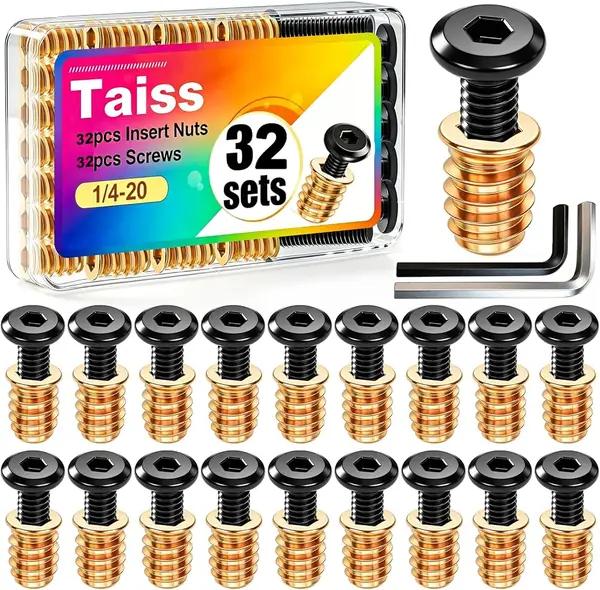
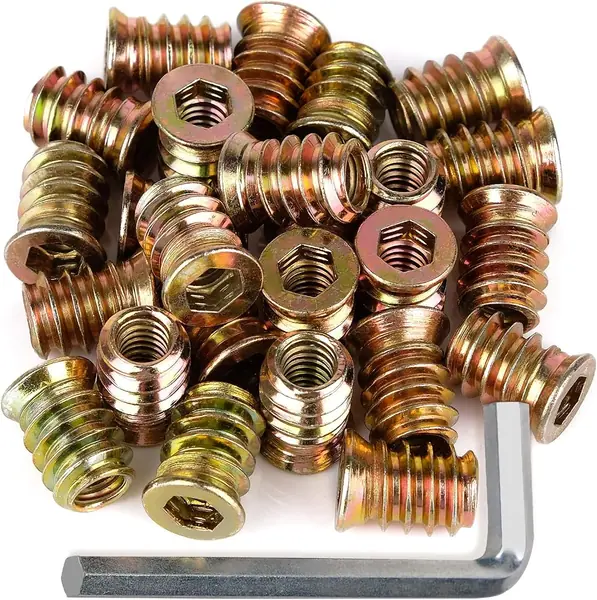
Taiss 1/4-20 threaded inserts and socket cap screws in a compartmented plastic case

One-off furniture builds

Shop Score 93/100
Quantity
32 inserts and 32 socket cap screws
Thread Size
1/4"-20
Insert Length
19/32 in (about 15 mm)
Included
Hex key and compartmented case
View on Amazon

Sixty-four pieces, half of them inserts and half socket cap screws, sorted into a compartmented plastic case with a hex key. It is a narrow idea done well, because an insert is only half of a joint and the screw that goes into it decides whether the finished assembly feels solid or fussy.

We ended up preferring the pairing more than we expected to. Socket cap screws take an Allen key and torque down without the cam-out you get from a Phillips head, and the 12.9-grade screws here are harder than the generic bolts most of us grab off a hardware rack. The inserts measure 19/32 inch, about 15mm, which is the length that suits 3/4-inch stock without breaking the far face.

One caution comes with any matched kit. A 3/4-inch screw in a 19/32-inch insert leaves very little thread in reserve, so the bracket or cleat you are driving through needs real thickness, or a washer, to keep the screw from bottoming out. Check the fit on the first joint before you commit to sixteen of them; on a desk or a bench that is a one-time measurement rather than a running problem.

Worth Noting

  • Only 32 insert sets in the box
Our Verdict

Our choice when you want the screws too: machined inserts, hardened cap screws, and a case that keeps the whole job sorted.

Check Latest Price
3.

Anwenk 1/4"-20 x 15mm Inserts, 40-Pack Best Budget

Anwenk 1/4-20 by 15mm carbon steel threaded inserts with a 6mm hex key

3/4-inch plywood and board

Shop Score 92/100
Quantity
40 pieces
Thread Size
1/4"-20
Insert Length
15 mm
Pilot Hole
9.6 ± 0.2 mm diameter, about 18 mm deep
View on Amazon

Anwenk publishes the number most listings leave out: a pilot hole of 9.6mm, give or take 0.2, drilled about 18mm deep. That figure decides whether your first insert goes in clean or spins, and having it printed on the page is worth more than the extra pieces some rivals throw in. The bag holds forty inserts, 10.5mm across the body and 15mm long, plus a 6mm hex key.

We like the length as much as the price. Fifteen millimeters is the size that fits ordinary 3/4-inch plywood, MDF, and board: deep enough to carry real load, short enough that the pilot hole does not blow out the far face. Cost per insert is the lowest in this group, which matters once a jig starts needing sixteen of them at a time.

The included key is short and thin, and hand-driving a long run with it gets old quickly. A T-handle hex key or a hex bit in a driver turns an afternoon into twenty minutes, and it is a tool you will reach for on every insert job after this one. The inserts themselves gave us nothing else to complain about, seating square and holding in both pine and plywood.

Worth Noting

  • Included hex key is short and tedious for driving many inserts
Our Verdict

The cheapest way into this job, and the right length for 3/4-inch plywood and board, so we keep a bag on the shelf.

Check Latest Price
4.

E-Z LOK Hex-Flanged Inserts for Soft Wood, 100-Pack Best for Softwood and MDF

E-Z LOK zinc hex-flanged threaded inserts for soft wood in a 100-piece pack

MDF and plywood

Shop Score 91/100
Quantity
100 pieces
Thread Size
1/4-20
Insert Length
13 mm
Head Style
Hex flanged
View on Amazon

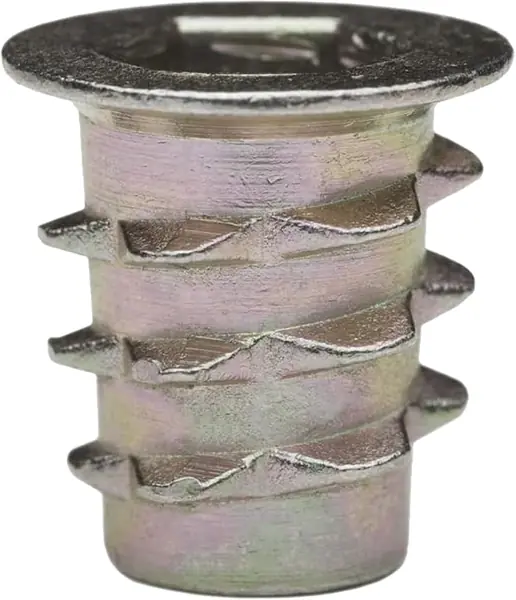
A hundred zinc hex-drive inserts, 1/4-20 inside, 13mm long, flanged at the head and threaded broadly on the outside. That is the pattern E-Z LOK builds for pine, plywood, composition board, and MDF, and the coarse external thread is the reason it works there at all.

The flange earns its keep twice over. It stops the insert from drawing below the surface, so a sled or a fixture still slides across the joint, and it puts a ring of bearing area against a soft panel that would otherwise crush around the hole. The hex body takes an Allen key, so nothing special is needed to drive one flush with the wood.

On a CNC spoil board or a fixture plate you sink dozens of these, and buying a hundred changes how you use them. We stopped hoarding the last few in the bag and started treating them as the consumable they are. That broad external thread bites MDF without splitting it, which is the failure that makes most people give up on inserts in sheet goods altogether.

Worth Noting

  • Some inserts arrive with threads too tight for a bolt
Our Verdict

The box we keep for MDF and pine: broad threads, a flange that spreads load, and a hundred pieces so you stop counting them.

Check Latest Price
5.

Twidec 1/4"-20 x 25mm Inserts, 50-Pack Best for Thick Stock

Twidec 1/4-20 by 25mm zinc-plated threaded inserts with 9mm drill bit and case

Table legs

Shop Score 90/100
Quantity
50 pieces
Thread Size
1/4"-20
Insert Length
25 mm
Included
9 mm HSS drill bit, 6 mm hex key, case
View on Amazon

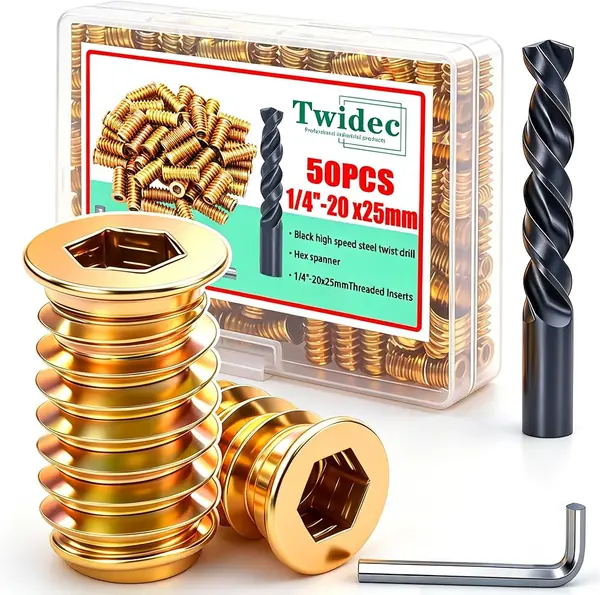
Twenty-five millimeters of body is what sets this kit apart from the 15mm packs here. You get fifty of them, a 9mm high-speed-steel twist drill, a 6mm hex key, and a case that holds the lot, which makes it read as a kit rather than a bag of loose hardware.

We like the length for table legs and thick tops. Twenty-five millimeters means roughly ten more millimeters of engaged thread than a 15mm insert, and in a leg you are bolting and unbolting, on knock-down desks and benches that move between rooms, that extra depth is what keeps a hole from loosening up over a few seasons. The blue zinc finish is ordinary but adequate indoors.

Depth is the catch. A 25mm insert wants a pilot hole around 27mm deep and stock thick enough to hide it, so 3/4-inch board is out unless the far side is hidden anyway. Legs, posts, and laminated tops are where these belong, and for that work the case and the matched bit are exactly what you want in the drawer.

Worth Noting

  • 25mm length is too deep for standard 3/4-inch stock
  • Blue zinc plating is suited to indoor projects only
Our Verdict

For legs, thick tops, and anything you will bolt and unbolt, these 25mm bodies give the deepest bite in this group.

Check Latest Price
6.

E-Z LOK Brass Knife Thread Inserts, 10-Pack Best for Hardwood

E-Z LOK brass knife thread inserts for hardwood with 5/16-18 internal threads

Oak and maple

Shop Score 89/100
Quantity
10 pieces
Thread Size
5/16"-18
Insert Length
0.625 in
Material
Brass
View on Amazon

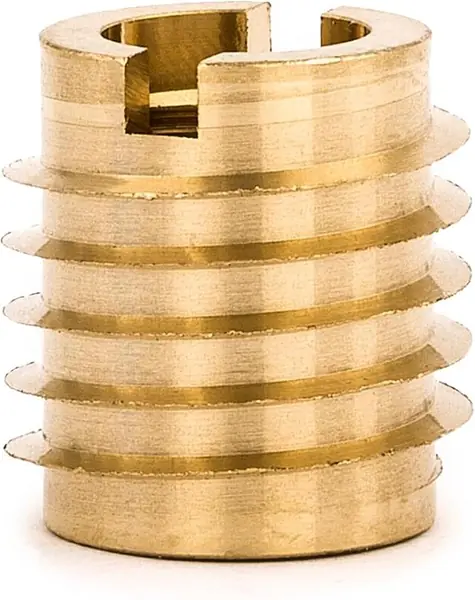
Ten brass inserts, 5/16-18 inside, 0.625 inch long, with a proprietary external knife thread that slices into the wood rather than wedging it apart. E-Z LOK builds them for oak, cherry, and maple, dense stock where an ordinary coarse-thread insert has to compress fibers that will not move.

That is the mechanical argument for the price. A knife thread cuts a clean path, so a hard, dry blank is less likely to split at the rim of the hole, and brass brings corrosion resistance that zinc cannot match on a piece living in a humid room. Installation works with a screwdriver, though the tidier method is a bolt with two jam nuts locked together and turned with a wrench, which keeps the insert square all the way down.

We treat this as the hardwood answer rather than an all-purpose one. In pine or plywood the fine knife thread has less to bite and you are paying brass money for holding power a zinc insert delivers for far less. For a walnut apron or a maple jig you plan to keep for years, the way these seat in stubborn grain is worth the premium.

Worth Noting

  • Costs far more per insert than steel
Our Verdict

The specialist pick: a brass knife thread that cuts into oak and maple instead of crushing them, for furniture you expect to keep.

Check Latest Price
7.

Anwenk 3/8"-16 x 25mm Inserts, 40-Pack Best for Heavy Structural Joints

Anwenk 3/8-16 by 25mm threaded inserts for wood with a hex wrench

Heavy structural joints

Shop Score 88/100
Quantity
40 pieces
Thread Size
3/8"-16
Insert Length
25 mm
Outside Diameter
15.35 mm
View on Amazon

Three-eighths rather than a quarter: these take a 3/8-16 bolt, measure 15.35mm across the outside, run 25mm long, and arrive forty to a bag with a hex wrench. Anwenk calls for a 15mm pilot hole about 28mm deep, which tells you most of what you need to know about where they fit.

A 3/8 thread carries a heavier bolt, and heavier bolts are what hold bed rails, bench legs, and gate hinges. In a joint that sees racking rather than straight pull, one substantial bolt does the work of two small ones, and the 25mm body gives that bolt something to pull against.

The cost is in the hole. Fifteen millimeters is a lot of material to take out of a 3/4-inch board, and near an edge or a knot the pilot drill can split the stock. Keep generous edge distance, clamp a backer where the grain runs out, and drill in two steps if the wood is at all brittle.

We reach for these when the joint is structural. For drawer fronts, small jigs, and anything a 1/4-inch bolt will hold, they are more hole than the job needs. For a bed frame that gets dragged across a floor, the bigger thread is cheap insurance against a joint that works loose.

Worth Noting

  • Large 15mm pilot hole can split thin or brittle stock near edges
  • Overkill for drawer fronts, small jigs, and light-duty work
Our Verdict

When a 1/4-inch bolt is not enough, these take a 3/8-16 thread for bed rails, bench legs, and gates that carry real weight.

Check Latest Price
8.

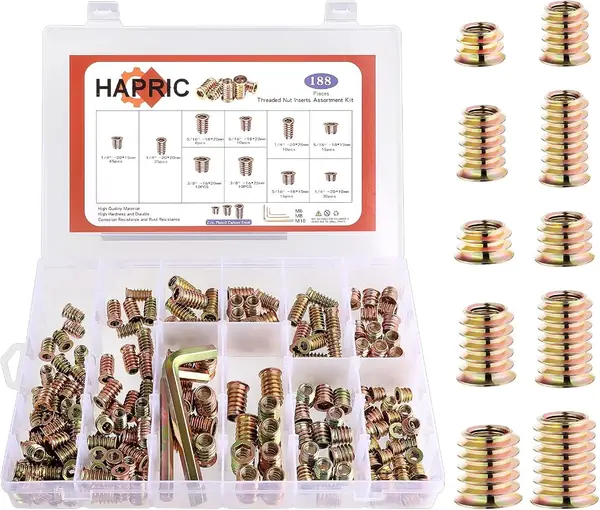
Hapric 191-Piece Threaded Insert Assortment

Hapric threaded insert assortment in a labeled storage box with three hex wrenches

Shop repair stock

Shop Score 86/100
Included
Hex wrenches and labeled storage box
Sizes
10
Pieces
191
Thread Sizes
1/4"-20, 5/16"-18, 3/8"-16
View on Amazon

Ten sizes across three thread families, 1/4-20, 5/16-18, and 3/8-16, in lengths from 10mm to 25mm, packed in a labeled box with separate compartments and a set of hex wrenches. It is the only pick here that assumes you do not know your thread size yet.

The case for an assortment is simple. You rarely know which insert you need until the bolt is in your hand, and one box covers a chair with 1/4-inch hardware, a machine base on 5/16, and a bench leg on 3/8 without another store run.

It is a mixed bag in the literal sense. The compartments are labeled and the wrenches are sturdier than the token keys most kits include, but there is no drill bit and no chart pairing each size with a pilot diameter, so you work that out yourself or keep a drill index beside the box.

We treat it as the box that lives on the shelf rather than the one we buy for a specific project. If you already know your size, a single-size pack costs less and usually throws in the pilot bit. If you repair as much as you build, the variety is what earns it the space.

Worth Noting

  • No drill bit or pilot-size chart included
Our Verdict

For the shop shelf: ten sizes across three thread families, labeled, so the right insert is already there when a bolt turns up.

Check Latest Price

How We Tested Threaded Inserts for Wood

We started by pulling every listing that matched a common machine bolt — 1/4"-20, 5/16"-18, or 3/8"-16 — and sorting them by external thread design, body length, quantity per pack, and whether a pilot bit and drive key came in the box. That narrowed a crowded field to 14 packs, which we bought ourselves and used over four months.

Testing ran out of a garage shop, on scrap and on real work: pine and plywood shelving, MDF cabinet panels, oak and maple offcuts, and a table whose legs had pulled their fasteners. We drilled each recommended pilot hole to depth, then drove inserts by hand with a hex key and with a drill on a low clutch setting. We did not use an impact driver on any of them, and we stopped short of drilling through to a visible face.

Once seated, each insert took a bolt that we ran in and out a couple dozen times. We watched for inserts that started crooked, stood proud instead of seating flush, rounded out at the socket, or spun under load, and we noted whether the external threads bit into softwood or polished the walls of a hardwood hole. To check length against stock, we cut blocks to the thickness of a finished panel and drilled until the bit tip was where the insert would sit.

We also counted what was actually in each box, priced out cost per insert, and inspected thread quality straight out of the bag — burrs, grit, and whether a bolt threaded in by hand. The multi-size assortments got the same treatment, since a labeled storage case is only worth paying for if the labels match the contents.

How to Choose Threaded Inserts for Wood

Start With the Bolt, Then Buy the Insert

Internal thread size decides everything else, and it is the spec shoppers check last. Most American furniture hardware runs 1/4-20, which is why it dominates this list. 5/16-18 and 3/8-16 show up in heavier joints, and imported flat-pack hardware is often metric.

Measure the bolt you intend to use, diameter and threads per inch, before you order anything. Then buy every insert in that thread size, so one hex key and one box of bolts covers the whole project instead of three near-misses.

Match Insert Length to Board Thickness

A screw-in insert needs a pilot hole 1 to 2mm deeper than its body. That makes the common 15mm insert the natural fit for 3/4-inch plywood and board, with a couple of millimeters to spare. Step up to a 20mm or 25mm body and you need thicker stock, such as legs, posts, and laminated tops, or a hole that breaks through the far face.

Choose the External Thread for Your Wood

Two designs cover most work. Coarse screw-in inserts, often sold as nut inserts, have external protrusions that cut into softwoods, plywood, MDF, and composition board, and they are the general-purpose choice. Knife-thread inserts slice a clean path through dense hardwoods like oak and maple, where a coarse thread has to compress fibers that resist it.

Pilot-hole sizing runs opposite to instinct: near the body diameter in softwood, closer to the thread diameter in hardwood. Too small a hole splits the stock or snaps the insert, and too large a one leaves it spinning.

Flanged or Flush, and Whether It Seats Square

A flanged insert stops at the surface and spreads load across a small collar, which suits soft panels and jigs you slide work across. A flush insert sits below the surface and needs a counterbore, which is more setup for a cleaner face.

Either way, the hex socket is what keeps the insert square on the way in, and a short stamped key makes that harder than it needs to be. A T-handle key is worth owning before you install forty of them.

What Comes in the Box Is Worth Paying For

These inserts want pilot holes at sizes no standard drill index carries, whether that is 9.0mm, 9.6mm, or 15mm, and a hole a few tenths off is the difference between a solid anchor and a spinner. A kit that includes the matching bit removes the guesswork, and we weight that heavily when the price gap is small.

Whatever you buy, run a bolt through the first few inserts before you commit to a whole project. Chasing a rough thread takes a minute; digging a bad insert out of MDF does not.

Frequently Asked Questions

Final Verdict

The PGMJ 80-pack is what we tell most people to buy, and the reason is mundane: it supplies the 9.0mm bit these inserts need, in a quantity that covers a project and the one after it. If your work is 3/4-inch plywood or MDF, take the 15mm Anwenk instead, where the shorter body is the safer fit and the cost per insert is lower.

And if you are putting threads into oak or maple, skip zinc entirely and buy the E-Z LOK brass knife threads. Nothing else here seats as cleanly in dense grain.