↑↓ navigate ↵ open Esc close All results →

Best Woodworking Vises of 2026

When a bench vise racks under clamping pressure or lets a board creep mid-sawing, the risk reaches beyond ruined stock straight toward hands working near sharp teeth and chisels. Holding lumber immobile lets a woodworker focus entirely on the cut instead of bracing the workpiece with a hip or spare hand.

Bolting 12 vises onto benches for eight months of dovetailing, edge-jointing, carving, and case assembly showed how fast spec sheets mislead shoppers. Jaw width attracts the most attention, yet opening capacity, throat depth, and a rigid bench apron determine what parts fit—as mounting a heavy cast-iron vise to a light frame quickly proved when the bench itself flexed first.

Flush-mounted front and face vises team with bench dogs to hold long boards flat, while pivoting units free up odd angles for carving and assembly without marring finished wood.

Our Top Picks

The Best Woodworking Vises

1.

Yost Vises M9WW Rapid Action Vise Best Overall
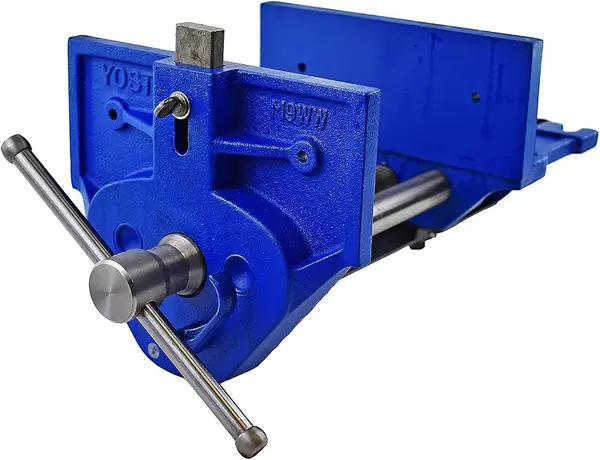
Blue Yost cast-iron woodworking vise with chrome T-bar handle and rapid-action lever

Full-size hand-tool benches

Shop Score 94/100
Jaw Width
9 inches
Jaw Opening
10.25 inches
Weight
32.1 lb
Throat Depth
4 inches
View on Amazon

Rapid action is the feature that names this vise, and it's the one we appreciate most. Throw the lever at the end of the handle and the main screw disengages, so the front jaw slides to the workpiece instead of cranking there. Across a 10.25-inch opening that's a long walk saved every time you go from a thin drawer side to a two-inch apron.

Capacity and mass cover the rest. Nine inches of jaw width and four inches of throat depth let you seat a wide panel low, so a plane rides across the bench and onto the work instead of dropping onto a jaw edge. At 32.1 pounds of cast iron, the mass is doing real work when a jack plane bites a knot, and the steel guide rails keep the front jaw tracking straight rather than racking under an off-center load.

We think this is the right default for most hand-tool benches. It's the biggest and heaviest vise in this guide, it's the only traditional vise here with a rapid-action screw, and the chrome-plated T-bar handle is long enough to spin with an open palm. Nothing about it is fussy: mount it, grease it, and the vise side of your bench is settled.

Two practical notes from setting it up. Grease the screw and the guide rails when it goes on and once a season after that; a dry screw is where a vise starts to feel rough. And the jaws are bare steel, so cut a pair of hardwood facings if you'll be holding finished surfaces — a steel jaw face marks cherry and walnut faster than you'd like.

Worth Noting

  • Heavy enough that hanging it takes two people
Our Verdict

This is the vise we point most woodworkers to: 9-inch jaws, a lever that slides the jaw free, and enough cast iron to sit still under a plane.

Check Latest Price
2.

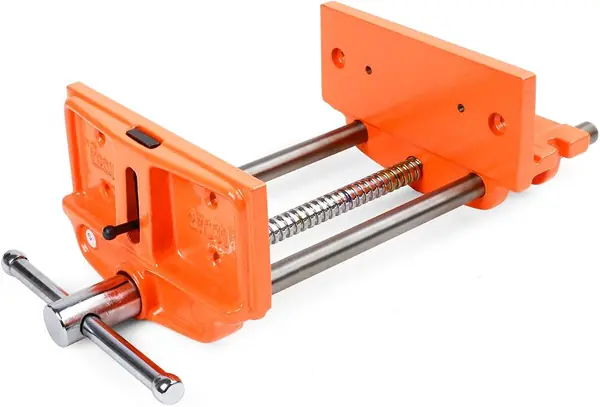
Pony Jorgensen 27091 Woodworker's Vise Best for Flush Face Mounting

Orange and gray Pony face-mount woodworking vise with steel bench dog in the front jaw

Flush face mounting

Shop Score 93/100
Jaw Width
7 inches
Mounting
Face of bench, jaws flush with top
Jaw Faces
Drilled for wooden facings
Bench Dog
Steel dog in front jaw
View on Amazon

The steel dog in the front jaw is the detail that earns this vise its bench space. Raise it, set a bench stop at the far end of the top, and a long board lies flat against the bench instead of hanging out of the jaws — which is how you plane an edge without chasing the work around the shop.

For anyone building a vise into the front face of a bench, we like this one better than the bigger Yost. The jaw tops are meant to come flush with the benchtop, so a plane sole crosses from wood to vise and back without a step, and the jaw plates are drilled for wooden facings so you're not pressing finished stock against steel.

Flush is the catch. Depending on how the bench is built, getting the jaw tops level with the top can mean mortising part of the apron or shimming the vise off the face, and that's the part to sort out before you drill anything. Seven inches of jaw width is plenty for rails, stiles, and drawer sides; the medium-duty body feels solid once it's bolted down, and the screw turns smoothly along the rails.

This is a vise for a bench that lives against a wall and gets used for joinery and assembly. It isn't the one to buy if you plan to hang a full-width door on it every weekend — the deeper throat and extra iron of a heavier vise are what that job wants. Below that ceiling, the flush jaw line is worth the extra fitting time.

Worth Noting

  • Jaws can arrive out of parallel
  • Wooden facings are not included
Our Verdict

Buy it if you want the jaw tops flush with your bench and a steel dog for long boards; this is the one we build into a bench face.

Check Latest Price
3.

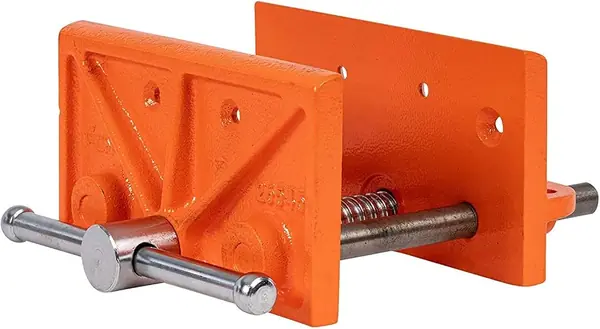
Pony 26545 Light Duty Woodworker's Vise Best Budget

Orange Pony light-duty woodworking vise with 6-1/2-inch jaws and cast body

Small benches

Shop Score 92/100
Jaw Width
6-1/2 inches
Jaw Opening
4-1/2 inches
Duty Rating
Light duty
View on Amazon

If your bench is a doubled sheet of plywood in a spare room, this is the vise we point to. Six and a half inches of jaw width and four and a half inches of opening cover drawer parts, small panels, and the odd chair leg, and it goes onto a top that was never built to carry a serious iron casting.

The design is about as simple as a vise gets: a screw, two jaws, and a body that clamps to the bench edge. That simplicity is the appeal. There's no quick release and no dog, so you crank the jaw open and shut, but the screw drive runs smoothly and the jaws hold small stock steady for planing and sawing.

Mount it so the jaw tops sit just under your benchtop line where the bench allows it, and bolt it through the top rather than driving screws into the edge. A vise is a lever, and the fasteners take that load — end grain won't hold a screw the way a through-bolt with a washer will.

Light duty is the honest description, and it shows in how the vise behaves: small parts, light cuts, no leaning on the handle. For a bench that mostly makes parts — boxes, jigs, small frames — that's all the vise you need, and the compact body leaves bench top free on both sides of it.

Worth Noting

  • 4-1/2-inch opening limits it to small stock
Our Verdict

For a small bench and light work, we think this is the sensible first vise: it bolts up in minutes and holds small stock steady.

Check Latest Price
4.

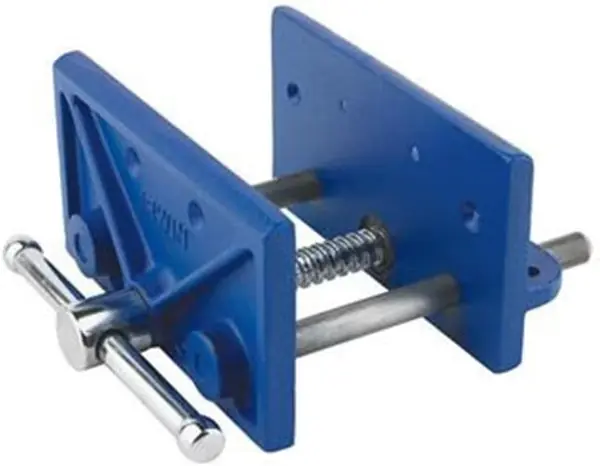
IRWIN 226361 Woodworker's Vise Best for Occasional Small Jobs

Blue cast-iron IRWIN woodworker's vise with square body for under-bench mounting

Occasional small jobs

Shop Score 91/100
Jaw Width
6-1/2 inches
Jaw Opening
4-1/2 inches
Mounting
Under-bench square body
Jaw Faces
Provision for wooden cheeks
View on Amazon

The top jaws on this one toe in slightly, so the vise pinches a board at the top first and the grip tightens as you close it. It's a small design choice that makes a modest woodworker's vise hold better than its size suggests, and it's the sort of thing that gets lost in a spec list.

We rate it as a good small vise for occasional work. The body is cast iron with a square seat that mounts flat under a bench top, the jaws have a provision for wooden cheeks so you're not marking finished parts, and the screw runs clean. For drilling, doweling, and holding a small panel while you sand, it does what a vise is for.

The base is the part to think about when you mount it. It's a small casting doing a lever's job, and sideways load is what it handles least well, so run bolts through the bench top with washers rather than driving screws into the edge of a laminated top. That's the difference between a vise that stays put and one that works itself loose.

Expect the powder coat to chip where boards and tools rub against it. That's cosmetic on a vise and not a reason to pass, but it's the kind of thing that bothers people who keep a tidy bench. Otherwise the finish and the casting are what you want at this size: nothing precious, nothing flimsy.

Worth Noting

  • 4-1/2 inches of opening limits stock size
Our Verdict

Our take: a well-made small vise for drilling and light assembly, as long as you mount it solidly and don't expect full-size capacity.

Check Latest Price
5.

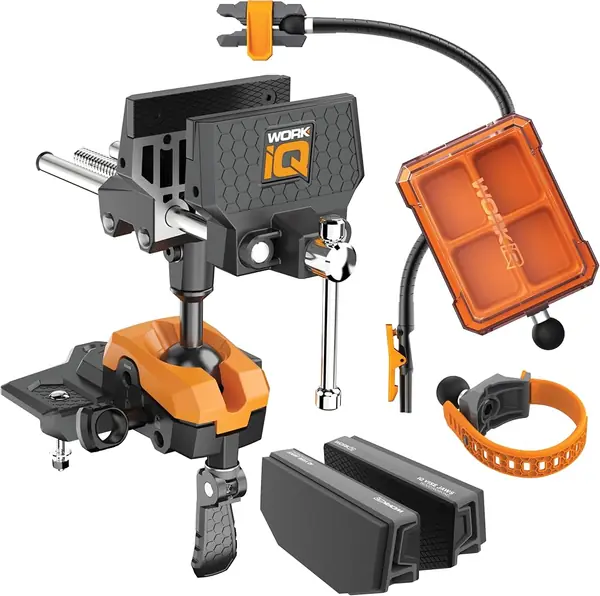
WORK IQ IQ Vise EXT Best for Carving and Assembly

Yellow WORK IQ articulating bench vise with ball-and-socket base and removable jaws

Carving and assembly

Shop Score 90/100
Positioning
Multi-axis ball-and-socket
Jaw Capacity
7.5 inches
Torque Rating
130 ft-lbs
Accessory Ports
Four IQ Connect ports
View on Amazon

This isn't a bench vise in the sense the others here are. There's no jaw line to bring flush with a benchtop and no screw to crank a board against a dog; instead a ball-and-socket base lets you swing the work to the angle you want and then lock it there.

The IQ Vise EXT opens to 7.5 inches and locks through a Quick Cam compression lever, with an IQ Lok pin that engages the joint in eight positions for heavier cuts; the maker rates the assembly to 130 ft-lbs of torque. Four IQ Connect ports around the base take the maker's hands-free accessories, and the woodworking jaws are glass-filled nylon — firm enough to hold a carving blank, soft enough to leave it unmarked. The jaws also come off and reverse, which matters more than it sounds when the piece in front of you has no square edge.

We think it earns its keep in carving, filing, and assembly, where you reposition the piece constantly and a fixed vise makes you fight it. Swing the joint, lock the cam, and both hands go back to the tool instead of the workholding. For a spoon carver or someone fitting small parts together, that changes how the bench works.

For planing a long edge it's the wrong tool: the whole idea of a face vise is a jaw flush with the bench top and a dog to catch the far end of a board, and this has neither. It bolts down through the base, so if you want to use it on two benches, wing nuts and a second set of holes are worth the trouble.

Worth Noting

  • Premium price next to a standard bench vise
Our Verdict

We recommend it for carving, filing, and assembly, where swinging the work to a better angle beats clamping it harder.

Check Latest Price

How We Chose and Tested Woodworking Vises

We built the shortlist from research first, reading spec sheets and manuals for more than 40 vises and filtering by jaw width, jaw opening, throat depth, mounting style, and whether the jaw faces were machined or drilled for wooden facings. From there we narrowed to the 12 we mounted on benches and kept in use for eight months.

Every vise was bolted down before anything went between the jaws, following each maker's mounting instructions, and then we shoved and hammered at the body to confirm nothing shifted under load. We checked parallelism out of the box with a feeler gauge across the closed jaws, then clamped a board and looked for light gaps at either end. We measured the widest board each would grip across and the thickest stock that fit between the jaws, and ran a hand and a chisel down the throat to see how much clearance the jaw line left us.

For long stock we set up a bench dog and a stop and checked whether a board could lie flat on the bench and still be gripped at the end. On the rapid-action vises we timed repositioning between thin and thick stock against a plain screw. We clamped finished maple to see which jaw faces left dents and how much room the wooden facings had to work with, then spent eight months rechecking parallelism, watching for slop in the screw and guide rods, weighing each one to note what it asks of a bench and an installer, and comparing what it cost against how it held up.

How to Choose a Woodworking Vise

Start With the Mounting, Not the Jaws

Face-of-bench, under-bench, and top-mount vises solve different problems. A face-mount vise builds into the front apron with its jaw tops flush to the benchtop, which is what you want if you plane and saw against the bench. An under-bench square body is quicker to fit but leaves the jaws standing proud, and anything standing proud becomes an obstacle when a wide panel slides across the top. A top-mount articulating vise is a different animal: excellent for bringing the work to you, not for holding a board flat.

Before you drill, set the vise against the bench and swing the handle through a full turn. If it fouls a leg, a stretcher, or the wall, move it. And if you plane long boards, look for a steel dog in the front jaw to pair with a bench stop; that combination does most of what a tail vise does.

Three Jaw Numbers, Three Different Jobs

Jaw width is how wide a board the jaws grip across, opening is the thickest stock that fits between them, and throat depth is the room below the jaw line for your hand, a saw, or a plane. A vise sold as "9-inch" is usually quoting one of those and not the others, so check which one. Wide jaws with a shallow opening won't take a thick blank, and a deep throat with narrow jaws still won't hold a panel.

Pick the opening from your thickest workpiece and the width from your widest edge-work panel, then confirm the throat depth leaves room for the tool you'll be pushing.

Rapid Action Pays Off If You Reposition Often

A plain screw means cranking the jaws open and closed every time the workpiece changes. A rapid-action vise disengages the screw with a lever so the front jaw slides free, then re-engages for clamping force. If you fit joinery, where the piece comes in and out every few minutes, that's the difference between working and cranking.

If the vise holds one board while you drill a dozen holes, a plain screw is fine and it's one less mechanism to think about. Either way, the lever is a part to keep clean rather than a part to force.

Jaws Are Where a Vise Marks Your Work

Bare steel jaws leave pressure marks on softwood and can dent a finished face. Wooden cheeks spread the load and hold the work without bruising it, which is why some vises come with jaw plates drilled for them; the wood itself is usually something you add. Parallelism matters as much as the facing: close the jaws on a thin offcut and look for daylight at the top or bottom. Jaws that meet at an angle mark one edge and let a board pivot, so run that check on the bench before you drill any mounting holes.

Frequently Asked Questions

Final Verdict

For a bench built for hand tools, the Yost M9WW is the vise we recommend. Nine inches of jaw width, a 10.25-inch opening, and a lever that slides the jaw where you need it make it the most capable traditional vise in this group, and its cast iron doesn't move when a plane bites.

If your bench needs the jaw tops flush with the top and you want a steel dog for long boards, the Pony Jorgensen 27091 is the better fit. If you carve and assemble more than you plane, the WORK IQ is the one that earns its bench space.