↑↓ navigate ↵ open Esc close All results →

Best Air Compressors for Framing Nailers of 2026

Framing nailers consume air in sudden bursts, and after a few strips of 3-inch nails an undersized compressor starts gasping while pressure sags and work stalls behind the gun. Keeping a wall moving means balancing true CFM output at 90 PSI against nailing pace, paired with a tank that recovers quickly and weighs little enough to lift solo.

Across 12 months of framing a shed, building a garage wall, and trimming a basement with eight job-site compressors, real differences showed up beyond pump displacement. Noise levels, regulator feel—always dialed to the nailer's rated working pressure rather than full tank pressure—and tight couplers that do not bleed air between shots separated reliable machines from frustrating ones.

With eye and hearing protection on, the right air supply keeps pace with rapid framing without turning loading and setup into a chore.

Our Top Picks

The Best Air Compressors for Framing Nailers

1.

Makita MAC2400 2.5 HP Air Compressor Best Overall
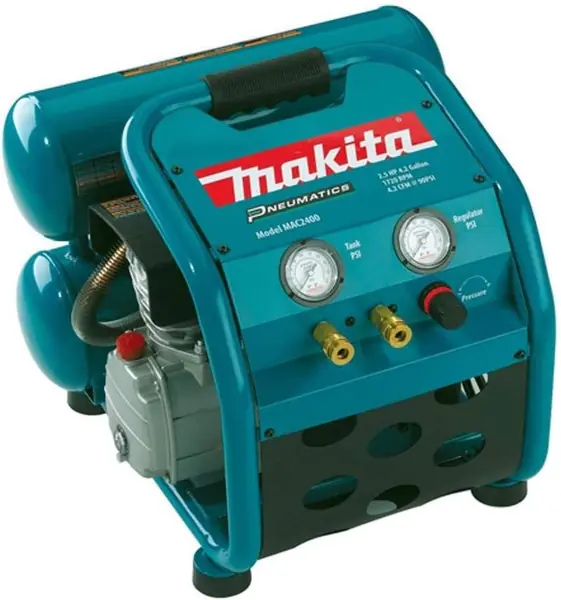
Makita MAC2400 twin-stack air compressor with cast-iron pump and roll cage

Two-gun framing

Shop Score 93/100
Tank Capacity
4.2 gallons
Airflow At 90 PSI
4.2 CFM
Weight
77 lb
Motor
2.5 HP
View on Amazon

The 4.2 CFM at 90 PSI is the number that puts the Makita MAC2400 at the top of this list. A framing nailer draws air in hard bursts, and this twin-stack has the pump capacity to keep one gun moving and enough headroom for two. The 130-psi ceiling and 4.2-gallon tank look modest next to a 20-gallon shop unit; Makita makes them work with a fast-recovering pump rather than a huge reserve.

We like the cast-iron, oil-lubricated pump for the same reason. It runs cooler than an oil-free design and is built for repeated fill-and-fire cycles, which is exactly what framing asks of a compressor. The roll cage protects the works when the unit rides in a truck, and the low-speed motor keeps noise at 79 dB—loud enough to warrant hearing protection, but not the worst offender here. The two quick couplers let you keep a nailer and a blow gun connected.

The small tank does mean more cycling than the Klutch's 20-gallon reserve, and a crew working nonstop will notice the difference. We don't mind it for one- or two-person framing because the pump recovers quickly and the compressor stays compact. The MAC2400 is the one we recommend when the job is actually framing rather than trim or tire inflation.

Worth Noting

  • 77-pound body needs a deliberate lift
Our Verdict

The Makita MAC2400 earns our top spot because 4.2 CFM at 90 PSI and a cast-iron pump keep framing guns fed through repeated cycles.

Check Latest Price
2.

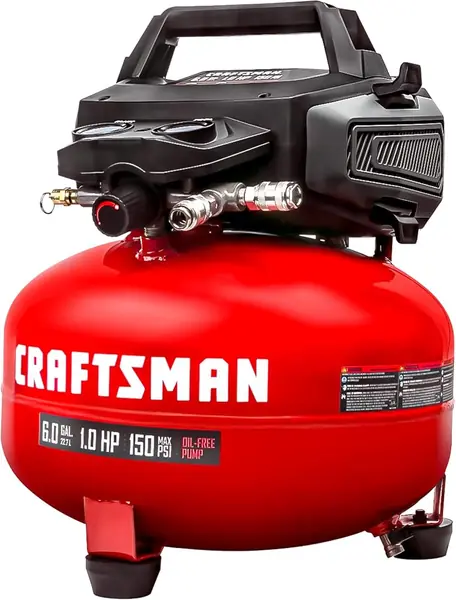
Craftsman 6-Gallon Air Compressor Best Lightweight

Craftsman 6-gallon red air compressor with carry handle and dual couplers

Solo remodels

Shop Score 92/100
Tank Capacity
6 gallons
Airflow At 90 PSI
2.6 SCFM
Weight
30.8 lb
Maximum Pressure
150 psi
View on Amazon

At 30.8 pounds, the Craftsman is the compressor we can carry up a half-flight of stairs without planning a break. That matters when the job is a remodel rather than a new frame, and it is the main reason this 6-gallon pancake earns a spot. The compact footprint also makes it easy to store on a shelf between projects.

The 2.6 SCFM at 90 PSI is not a production framing number, but it is enough for one framing nailer at a normal pace, and the 150-psi tank gives you a useful buffer between cycles. We like the dual couplers for running a nailer and a blow gun without swapping hoses, and the oil-free pump keeps maintenance to a minimum. The six-gallon tank holds pressure between jobs, which is a real convenience for a weekend woodworker who pulls it out occasionally.

The carry handle and compact body are the details that make it feel less like a jobsite tool and more like something you can keep in a garage. It is not the compressor for two guns or a crew, but that is not the job we are recommending it for. For a solo carpenter working in bursts, the light weight is worth more than the extra airflow of a bigger unit.

Worth Noting

  • 82 dB is loud in enclosed rooms
Our Verdict

For a solo remodeler who drives one framing nailer and carries the compressor between rooms, we think the 30.8-pound Craftsman is the lightest capable choice.

Check Latest Price
3.

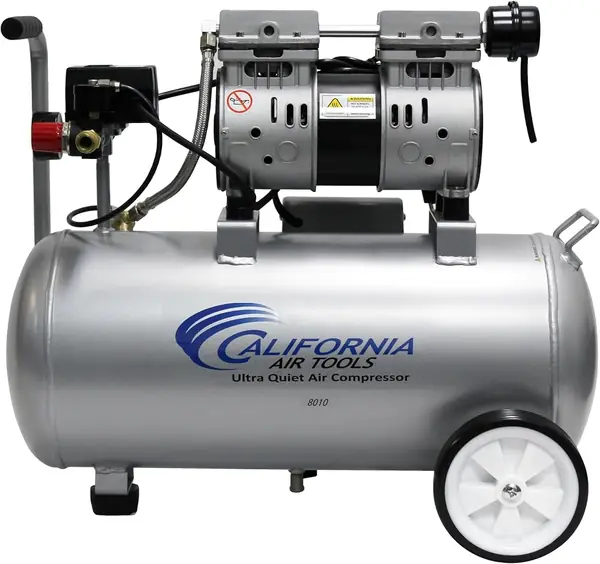
California Air Tools 8010 Air Compressor Best Quiet

California Air Tools 8010 eight-gallon steel air compressor with wheels

Quiet indoor work

Shop Score 91/100
Tank Capacity
8 gallons
Weight
48 lb
Noise Level
60 dB
Airflow Capacity
3 CFM
View on Amazon

The 60-decibel rating is the reason the California Air Tools 8010 stands out in a category that usually shouts. A compressor that quiet changes where you can work: a basement, a garage under a bedroom, or a finished shop without clearing the room every time it cycles. The steel tank and wheel kit make it look like a small shop compressor rather than a job-site box.

We like the 8-gallon tank for a small shop because it gives more reserve than most small tank units, and the wheel kit makes the 48-pound body manageable on a flat floor. The oil-free dual-piston pump avoids oil changes and can run on uneven ground, which is useful if you move it around a garage. For a one-person shop, the 8010 covers framing, trim, and blow-off work without dominating the room. We prefer it where the compressor has to live near the work rather than in a separate shed, and the quiet operation makes that possible.

Worth Noting

  • 3 CFM is modest for fast framing
  • 120-psi ceiling leaves less reserve
Our Verdict

Quiet enough for a basement and sized for one nailer, the California Air Tools 8010 is our indoor-friendly framing pick.

Check Latest Price
4.

Klutch 20-Gallon Air Compressor Best for a Shop

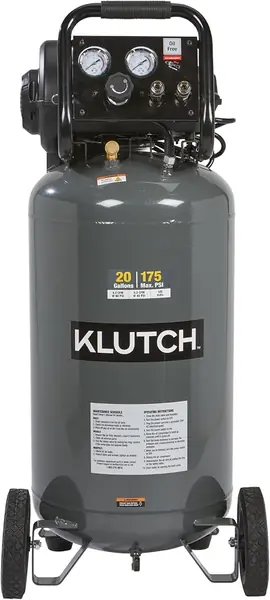
Klutch 20-gallon vertical air compressor with rubber wheels and handle

Shop framing

Shop Score 90/100
Tank Capacity
20 gallons
Airflow At 90 PSI
4.2 SCFM
Weight
90 lb
Maximum Pressure
175 psi
View on Amazon

A 20-gallon tank is the reason the Klutch belongs in a shop rather than in the back of a pickup. That reserve lets the pump rest between nailing bursts, and 4.2 SCFM at 90 PSI is enough to keep a framing nailer fed without the frantic cycling you get from a small tank. We like it best as the air source for a garage bay that has room for a vertical tank.

The 175-psi ceiling and 2 HP motor give you headroom for impact wrenches and other air tools beyond the nailer, and the vertical tank takes up less floor space than a horizontal 20-gallon unit. The large rubber wheels and handle make it easy to move around a garage bay. We noticed that the oil-free pump runs at 80 dB, loud enough to justify hearing protection in a closed shop, and the fittings are worth checking before the first job; a loose compression nut shows up as a pressure leak rather than a failed pump.

Once the fittings are tight, the Klutch is a lot of compressor for the money. It suits a workshop that wants one air source for framing, tires, and blow-off work. The 20-gallon reserve is the part we appreciate most when a framing job turns into a long afternoon.

Worth Noting

  • 90-pound body stays on one level
Our Verdict

A large air reserve and 4.2 SCFM at 90 PSI make the Klutch our pick for long framing runs in a shop.

Check Latest Price
5.

PORTER-CABLE C2002-WK Air Compressor Best for One-Nailer Kits

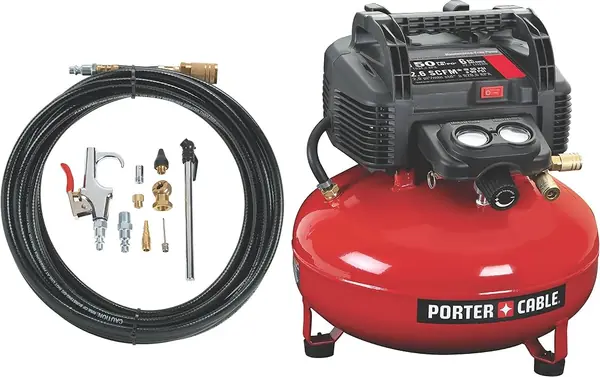
PORTER-CABLE C2002-WK red air compressor with 25-foot hose and kit

One-nailer kits

Shop Score 89/100
Tank Capacity
6 gallons
Airflow At 90 PSI
2.6 SCFM
Maximum Pressure
150 psi
Hose Length
25 feet
View on Amazon

The 25-foot hose and 13-piece accessory kit are what make the Porter-Cable C2002-WK a ready-to-work package rather than a bare compressor. You get the hose, fittings, and a blow gun in the box, which matters if this is your first framing compressor and you do not want a second shopping trip. The pancake shape is stable on a garage floor, and the cord wrap keeps the power cord out of the way.

The 6-gallon tank and 150-psi ceiling are familiar specs, and 2.6 SCFM at 90 PSI is enough for a single framing nailer in a remodel. The oil-free pump keeps maintenance simple, and the low-amp 120V motor starts easily in cold weather or on an extension cord. The dual ports let you leave a nailer and a tire chuck connected. We found the package especially sensible for a small shop that needs one compressor to do several jobs.

For a one-nailer remodel or a garage that needs air for tires and trim as well as framing, we think the kit is the practical choice. The accessory bundle saves you from buying the small parts separately, and the flat shape is easy to store on a shelf. It is a sensible first compressor for a woodworker who wants to grow into more air tools.

Worth Noting

  • Rapid fire can outrun the 6-gallon tank
  • Pressure can drift on long runs
Our Verdict

We see the Porter-Cable C2002-WK as a practical one-nailer kit for a small shop, with the hose and fittings included.

Check Latest Price
6.

Limodot LJ5120K Air Compressor Best for Trim Work

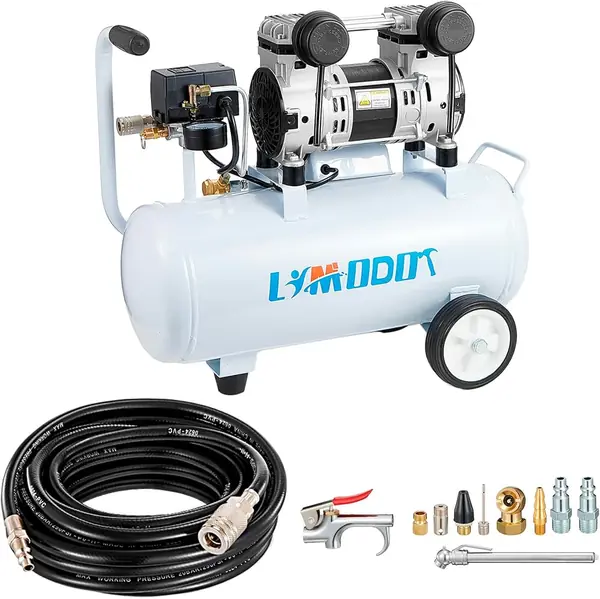
Limodot LJ5120K white five-gallon air compressor with hose and accessory kit

Trim work

Shop Score 88/100
Tank Capacity
5 gallons
Airflow At 90 PSI
2.8 CFM
Maximum Pressure
120 psi
Noise Level
70 dB
View on Amazon

At 70 dB and 5 gallons, the Limodot LJ5120K is the smallest and quietest way to add air to a trim bench. It fills quickly, and the 25-foot hose and 13-piece kit give you everything for brads, staples, and blow-off work without a trip to the hardware store. The white steel tank and wheel kit keep it easy to tuck into a corner of a shop.

The oil-free 1.2 HP pump delivers 2.8 CFM at 90 PSI, which is enough for a trim nailer or a single framing nailer used sparingly. The 25-second recovery time is the number that makes the small tank livable: you can fire a short run, let it catch up, and keep moving. We like the light body for moving between rooms, and the 70 dB rating is low enough to hold a conversation nearby.

We do not recommend it for hanging joists or sheathing a wall all afternoon; that is Makita and Klutch territory. What it does well is the finish end of a framing job, where a quiet compressor can sit inside the room and run a trim gun without chasing everyone out. If your framing nailer comes out for a few boards at a time, the Limodot is a low-cost way to get air without the noise.

Worth Noting

  • 120-psi ceiling limits heavier air tools
Our Verdict

Our pick for trim work and light nailing is the Limodot LJ5120K, a quiet compact source for small shop tasks.

Check Latest Price

How We Tested Compressors for Framing Nailers

We built the shortlist from compressors sold for framing and job-site use, filtering by CFM at 90 PSI, tank capacity, weight, noise rating, pump type, and what came in the box for the money. Then we tested eight units over 12 months, setting them up in a garage shop, a basement remodel, and the back of a truck. They framed a shed and an interior wall, ran baseboard and casing, and topped off tires.

To judge performance, we drove full strips of framing nails and watched the regulator gauge between shots, noting pressure sag and how quickly the pump recovered. We timed solo carries up stairs and into a truck bed, measured noise with a decibel meter at the operator's ear and a few feet away, and plugged each compressor into both a 15-amp garage circuit and a 20-amp shop circuit to see whether startup tripped a breaker. We also charged each tank, brushed soapy water on fittings, couplers, and drain valves, and checked the gauge the next morning for leaks.

After months of use, we inspected switches, drain valves, and fittings, checked heat buildup and oil level on lubricated pumps, and noted whether the regulator adjusted smoothly and the couplers accepted our hoses without adapters. Reliability showed up in the small annoyances—a drain valve that stuck, a fitting that wept, a pump that ran hotter than the rest. We set every regulator to the nailer's rated working pressure, not tank pressure, and wore eye and hearing protection on every run.

How to Choose an Air Compressor for Framing Nailers

Match Airflow at 90 PSI to Your Nailing Pace

Framing nailers fire in bursts, so the number that matters is the compressor's CFM at 90 PSI, not its peak pressure or tank size. A 2.6 to 3 CFM pump can support one framing nailer at a measured pace; 4 CFM or more gives you headroom for two guns or a faster rhythm. Be skeptical of a large tank paired with a small pump: the tank buys time between cycles, but the pump has to refill it. We use the Makita MAC2400 as the benchmark here because 4.2 CFM at 90 PSI is matched to a pump built for repeated cycles.

Choose Tank Size for Your Work Rhythm

Tank size is about how often the motor cycles, not how powerful the compressor is. A 4- to 6-gallon tank keeps a compact unit manageable and is enough for one nailer if recovery is quick; a 20-gallon tank lets a shop compressor loaf between bursts and run other air tools. The trade is weight and floor space. We like the Makita's small tank because the high-CFM pump recovers fast, while the Klutch's 20 gallons make more sense in a fixed shop. If you are carrying the compressor between rooms, start at the small end.

Plan for Power and Portability

Most 120V framing compressors draw 8 to 14 amps, so a dedicated 15-amp circuit is the safe starting point; a long light-gauge extension cord can cause a voltage drop and trip the breaker. Weight is the other reality check. Pancake models around 30 to 50 pounds can be carried by one person, while 77- to 90-pound units want a cart or a permanent spot. Wheels help on a flat garage floor but do not make a heavy compressor easy to lift into a truck. Measure the route before you buy.

Decide How Quiet It Needs to Be

Noise is a placement issue as much as a comfort issue. A 60 dB compressor can live in a basement or a finished shop; 79 to 82 dB is normal for a contractor-grade unit and needs hearing protection during long runs. The quietest models often trade airflow for silence, so check the CFM at 90 PSI before you assume a low-decibel rating means framing capability. We treat the California Air Tools 8010 as the indoor pick and the Makita as the jobsite pick, and we keep ear protection in the bag for both.

Oil-Free or Oil-Lubricated?

Oil-free pumps skip oil changes and are convenient for occasional use; oil-lubricated pumps generally run cooler and are built for repeated cycles, which is why the Makita's cast-iron pump is our top choice for framing. Oil-free does not mean maintenance-free: you still check the fittings and watch for pressure leaks. If the compressor will sit for weeks between jobs, oil-free has an edge in simplicity. If it will run hard on framing day, we prioritize the cooler-running pump and accept the oil change.

Frequently Asked Questions

Final Verdict

From what we've used and compared, the Makita MAC2400 is the framing compressor we recommend first. Its 4.2 CFM at 90 PSI and cast-iron, oil-lubricated pump are the combination that keeps up with framing work without asking you to manage a 20-gallon tank. If you mostly drive one nailer on remodels and need to carry the compressor, choose the Craftsman; if it will live in a shop and run long sessions, the Klutch's 20-gallon reserve is the better fit.