↑↓ navigate ↵ open Esc close All results →

Best Portable Air Compressors for Air Tools of 2026

Portable air compressors sit on an unforgiving seesaw: usable airflow at 90 PSI on one end, decibels and dead weight on the other. Units light and quiet enough for indoor finish work often starve a framing nailer or impact wrench, while high-output pumps make you think twice before hauling them out of a corner for a ten-minute repair.

Running nine pancake, wheeled horizontal, and vertical compressors over 10 months in garages and driveways showed that peak tank PSI tells almost nothing about real speed. What keeps tools firing is regulated delivery pressure paired with rapid pump recovery—because waiting on a sluggish tank stalls progress faster than almost any shop hiccup.

Covering quiet indoor benches, demanding job sites, and everyday trim carpentry in between, these four units sustain their rated airflow long enough to finish the task.

Our Top Picks

The Best Portable Air Compressors for Air Tools

1.

California Air Tools 8010 Best Overall
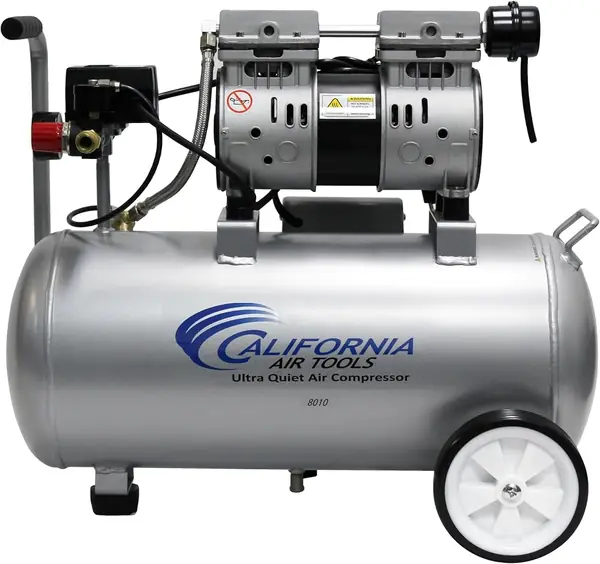
California Air Tools 8010 air compressor with silver 8-gallon horizontal steel tank and wheels

Indoor shop nailers

Shop Score 92/100
Weight
48 lb
Air Flow
3 CFM
Tank Capacity
8 gallons
Noise Level
60 dBA
View on Amazon

Sixty decibels is where this one starts, because it changes where the compressor can live. That's roughly the volume of a normal conversation, and it comes from a 1.0 HP motor turning at 1,680 RPM driving an oil-free dual-piston pump rather than the ear-level racket of a typical pancake compressor. In a basement shop, or a garage under a bedroom, that gap decides whether you can run a nailer at eight in the evening. Of everything in this roundup, it's the figure we cared about most.

The 8-gallon steel tank is the other half of the argument. A brad or finish nailer draws a fraction of the pump's 3 CFM, so the tank carries a long trim session with the motor mostly resting; the listed figures are 165 seconds to fill from empty and 60 seconds to recover from 90 to 120 PSI. Wheels and a 48-pound body make it a rolling tool rather than a carried one, though the push handle sits low enough that you bend to steer it, and the tank is top-heavy enough that stairs take two hands and some care.

Longevity is the part we can't wave off. Beside the machines that run for years, some quit within months, and a regulator can arrive damaged from shipping. Buy where returns are easy, register the one-year warranty the day it lands, and open the drain after every session — a steel tank that holds water is a steel tank that rusts.

Worth Noting

  • 3 CFM stalls on impact wrenches and die grinders
  • Manual drain valve is a reach under the tank
Our Verdict

For a home woodshop running nailers, we point you here first: 60 dBA keeps the noise out of the rest of the house, and the 8-gallon tank keeps up.

Check Latest Price
2.

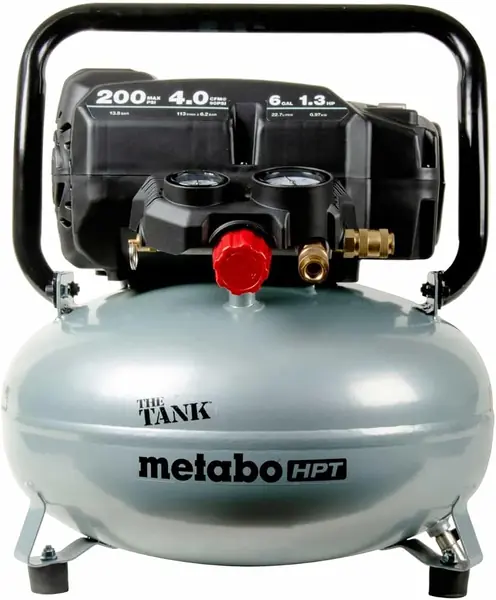
Metabo HPT EC914S Best for Framing and Job Sites

Metabo HPT EC914S pancake air compressor with six-gallon tank and top carry handle

Framing and roofing

Shop Score 90/100
Weight
42 lb
Air Flow
4 CFM at 90 PSI
Tank Capacity
6 gallons
Maximum Pressure
200 PSI
View on Amazon

A pancake with a top handle is the shape to want if the compressor travels. At 42 pounds the EC914S goes up a ladder or down a set of steps in one hand, and it perches on a shelf or a truck bed without claiming the floor space a wheeled horizontal tank needs.

Then there's the airflow: 4 CFM at 90 PSI is the most per pound in this group, and it's what puts this one on framing and roofing duty, where Metabo rates it to run two framing nailers, two roofing nailers, or five brad nailers at once. We also like the 200 PSI ceiling for a subtler reason. Because the regulator only passes the 90 PSI your tool needs, a 6-gallon tank at 200 PSI stores close to three times the usable air of an 8-gallon tank at 120 PSI, so the motor restarts less often than the tank size suggests.

What the listing leaves out is noise. California Air Tools publishes 60 dBA for its quiet models; Metabo publishes no dBA figure for this one, so a buyer headed for a finished basement or an apartment can't check the number that matters most, and we send that buyer to the 8010 instead. On a job site, with the door open and the tool in your hand, one trip up the stairs beats a decibel count.

Worth Noting

  • One-year warranty is the shortest in this group
Our Verdict

For framing, roofing, or two nailers running at once, this is the one: 4 CFM at 90 PSI in a 42-pound body you carry in a single trip.

Check Latest Price
3.

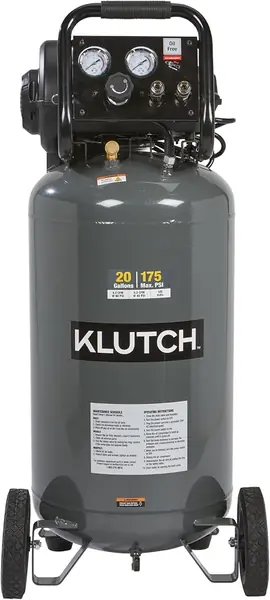
Klutch 20-Gallon Best for Heavy Air Tools

Klutch 20-gallon vertical air compressor on rubber wheels with a tall tank and handle

Stationary shop use

Shop Score 89/100
Weight
90 lb
Air Flow
4.2 SCFM at 90 PSI
Tank Capacity
20 gallons
Maximum Pressure
175 PSI
View on Amazon

Twenty gallons and 4.2 SCFM at 90 PSI put this Klutch in a different class from the rest of the group. That's enough air to run an impact wrench or a spray gun without standing around waiting on the pump, and enough reserve that the motor cycles every few minutes rather than every few shots. It stands 41.5 inches tall on a footprint of about 19 by 17.5 inches, so it costs a corner of the shop instead of a stretch of floor.

We think of it as the compressor you buy once and stop moving. At 90 pounds with the tank standing upright, it rolls on its rubber wheels to wherever it lives and then stays there, which is the right bargain for a fixed bench with an impact wrench and a sprayer within reach. If your work follows you around the property, the 42-pound Metabo or the 29-pound California Air Tools will serve you better.

At 80 dBA it's the loudest machine here, so ear protection stops being a formality when it's running beside you — that's the price of the airflow, and a fair one for a compressor that owns its own corner. Plan ten minutes at setup, too: tighten the quick-connect fittings and confirm the auto shutoff cuts out at pressure, because a loose compression nut is one way this one leaks, and it's a wrench fix rather than a return.

Worth Noting

  • 14-amp draw on 120 volts
Our Verdict

If the compressor lives in one corner and an impact wrench or spray gun is on the shelf, the Klutch's 20 gallons and 4.2 SCFM are worth the weight.

Check Latest Price
4.

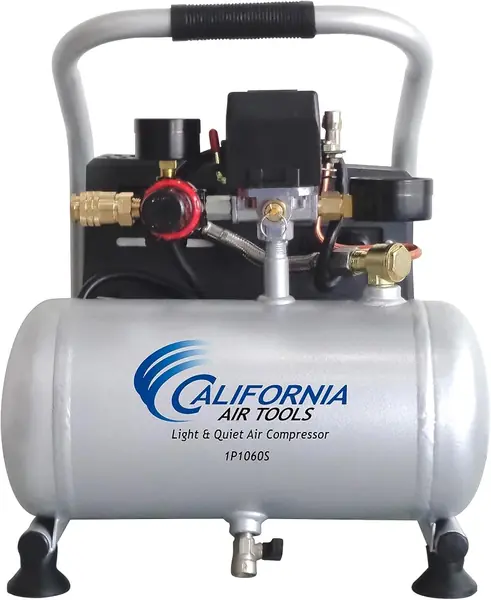
California Air Tools 1P1060S Best for Trim Work

California Air Tools 1P1060S one-gallon steel tank air compressor with carry handle

Trim work

Shop Score 88/100
Weight
29 lb
Air Flow
1.2 CFM at 90 PSI
Tank Capacity
1 gallon
Noise Level
56 dBA
View on Amazon

Start with what it won't do. At 1.2 CFM this is a trim compressor: brad nailers, pin nailers, staplers, and blow guns, plus a framing nailer only in short bursts. An impact wrench or a die grinder will outrun it in seconds, and a spray gun is out of the question. That's not a flaw so much as the terms of the deal, and they're worth knowing before you plug it in.

Inside those terms it's our favorite small compressor. Fifty-six decibels is the quietest figure in this roundup, and 29 pounds with a well-placed handle means you can carry it from the bench to the ceiling in one hand and set it on a shelf when the job is done. In an apartment or against a shared wall, it's the one that won't earn you a note under the door. The tank fills quickly, and the whole machine is small enough to live beside the benchtop tools.

Setup is the real appeal: no wheels to unfold, no hose wrestled across the shop, carry it in, plug it in, work. Drain it after every session — a small steel tank has less room to forgive condensate, and that's the habit that keeps a small compressor useful.

Worth Noting

  • One-gallon tank cycles the motor often
Our Verdict

For brad and pin nailers in a small shop or an apartment, this is the one we reach for: 56 dBA, 29 pounds, and no bigger than a toolbox.

Check Latest Price

How We Tested Portable Air Compressors for Air Tools

We started with specs, pulling listings for more than 40 compressors and cutting anything that couldn't run a common 2- to 3-CFM air tool, wouldn't fit a 15-amp 120-volt circuit, or needed two people to lift. That left nine units in pancake, wheeled horizontal, and vertical formats, and we ran them for 10 months.

Each compressor went into a two-car garage and onto a driveway, hooked in turn to a framing nailer, a brad gun, and an impact wrench. We nailed until the motor kicked on and kept going, timing how long the pump took to recover and watching the regulator gauge to see whether it held 90 PSI through a long burst. A sound meter at ear distance gave us decibel readings, and we noted whether we could hold a conversation over the motor or hear it from the front of the house.

Weight and shape got the same treatment: we carried each unit up a short flight of stairs, lifted it into a truck bed, rolled it over a garage threshold, and weighed it ourselves. Every tank was pressurized, shut off, and checked the next morning for leaks with soapy water at the fittings and an eye on the gauge. We drained the tank after every session, which was the quickest way to judge drain valves — some dumped water cleanly, others sprayed our shoes — and noted fittings, regulator drift, and warranty length as we went.

Reliability and value came out of the long haul: the units that stayed set up as daily drivers for the full 10 months showed which fittings loosened and which pumps started short-cycling. We weighed price against airflow, noise, and warranty coverage, not tank size alone.

How to Choose a Portable Air Compressor for Air Tools

Match Airflow at 90 PSI to the Tool

Every pneumatic tool has a CFM requirement, and the compressor has to meet it at the pressure the tool runs at — for most nailers, 90 PSI, not the 120 or 200 PSI printed on the tank. A brad or pin nailer sips well under 1 CFM; a framing nailer wants around 2; an impact wrench, die grinder, or spray gun will take 4 or more. That's why the California Air Tools 1P1060S at 1.2 CFM is a trim machine, while the Klutch's 4.2 SCFM is what lets it drive an impact wrench.

The trap: a big tank does not fix a small pump. The tank is a buffer; the pump sets what you can sustain, and 20 gallons behind a 1 CFM pump still runs dry.

Read Tank Size and Pressure Together

Tank size gets quoted as if it were capacity for work, but what matters is usable air — the cubic feet held above the pressure your tool needs. Because the regulator only passes what the tool demands, a 6-gallon tank at 200 PSI holds close to three times the usable air of an 8-gallon tank at 120 PSI. That's the trade the Metabo HPT EC914S makes, and why a smaller high-pressure tank can outlast a bigger low-pressure one between motor cycles.

Buy on usable air if you work in bursts: a few nails, then a pause. Buy on pump CFM if a tool runs continuously, because no tank stays ahead of a tool that never stops.

Let Noise Decide Where It Lives

Decibels are logarithmic, so the gap between 56 dBA and 80 dBA is not a small difference — it's the difference between a machine you can run in a basement while someone watches television upstairs and one that owns the room. Our rule: stay under 60 dBA for indoor, shared-wall, or apartment work. At 78 dBA and up, plan on a garage with the door open, an outdoor setup, or ear protection.

The trap in the listings: 'quiet' without a number is marketing. Ask for dBA, and treat a missing figure as a reason to look at a model that publishes one.

Weight and Shape: Where Will It Actually Live?

Portable covers several shapes: a 29-pound carry unit, a 42-pound pancake with a top handle, a 48-pound wheeled horizontal tank, and a 90-pound vertical that rolls on rubber wheels. Match the shape to the trip you actually make. Stairs, ladders, and truck beds favor light weight and a top handle; a fixed bench favors wheels and a big tank.

Compact in a listing often means it fits a shelf or a truck bed, not that you want to carry it up two flights. If the compressor never leaves the shop, weight stops mattering and airflow should decide; if it leaves weekly, the lighter machines are the ones you'll still be happy with a year in.

Power Draw, Drainage, and Setup

These run on household 120-volt current, but draw ranges from about 4.5 amps on the small California Air Tools to 14 amps on the Klutch. A 15-amp garage circuit shared with a shop vac, a heater, or a charger will trip on the big one; run it alone, or better, on a 20-amp circuit.

Oil-free pumps skip oil changes, not maintenance. Open the drain after every session, because condensate rusts a steel tank from the inside, and check the quick-connect fittings and pressure switch when you first set the machine up. A loose compression nut is a five-minute wrench fix; a tank full of water is not.

Frequently Asked Questions

Final Verdict

Most woodworkers should start with the California Air Tools 8010. At 60 dBA it's quiet enough for a basement or a garage under a bedroom, the 8-gallon tank rides out a long trim session, and the wheels mean one person can reposition it without help.

If the work travels — framing, roofing, a site with no driveway — the Metabo HPT EC914S is the better buy: 4 CFM at 90 PSI and 42 pounds you carry in one hand. And if the compressor never moves and an impact wrench is part of the plan, the Klutch's 20 gallons earn their corner.