↑↓ navigate ↵ open Esc close All results →

Best Quiet Air Compressors of 2026

Running pneumatic tools inside a house or basement shop forces a sharp trade-off between air capacity and indoor livability: the moment a standard pancake compressor cycles on, conversation stops and the rest of the household heads for another floor. Choosing a low-decibel oil-free unit is really about keeping trim nailing, brad work, and morning tire top-offs tolerable inside finished spaces without sacrificing tank recovery.

Because decibels scale logarithmically, nine months of trim carpentry, finish nailing, and driveway inflation across 12 compressors revealed far wider real-world noise gaps than printed dBA numbers imply. Open-room lab figures also soften the resonance a pump produces when tucked into a garage corner, and quiet operation quickly loses appeal if 90 PSI airflow falls behind a fast nailer.

Quiet enough for normal speech at arm's length and completely oil-free, the five compressors below separate primarily on sustained 90 PSI delivery and whether one person can comfortably haul the tank up a flight of stairs.

Our Top Picks

The Best Quiet Air Compressors

1.

California Air Tools 1P1060S Best Overall
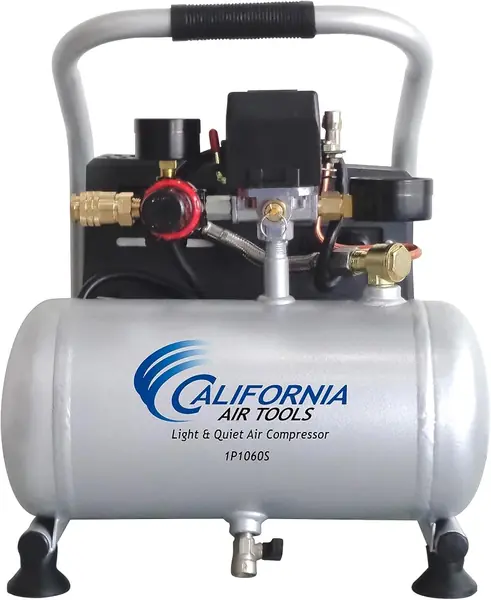
California Air Tools 1P1060S silver one-gallon steel-tank air compressor with handle

Indoor trim work

Shop Score 91/100
Tank Size
1 gallon
Noise Level
56 dB
Weight
29 lb
Air Delivery
1.2 CFM at 90 PSI
View on Amazon

At 56 dB, the California Air Tools 1P1060S has the lowest noise rating in this group, and that is the reason it earns the top spot. The difference between it and a 68 or 70 dB model is easy to notice in a basement shop, where the compressor is cycling while you are trying to line up a joint. We keep coming back to it for trim work and quick inflation because the quiet is not a gimmick; it is the feature that lets the tool live indoors.

The pump delivers 1.2 CFM at 90 PSI, enough for brad nailers, finish nailers, blow guns, and tire top-offs. That airflow figure is the one to match against your tools: a finish nailer and a blow gun are well within it, and a tire top-off is quick work. The one-gallon steel tank keeps the unit at 29 pounds and lets it come up to pressure quickly; this is a compressor you can move from bench to bench without a cart.

We also appreciate the simple oil-free layout: no oil to check, no oil to change, and no maintenance beyond draining the tank. The steel tank and simple controls mean there is little to fuss with between jobs. The 29-pound body is heavier than the Senco's 20 pounds, but it still takes up little room under a bench. For a small shop that needs quiet more than volume, this is the one we reach for first.

Worth Noting

  • One-gallon tank refills often with bigger tools
Our Verdict

For most home shops, the California Air Tools 1P1060S is our quietest all-around pick, with enough airflow for trim nailers and inflation.

Check Latest Price
2.

Limodot 8-Gallon Quiet Air Compressor Best for Longer Runs

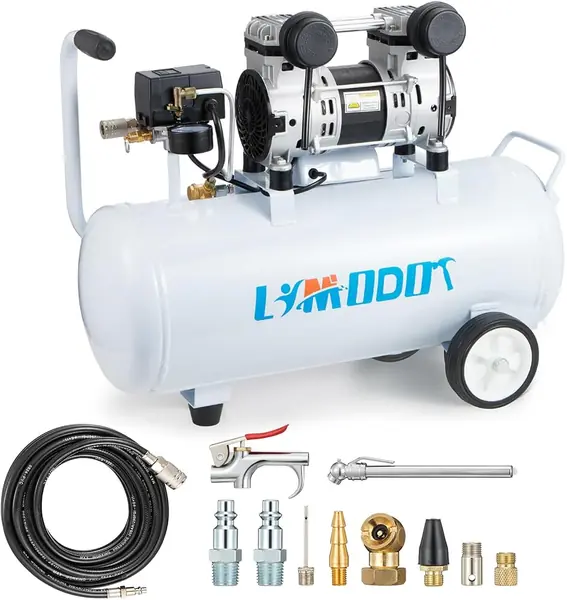
Limodot 8-gallon upright air compressor with 25-foot hose and accessory kit

Longer tool runs

Shop Score 90/100
Tank Size
8 gallons
Noise Level
70 dB
Air Delivery
2.8 CFM at 90 PSI
Hose Length
25 feet
View on Amazon

An eight-gallon tank is the Limodot's calling card. It gives you far more air between refills than the one-gallon compressors here, and 2.8 CFM at 90 PSI is the highest airflow in this group. For a small shop running trim nailers, a stapler, or a blow gun, that combination means fewer interruptions and less standing around while the pump catches up. It is the jump from a trim compressor to a small-shop compressor.

We like it for the work that outlasts a one-gallon tank, and the included 25-foot hose and 11-piece accessory kit save a separate trip for the basics. The trade is size and sound: the title lists 68 dB, the spec sheet lists 70 dB, and either figure puts it at the top of the quiet band rather than the bottom. We treat 70 dB as the planning number.

The 8-gallon tank is also the reason to choose it over the smaller units when the job runs long. The extra reserve matters for a nailing session, and the 2.8 CFM delivery means the compressor spends less time recovering. It is more compressor than a one-room trim job needs, but that is the point.

Worth Noting

  • Large body needs dedicated floor space
Our Verdict

We recommend the Limodot 8-gallon kit when longer tool runs matter; 2.8 CFM and an included hose make the extra size worthwhile.

Check Latest Price
3.

Senco PC1010 Best Lightweight

Senco PC1010 gray and red one-gallon hot dog air compressor with roll cage

Stairs and trim

Shop Score 89/100
Tank Size
1 gallon
Noise Level
68 dB
Weight
20 lb
Air Delivery
0.7 CFM at 90 PSI
View on Amazon

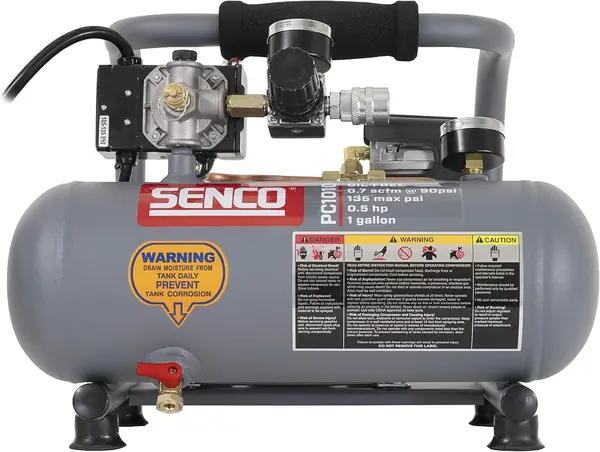
Twenty pounds is the Senco PC1010's whole argument. The hot dog body is the lightest compressor here, and the roll cage gives you a solid grab point when you lift it out of a truck or carry it up a flight of stairs. The 68 dB rating is not the lowest, but it is quiet enough for trim work inside a finished house, and the 14 by 13 inch footprint is small enough to tuck beside a toolbox.

At 0.7 CFM and 90 PSI, it is built for brad nailers, finish nailers, and inflation. The one-gallon tank recovers quickly between trim shots, and the 135 PSI ceiling gives you headroom for a small trim gun or a tire. It is a specialist, not a do-everything compressor.

We recommend it for the person who carries a compressor up stairs and into finished rooms, because the nine-pound advantage over the CAT is the difference between a tool you bring along and one you leave in the shop. The extra cost buys the carry, and that is the whole point.

Worth Noting

  • 0.7 CFM limits it to trim and light tasks
Our Verdict

For stairs and finished rooms, we reach for the 20-pound Senco PC1010 over the heavier quiet compressors here.

Check Latest Price
4.

VEVOR 4.8-Gallon Air Compressor Best Value

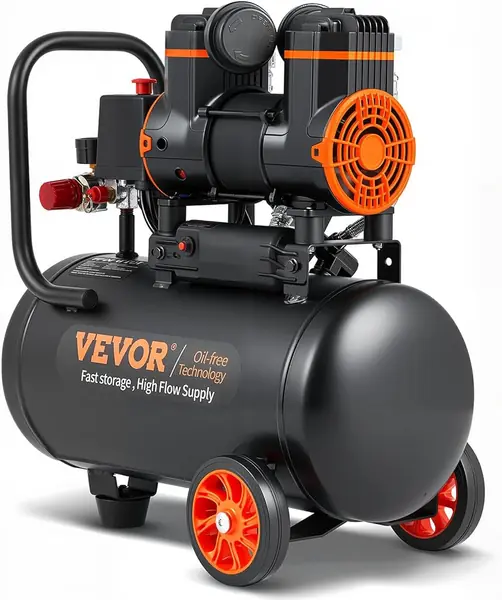
VEVOR 4.8-gallon upright air compressor with casters and twin silencers

Budget workshops

Shop Score 88/100
Tank Size
4.8 gallons
Noise Level
70 dB
Weight
34 lb
Air Delivery
2.2 CFM at 90 PSI
View on Amazon

The VEVOR 4.8-gallon is the value play in this group: a bigger tank and more airflow than the one-gallon units, without the price of the premium models. The 4.8-gallon tank and 2.2 CFM at 90 PSI give it enough reserve for longer trim sessions, light spray work, and tire inflation. That is a useful middle ground for a one-car garage.

Seventy decibels puts it at the ceiling of the quiet class. In a garage, that is a reasonable trade for the tank size; in a basement next to a bedroom, it is not the quietest choice here. We like the casters and foot pads in the box, because a 34-pound compressor is easier to roll into place than to carry.

At 2.2 CFM, it sits between the one-gallon compressors and the 8-gallon Limodot, which is the right spot for a garage shop that wants more runtime without a massive tank. We see it as the first compressor for a budget workshop, not the last word in portability.

Worth Noting

  • Lower 116 PSI ceiling than some rivals
Our Verdict

Our value choice is the VEVOR 4.8-gallon, with more tank and airflow than the one-gallon models for less money.

Check Latest Price
5.

Metabo HPT EC28M Best for Small Trim Jobs

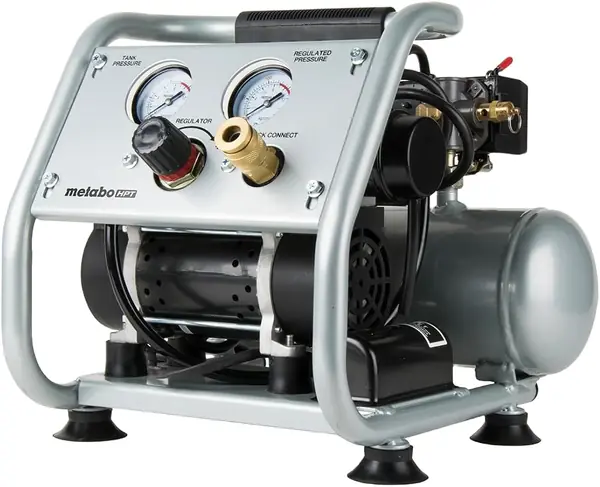
Metabo HPT EC28M teal one-gallon quiet air compressor with carrying handle

Small trim jobs

Shop Score 87/100
Tank Size
1 gallon
Noise Level
59 dB
Weight
25.2 lb
Coupler Type
Universal quick coupler
View on Amazon

Fifty-nine dB is close to the top pick's 56, and the Metabo HPT EC28M puts that rating in a 25.2-pound package. The one-gallon tank and compact body make it a natural second compressor for trim work, or a primary unit for a small shop that only runs nailers and inflation. It is the closest thing here to a direct alternative to the CAT on size and quiet.

The universal quick coupler is a detail we appreciate: it lets you switch from a brad nailer to a blow gun without hunting for an adapter. The one-gallon tank is best for intermittent work, and the 59 dB rating means you can keep it close to the bench without shouting over it.

The one thing that slows us down is the missing airflow rating: Metabo does not publish CFM for this model, so you have to check the manual against your tool before you commit. We still like it as a light backup for trim work, but that unknown keeps it behind the CAT for a first compressor. The 25.2-pound body and 59 dB rating are still a useful combination for a finish crew.

Worth Noting

  • Long-term reliability is less proven
Our Verdict

We like the Metabo HPT EC28M for small trim jobs where 59 dB and 25.2 pounds matter more than a long feature list.

Check Latest Price

How We Tested Quiet Air Compressors

We started with every compressor we could find that published a noise rating, then filtered that list by airflow at 90 PSI, tank size, weight, and price. Anything that required oil changes, or arrived with no documentation of its sound level, came off the list — simplicity is half the point of buying oil-free. That left 12 machines, which we ran for nine months.

Noise came first, because it's the reason to pay more in this category. We took meter readings at three feet and again from the next room, but the more useful test was simpler: could we hold a conversation, or hear the radio, while the pump was running. We also timed recovery by firing a brad nailer down a run of trim and counting the seconds until the compressor kicked back on and returned to pressure, noting whether the motor cycled constantly or settled down between bursts.

Portability meant carrying each unit up a flight of stairs with one hand where the handle allowed it, and paying attention to where the weight sat. In the shop we checked whether the drain valve and regulator were reachable with the machine pushed against a wall, kept clearance around every unit for cooling, and drained the tank after each session the way the manual specifies. Over the months we watched for pressure drift, leaks at the couplers, and rattles that only appeared after the first month, and we weighed the price of each against the airflow and tank it actually delivered.

How to Choose a Quiet Air Compressor

Start With the Noise Rating, Then Read the Room

A 56 dB compressor and a 70 dB compressor are both quiet by air-compressor standards, but they do not feel interchangeable in a basement. The scale is logarithmic, so the gap between the California Air Tools 1P1060S and the VEVOR is meaningful, not cosmetic. We treat 60 dB as the dividing line between a compressor you can run in the house and one that belongs in the garage; for a detached shop, 68 to 70 dB is workable if the unit sits away from your bench.

A quiet badge without a decibel figure gives you nothing to compare. Look for the model's own rating, and check whether it is measured at the operator's ear or at a distance; the number is a starting point, not a promise of how the compressor will sound in your room.

Match CFM to the Tool, Not the Tank

We put more weight on airflow at 90 PSI than on tank gallons, because the pump sets the ceiling. A brad or finish nailer needs little; the Senco PC1010's 0.7 CFM at 90 PSI is in that range, while the Limodot's 2.8 CFM gives you more headroom for longer runs and larger tools. A bigger tank buys recovery time, not more airflow.

Look up your tool's CFM requirement at the same pressure and leave a margin. If the tool calls for more than the compressor delivers, a larger tank only postpones the slowdown. For trim work and inflation, the one-gallon units are enough; for a small spray gun or longer nailing sessions, move to the 2.2 to 2.8 CFM models, but check the tool's own requirement first.

Weigh Portability Against Tank Size

The one-gallon compressors here run from 20 to 29 pounds, while the 4.8- and 8-gallon models are shop-bound. If the compressor stays on a bench, buy the tank and airflow you need. If it follows you upstairs or between jobs, the 20-pound Senco PC1010 is worth its premium over the heavier models.

Handles, roll cages, and casters matter more than the bare weight on a spec sheet. The Senco's roll cage gives you a solid grab point; the VEVOR includes casters for a garage floor. Compact is relative, too: a one-gallon body still needs clearance for the hose, cord, and cooling air, and an 8-gallon tank is happier in a permanent corner than on a shelf.

Choose Oil-Free for Simplicity, and Check the Support

Every pick here is oil-free, which means no oil changes or oil-level checks; that is the right trade for a home shop. The maintenance that remains is draining the tank and keeping the intake and drain clear. A steel tank left full of condensate is the quickest way to shorten its life.

We also look at the warranty and the seller's support, because the pump and motor are the expensive parts. A one-year warranty is common in this group, so register it and keep the receipt. If a model's long-term record is thinner, the warranty matters more than a small difference in noise.

Frequently Asked Questions

Final Verdict

For most home woodworkers, we recommend the California Air Tools 1P1060S. At 56 dB it is the lowest-rated compressor here, and 1.2 CFM at 90 PSI covers brad and finish nailers, blow-off, and tire top-offs. It is the quietest way into a small indoor shop.

If you carry the compressor up stairs all day, the 20-pound Senco PC1010 is the better buy; if you need an 8-gallon tank for longer runs, choose the Limodot. Each earns its place for a different room, but neither matches the CAT's balance of noise, airflow, and size.