↑↓ navigate ↵ open Esc close All results →

Best Auger Drill Bits of 2026

An auger bit turns a drill into a shovel: the point screws in, the flute lifts the soil out, and a hole that took ten minutes with a trowel takes about ten seconds. The speed hides a fit problem. Too wide a bit stalls a compact drill and kicks back; too dull a point just polishes clay. Pair the bit to your drill and you get straight-sided holes at the depth you wanted, with the spoil in a pile instead of across the bed.

We tested 14 auger bits and sets over four months — spring bulb beds, a fence line, a deck rebuild — and soil augers and wood augers turned out to behave nothing alike. A garden bit pulls itself down and lifts the soil; a wood bit wants steady pressure and room to clear chips, and the ones that felt easiest to use were the ones that fed themselves.

The seven picks below cover both jobs, plus a ship auger for deeper timber bores. All of them held their shanks, bit on the first turn, and were still straight when the four months were up.

Our Top Picks

The Best Auger Drill Bits

1.

K-Brands 4-Pack Auger Drill Bit Set Best Overall
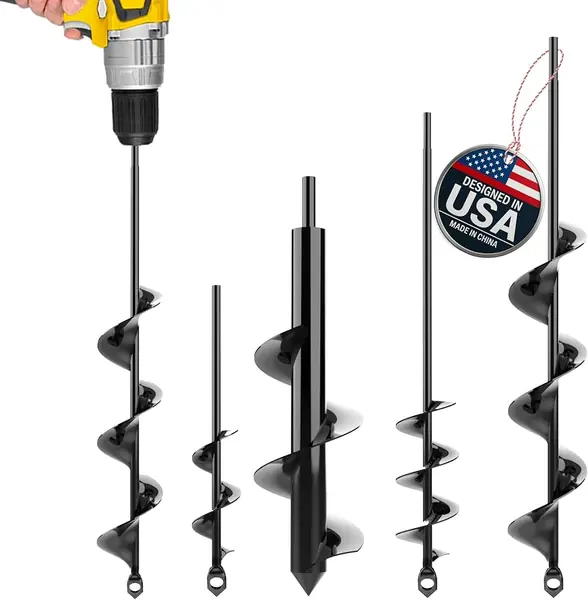
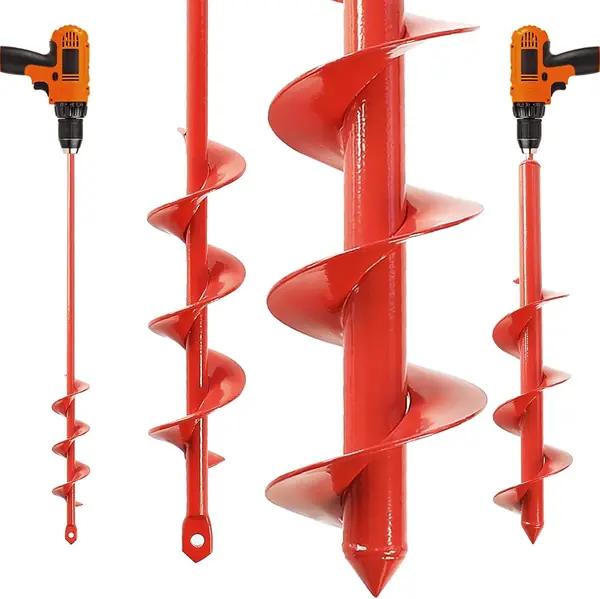
Four hex-shank garden auger bits of increasing diameter and length for planting

All-around garden digging

Shop Score 93/100
Shank
3/8-inch hex
Material
Alloy steel
Bit Lengths
8.6 to 16.5 inches
Bit Diameters
1.6 to 3 inches
View on Amazon

Four bits, each with a job it does better than the others: the 1.6 x 8.6-inch stub for bulbs and bedding plants, the 3 x 12 for shrubs, small trees, and fertilizer spikes, the 2 x 14.5 for working under a root or into the face of a slope, and the 2.6 x 16.5 for reaching full planting depth.

All four run on a 3/8-inch hex shank, so they go into a three-jaw chuck on any cordless or corded drill without an adapter, and the three-flute spiral lifts spoil out of the hole instead of packing it around the shaft. We swapped the same bit between a compact 18V driver and a corded drill mid-project and the hex never spun in the chuck.

These are garden bits, so the drill does half the work. The 1.6-inch will spin in a small driver, but the 3-inch and 2.6-inch bits want a drill with real torque and a two-handed grip, because a spiral that bites into clay sends the resistance straight back to your wrists. Keep it in low gear and let the point pull itself down instead of leaning on the drill.

If you're buying your first auger and don't know what your beds want, start here: an afternoon tells you which diameter you actually reach for, and you can buy a better single bit in that size later. For most people it turns out to be the 2.6 x 16.5 — deep enough for a gallon pot and long enough that you're not kneeling in the mulch to use it.

Worth Noting

  • Bends or stalls in rocky, hard-packed ground
Our Verdict

Four diameters in one set cover bulbs, shrubs, and fertilizer spikes, and the 3/8-inch hex shank fits whatever drill you already own — this is the one we recommend first.

Check Latest Price
2.

IRWIN SPEEDBOR Max 6-Piece Set Best for Wood

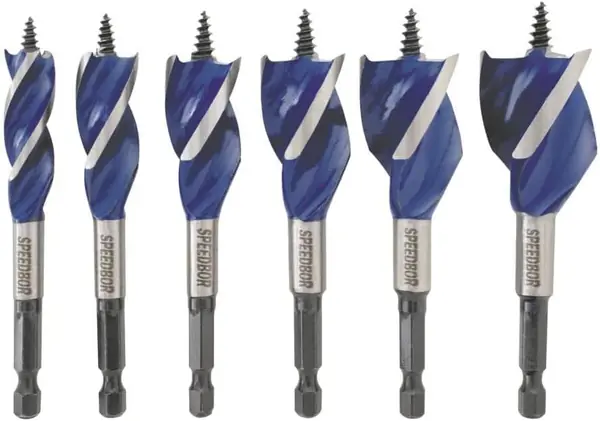
Six-piece IRWIN SPEEDBOR Max wood boring bit set with hex shanks and screw points

Framing and rough-ins

Shop Score 92/100
Shank
1/4-inch quick-change hex
Pieces
6 bits
Bit Sizes
1/2 to 1-1/8 inches
Overall Length
4 inches
View on Amazon

At 4 inches from tip to shank, these are the shortest bits here, and that is the point: one fits into a stud bay with the drill body still outside the framing. For holes in wood we reach for this set before anything else in this article — the full screw point pulls the bit in on its own, and the three cutting spurs scribe the rim so the edge comes out cleaner than a paddle bit leaves it.

The six bits run from 1/2 inch to 1-1/8 inch, all on a grooved 1/4-inch hex shank that snaps into a quick-change chuck and holds in an impact driver. We put them to work on rough-ins, the wire and pipe passes through plates and studs where a hole needs to be quick and roughly round rather than furniture-grade. What the length buys in access it gives back in depth: about 2 inches of boring, right for a 2x4 wall or a deck ledger, useless in a 4x4 post.

So the boundary is depth, not quality. These are rough-in and shallow-bore bits, and a wire run through double-stacked 2x4s needs a longer auger. Where the depth works, the speed is the whole appeal — the flutes clear chips fast enough that you are not backing out every half inch to clear the hole.

Worth Noting

  • Dulls quickly in knots and hard lumber
Our Verdict

For wood, we reach for these: the screw point pulls them in, the spurs leave a cleaner rim than a paddle bit, and the 4-inch length fits between studs.

Check Latest Price
3.

TCBWFY 5-Piece Garden Auger Set Best for the Widest Range of Jobs

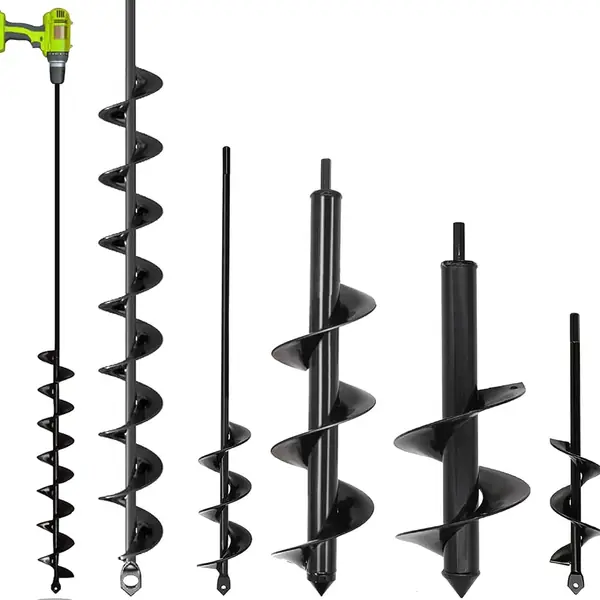
Five hex-shank garden auger bits ranging from a short bulb bit to a 32-inch shaft

Widest job range

Shop Score 91/100
Shank
3/8-inch hex
Pieces
5 bits
Bit Lengths
9 to 32 inches
Bit Diameters
1.6 to 4 inches
View on Amazon

A 2-inch bit on a 32-inch shaft sounds like a novelty until you need water at the root of an established shrub: it opens a hole deep enough to get below the crown without a shovel touching soil. That bit is the reason to look at this five-piece set, which otherwise covers familiar ground — 1.6 x 9, 1.6 x 16.5, 3.5 x 16, and 4 x 12 inches — from bulb holes up to a post sleeve.

The design detail worth knowing is how close the cutting edge starts to the point. On a bit with a long bare tip you have to push down before the flutes engage; here the blade begins almost at the point, so the auger starts cutting as soon as it touches down. All five share the same 3/8-inch hex shank and a painted finish that hoses off at the end of the day.

Where we hesitate is at the top of the range. A 4-inch bit pulls hard enough to bog a compact drill, and the long shaft needs a straight, steady hand or the hole wanders off vertical. That makes it a set for the gardener with a list — bulbs in one bed, shrubs in another, a fence to shore up — rather than someone who needs one reliable hole size.

Worth Noting

  • Shafts can bend under heavy torque in hard ground
Our Verdict

Nothing else here reaches 32 inches, and the five bits cover everything from bulb holes to a 4-inch post sleeve, so it suits a long job list.

Check Latest Price
4.

MAXCCINO 2-Piece Auger Set Best for Deep Holes

Two carbon steel garden auger bits measuring 1.6 and 3.5 inches by 16.5 inches

Deep planting holes

Shop Score 90/100
Shank
3/8-inch hex
Material
Carbon steel
Pieces
2 bits
Bit Sizes
1.6 x 16.5 and 3.5 x 16.5 inches
View on Amazon

Two bits, both 16.5 inches long, and the shared length is the whole idea: one measures 1.6 inches across for bulbs, fertilizer spikes, and seedling holes, the other 3.5 inches across for shrubs and small posts. Both reach the depth a gallon pot and a bare-root tree actually want, which is more than most short kits manage.

Carbon steel shafts and a two-flute spiral do the cutting, and if durability is your worry — after enough bent augers it should be — this is the pair we trust most in this group. Across the garden bits here, these two hold their shape best in clay and gravel, which is a large part of why the set stays on our short list rather than being filed as the cheap option.

What you give up is range. There is no stub bit for tight planting and nothing smaller than 1.6 inches, so this is a pair for work you do on your feet. For shrubs, bare-root trees, and fertilizer stakes — jobs where depth matters more than a fistful of sizes — it is the pair we take.

Worth Noting

  • Struggles in dry, hard-packed ground
Our Verdict

Two long bits at 1.6 and 3.5 inches, with the steadiest durability record among the garden augers in this group.

Check Latest Price
5.

SYITCUN 4 x 16-Inch Auger Bit Best for Big Planting Holes

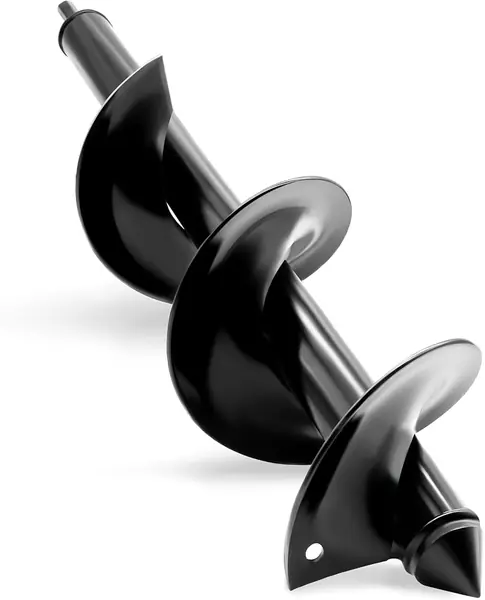
Single wide-diameter spiral soil auger bit with hex shank for planting

Big planting holes

Shop Score 89/100
Shank
3/8-inch hex
Material
PCM steel
Length
16 inches
Cutting Diameter
4 inches
View on Amazon

Four inches across is a transplant hole, not a bulb hole: a gallon nursery pot drops in with room for backfill, a shrub goes in without a pickaxe, and an umbrella sleeve sits flush. The hole comes out round with sides clean enough to backfill without air pockets, and we reach for this bit when width is the requirement rather than depth.

What it won't do is rescue bad ground. In dry, hard-packed clay or rocky soil it chatters, stops cutting, and starts polishing the bottom of the hole; the fix is a watering can and ten minutes, not more downward pressure. In soft loam and watered clay it opens the full 4 inches in a pass and leaves the spoil in a ring you can push back in with your boot.

Worth Noting

  • Wants a 1/2-inch drill with real torque
  • Only the 4-inch size in this listing
Our Verdict

A 4-inch auger that opens a planting hole in one pass; just make sure the drill driving it is big enough for the torque.

Check Latest Price
6.

SOMADA 1/2 x 12-Inch Auger Bit Best for Deep Wood Bores

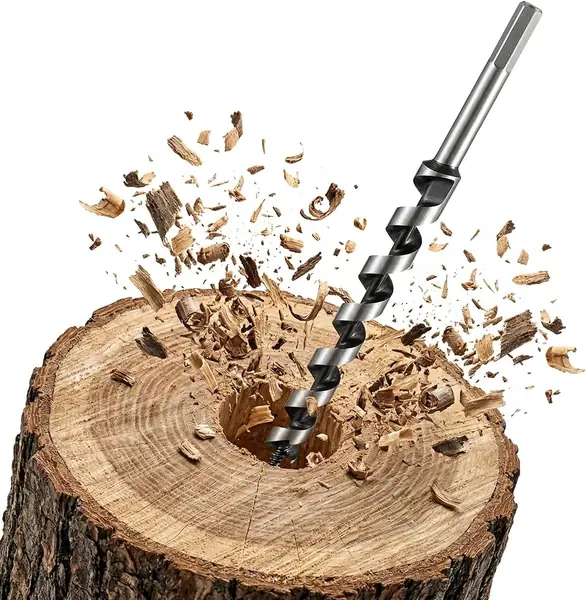
Single 1/2-inch by 12-inch wood auger bit with hex shank and screw point

Deep wood bores

Shop Score 88/100
Shank
3/8-inch hex
Length
12 inches
Cutting Diameter
1/2 inch
Boring Depth
Up to 10 inches
View on Amazon

Priced like a consumable rather than a tool, this 12-inch bit reaches holes the short wood bits cannot: landscape timbers, deck ledgers over a rim joist, tree stumps, fence posts. It bores up to about 10 inches deep on a 3/8-inch hex shank, and the screw point starts itself without a pilot hole.

That combination is why it earns a spot rather than a shrug. It eats through pressure-treated 4x4s and softwood without complaint, and it is sold in a long list of diameters and lengths, so a 3/4-inch or 1-inch version is a click away when the 1/2-inch hole turns out too small for the bolt you had in mind. For the occasional deep bore, this is the bit we grab.

Where it lands is the dozen-holes-a-season job: a fence post, a stump, a wire through a landscape timber. For anything that looks like production work — a deck's worth of shallow boring through joists and studs — the IRWIN set cuts cleaner with bits that fit between framing.

Worth Noting

  • Edge dulls quickly in hardwood and knots
Our Verdict

Where the short wood bits run out, this 12-inch auger keeps boring — up to 10 inches deep on one self-feeding pass.

Check Latest Price
7.

SORANGEUN 1.6 x 16.5-Inch Auger Bit

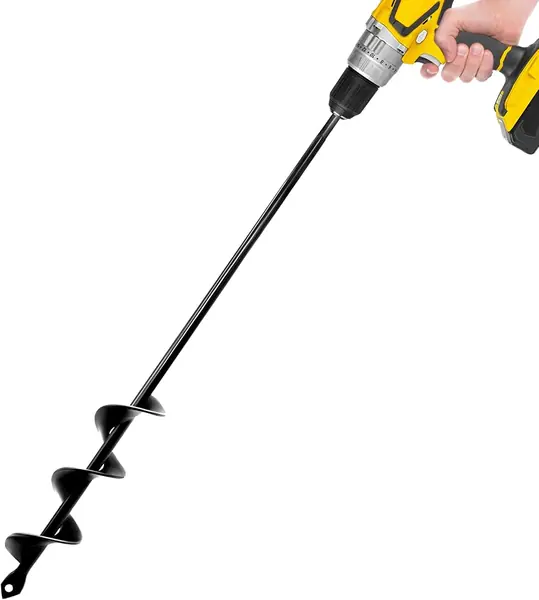
Single 1.6-inch by 16.5-inch spiral planting auger bit with hex shank

First auger bit

Shop Score 87/100
Shank
3/8-inch hex
Material
Manganese steel
Length
16.5 inches
Cutting Diameter
1.6 inches
View on Amazon

One bit, 1.6 inches across and 16.5 inches long, is the smallest sensible first auger: narrow enough for tulip bulbs and fertilizer stakes, long enough that you are not bent double over the bed, and inexpensive enough to be a low-stakes experiment.

It goes into a standard 3/8-inch chuck and turns in any drill that will hold it, and at 16 ounces the shaft is light enough that a compact driver does not feel strained. In soft beds it opens a clean 1.6-inch hole without downward pressure; in harder ground it mostly stirs the soil inside the hole rather than lifting it out, so you finish with a hand trowel.

Where it stops is anything wider than a 4-inch pot: a 1.6-inch hole will not take a shrub. What we like is the low stakes — buy it to find out whether you enjoy planting with a drill, the rhythm of standing upright while the holes appear, and buy a wider bit when the shrubs arrive.

Worth Noting

  • Thin shaft can bend in rocky ground
Our Verdict

The lowest-stakes way to try an auger: one small bit for bulbs and fertilizer spikes that any 3/8-inch drill can turn.

Check Latest Price

How We Chose and Tested the Best Auger Drill Bits

We started by sorting the market on the specs that decide whether a bit works at all: shank type, cutting diameter, overall length, and flute material. Anything whose diameter would outrun a compact drill's capacity came off the list, and so did smooth round shanks that spin in a three-jaw chuck. The shortlist mixed singles and sets, soil augers and wood augers, stubby bits around 4 inches and long ones past 2 feet, and we looked at every cutting edge out of the box, since a bit that arrives dull never really recovers.

For the next four months, 14 bits went into the yard: bulb holes in loam, the same bits forced into heavy clay and a rocky bed, post holes along a fence line with the utility lines marked before we started, and a run of holes under a patio umbrella base. We recorded whether each point bit on contact or needed leaning on, how the flute carried spoil out of the hole instead of churning it into mud, and whether the bit grabbed in roots or rock. Every run was two hands on the drill and a wide stance, and we backed off the moment a wide bit started to torque.

Indoors we bored pressure-treated 2x10s, knotted softwood, drywall, and composite decking, watching how fast chips cleared, whether the hex shank held without slipping, and how much downward pressure each screw point demanded. Holes were measured against the bit's stated diameter in both soil and lumber, because a bit that bores under size is a bit you stop reaching for.

Between sessions we wiped each bit dry, watched for rust and finish wear, and checked shafts for bends and tips for nicks after every rock or knot. Value came last: what a set cost per diameter you would actually use, against buying single bits one at a time.

How to Choose an Auger Drill Bit

Wood Bits and Soil Bits Do Different Work

Wood augers and garden augers share a spiral and little else. A wood bit has a fine screw point and cutting spurs that scribe the rim, so it slices a clean circle and throws chips up the flute; the IRWIN set here is a good picture of that geometry. A soil auger is coarser — a wide spiral, a blunter point, a shaft long enough to bury itself 16 inches.

Run a garden auger into a stud wall and it tears the grain instead of cutting it, and a short wood bit cannot reach planting depth. Decide the material first, then shop.

Match Diameter and Reach to the Hole

Bulbs want roughly 1.6 to 2 inches, a gallon nursery pot wants 3, and an umbrella or post sleeve wants 4. Depth follows the same logic, and it is where buyers get caught: a bit bores about as deep as its flute is long, so the 4-inch IRWIN bits top out near 2 inches while a 16.5-inch garden auger reaches planting depth.

Longer is not automatically better. A 32-inch shaft wanders more in the hole and is genuinely awkward in a crowded perennial bed, so buy the shortest bit that reaches your depth.

Your Drill Decides How Well It Cuts

A 1.6-inch auger turns in a compact 18V driver. A 3.5- or 4-inch auger in clay is a different animal: it wants a drill with a 1/2-inch chuck, a side handle, and low gear, and even then it can grab and wrench your wrists if you are not braced.

Hold the drill with both hands, keep your feet wide, and let the point feed itself instead of pushing down. Before you bore 16 inches of steel into a lawn, know where the irrigation lines and the utilities run.

Shanks, Chucks, and Fit

Almost everything here uses a hex shank, which is why these bits hold in a three-jaw chuck instead of spinning: 3/8-inch hex on the big garden augers, 1/4-inch quick-change hex on the short wood bits sized for an impact driver.

Check your chuck's minimum capacity before ordering anything with a 1/2-inch shank, and do not expect a 3/8-inch hex to go into a 1/4-inch impact collet — it will not.

Sets, Singles, and What You Actually Need

A four- or five-piece set makes sense when you do not yet know which diameter your planting wants, or when the job list genuinely runs from bulbs to a fence post; you get the range for less than the sizes cost separately. A single bit makes sense when the job is already measured.

Expect soil augers to wear at the point and wood bits at the spurs. None of these is a lifetime tool in gritty ground, and the ones that fail in soil usually bend before they wear out.

Frequently Asked Questions

Final Verdict

After all the holes, the choice comes down to material. For soil, we point most people to the K-Brands four-piece set: four diameters answer the question every new auger owner has — which size does this job want — and the bits run in whatever 3/8-inch drill is already in the shed.

For lumber, the IRWIN SPEEDBOR set is the better tool, with a screw point that pulls itself in, spurs that keep the rim clean, and a length that fits between studs.