↑↓ navigate ↵ open Esc close All results →

Best Step Drill Bits of 2026

The first time we traded a pilot bit, a reamer, and a rotating cast of twist bits for one cone-shaped bit, we didn't go back. A step bit drills a pilot hole and opens it in rings, so you stop at the exact size you need without changing tools. It fixes the ragged, wandering hole a twist bit leaves in a panel thinner than its own point.

We tested 12 step bits and sets for six months, drilling clamped sheet metal, backed plastic boxes, and conduit knockouts on a bench and on job sites. The step count gets the attention, but steel and flute geometry decide whether a bit survives a hard sheet: two straight flutes clear chips slowly and run hot, while four spiral flutes pull curls out fast enough to keep an edge alive.

The shank matters as much — hex for an impact driver, tri-flat for a chuck — and coating is what shoppers overrate: titanium nitride is fine for mild steel, but the aluminum-titanium family earns its price on stainless. The list below covers a first set, a stainless specialist, and oversized holes.

Our Top Picks

The Best Step Drill Bits

1.

DEWALT DWA1790IR Step Drill Bit Set Best Overall
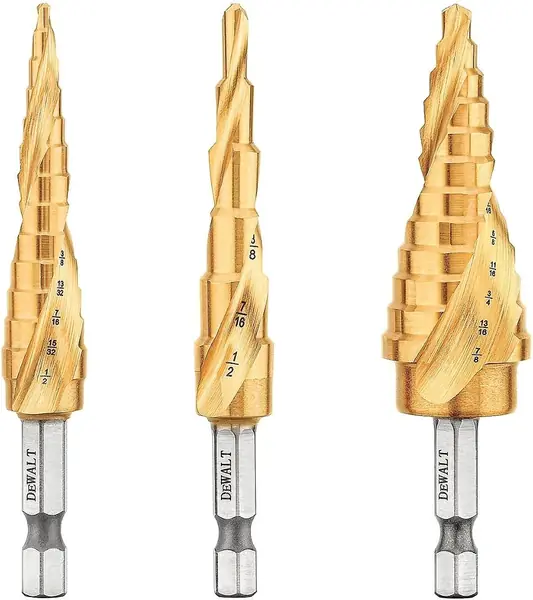
DEWALT three-piece titanium step drill bit set with 1/4-inch hex shanks

Impact driver work

Shop Score 94/100
Step Range
1/8 in to 7/8 in
Shank
1/4 in hex
Coating
Titanium nitride
Hole Sizes
31
View on Amazon

Thirty-one hole sizes come out of three bits here, and every one of them ends in a 1/4-inch hex shank, so they drop straight into an impact driver's quick-change holder. That detail matters more to us than the count: swapping sizes is one motion, and the double-spiral flute pulls chips up and out of the cut instead of letting them pack in and heat the edge.

What sold us is the start. The split point bites where you put it rather than skating off the punch mark, and the engraved step numbers are legible without stopping to squint — the kind of thing you appreciate the first time you're drilling upward into a bracket. In mild steel the middle bit kept cutting cleanly through one hole after another, which is more than we can say for a couple of the cheaper bits in this guide.

Titanium nitride over high-speed steel is a sensible middle ground: hard enough for sheet metal, aluminum, and plastic, and not so brittle that it chips the first time you lean on it. The three ranges overlap — 1/8 to 1/2, 3/16 to 1/2, and 3/16 to 7/8 inch — so the small bit starts the hole and the long one finishes it.

This is the most expensive set on the list, and we think the money lands where it should: in edges that keep cutting and bits that don't wander. Nothing else here starts as cleanly or holds up as well through a long run of holes, and that is the whole case for paying more.

Worth Noting

  • Stops at 7/8 inch, so no 1-inch knockouts
Our Verdict

We rank this set first because the bits start where you put them and keep cutting after the cheap ones quit; it suits anyone driving holes with an impact driver.

Check Latest Price
2.

NEIKO 10185A Step Drill Bit Best Budget Single Bit

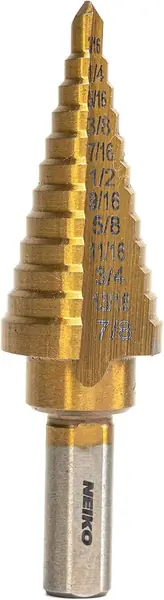
NEIKO titanium step drill bit with tri-flat shank and twelve stepped sizes

Occasional metalwork

Shop Score 92/100
Step Range
3/16 in to 7/8 in
Shank
3/8 in tri-flat
Material
HSS with titanium nitride
Steps
12
View on Amazon

One bit, one chuck, a handful of holes a month — that's the buyer this suits. Twelve steps run up to 7/8 inch, the NEIKO's tri-flat shank grips a three-jaw chuck without spinning, and it costs less than almost anything else here.

In sheet metal the split point starts without a pilot, and the two flutes lift a curl of metal out of the hole rather than smearing it. The steps are distinct ledges, so you drill until the ledge you want just breaks the surface and stop there — no calipers held against a cone.

We treat this as a consumable, and it's priced like one. Mild steel, aluminum, and plastic are all easy work for it; stainless dulls it faster than the cobalt bits here, so run it slow with a drop of cutting oil and don't expect it to be the last bit you buy. That trade is the appeal — the cheapest way to find out how often you reach for a step bit at all.

Worth Noting

  • 3/8-inch shank won't fit 1/4-inch quick-change holders
Our Verdict

Buy this one if you want a single bit for the common sizes without spending much; ours lives in the drill bag as the spare and the loaner.

Check Latest Price
3.

toolant M35 Cobalt Step Drill Bit Best for Stainless Steel

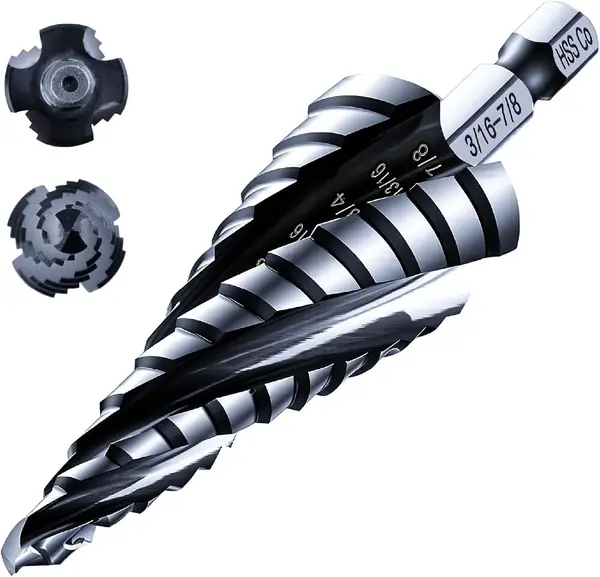
toolant M35 cobalt step drill bit with four spiral flutes and hex shank

Stainless steel

Shop Score 91/100
Step Range
3/16 in to 7/8 in
Material
M35 cobalt HSS
Coating
TiAlN
Flutes
4 spiral
View on Amazon

Four spiral flutes instead of the usual two is why we hand the toolant bit to anyone cutting stainless. The extra edges share the load and clear chips faster, and M35 cobalt holds its hardness at temperatures that turn a plain high-speed-steel bit blue.

The dark TiAlN coating is the harder cousin of the gold titanium finish on most bits here. The maker claims 89 HRC at the surface, a number we can't check at a bench, though we can tell you the edge kept cutting stainless sheet where a two-flute bit started rubbing and squealing. Twelve steps cover 3/16 to 7/8 inch.

The 1/4-inch hex shank suits an impact driver, and the 90-day replacement offer is the sort of thing we like to see on a bit this thin at the tip. It stops at 7/8 inch, so a conduit knockout or anything near an inch is a job for the Milwaukee or the Jerax instead.

Worth Noting

  • Shank can snap under heavy side load
  • Step numbers are hard to read
Our Verdict

When the job is stainless or hardened sheet, we reach for this bit before any other here, and it earns the extra cost in holes that don't burn.

Check Latest Price
4.

COMOWARE M2 Cobalt Step Drill Bit Set Best Cobalt Set

COMOWARE five-piece M2 cobalt step drill bit set with AlTiN coating

Sheet metal

Shop Score 90/100
Step Range
1/8 in to 1-3/8 in
Material
M2 cobalt HSS
Coating
AlTiN
Pieces
5
View on Amazon

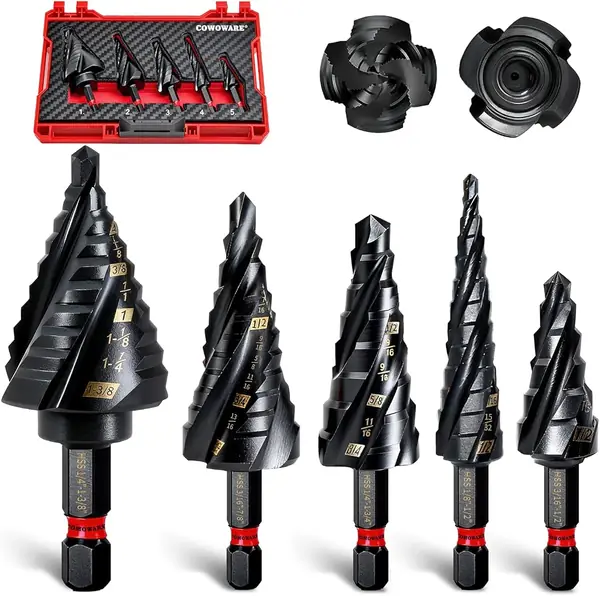
The ceiling on this set is plate steel. Lean on its largest bit in 1/4-inch stock and the edge heats before the hole opens; in 16- and 18-gauge sheet, the five COMOWARE bits walk from 1/8 inch up to 1-3/8 inch with four spiral flutes that clear chips instead of smearing them.

This is the least expensive route here to a cobalt set, and that's the argument: M2 steel under an AlTiN coating handles more hard-metal work than the gold titanium sets at similar money, and the range covers most of what a home shop actually drills. Each step is marked clearly enough that you can stop where you want without measuring the cone.

Plastic and PVC go quickly and aluminum is easy; steel rewards slow speed and steady pressure. We ended up reaching for the mid-size bit most often, which is the quiet advantage of a five-bit set over one long cone — the bit in your hand is sized for the hole instead of stretching to reach it.

Worth Noting

  • Edge dulls faster than the cobalt label suggests
Our Verdict

A cobalt set at what the plain high-speed-steel sets charge is why we point people here for a full run of sizes in hard metal.

Check Latest Price
5.

Milwaukee 48-89-9209 Step Drill Bit Best for Conduit and Knockouts

Milwaukee step drill bit with black oxide finish and flatted round shank

Conduit and knockouts

Shop Score 89/100
Step Range
7/8 in to 1-1/8 in
Shank
Round with flats
Material
HSS, black oxide
Flutes
2
View on Amazon

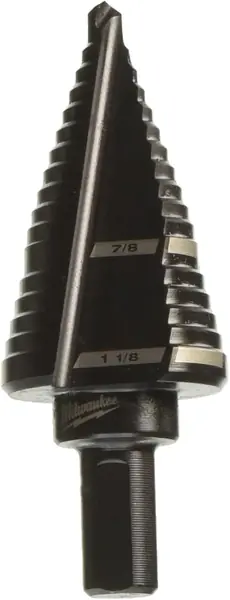
Seven-eighths to 1-1/8 inch is a narrow slice of the world, and it happens to be the slice that matters if you're landing conduit connectors or cutting box knockouts. The Milwaukee bit exists for that.

Black oxide rather than a gold coating, two flutes, and a round shank with three flats machined into it so a three-jaw chuck can't spin it under load. Nothing about it is decorative.

The cut is smooth and the hole comes out round, and once the first step is seated the bit stops wandering. In light-gauge boxes and thin sheet it makes short work of a hole that a hole saw would overshoot.

Our read is that this is a professional's bit with a professional's price, and what you're buying is the two sizes an electrician makes a living with, stepped finely enough to land a connector flush and hard enough to keep going after the budget bits have quit. If your work is general fabrication rather than conduit, a set with more range is the better buy.

Worth Noting

  • Covers only 7/8 to 1-1/8 inch
Our Verdict

We keep this in the electrical bag rather than the drill index: it's the two sizes conduit work actually needs, and it holds an edge doing it.

Check Latest Price
6.

ZELCAN 5-Piece Step Drill Bit Set

ZELCAN five-piece titanium step drill bit set in a labeled storage case

Wide size coverage

Shop Score 88/100
Step Range
1/8 in to 1-3/8 in
Shank
1/4 in hex
Pieces
5
Hole Sizes
50
View on Amazon

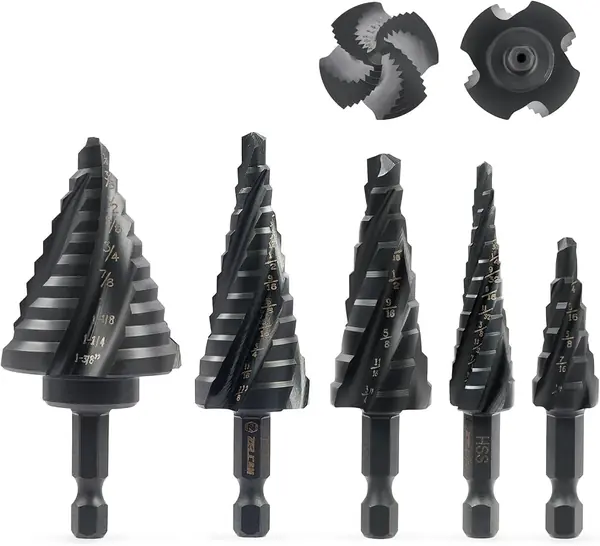
A labeled case sounds like packaging until you own five step bits and can't tell 3/8 from 7/16 at a glance. The ZELCAN's case holds all five, and it's the part we came to appreciate most — more than any single bit in the box.

Together the five bits cut 50 hole sizes from 1/8 inch to 1-3/8 inch, with four flutes and a 1/4-inch hex shank that pops into a quick-change holder. Sheet metal and plastic cut cleanly, and the smaller bits are the sweet spot.

In steel the cut stays smooth as long as you keep the speed down and let the flutes clear the chips. It's the set we name for someone fitting out a shop who wants every common size in one box rather than the best edge in the drawer.

Worth Noting

  • Largest bit dulls fast past 7/8 inch
  • Tips are brittle under heavy pressure
Our Verdict

For a home shop that wants every common size on hand without cobalt prices, this set earns its place on range and organization.

Check Latest Price
7.

COMOWARE Ti-Coated HSS Step Drill Bit Set

COMOWARE five-piece titanium step drill bit set with aluminum case and center punch

First set

Shop Score 87/100
Step Range
3/16 in to 1-3/8 in
Shank
3/8 in tri-flat
Coating
Titanium
Pieces
5 plus center punch
View on Amazon

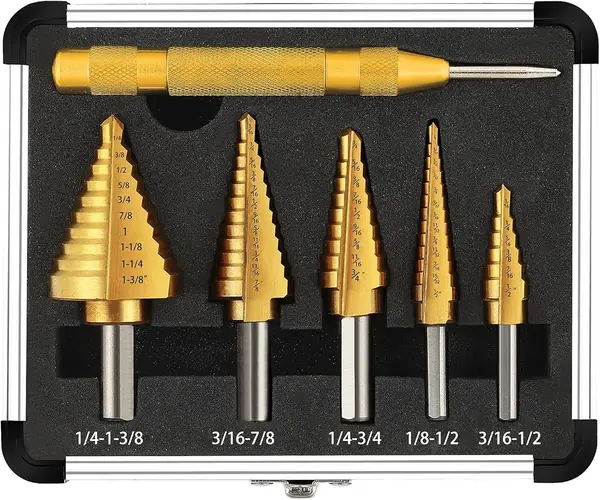
Five COMOWARE bits, a center punch, and an aluminum case to keep them in — the bundle is the pitch, and the case is the part that earns its keep once the set lives in a tool chest.

The bits run from 3/16 inch up to 1-3/8 inch, overlapping so there's always a smaller one for the pilot and a larger one to finish. Two straight flutes clear chips less aggressively than spiral ones, so keep the pressure light and let the bit cut at its own pace.

We treat this as a starter set, and a good one: it drills sheet metal, plastic, and aluminum without complaint, and the case means the set stays complete instead of shedding bits into a drawer. The punch alone saves you hunting for one the first time a bit wants to walk across a panel.

Worth Noting

  • Edges arrive less sharp than premium bits
Our Verdict

We point beginners here because the range, the case, and the punch cover a first year of hole-making without a second purchase.

Check Latest Price
8.

Jerax Tools 1/4-Inch to 2-Inch Step Drill Bit Best for Oversized Holes

Jerax tools large step drill bit with marked sizes and tri-flat shank

Oversized holes

Shop Score 86/100
Step Range
1/4 in to 2 in
Shank
3/8 in tri-flat
Material
High-speed steel
Steps
10
View on Amazon

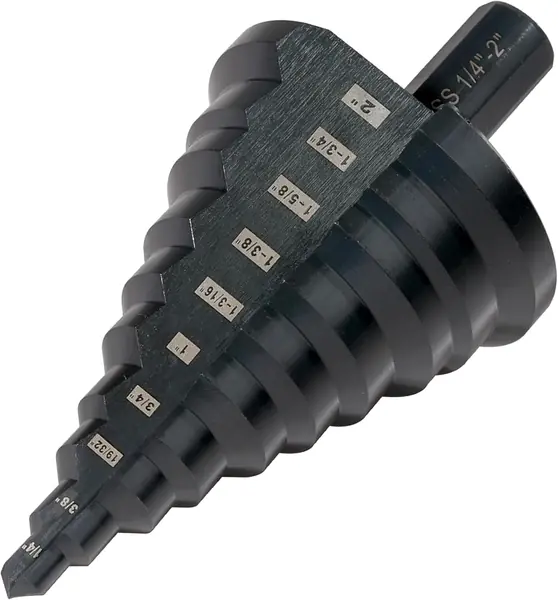
Two inches is the number that matters here. Nothing else on this list gets past 1-3/8 inch, and the gap between those two figures is the difference between a hole for a conduit connector and a hole for a speaker cup, a pipe stub, or a foot-pedal box.

Ten steps mark the way up from 1/4 inch, with the sizes highlighted on polished flutes so you can watch the target approach instead of stopping to measure. The 3/8-inch tri-flat shank wants a chuck with that capacity.

It's the heaviest unibit here, and that weight is why it stays stable in a hand drill rather than chattering its way around the hole. Straight flutes and a lot of cutting surface mean slow speed and light, steady pressure; rushing a hole this size is how you blue an edge.

What we think the Jerax is for is the hole nothing else in your box will make. Buy it when you need 1-1/2 to 2 inches through sheet metal or plastic, and skip it if your work tops out at 7/8 inch, because a smaller bit will be easier to control and cheaper to replace.

Worth Noting

  • Dulls quickly in stainless steel
Our Verdict

We keep it for the odd oversized hole in sheet or plastic, where one heavy bit beats hunting down a hole saw.

Check Latest Price

How We Chose and Tested Step Drill Bits

We started by rounding up every step bit and set we could find in stock, then filtered on the things that actually decide the purchase: base steel and coating, two straight flutes versus four spiral ones, shank type, hole-size range, and cost per usable size. Sets that repeated sizes we already had, or that topped out below the common knockout sizes, came off the list. That left 12 bits and sets, which we ran for six months.

Testing happened where these bits get used — a shop bench with a drill press and two hand drills, plus electrical rough-ins on a couple of job sites. We clamped every piece of sheet metal in a vise or to the bench, backed plastic boxes with scrap wood, and wore eye protection every session. Metal got low speed, steady pressure, and cutting oil, and we cleared chips by backing the bit out rather than leaning on it.

We drilled the same holes in pine, plastic, sheet steel, and progressively harder stainless, counting holes per bit until it slowed and started throwing dust instead of curls; every finished hole got calipers for out-of-round and step-to-step accuracy. Each bit started on a center-punch mark, and we noted whether it walked off the mark or bit on contact. After each session we looked at edge sharpness under a loupe and at how chips cleared the flutes, felt the shank for heat, and opened the cases with gloves on to see whether the size markings stayed legible.

How to Choose Step Drill Bits

One Bit or a Set

The first decision is how many cones you want in the drawer. A single bit in the size you actually drill costs less and takes up no room; a five-bit set spreads similar money across thirty to fifty hole sizes and saves you when the next hole isn't the size you planned.

We reach for a single bit for conduit and knockouts and for a set when we're fitting out a shop. If you buy a set, check that the ranges overlap, so a smaller bit can pilot the hole for the largest one.

Range and Step Count

Most unibits are sold on a range, like 3/16 to 7/8 inch, and a count, like 12 steps. The range sets your biggest hole; the count sets how fine the increments are, which matters when a connector or grommet has to fit snugly rather than approximately.

Going bigger costs control. A bit that reaches 2 inches is heavy and wants a drill you can hold with two hands, and the cone below the top step is a lot of steel to spin. Buy the largest size your work calls for and stop there.

Steel and Coating

High-speed steel with a titanium coating handles wood, plastic, aluminum, and mild sheet, and it's what the affordable bits here use. Stainless, hardened sheet, and long runs in steel call for M2 or M35 cobalt with an AlTiN coating, which keeps its hardness when the edge gets hot.

The gold color on a cheap bit tells you very little — what survives heat is the steel underneath. If stainless shows up in your work regularly, the upgrade pays for itself in bits you don't have to replace.

Flutes and Shanks

Two straight flutes are the default: simple, easy to control, and fine in thin material. Four spiral flutes cut faster, throw chips clear, and run cooler, which is why the cobalt bits here use them.

The shank is where buyers get caught. A 3/8-inch round or tri-flat shank will not go into a 1/4-inch quick-change holder, and a 1/4-inch hex shank needs a chuck that grips it squarely. Check the tool in your hand before you check the bit.

Speed, Pressure, and Cutting Oil

Heat is what kills step bits, and heat comes from speed. Run the drill slow in metal, lean steadily rather than hard, and lift the bit now and then so the flutes clear chips instead of re-cutting them.

A drop of cutting oil makes a real difference to how long an edge lasts in steel. In plastic, ease off the pressure so swarf clears instead of welding itself to the cone.

Frequently Asked Questions

Final Verdict

The DEWALT set is what we recommend first: three bits, 31 sizes, hex shanks that suit an impact driver, and edges that keep cutting after the budget bits have dulled.

If you drill a few holes a month, the NEIKO single bit is the sensible spend. If stainless is routine in your shop, the toolant cobalt bit is worth the step up, and for a hole past an inch and a half, nothing here but the Jerax will do it.