↑↓ navigate ↵ open Esc close All results →

Best Step Drill Bits for Stainless Steel of 2026

Stainless steel is where a lot of step bits quietly give up. The metal work-hardens the moment a dull edge starts rubbing instead of cutting, and the hole turns glassy and harder than the bit that made it. The right bit — the right steel and coating, a flute that clears chips rather than packing them — goes through in one clean run instead of a slow burn.

We tested 16 step bits over four months, drilling clamped stainless sheet at low speed with cutting fluid, and the same lesson kept repeating: the size count printed on the package matters far less than the edge doing the cutting. A titanium-nitride coating, which most budget sets advertise, is a different animal from AlTiN or TiAlN on stainless, and cobalt content announces itself fast at the larger steps, where the bit is widest and the chips come off hot.

The picks below cover small-hole jobs, big knockouts for conduit, and the mixed aluminum-and-stainless work that fills most garage weekends. They differ in hole band and shank size; what they share is that they kept cutting long after a cheaper bit would have started to rub.

Our Top Picks

The Best Step Drill Bits for Stainless Steel

1.

DEWALT DWA1790IR Step Drill Bit Set Best Overall
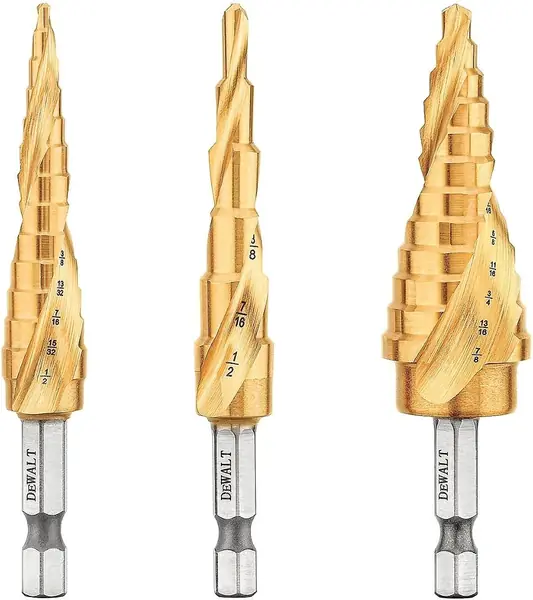
DEWALT three-piece titanium nitride step drill bit set with 1/4-inch hex shanks

Stainless sheet work

Shop Score 94/100
Flutes
2, spiral
Hole Sizes
31 sizes, 1/8 in to 7/8 in
Shank
1/4 in hex, impact ready
Finish
Titanium nitride coated
View on Amazon

Stainless ruins step bits in two ways. The tip skates across the surface before it bites, or the edge dulls a step or two short of the size you wanted and leaves you leaning on a bit that is now polishing rather than cutting. DEWALT's split-point tip answers the first problem, starting the cut on contact instead of wandering off the punch mark, and the double spiral flute lifts chips out of the groove instead of grinding them back into the hole.

That combination is why this set earned the top spot. In our testing the DEWALT bits kept throwing long shavings through stainless sheet while the cut stayed clean, and nothing else here cut as predictably through the middle of the range. The 4.96-ounce, three-bit set also travels well: it is the one we drop in a bag when the work is somewhere other than the shop.

Three bits cover 31 hole sizes from 1/8 inch to 7/8 inch, which handles enclosure work, panel cutouts, and small knockouts. Two of them start at 1/8 and 3/16 inch, so the small sizes are covered twice, which is handy the day the short bit goes missing. The 1/4-inch hex shank is rated for impact drivers, though we still run stainless in a drill at its slowest speed for control.

The ceiling is 7/8 inch. If your work runs up to 1-1/8 or 1-3/8, add the Klein bit below rather than forcing this set past its largest step, because that is where tips break. We also paid attention to the laser-etched numbers: they are still readable after the coating has worn shiny on the first two steps, which is more than we can say for the stamped markings on some sets.

Worth Noting

  • Premium price for a three-piece set
Our Verdict

For stainless, this is the set we hand people: the split point starts the hole where you aim it and the edges keep cutting.

Check Latest Price
2.

TEMO M35 Cobalt Step Drill Bit Best Cobalt Bit for Stainless

TEMO M35 cobalt spiral step drill bit with quick-release hex shank

Small-hole stainless work

Shop Score 93/100
Flutes
Double spiral
Hole Sizes
12 sizes, 3/16 in to 7/8 in
Shank
1/4 in hex with quick-release slot
Material
M35 cobalt high-speed steel
View on Amazon

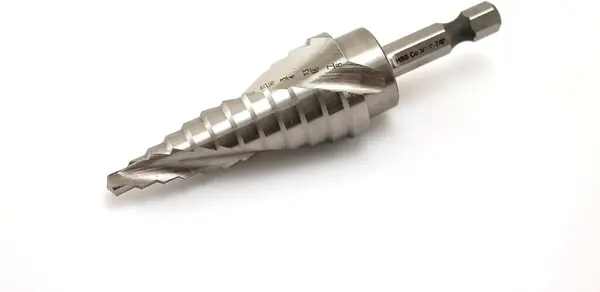
M35 is the grade of high-speed steel that carries roughly 5 percent cobalt, and that is the number to look at when stainless is on the bench, because cobalt is what keeps an edge from softening once the cut runs hot. We like that TEMO puts it in a single bit rather than a case: one 3/16-to-7/8-inch cone, double spiral flutes, and a 1/4-inch hex shank cut with a quick-release slot so it moves between a drill and a driver without a chuck key.

Twelve steps cover the band most enclosure, panel, and automotive work lives in, and each one is listed in both inch and metric sizes, which saves a conversion when the drawing is metric. The spiral flutes pull chips clear rather than packing them into the groove, and the self-starting point means fewer center-punch marks wandering off line on a smooth panel.

Cobalt is not a license to lean on the drill. Step bits want cutting fluid, low speed, and light steady pressure, and a cordless drill run wide open will cook any of them, cobalt or not. Fed properly, this one handles a long run of small holes and drops into a tool bag pocket between jobs.

Worth Noting

  • Single bit that stops at 7/8 inch
Our Verdict

Cobalt in a single bit is the whole point here, and this one carries 5 percent of it with spiral flutes to match.

Check Latest Price
3.

Klein Tools KTSB15 Step Drill Bit Best for Large Holes

Klein Tools KTSB15 double-fluted step drill bit with 3/8-inch hex shank

Large knockouts

Shop Score 92/100
Flutes
Double straight
Hole Sizes
3 sizes, 7/8 in to 1-3/8 in
Shank
3/8 in hex
Coating
AlTiN over M2 steel
View on Amazon

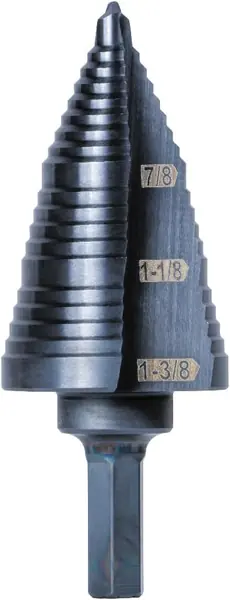
Most step bits spend their steps on the small sizes and treat the top of the range as an afterthought, which is how you end up forcing a cone past its last useful step. The KTSB15 goes the other way: three steps between 7/8 inch and 1-3/8 inch, all of them large, covering the holes behind a 1/2-inch conduit connector up through 1-inch pipe. The cone is short, which is what you want when the hole sits close to a corner or a return.

Aluminum titanium nitride is the coating we look for on stainless, since it takes more heat than the titanium nitride on cheaper sets before it breaks down, and the M2 steel underneath is a known quantity in a metalworking bit. The 3/8-inch hex shank fills a half-inch chuck without an adapter and resists rounding out when a large bit grabs, the double straight flutes leave clean walls, and the laser-etched numbers are readable at a glance.

In our testing it cut 16-gauge stainless cleanly, throwing a chip rather than smearing one, and the tip did not wander off a punched mark. The catch is speed: run it fast and it work-hardens the sheet and dulls the edge, because at these diameters there is a lot of cutting edge in the cut. A slow drill, cutting fluid, and steady pressure get you a hole you can put a connector through without a file.

Worth Noting

  • Covers only the 7/8 to 1-3/8 inch band
Our Verdict

Buy this when the hole outgrows your set: AlTiN-coated, 7/8 to 1-3/8 inch, and steady at the slow speeds stainless wants.

Check Latest Price
4.

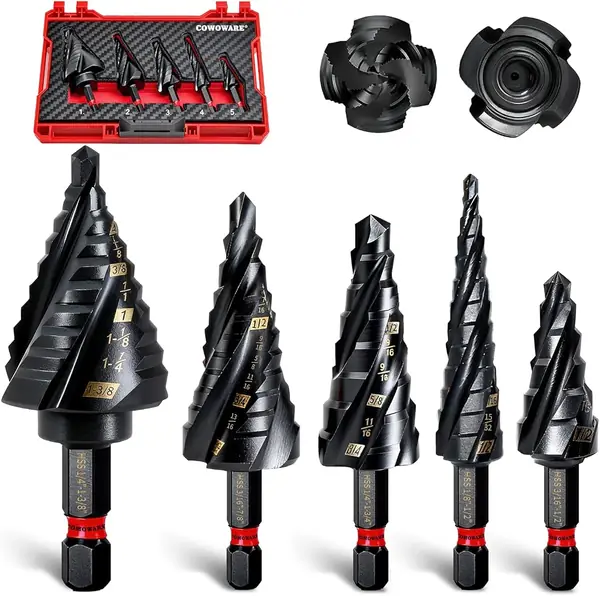
COMOWARE M2 Step Drill Bit Set Best Size Range

COMOWARE five-piece M2 cobalt step drill bit set with four spiral flutes

Mixed metal work

Shop Score 90/100
Flutes
4, spiral
Hole Sizes
1/8 in to 1-3/8 in
Material
M2 cobalt steel
Coating
TiAlN
View on Amazon

One set, 1/8 inch through 1-3/8 inch: that is the pitch, and it holds up. Five bits split the range so you are not pushing a small cone past 1/2 inch or starting a 1-inch hole with a bit that has run out of step. M2 cobalt steel under a titanium aluminum nitride coating puts the cutting edge in the right family for stainless, and four spiral flutes move chips out fast.

We like this set for the shop that drills a bit of everything, because it is the one here that covers panel work and knockouts in the same case and the four-flute geometry is quick enough that a 3/4-inch hole does not eat your afternoon. The trade is edge life: four flutes and a cobalt core buy speed, not immortality, so run these slow with fluid and let the bit do the work rather than the wrist.

Buy it as a range play rather than a stainless production tool. If most of your drilling is sheet metal with the occasional stainless bracket, having every size from 1/8 to 1-3/8 on hand is worth more than the last word in edge retention. If stainless is the entire job, a single focused cobalt bit such as the TEMO is the sharper way to spend.

Worth Noting

  • Top steps dull early in hard sheet
Our Verdict

Five cobalt bits from 1/8 to 1-3/8 inch make this the widest range here without a second purchase.

Check Latest Price
5.

toolant M35 Cobalt Step Drill Bit Best Budget Cobalt

toolant M35 cobalt step drill bit with four spiral flutes and hex shank

Fast thin-metal work

Shop Score 89/100
Flutes
4, spiral
Hole Sizes
9 sizes, 1/4 in to 3/4 in
Material
M35 cobalt steel
Coating
TiAlN
View on Amazon

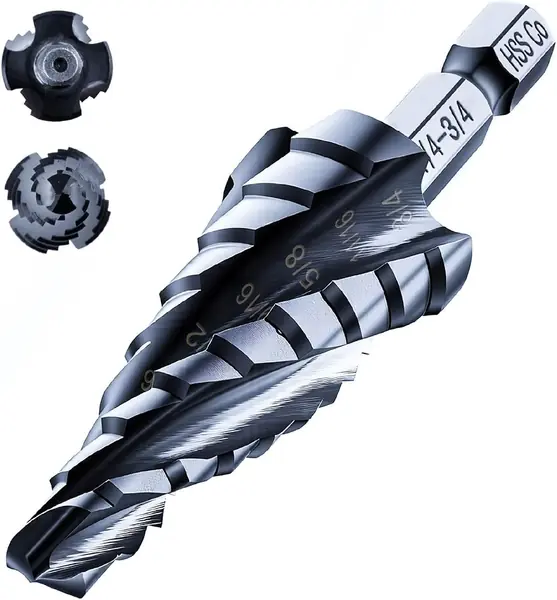
Four flutes instead of two is the first thing to notice. More cutting edges spread the load and clear chips faster, and in a 1/4-inch impact driver that shows up as a bit that cuts quicker and needs less pressure than a two-flute design. Add M35 cobalt and a titanium aluminum nitride coating and you have a stainless-capable bit sitting at the bottom of the price range in this group.

Nine steps run from 1/4 inch to 3/4 inch, which is the band that enlarges existing holes: a pilot through a bracket, then step up until a bolt or a connector clears. Our test cuts in 1/8-inch steel went quickly and the steps stayed sharp through the run. The self-starting point is not a substitute for a pilot mark, though; this bit will walk on smooth stainless if you give it the chance.

What the money buys is speed. The bit is short, so it is easy to control one-handed on a ladder, and the four-flute geometry makes short work of the small holes that electrical and HVAC work is made of. We treat it as the bit that lives in the driver rather than the one we save for best.

Worth Noting

  • 1/4-inch hex shank can snap under load
  • Tops out at 3/4 inch
Our Verdict

The least expensive way into M35 cobalt and a four-flute cut, and a genuinely capable stainless bit for the money.

Check Latest Price
6.

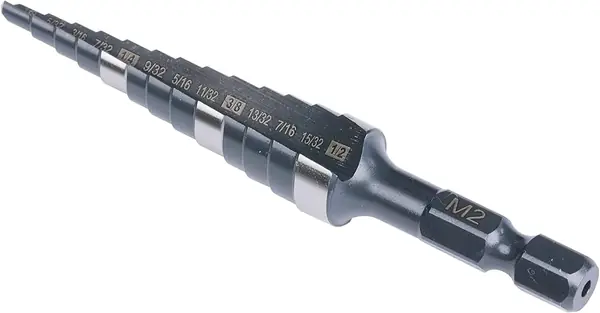
Jerax Tools M2 Step Drill Bit Best for Small Holes

Jerax Tools single M2 step drill bit with polished steps and hex shank

Small-hole jobs

Shop Score 88/100
Flutes
Double straight
Hole Sizes
13 sizes, 1/8 in to 1/2 in
Shank
1/4 in hex quick change
Material
M2 high-speed steel, nitrided
View on Amazon

Most holes drilled in a shop are small ones, and a bit running from 1/8 inch to 1/2 inch in thirteen steps covers nearly all of them without a change. That works out to increments of 1/32 inch, fine enough to land on a switch or connector size rather than the nearest step above it. Jerax marks every step and polishes the cone so the size you are cutting stays visible during the cut, and the straight double flutes leave a clean wall. We reach for this one for switch holes, pilot enlargements, and any job where a single cone beats three twist bits.

M2 high-speed steel with a nitrided surface is one step down from cobalt on heat resistance, which is exactly why this is the small-hole bit rather than the stainless workhorse. In thin sheet it holds up well, the straight flutes want a peck-and-clear rhythm instead of constant pressure, and at this price keeping a spare in the drawer is not a luxury.

Worth Noting

  • Stops at 1/2 inch
Our Verdict

Thirteen marked steps between 1/8 and 1/2 inch cover most of the holes a shop actually drills.

Check Latest Price
7.

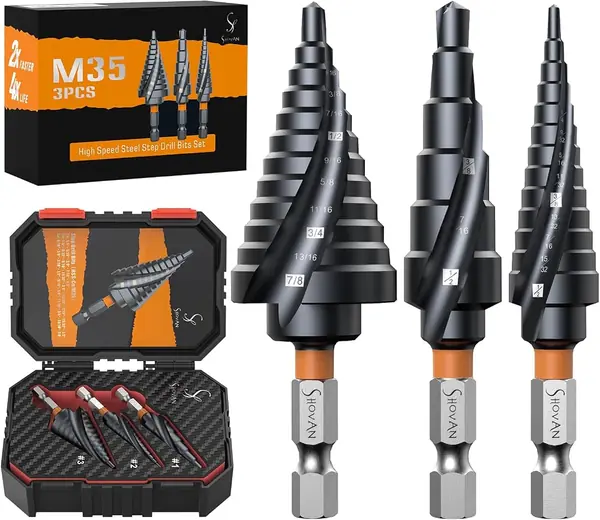
SS SHOVAN M35 Cobalt Step Drill Bit Set

SS SHOVAN three-piece M35 cobalt step drill bit set in a storage box

Occasional stainless

Shop Score 87/100
Flutes
Spiral, 2
Material
M35 cobalt, TiAlN coated
Pieces
3 bits
Hole Range
1/4 in to 7/8 in
View on Amazon

Three cobalt bits in a box, priced between the single-bit picks and the big sets. Each is M35 steel with a titanium aluminum nitride coating and a spiral flute, which is the specification list we want to see when stainless is the material in question. The question with any set at this level is whether the execution matches the paper, and here it mostly does.

The bits divide the work by size rather than by task: the smallest handles the 1/4-to-1/2-inch holes, and the larger two carry the set up to 7/8 inch. Having three separate cones means a dull or broken bit does not bench the whole range, which is more than you can say for a one-bit purchase. The box keeps them together, and the 118-degree point starts without a lot of ceremony.

Stainless is where a set like this earns or loses its money. Grade 304 work-hardens faster than 316 or 18-8 sheet, and a step bit that rubs instead of cutting will fail in any of them, which is why the same set can run fifty clean holes on one bench and snap on another. Clamp the work, keep the fluid on, and run the drill slower than feels right.

We see it as a second set rather than a primary one. Keep it for the occasional stainless bracket and for the sizes your main bit does not reach, and do not expect it to out-cut a single dedicated bit on a production run. What it does offer is a spare cone in the middle of a job, which is the kind of thing you only value after the first snap.

Worth Noting

  • Sizes repeat across the three bits
Our Verdict

A three-bit cobalt set for the shop that meets stainless occasionally rather than daily.

Check Latest Price
8.

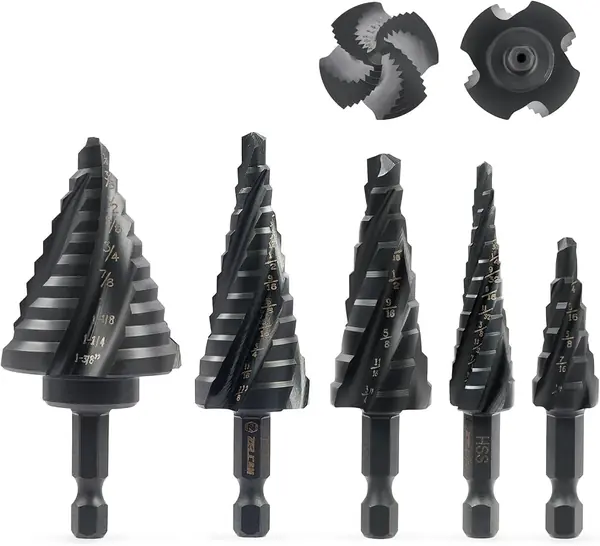
ZELCAN 5-Piece Step Drill Bit Set

ZELCAN five-piece titanium-coated step drill bit set with storage case

Mixed-material DIY

Shop Score 86/100
Hole Sizes
50 sizes, 1/8 in to 1-3/8 in
Shank
1/4 in hex, quick release
Coating
Titanium nitride over HSS
Pieces
5 bits
View on Amazon

Fifty hole sizes across five bits, from 1/8 inch to 1-3/8 inch, in a case that keeps them in order. On paper that is the most size variety per dollar in this group, and for a woodworker who drills metal a few times a month it covers jobs that would otherwise need three separate purchases. The four-flute spiral design is more cutting geometry than most of the picks here carry, where two flutes are the norm.

Titanium nitride over high-speed steel is the everyday combination: very good on aluminum, mild steel, and plastic, and adequate on stainless as long as you keep the speed down and the fluid on. The four flutes make the cut feel fast because chips leave the groove instead of packing it, and fast cutting in stainless is exactly where heat becomes the limiting factor.

The size markings and the quick-release hex shank are the two details that make the set easy to live with. Sizes are easy to find in the case, the shank swaps between a drill and a driver without a chuck key, and each bit is short enough to fit where a full twist-bit set will not.

We rate this as the starter set, and we mean that kindly. Fifty sizes let you find out which five you actually reach for before you spend cobalt money on the band that matters. Keep it for sheet metal, plastic, and the odd stainless bracket; when stainless becomes the job rather than the exception, step up to a cobalt bit for the sizes you use most.

Worth Noting

  • Dulls quickly on stainless
Our Verdict

Fifty sizes for the price of a single cobalt bit, best treated as the set you learn on.

Check Latest Price

How We Tested Step Drill Bits on Stainless Steel

We started with spec sheets on roughly 60 step bits and narrowed that to 16, spread across budget titanium sets, cobalt bits, and single bits built around one band of hole sizes. Anything whose base steel or coating we couldn't confirm got dropped, and so did bits whose hole range overlapped nothing useful on a stainless job. Each of the 16 then went into service for four months on the work a buyer actually faces: knockouts in electrical panels, holes in a stainless sink deck, brackets and flanges, and mixed-material projects where the bit crosses from aluminum into stainless and back.

Every cut was made with the sheet clamped in a vise or clamped to the bench, run at low rpm with cutting fluid, and we kept eye protection on the whole time because the larger steps throw hot chips. We logged the point where each bit stopped cutting and began rubbing — whether chips came off as tight curls or fine dust, whether the hole squealed, whether the tip walked off the punch mark before the first step bit in. Finished holes were checked with calipers against the marked size, and we noted whether the size markings were still readable once the bit was slick with fluid and grit.

To judge edge life rather than first-hole impressions, we kept a running count of holes per bit in the same gauge of stainless and ran the small-hole bits until they stopped cutting altogether. Shanks were chucked and re-chucked to see whether a quarter-inch hex or a beefier three-eighths held without spinning under load, and quick-release collars were swapped with gloves on. At the end we worked out cost per usable step in the band we actually drilled, because a cheap set with one step you need is not a bargain.

How to Choose Step Drill Bits for Stainless Steel

Start With the Edge, Not the Size Count

Stainless work-hardens when a dull edge rubs instead of slicing, and it conducts heat poorly, so the temperature stays right where the cutting edge lives. That makes the edge the first decision. M35 high-speed steel carries about 5 percent cobalt and is the grade to look for when stainless is regular work; M2 cobalt and plain HSS with a titanium nitride coating will get through a bracket or two but give up sooner under sustained cutting.

Coating matters nearly as much. Titanium nitride is the everyday finish and is fine for mild steel. Aluminum titanium nitride, which Klein and COMOWARE use, takes more heat before it breaks down. We put cobalt and coating ahead of size count every time, because a bit that holds its edge in the band you drill beats a bigger set that dulls on the first hole.

Speed and Fluid Decide More Than the Label

Every step bit here will drill stainless at the right speed and none of them will at the wrong one. Run the drill as slow as it goes, lean in enough to keep the edge biting, and use cutting fluid or a dab of tapping oil on every hole. A bit that spins fast and light polishes the steel, hardens the surface, and then has to cut through something tougher than what it started on.

Clear the chips as you go. Spiral flutes throw them; straight flutes need you to back out every few seconds. If a bit stops cutting and starts squealing, stop, because more pressure will not rescue a rubbing edge. Lower speed, a drop of fluid, and a fresh start on the mark usually will.

Match the Band to the Holes You Drill

Step bits are sold in bands, and the band matters more than the count. A 1/8-to-1/2-inch bit like the Jerax covers switch holes, pilot enlargements, and connector holes. A 3/16-to-7/8-inch bit like the TEMO adds the 5/8 and 3/4 sizes that brackets and clamps call for. The 7/8-to-1-3/8 band, which the Klein covers on its own, is knockout territory.

Watch the step spacing. Thirteen steps across a four-inch range gives fine increments; six steps across a similar span jumps in sixteenths or worse, so you end up drilling to a size you did not want. And a set advertising fifty sizes is spreading them across five bits, not putting fifty steps on one cone.

Shanks, Flutes, and Markings

Two shanks dominate. The 1/4-inch hex with a quick-release slot snaps into an impact driver and swaps without a chuck key. The 3/8-inch hex fills a half-inch chuck directly and resists rounding out when a large bit grabs, which is why the Klein large-hole bit uses one. If big holes are on your list, look for the thicker shank.

Four flutes cut faster than two and clear chips more aggressively, but they want more torque and forgive less wandering, which is why most picks here stay with two. Markings deserve a thought too: laser etching wears shiny with use, and polished steps with highlighted sizes let you read the diameter while the bit is still turning.

Frequently Asked Questions

Final Verdict

Our default for stainless is the DEWALT set. The split point starts holes where you put them, the spiral flutes keep the cut clean, and the edges survive sheet that turns cheaper bits into polishing cones. It is the most expensive way here to buy three bits, and it stops at 7/8 inch.

If cobalt is what you are after, the TEMO bit carries 5 percent of it for less money and covers the small-hole band well. When the hole is bigger than 7/8 inch, the Klein KTSB15 is the bit that finishes the job.