↑↓ navigate ↵ open Esc close All results →

Best Drill Bit Stop Collars of 2026

Masking tape on a bit creeps as soon as the adhesive picks up sawdust, leaving the tenth shelf-pin hole deeper than the first. A drill stop collar replaces that guesswork with a hard ring locked at your depth mark, so every hole bottoms out in the same place—provided the collar grips the shank instead of sliding up the bit mid-afternoon.

Holding a setting matters more than making one when brad-point bits run into pine and twist bits bore oak. Across 14 sets tested over four months, the deciding details were small: a split ring grabs an unmarked shank where a single set screw spins, outside diameter has to clear a jig or drill guide, and imperial fractions versus metric millimeters narrow the field quickly. Between pilot-hole bits, full metric sets, and wide imperial runs, the options ahead are organized by how reliably they hold a depth rather than how easily they set one.

Our Top Picks

The Best Drill Bit Stop Collars

1.

Milescraft 5342 6-Piece Drill Stop Set Best Overall
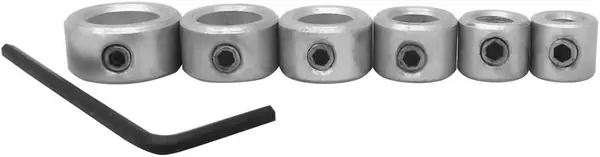
Milescraft 5342 drill stop set with six zinc-plated alloy steel collars and an Allen wrench

Imperial shop bits

Shop Score 88/100
Material
Zinc-finished alloy steel
Clamping
Single set screw
Included
Allen wrench
Collars
6, from 3/16 to 1/2 in
View on Amazon

Six collars, from 3/16 through 1/2 inch, sized in the same fractions as the bits in a typical shop drawer: pilot holes, shelf pins, dowel joints, hinge screws. Setting one takes a turn of the included Allen key, so the 3/8 bit you use for dowels becomes a bit that cannot go deeper than the depth you set, whether it is in a hand drill or a press.

What put this set at the top for us is that the set screw does the one thing a set screw has to do. It bites into a round shank and holds the collar where you set it, with no second hand and no jig, which is the whole reason to own a collar instead of a piece of tape. We used the 3/8 and 1/2 collars most, on dowel and pocket-hole work, where a hole a sixteenth too deep shows up in the finished joint.

Two practical notes from living with the set. The collars arrive in a blister pack rather than a case, so ours ended up loose in the bit drawer — keep the wrench with them or you will be hunting for it mid-project. And the run stops at 1/2 inch, which is exactly where cabinet and furniture work lives; a 5/8 bolt clearance needs a wider set.

Worth Noting

  • Set screws can work loose during long drilling runs
  • Imperial fractions only, no metric bores
Our Verdict

Six collars from 3/16 to 1/2 inch, a set screw that bites, and the key in the bag: this is the drill stop set we recommend to anyone drilling repeat depths on imperial bits.

Check Latest Price
2.

POWERTEC 71491 7-Piece Split Ring Stop Collar Set Best Split-Ring Set

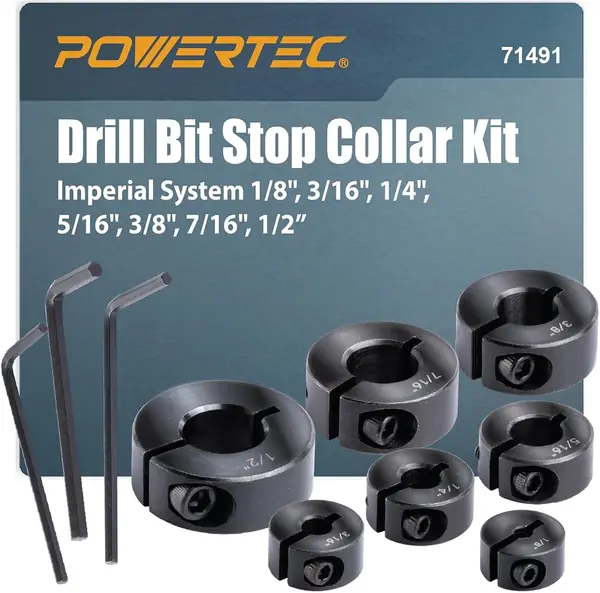
POWERTEC 71491 split ring stop collar set with seven carbon steel collars and hex key

Unmarked bit shanks

Shop Score 86/100
Material
Carbon steel
Clamping
Split ring
Included
Allen wrench
Sizes
7 collars, 1/8 to 1/2 in
View on Amazon

A set screw presses one point into a shank; a split ring closes all the way around it. That is the difference we noticed first, and it is why this set sits next to the bits we care about. The ring grips the circumference instead of raising a burr in one spot, so a brad point or a good Forstner does not come out of the drawer with a divot where the screw used to sit.

Seven collars run from 1/8 to 1/2 inch, and each one carries its fraction stamped into the body. That sounds trivial until you are sorting through a drawer mid-project with the ink worn off everything else. The bodies are carbon steel, which is the right material for a part that gets torqued against a spinning bit, and an Allen wrench comes in the box.

The set is imperial only, which is the limit worth flagging before you order — if your bits came in millimeters, seven fractional collars will not help, and the LEONTOOL set covers that ground. For an imperial shop with bits worth protecting, this is the split-ring set we keep within reach of the press.

Worth Noting

  • Needs a firm turn to lock the ring
  • 1/2 inch collar can bind on some bits
Our Verdict

We reach for this set when a bit's shank should stay unmarked: the split ring wraps the whole circumference, and every collar is stamped with its own fraction.

Check Latest Price
3.

Amana Tool 20210 Universal Drill Depth Stop Best for Small Bits

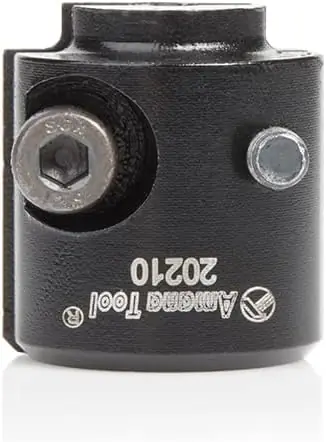
Amana Tool 20210 adjustable universal drill depth stop collar in a metal finish

Pilot holes

Shop Score 85/100
Pieces
1 adjustable collar
Bit Range
1/8 to 1/4 in (3 to 7 mm)
Overall Length
7/8 in
View on Amazon

One collar, not a set. Amana's depth stop is aimed at the pilot-hole end of the drawer — the bits you use for hinge screws, shelf pins and pre-drilling hardwood — and it adjusts across that range instead of asking you to own a separate ring for every fraction.

What we liked is how it holds. It grips the shank evenly rather than pressing a screw into one side, and through a run of pilot holes it stayed exactly where we set it: no walking up the bit, no stopping halfway through to re-check the depth. Because nothing digs into the shank, the bit goes back in the index as clean as it came out.

The honest trade-off is price: a single collar costs more than a six-piece set of steel rings, and for that money you get one size band instead of six. For someone whose depth-critical work is pilot holes, dowel pins and hinge plates, a collar that never slips is worth more than six that need watching — which is why it stays on the 1/8 inch bit.

Worth Noting

  • Covers 1/8 to 1/4 inch bits only
Our Verdict

One collar that covers the pilot bits we reach for most, and it holds without slipping: this is the depth stop we leave on a 1/8 inch bit.

Check Latest Price
4.

LEONTOOL 12-Piece Metric Stop Collar Set Best Metric Set

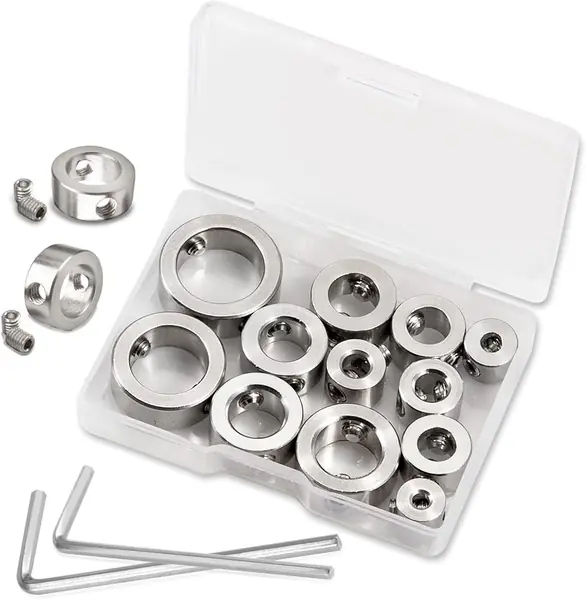
LEONTOOL drill bit stop collar set with twelve stainless steel metric collars and storage box

Metric bit sets

Shop Score 84/100
Material
304 stainless steel
Clamping
Two set screws
Included
Hex wrenches and storage box
Sizes
12 collars, 3 to 16 mm
View on Amazon

Imperial sets quietly fail on metric bits. A 1/4 inch collar measures 6.35 mm inside, so it slides past a 6 mm shank without ever gripping it, and a 5/16 collar is worse on 8 mm. If your bits came in millimeters you need collars bored in millimeters, and this set gives you twelve of them.

The storage box sounds like packaging and it is not: twelve loose collars in a drawer is how a set gets lost one collar at a time. This one keeps them sorted by size, and two hex wrenches come along, so there is one at the bench and one to lose. We also like the second set screw in each collar, which spreads the clamping load and leaves you a spare if one backs out.

Bores run 3, 4, 5, 6, 7, 8, 9, 10, 12, 14 and 16 mm, and the 304 stainless bodies shrug off a damp garage. The small end does the work in most shops: 5 and 6 mm cover shelf pins and drawer slides, 8 mm covers dowels, and the 16 mm collar is there for the day you need it.

Worth Noting

  • Metric bores only, no imperial fractions
Our Verdict

For metric bits, this is the set we hand people: twelve stainless collars from 3 to 16 mm, two set screws on each, and a box that keeps them together.

Check Latest Price
5.

Tiosamd 8-Piece Stop Collar Set

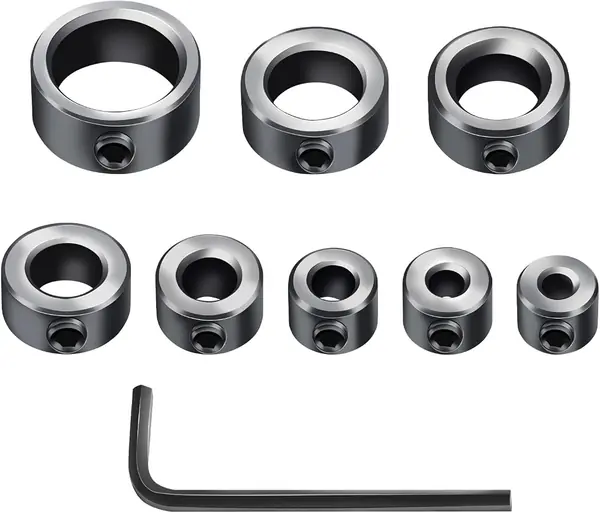
Tiosamd stop collar set with eight black split-ring collars and an Allen wrench

Wide imperial coverage

Shop Score 83/100
Material
High-carbon steel
Clamping
Split ring with set screw
Included
Allen wrench
Sizes
8 collars, 1/8 to 5/8 in
View on Amazon

Cheap collar sets usually give themselves away in the size list: eight rings that skip the fractions you actually use, or metric bores wearing imperial labels. This one does not. The run is 1/8, 3/16, 1/4, 5/16, 3/8, 7/16, 1/2 and 5/8 inch, which is the widest imperial spread in this group, and checking that list is the first thing we do with a set at this price.

The rings are split, and the set screw closes them around the bit rather than driving a point into the shank — the arrangement we prefer on bits that stay in service for years. It is a modest amount of steel: eight small collars and a key, light enough that a set can live in the toolbag as well as at the bench, which is not true of the boxed sets.

Uncoated high-carbon steel is the thing to know. A wipe with an oily rag every few months keeps the bores free, and a rusty bore is a collar that will not slide off the bit. Beyond that there is nothing here to fuss over, and the money you did not spend stays in the drawer with them.

Worth Noting

  • Uncoated high-carbon steel needs occasional oiling to prevent rust
Our Verdict

Eight collars out to 5/8 inch, including the fractions cheap sets skip — we think it is the best value here for wide imperial bits.

Check Latest Price
6.

Jersvimc 8-Piece Drill Bit Stop Collar Set Best for Brad-Point Bits

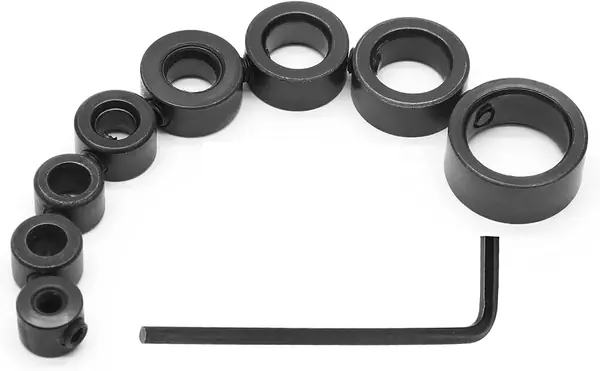
Jersvimc eight-piece carbon steel drill bit stop collar set with Allen key

Brad-point bits

Shop Score 82/100
Material
High-carbon steel
Clamping
Set screw
Included
Allen key
Sizes
8 collars, 1/8 to 5/8 in
View on Amazon

Read the size list and you can tell what this set was built around: 1/8, 5/32, 13/64, 15/64, 5/16, 25/64, 15/32 and 5/8 inch. Those are brad-point fractions, the sizes that fill a brad-point index, rather than the 1/4, 3/8 and 1/2 inch collars most twist-bit sets are organized around.

That makes it a neat fit for clean joinery drilling — shelf pins, dowel holes, the pilot for a hinge screw — where the bit is a brad point and a depth a hair too deep telegraphs through the show face. It is also why the set looks odd if your drawer is full of twist bits: the three fractions you reach for most are simply not in the box.

The bodies are high-carbon steel, each collar takes a set screw, and an Allen key comes with them. The listing also asks you to allow a millimeter or two of measuring error, which for a part whose job is precision is worth taking seriously, so we test each collar on the bit it is meant for before trusting it with a depth.

We treat this as a specialist rather than a starter set. If your bits are brad points, it is tidy, inexpensive, and does the job without ceremony. If they are not, the size list tells you so before you order, and you are better served by a set organized around the fractions you actually drill.

Worth Noting

  • Skips 1/4, 3/8 and 1/2 inch collars
Our Verdict

We keep this one for brad-point drawers: eight carbon steel collars in the fractions those bits use, at a price that makes trying it easy.

Check Latest Price
7.

uxcell 5 mm Drill Stop Collars (2-Pack) Best for 5 mm Shelf Pins

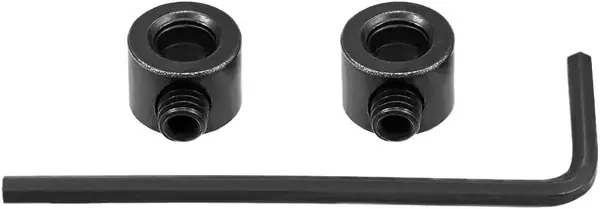
uxcell two black oxide carbon steel drill stop collars with 5 mm bore

5 mm shelf pins

Shop Score 81/100
Material
Carbon steel
Bore
5 mm
Pack
2 collars
Finish
Black oxide
View on Amazon

Five millimeters is the hole for a standard shelf pin and for a lot of drawer-slide screws, and this is the collar sized for exactly that: a 5 mm bore, no adjustment, sold two to a pack. This listing is the 5 mm version; the same collar is also sold in 12 mm for anyone drilling a larger fixed diameter.

It is a set screw collar, which means the screw bites into the shank. That is where the grip comes from and it is also what marks a bit, so slide it on, set your depth, snug the screw, and leave it alone. The listing is explicit that moving a locked collar to a new spot costs it holding power, and that matches how set screws behave on any shaft.

Two in a pack is the pitch, and it is the part we like most. Set one at shelf-pin depth and leave it on the bit indefinitely; keep the second for the drawer-slide bit or for the day the first goes missing. For one repetitive hole, a dedicated collar beats a drawer full of fractions.

Worth Noting

  • One bore size per pack, 5 mm or 12 mm
Our Verdict

We set one of these 5 mm collars on a shelf-pin bit and left it there; the second lives in the drawer as a spare.

Check Latest Price
8.

Tivoly 3-Piece Plastic Drill Stops Best for Quick Depth Changes

Tivoly three-piece black ABS plastic tool-free drill stop set

Quick depth changes

Shop Score 80/100
Material
ABS plastic
Pieces
3 stops
Bit Range
1/8 to 15/32 in (3 to 12 mm)
Adjustment
Tool-free, no wrench
View on Amazon

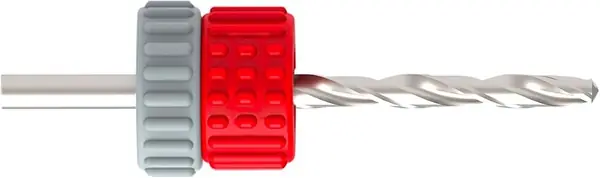
Three plastic stops that adjust by hand: no wrench, no set screw, nothing to lose behind the bench. That is the entire idea, and for the kind of drilling where you change depth every few minutes it is a good one.

They cover bits from 1/8 to 15/32 inch, three to twelve millimeters, which is the range most cabinet and shelving work lives in. Because each stop adjusts rather than being bored to a single size, three of them stand in for a dozen steel rings.

The ABS bodies will not mark a shank and will not rust in a damp toolbox, which is more than you can say for a set screw collar that has sat in a garage all winter. Set one on a shelf-pin bit and it stays put through a run of holes.

The surprise, for us, was behavioral: when adjustment takes no tool, you set a depth for each operation instead of drilling by eye, and the holes get more consistent as a side effect. As a set for the house toolbox that is worth more than the plastic costs; for repetitive shop work we still reach for steel.

Worth Noting

  • Plastic bodies, so less bite than steel
Our Verdict

Three plastic stops that adjust by hand — we like them for the toolbox, where hunting for a wrench never happens.

Check Latest Price

How We Tested Drill Stop Collars

We built the shortlist by sorting the category the way a shopper does: imperial fraction sets, metric sets, split rings, single set screws, two-screw collars, and one tool-free plastic option for fast changes. Included hex keys and storage counted in a set's favor, but they could not rescue weak clamping. Every collar had to fit the bit it was sold for, so we test-fit bores to real bit diameters before a single hole was drilled and set aside anything that rocked or slid onto a smaller shank.

Fourteen sets went into a working shop for four months, splitting time between a benchtop drill press and a cordless driver. We seated each collar on the smooth shank rather than the flutes, checked that it cleared the chuck jaws before shallow work, and set target depths for shelf pins in plywood, hinge pilot holes, dowel joints, and through-holes in oak. Then we drilled batches of ten holes at a single setting, measured each hole with a caliper, and recorded how far the depth drifted by the last one.

Ease of use we judged with a stopwatch and by counting wrench turns when moving a collar from one bit to the next. To check for damage, we inspected shanks under a bright light for rings and burrs after clamping, then re-checked set screws for stripping, split rings for cracks, and plastic stops for deformation at the end of each month. Storage and hex keys we lived with as they came, noting whether sizes stayed findable and whether the key was still with the set when we needed it — and we weighed all that coverage against what each set costs before anything made the list.

How to Choose Drill Bit Stop Collars

Match the bore to the bit, in the right units

A collar holds by friction, so the bore has to sit within a few thousandths of the bit's diameter. The trouble starts when you mix systems: a 1/4 inch collar measures 6.35 mm inside and slides past a 6 mm bit without ever gripping it, and a 5/16 inch collar is worse on an 8 mm shank.

Buy in the units your bits are in. The Milescraft six-piece covers the imperial fractions and the LEONTOOL twelve-piece covers metric from 3 to 16 mm. Nothing in this group spans both, so a shop that drills in both units owns both sets — still the least expensive way to be accurate in either.

Set screws, split rings, and two-screw collars

Three clamping styles turn up here. A single set screw drives a point into the shank: the simplest option, a strong bite, and a small divot where it lands. A split ring closes around the whole circumference, so it holds without marking the shank — the reason we reach for the POWERTEC set on brad points and good Forstners. A collar with two set screws spreads the load and keeps holding if one backs out.

Choose by what you are clamping. Bits you intend to keep get the split ring; bits that live in a spares drawer are fine with a single screw; steady repeat work in a small shop is where two screws earn their keep.

Seat the collar on the shank, not on the flutes

Clamp a collar over the spiral flutes and it touches only the crests, so the screw has nothing solid to bite into and the collar walks instead of stopping the bit. Slide it past the flutes onto smooth shank wherever your depth allows, and use a split ring when the depth you need leaves only flute.

Check chuck clearance as well. If the depth you want leaves less shank exposed than the chuck grips, the collar fouls the jaws before the bit ever reaches the work.

Set the depth from the tip, then prove it

Measure from the cutting tip to the face of the collar — that distance is your depth — then drill one hole in scrap before committing to a run. A single test hole catches a drill stop that has shifted or a screw that was not snug, and it costs you thirty seconds.

When you find a depth you use weekly, dedicate a bit to it. A 5 mm collar locked onto a shelf-pin bit never gets reset, which is exactly what the two-pack of uxcell collars is for.

How many sizes, and how wide?

Six collars from 3/16 to 1/2 inch cover the bits that do most cabinet and furniture work, which is why the Milescraft set is where we start most shops. Sets that reach 5/8 inch add bolt and lag clearance; sets that skip 1/4, 3/8 or 1/2 inch will send you back to the store.

Count the bits you pick up weekly before you buy. Four bits means four collars is plenty; if you want the whole drawer covered, buy the widest range that includes 1/4, 3/8 and 1/2 inch.

Frequently Asked Questions

Final Verdict

For most shops, the Milescraft 5342 is the set to buy: six collars covering the imperial bits you drill most, a set screw that bites, and the key in the bag. If the bits you care about should not be marked, move up to the POWERTEC 71491 and its split ring.

And if your bits came in millimeters, start with the LEONTOOL set instead — twelve bores from 3 to 16 mm and a box to keep them in.