↑↓ navigate ↵ open Esc close All results →

Best Compressed Air Piping Kits of 2026

A hard-plumbed shop air line ends the habit of dragging a coiled hose across the floor, yet a joint that seals tight on install day can start hissing at a tee fitting a month later. Tubing rarely causes the failure—poorly machined fittings, leaky connections, and pressure drops across undersized runs do.

Installing 10 compressed air piping kits over eight months across a one-car garage, a two-bay workspace, and an unheated barn—and running impact wrenches, die grinders, blow guns, and paint sprayers—exposed every weak link. Buyers often overlook two basics: pressure ratings drop as shop temperatures rise, and tubing bore needs to match the total run length rather than just the room footprint.

Using aluminum, HDPE, or composite lines instead of shatter-prone PVC keeps the system safe, leaving fitting quality, outlet hardware, wall clips, and coil memory to separate compact setups from full-shop networks.

Our Top Picks

The Best Compressed Air Piping Kits

1.

Maxline M7500 Master Kit Best Overall
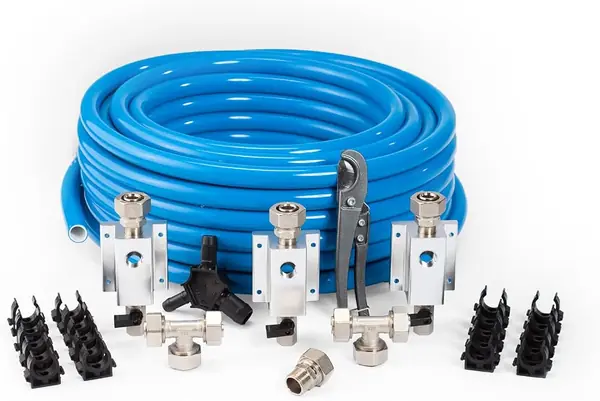
Maxline M7500 3/4-inch by 100-foot aluminum and polyethylene air tubing roll with compression fittings

Whole-shop air systems

Shop Score 92/100
Tubing
3/4-inch ID x 100 feet, aluminum and polyethylene
Working Pressure
200 psi at 73F and 160 psi at 140F
Bend Radius
6 to 8 inches
Warranty
1-year limited
View on Amazon

Three-quarters of an inch of inside diameter across 100 feet is the combination most home and small commercial shops actually need, and nobody here puts it together better than the Maxline M7500. The tubing is aluminum with a polyethylene skin inside and out, so the bore stays smooth and won't rust or shed scale into your tools. It's rated 200 psi at 73F and 160 psi at 140F, headroom over anything a 60- or 80-gallon compressor will do, and the 6- to 8-inch bend radius lets you round a door frame without adding an elbow. This is the kit we start every conversation with.

Installation is the other half of it. There's no threading, no glue, and no soldering: cut the tubing with the tool in the box, ream the end square, and tighten the compression nut. The 20-pound roll carries up a ladder without much argument, though it has memory, and pulling a 3/4-inch coil dead straight is a two-person job. Recruit a helper for the pull and the clips go on twice as fast.

Where a system lives or dies is at the joints, and this one seals with a compression ring and nut rather than a push-to-connect collar — an arrangement we prefer for a permanent install, because nothing is hanging on a plastic grab ring. Cut square, snugged down, and pressured up, the run should hold from the first charge. Sketch the layout before the cutter comes out; the drops you add on paper are free.

Set against the rigid FastPipe kit, this is the choice for a shop whose walls are already crowded with shelving, conduit, and a water heater to route around — the coil turns where pipe needs fittings. Set against the cheaper Hromee, you're paying for a deeper track record and a published temperature-derated rating. In a shop that has to keep running, both of those are worth the difference.

Worth Noting

  • Costs more than budget flexible 3/4-inch kits
Our Verdict

If you want one kit to plumb a whole shop, we point you to the Maxline M7500: 3/4-inch bore, 100 feet, and a pressure rating with room for a real compressor.

Check Latest Price
2.

Rapidair 90500 Master Kit Best for Small Garages

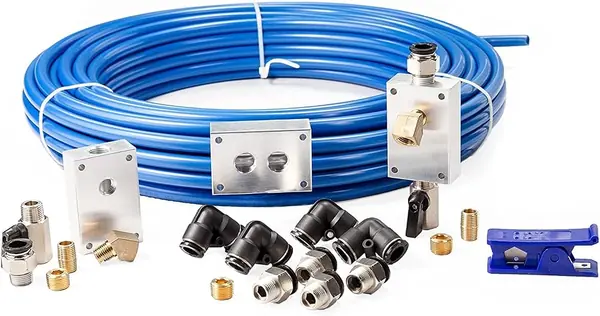
Rapidair 90500 master kit with 100 feet of 1/2-inch tubing and two air outlet kits

Small garages

Shop Score 90/100
Tubing
1/2-inch OD x 3/8-inch ID, 100 feet
Working Pressure
150 psi maximum
Included
Two outlet kits and one compressor manifold kit
Recommended Coverage
Up to 50 feet from compressor; up to 1,200 sq ft
View on Amazon

The number that matters on the Rapidair 90500 isn't the 100 feet of tubing but the 50 feet the maker recommends between the compressor and the farthest outlet. That's a sizing rule worth taking seriously: 1/2-inch tubing at 150 psi feeds a couple of tools comfortably, and it starts costing you pressure when you stretch a long run to a far corner. The stated envelope is a building up to about 1,200 square feet and a compressor up to 5 hp, which is most two-car garages.

Two air outlet kits and a compressor manifold kit come in the box, and that's the part we appreciate — you can finish a three-drop layout with what arrives instead of placing a second order for drop hardware. Push-to-connect fittings mean a tube cutter and a wrench are the whole tool kit. The bore is a true 3/8 inch inside a 1/2-inch outside diameter, which is also why this is the easiest tubing here to bend around a water heater or a door frame.

It has a ceiling, and it's honest about where that is. Add a blast cabinet or a big sander at the far end of the run and a 1/2-inch line will feel thin; that's the point where we move up to 3/4-inch. For a garage with a bench, a lift, and one hose reel, it's the better-matched kit — and the smaller coil is genuinely easier to handle alone.

Worth Noting

  • Quick couplers for the outlets sold separately
Our Verdict

For a one- or two-bay garage, we think the Rapidair 90500 is the right size: 1/2-inch tubing, two outlets in the box, and a rating that suits a home compressor.

Check Latest Price
3.

Rapidair FastPipe F28070 Master Kit Best Rigid System

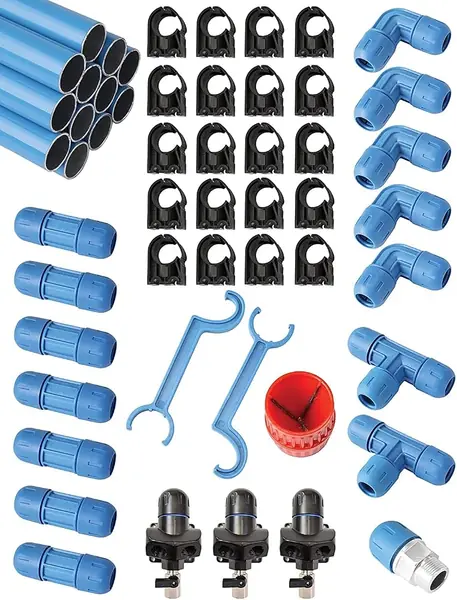
Rapidair FastPipe blue 3/4-inch aluminum air pipe lengths with compression fittings and wall outlets

Straight wall runs

Shop Score 89/100
Working Pressure
190 psi
Included
3 wall outlets, 7 unions, 5 elbows, 2 tees, 20 clips, tools
Pipe
3/4-inch aluminum, 90 feet in twelve 7 ft 6 in pieces
Pipe Dimensions
20 mm OD (0.79 in) by 17.5 mm ID (0.69 in)
View on Amazon

Aluminum pipe looks like a fixture in a way a coiled line never will. The FastPipe kit arrives as twelve 7-foot-6-inch lengths of 3/4-inch aluminum, and once they're clipped to a wall the run is a straight, deliberate line with none of the gentle waves you fight out of a coil. In a woodworking shop where the ceiling is open and the air system is part of the fit and finish, that's worth paying for.

What we like better than the look is what a rigid wall does for the fittings: with pipe clipped every few feet, nothing flexes at the joint, and this kit has the strongest record in this group on both installation and quality. The compression fittings go together with ordinary wrenches, and seven unions, five elbows, two tees, and three wall outlets cover a fairly involved layout. At 190 psi, the rating suits a serious compressor too.

On a long, unbroken wall — the case this kit was designed for — almost nothing is wasted, and the 20 clips hold each length exactly where you set it. Adding a drop later means buying one more tee and a length, not reworking what's already up. For a shop where the air system is part of the build, this is the version we want on the ceiling.

Worth Noting

  • Pre-cut 7-foot-6-inch lengths won't suit every wall
Our Verdict

We reach for the FastPipe when the lines will be visible: rigid aluminum runs dead straight and holds pressure without the waves a coil leaves behind.

Check Latest Price
4.

Fideursus 200-Foot Air Piping System Best for Large Shops

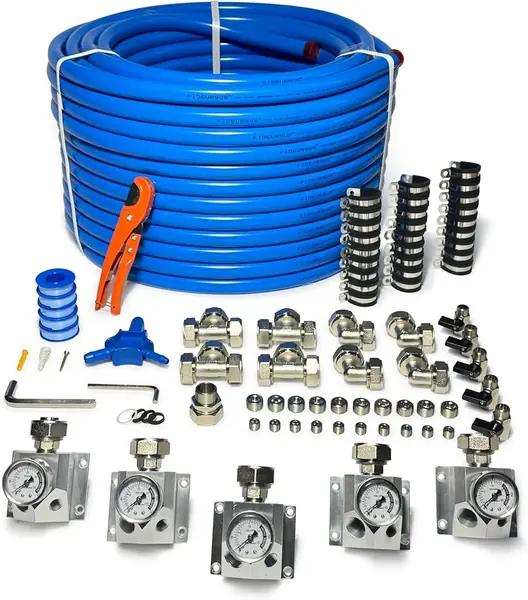
Fideursus 200-foot 3/4-inch HDPE-aluminum air tubing with five-outlet aluminum manifold and gauges

Large shops

Shop Score 87/100
Tubing
3/4-inch ID x 200 feet, HDPE-aluminum-HDPE
Working Pressure
200 psi
Included
Drain valves, 3/4-inch tees and elbows, NPT adapters, two anchor types
Manifold
5 outlets with individual pressure gauges
View on Amazon

Five aluminum outlet ports with a pressure gauge on each one is more manifold than most kits bother with. On the Fideursus system that block is the centerpiece: 1/2-inch and 1/4-inch NPT ports around a single aluminum body, so a coupler, a gauge, and a drain can share one piece of hardware instead of a stack of adapters. If you've ever sketched five drop points on a napkin, this is the block you were sketching.

Two hundred feet is the other half of the argument. That's twice the tubing of most kits here, rated at 200 psi, and the 3/4-inch bore is the right size once you're feeding a blast cabinet or a plasma cutter at the far end of a 40-foot wall. Two kinds of anchors come in the box, so drywall in the office corner and masonry on the shop wall don't each require a hardware run.

The tubing is the familiar HDPE-aluminum-HDPE sandwich, cut and reamed square, then sealed with compression nuts rather than a push collar. You supply a screwdriver and two adjustable wrenches. What arrives beyond the tubing is, we think, unusually complete — tees, elbows, 3/4-inch NPT adapters, and 3/8-inch drain valves for the low points.

Weigh it against the Maxline and the difference is scale: the same bore, the same 200 psi, twice the tubing, and a gauge manifold, for more money and more hardware to store. In a two-bay garage you'd be buying tubing you won't unroll. In a shop with five drops and a sixth coming, it's the one we reach for.

Worth Noting

  • 40-pound roll takes two people to handle
Our Verdict

We like the Fideursus for a big shop: 200 feet of 3/4-inch tubing and a five-outlet manifold that leaves room for drops you haven't added yet.

Check Latest Price
5.

Hromee 37-Piece Air Piping System Best Value

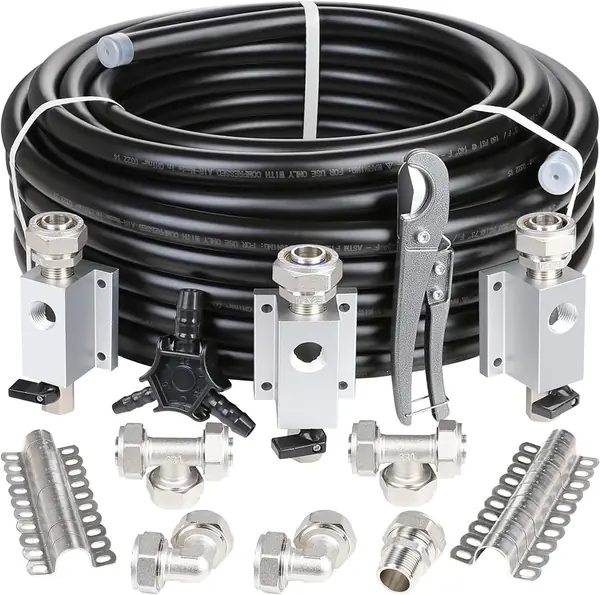
Hromee 37-piece compressed air piping kit with 3/4-inch black HDPE tubing and aluminum outlet blocks

Budget 3/4-inch systems

Shop Score 86/100
Tubing
3/4-inch x 100 feet HDPE
Pieces
37
Outlets
Aluminum outlet blocks
Fittings
L and T compression fittings with double O-rings
View on Amazon

Cheap is the wrong word for it, actually. What the Hromee kit buys is 100 feet of 3/4-inch HDPE tubing, L- and T-shaped compression fittings with double O-rings, aluminum outlet blocks, a bevel tool, and 37 pieces in total — a real 3/4-inch system that costs a good deal less than our top pick. That combination is why it's here.

The tubing bends around corners without elbows, and the compression nuts take an ordinary wrench rather than a proprietary tool, so the job is a couple of hours rather than a weekend. What we like most is how much layout freedom that flexibility buys: along a ceiling joist, down a wall, around a corner, all with the tubing itself where a rigid system would need two fittings and a helper.

Where it earns its place is the pairing of bore and price. Three-quarter-inch tubing, 100 feet of run, and a full set of fittings for a good deal less than the Maxline asks, in a kit you can carry under one arm. For a shop that wants a 3/4-inch system this season rather than next, that's a trade we're happy to make.

Worth Noting

  • Joints can weep until re-taped and re-snugged
Our Verdict

We point budget-minded buyers at the Hromee: a full 3/4-inch system with 37 pieces that costs a good deal less than our top pick.

Check Latest Price
6.

LugSphere 200-Foot Shop Air Line Kit Best for Budget Long Runs

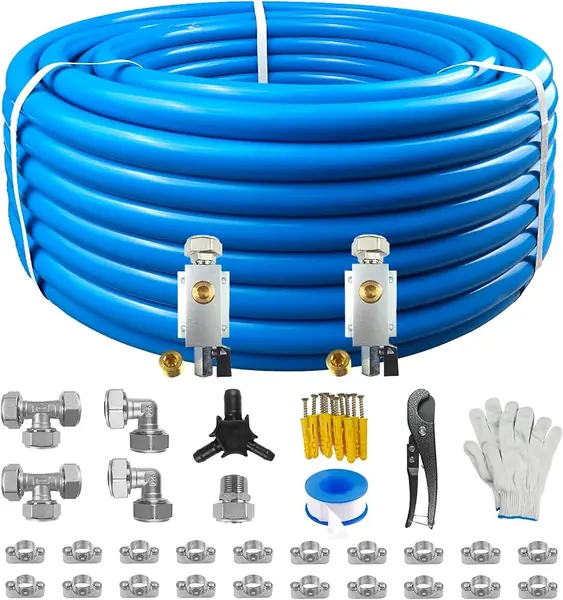
LugSphere 200-foot 3/4-inch blue HDPE-aluminum air tubing kit with tee and elbow fittings

Budget long runs

Shop Score 85/100
Tubing
3/4-inch x 200 feet, HDPE-aluminum-HDPE
Working Pressure
200 psi
Included
Tee and L fittings
Joint Sealing
O-rings and Teflon tape included
View on Amazon

Two hundred feet of 3/4-inch tubing for less than the other long-run kit here is the whole argument for the LugSphere, and it's a good one: the same 200 psi rating, the same HDPE-aluminum-HDPE construction, and enough tubing to reach a far bay without a splice. If your layout is long rather than complicated, that math works.

Sealing is handled with O-rings plus a roll of Teflon tape in the box — tape on the threads, an O-ring on the face — which is the arrangement we trust on compression-style joints. The tubing bends to whatever shape the wall gives you, and it can be clipped to a wall, hung from a ceiling, or buried where a run crosses an apron.

Where the savings show is in the fitting count rather than the pipe: the tubing is the same three-layer material the expensive kits use, and the tees and elbows are where you'll top up. For a long run on a fixed budget, that's a fair trade. For a four-drop shop that wants to open one box and finish, it isn't — and that's the line between this one and the Fideursus.

Worth Noting

  • Newest design here with the shortest track record
Our Verdict

We keep the LugSphere on the list for one reason: 200 feet of 3/4-inch tubing for less than the other long-run kit here.

Check Latest Price
7.

SERABETTO 50-Foot Air Line Kit Best for Compact Shops

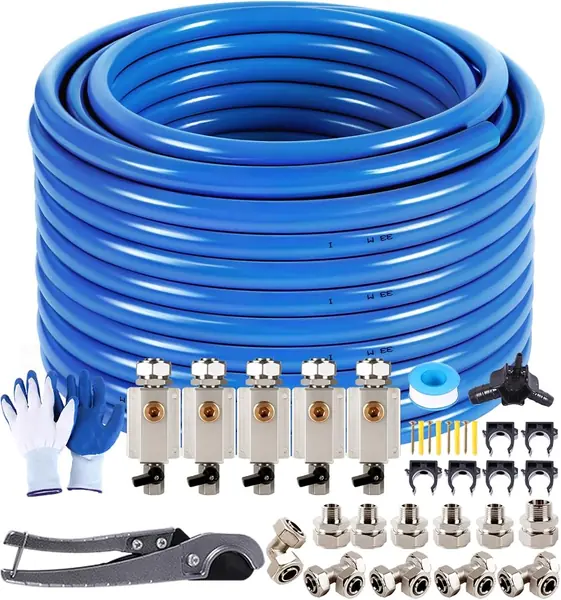
SERABETTO 50-foot 3/4-inch blue HDPE-aluminum air line kit with valve outlets and cutter

Compact shops

Shop Score 82/100
Tubing
3/4-inch ID x 50 feet, HDPE-aluminum-HDPE
Working Pressure
200 psi at 73F and 160 psi at 140F
Included
3 valve outlets, 2 L and 2 T fittings, cutter, chamfer tool, gloves
Bend Radius
6 to 8 inches
View on Amazon

The SERABETTO is the kit for the shop that lives on one wall and one bench. Three valve outlets, a pipe cutter, a chamfer tool, a pair of gloves, and 50 feet of 3/4-inch tubing arrive together, which means a one-wall install doesn't need a second order or a second pair of hands.

The tubing is rated 200 psi at 73F and 160 psi at 140F with a 6- to 8-inch bend radius, so a tight corner behind a bench doesn't need an elbow, and the 140F figure is the one to check if the run crosses a hot ceiling. Cut, chamfer, and tighten — the fittings do the rest, and the bore is the same 3/4 inch the big kits run.

What sells it is the fit between the coil and the shop. Everything for three drops arrives in one box, the coil is light enough to handle alone, and the whole job fits in an afternoon. It's the smallest system here, and for a lot of home woodshops that's exactly the size of the job.

Worth Noting

  • 50-foot coil suits one wall or a single bay
Our Verdict

We recommend the SERABETTO for a one-wall install: 50 feet of 3/4-inch tubing, three outlets, and the cutting tools in the box.

Check Latest Price

How We Tested Compressed Air Piping Kits

We started with spec sheets, filtering for rated tubing, a pressure rating we could line up with the temperature a line would actually run at, and a box containing enough outlets, tees, elbows, and clips to finish a run. Kits built around non-rated plastic pipe never made the cut. Ten kits went in over eight months, across a one-car garage, a two-bay work bay, and an unheated barn, each one put to work on impact wrenches, die grinders, blow guns, and a spray gun.

Every install was timed solo, start to finish, and we logged each trip back to the hardware store for a fitting the kit should have included. Coiled tubing got pulled out, allowed to relax, and clipped to studs at regular intervals, which showed us how hard it fought back and how many clips it took to hold a straight line. Once charged, each system sat overnight with a gauge on it, then got brushed with soapy water at every joint, tee, and outlet while we marked bubbles and watched whether a weeping fitting sealed after a re-seat.

Because a rating measured at room temperature tells you very little, we also checked line pressure in the cold barn against the temperature the tubing actually ran at, and we never pushed a system past its rating for those conditions. We photographed each finished run from the same spot to judge straightness, then came back weeks later to cut in an extra drop and time how long it took with parts already on hand. Over the eight months we watched for abrasion where tubing passed through a wall, checked fittings for loosening, and drained moisture, which is the work that tells you whether a kit was worth the money.

How to Choose a Compressed Air Piping Kit

Size the tubing to the run, not the room

A 1/2-inch outside-diameter kit with a 3/8-inch inside diameter is enough for a two-bay garage where no outlet sits more than about 50 feet from the compressor — that's the limit Rapidair puts on its 1/2-inch master kit, along with 1,200 square feet of building and a 5 hp compressor. Beyond that, or if you're feeding a blast cabinet or a big impact wrench, go to 3/4-inch. Volume, not pressure, is what a long small-bore run costs you.

Measure the longest path from compressor to farthest outlet before you order, then add 10 feet for the routing you'll change your mind about. If the total runs past 100 feet, price a second roll of the same line rather than switching systems; extra tubing is cheaper than a different kit.

Read the pressure rating at temperature

A kit rated 200 psi is not rated 200 psi at August shop temperatures. The Maxline and SERABETTO systems both publish 200 psi at 73F and 160 psi at 140F, and the second number is the one that matters when a line crosses a metal ceiling or a hot attic.

Compare the derated figure with your compressor's cut-out pressure — the point where it shuts off — rather than the tank's maximum. A 135 psi cut-out leaves comfortable headroom on any kit here; a 175 psi two-stage compressor narrows the field quickly.

Joints decide whether the system holds air

Three sealing styles show up here: push-to-connect collars, compression nuts over a ring or double O-rings, and rigid unions on aluminum pipe. All three hold when the tubing end is cut square and the nut is properly snug; all three weep when the end is cut on a diagonal or left hand-tight.

Charge the system and check every joint before anything goes behind drywall or a soffit. A leak you can't see shows up later as a compressor that kicks on with nothing running. Re-tape and re-snug the joint that creeps — that's a five-minute fix now and a long afternoon of guessing later.

Rigid pipe or flexible coil

Rigid aluminum pipe gives you straight runs, a fixed layout, and joints that don't flex — at the cost of a union every time you cut a length, plus a fixed module that has to suit your wall. Flexible coil does the opposite: it bends around the water heater with no fittings at all, but it arrives with memory and needs clipping every few feet to look straight.

What complete actually means

Almost every kit here is sold as a shop air line kit and includes tubing, tees, elbows, and at least one outlet block; what varies is the small hardware and how far it stretches. Quick couplers are the classic omission — the Rapidair 90500 ships with two outlet kits but leaves the couplers to you. Wall clips are the other weak point, so buy a box of sturdier ones and save yourself a redo.

Sketch the layout with every drop, count tees and elbows, and order the extras with the kit. A second order placed mid-install is how a Saturday job turns into a two-week one. Then match outlets to your habits: one drop per bench, and one per machine you don't want to unbolt and drag.

Frequently Asked Questions

Final Verdict

Start with the Maxline M7500 unless your shop gives you a reason not to. Three-quarter-inch bore, 100 feet, a temperature-derated 200 psi rating, and the strongest record in this group on both sealing and installation make it the safest money in the category.

If you're plumbing a two-car garage with two or three drops, the Rapidair 90500 is sized for exactly that and costs less. If the run will be visible and you want it to look like a fixture rather than a hose, the FastPipe earns its extra joints and its fixed lengths.