↑↓ navigate ↵ open Esc close All results →

Best Corded Hammer Drills of 2026

Against cured concrete or block, an underpowered drill simply spins a masonry bit and polishes the surface instead of breaking aggregate. Driving anchors cleanly takes real impact energy delivered to the bit tip, paired with a safety clutch that protects wrists when rebar binds and vibration damping sturdy enough for two-handed control.

Running 11 corded hammer drills and rotary hammers over eight months across slabs, block walls, tile, and stucco—always with eye protection, hearing protection, and the auxiliary handle locked in—made the divide between tool classes unmistakable. Compared with a dedicated SDS-Plus rotary hammer, a conventional keyed-chuck hammer drill feels sluggish on dense concrete, proving that impact energy matters far more than the amperage printed on the box.

Tool weight dictates comfort too: heavy demolition-ready rotary hammers shine downward on slabs and wear arms out overhead, while lighter drills handle wood and occasional masonry alongside decent case kits and warranties.

Our Top Picks

The Best Corded Hammer Drills

1.

ENEACRO ENRH3201 SDS-Plus Best Overall
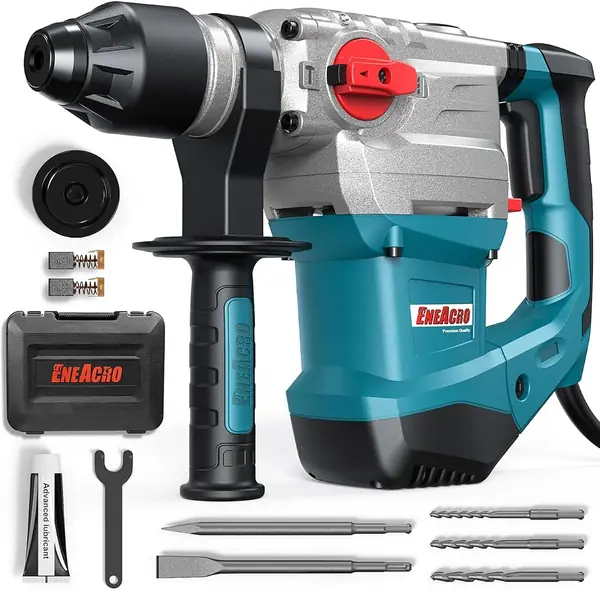
ENEACRO ENRH3201 corded SDS-Plus hammer drill in blue with case and bits

Concrete and tile

Shop Score 92/100
Motor
13 A (1,500 W)
Tool Weight
12.6 lb
Impact Energy
5.5 ft-lb (7.4 J)
Max Concrete Diameter
1-1/4 in.
View on Amazon

Three SDS-Plus bits and two chisels ride in the case, which is the detail that turns the ENRH3201 from a hole-driller into a demolition tool on day one: a tile floor or a mortar bed comes up without a second shopping trip. Behind that kit sits a 13-amp motor with 5.5 ft-lb (7.4 joules) of impact energy and a 1-1/4-inch concrete capacity — the most impact energy of anything on this page.

What we appreciate most is how little the tool asks of you. The mode selector clicks between straight drilling, hammer drilling, and chisel-only work, the 360-degree handle and safety clutch keep a bit that grabs in rebar from spinning the tool out of your hands, and the hammer does the cutting as long as you let it rather than leaning on it. The price of all that force is 12.6 pounds, the heaviest tool here; at chest height the weight is unbothered, and a ceiling of anchors becomes a two-hand job with breaks.

Bit sizes are the one thing to check before the first hole: the included bits are 8, 10, and 12 mm, so if your anchors call for a 3/16-inch hole you will be ordering a set. The kit does cover the consumables that fail first, a pot of gearbox grease and a spare pair of carbon brushes, which is the difference between a tool you maintain and one you replace.

Worth Noting

  • Case has no room for extra bits
Our Verdict

We think this is the corded hammer drill most people should buy: 13 amps, the most impact energy in this group, and a kit that drills and chisels out of the case.

Check Latest Price
2.

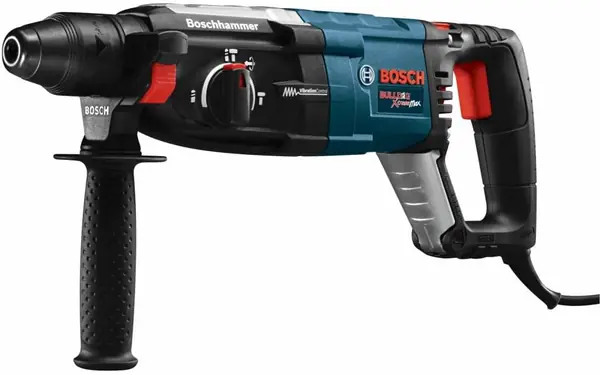
Bosch GBH2-28L Bulldog Xtreme Max Best for Overhead Work

Bosch GBH2-28L Bulldog Xtreme Max SDS-plus hammer drill in black

Overhead drilling

Shop Score 91/100
Motor
8.5 A (850 W)
Tool Weight
6.4 lb
Impact Energy
2.4 ft-lb
Max Capacity
1-1/8 in.
View on Amazon

Under six and a half pounds is what separates this Bosch from the 13-amp tools here. Held beside the 12.6-pound ENEACRO, the GBH2-28L is the one we hand someone facing a basement ceiling full of anchors, because the arm is still steady at the last hole rather than the third. It gives up raw force to get there — 2.4 ft-lb of impact energy from an 8.5-amp motor, against 5.5 ft-lb at the top of this set — and for 3/8- and 1/2-inch holes in old concrete that is still the right side of enough.

Two systems earn the money. KickBack Control uses an integrated sensor to stop rotation when a bit binds, which is exactly the moment a big bit tries to take the tool out of your hands; counter-balanced vibration control cuts the buzz that leaves your fingers tingling after twenty holes. Vario-Lock rotates and locks a chisel to the working angle instead of making you fight the tool into position, and the variable-speed trigger with reverse lets you start a hole slowly on tile or a finished face.

The spend goes to refinement rather than output. This is the most expensive drill on the page, and what it buys is a tool you can run one-handed at shoulder height, which none of the 12-pound picks manage. If your masonry work is a handful of anchors a year, the heavier 13-amp tools are the better trade.

Worth Noting

  • Bare tool only, no bits or chisels
Our Verdict

We recommend the Bosch to anyone who drills concrete often enough to feel the tool by lunchtime: 6.4 pounds, low vibration, and a sensor that stops a bind-up.

Check Latest Price
3.

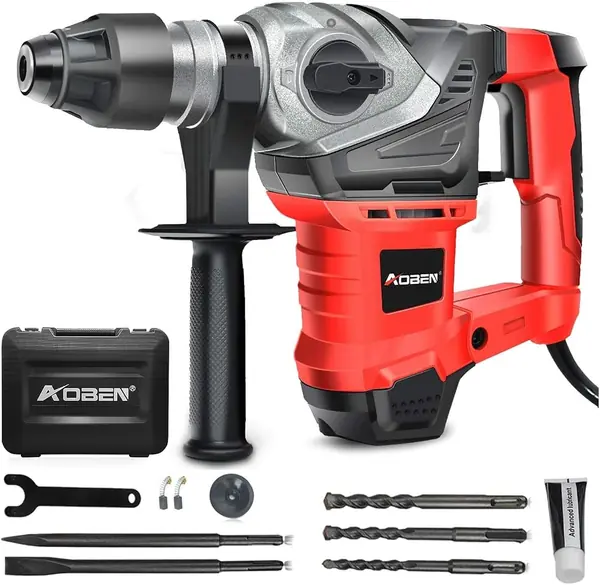
AOBEN AB2132ZA Best Value

AOBEN AB2132ZA 13-amp SDS-plus hammer drill with chisels and case

Budget demolition

Shop Score 90/100
Motor
13 A (1,500 W)
Tool Weight
12 lb
Max Concrete Diameter
1-1/4 in.
Included Tooling
Three bits and two chisels
View on Amazon

Same 13 amps, same 1-1/4-inch concrete capacity, and a good deal less money than the top pick: on paper the AB2132ZA gives up nothing that matters for setting anchors or breaking out a small slab. The box matches the bigger names too — three SDS-Plus bits, a flat chisel, a point chisel, a dust boot, spare carbon brushes, motor lubricant, and a case.

What we noticed in use is refinement, not capability. The three modes switch with a plain lever, the rubber overmold and 360-degree handle take most of the sting out of hammer-only work, and the safety clutch lets go when a bit jams rather than winding your wrist. It chisels a patio edge and drills a run of anchor holes without complaint; what it does not do is make those jobs feel as smooth as the Bosch does.

Where this one earns its place is the arithmetic of a single project. If a tile floor is coming out or a dozen anchors are going into a foundation, and the tool then goes on a shelf, the AOBEN spends a fraction of the Bosch money and leaves you owning chisels either way. Our reservation is how long it lasts rather than how hard it hits: this is a tool to use hard for one renovation rather than hand down, and the one-year warranty says as much.

Worth Noting

  • Heavy at 12 lb for overhead work
Our Verdict

For one big masonry project on a tight budget, the AOBEN gives you 13 amps and a full chisel kit for the least money of the big motors here.

Check Latest Price
4.

Berserker 26FA Best Middleweight

Berserker 26FA SDS-plus hammer drill in silver with chisels and case

Tile and stucco

Shop Score 89/100
Motor
9 A (1,050 W)
Tool Weight
9.5 lb
Impact Energy
3.3 ft-lb
Blows Per Minute
4,200 BPM
View on Amazon

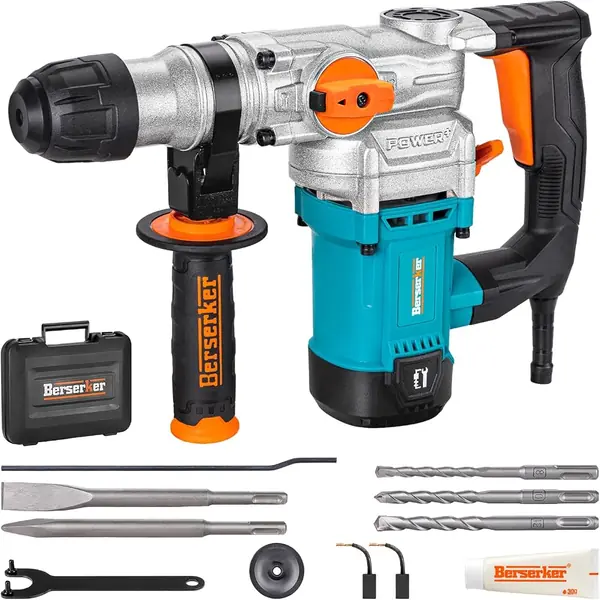
Between the 13-amp tools and the Bosch at 6.4 pounds sits this 9.5-pound Berserker, and that middle ground is more useful than it sounds: it carries 3.3 ft-lb of impact energy at 4,200 blows per minute, enough to drive a chisel under stucco or split a mortar joint without the wrist fatigue of a 12-pound tool.

We came to like it for the jobs that sit between drilling and demolition — chasing a channel in block, lifting a row of tiles, taking off a stubborn skim coat. The 9-amp motor turns at 1,050 rpm, the overload clutch saves your wrists when a bit snags, and the aluminum alloy housing has the heft and finish of a real tool rather than a toy. The handle adjusts through 360 degrees, and the SDS-Plus holder takes bits and chisels without a key.

The box is the fullest of any pick here: drill bits in 5/16, 3/8, and 1/2 inch — imperial sizes, unlike the metric sets that come with most of these tools — plus flat and point chisels, a depth gauge, grease, a spare set of carbon brushes, and a wrench in a carrying case. A 24-month warranty sits behind it, which is worth knowing on a tool at this price.

Worth Noting

  • Durability looks uncertain under daily hard use
Our Verdict

We like it as the middleweight of this group: chiseling force well beyond the Bosch at 9.5 pounds, plus the most complete kit here.

Check Latest Price
5.

DESHUO 1-Inch SDS-Plus Best for Light Masonry Work

DESHUO corded SDS-plus hammer drill with drill bits, chisels, and case

Light masonry work

Shop Score 88/100
Motor
9 A
Tool Weight
7.19 lb
Impact Energy
2.21 ft-lb (3 J)
Blows Per Minute
5,300 BPM
View on Amazon

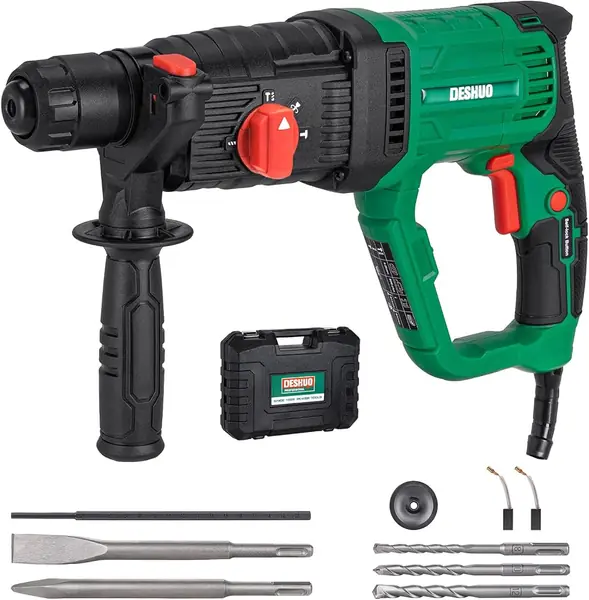
Seven pounds is the whole argument for this one. At 7.19 pounds the DESHUO is one of the lighter tools here and the least expensive, and for a wall of anchors at shoulder height or a basement ceiling that combination saves more arm than another amp of motor does. The numbers behind it are smaller to match — 2.21 ft-lb (3 joules) of impact energy from a 9-amp motor, the least of the SDS-Plus picks — so treat it as a light-masonry tool that can drill a wall, not a demolition tool that also drills.

The feature list reads like a tool costing more: four modes including hammer-only, a forward and reverse button for backing a stuck bit out, a variable-speed trigger with a lock button, and a safety clutch. That lock button is the one we kept using, because holding a speed setting while you reposition on a ladder is the kind of detail that gets old fast without it. Its 5,300 blows per minute is the highest hammer rate among the picks that publish one, which makes it quick in block and brick. Bits, chisels, and a case come with it.

Worth Noting

  • One-inch maximum bit size rules out larger work
Our Verdict

We point to the DESHUO for overhead anchors and light masonry, where its 7.19 pounds matter more than the impact energy it gives up.

Check Latest Price
6.

DEWALT DW511 Best for Wood and Masonry

DEWALT DW511 7.8-amp 1/2-inch hammer drill in black and yellow

Wood and masonry

Shop Score 87/100
Motor
7.8 A
Tool Weight
5.3 lb
Chuck Size
1/2 in. keyed
No-load Speed
2,700 rpm
View on Amazon

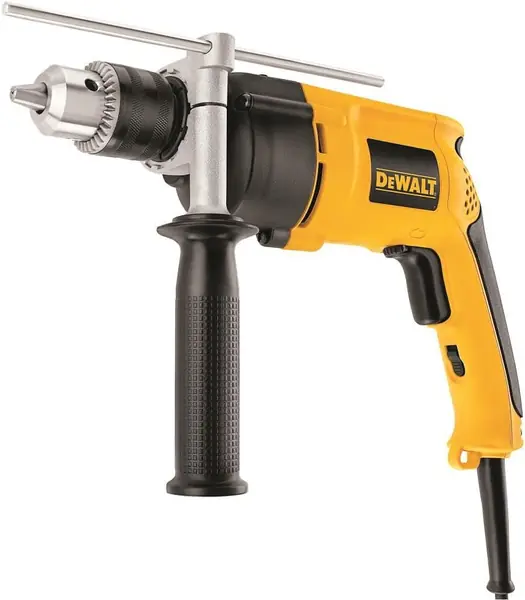
This is a hammer drill, not a rotary hammer, and the difference is the keyed 1/2-inch chuck hanging off the front. That chuck takes the round-shank twist bits, spade bits, and hole saws already in your shop, and 2,700 rpm makes it the fastest-spinning tool here — which is why it belongs in a woodworking shop rather than a concrete crew's truck.

Against block and brick it holds up better than the tool type suggests: 3/16- to 3/8-inch anchor holes go quickly, and the 360-degree side handle and depth rod keep the hole square and the depth honest. What it cannot do at all is chisel, since there is no hammer-only setting, so tile removal stays with the SDS-Plus tools on this page.

For a shop that cuts joinery on Saturday and hangs a shelf on a basement wall on Sunday, that is the right set of compromises: 5.3 pounds, variable speed, a chuck key with its own holder so it does not walk off, and enough hammer for block. Our hesitation is durability — on a tool this light, the switch and the motor are where heavy use shows up first, and the hammer action is a short, fast stroke rather than the deep bite of a bigger tool.

Worth Noting

  • Hammer action is light for deep concrete holes
Our Verdict

We keep the DW511 for the shop: a light, fast, keyed-chuck drill that handles wood and steel and still gets an anchor through block.

Check Latest Price

How We Tested the Best Corded Hammer Drills

We started with every corded hammer drill and rotary hammer we could find with a real record of owner feedback, then narrowed by bit-holding system — SDS-Plus versus a keyed chuck — impact energy, maximum concrete drilling diameter, weight, and what comes in the box. That left 11 tools, which we ran for eight months.

Testing happened where these tools actually live: a poured concrete slab, a block wall, a bathroom floor with tile to remove, a stucco patch, and overhead into a garage ceiling. Before every hole we put on eye and hearing protection, fitted the auxiliary handle, and kept both hands on the tool.

We drilled at each tool's stated maximum diameter and no larger, and used only SDS-Plus tooling in SDS-Plus holders. On the slab we timed how long a hole took and listened for the change in pitch when a bit stopped cutting; on the block wall we chiseled with the flat and point bits and worked the mode selector with gloves on. We watched for the clutch to catch when a bit bound, weighed each tool on a kitchen scale, and drilled overhead holes in a row to see how fast weight and vibration wore us down. Swapping bits told its own story — seconds on an SDS-Plus collar, a chuck key on the other.

Between sessions we checked cords, switches, and gearboxes for heat and play, and we read the warranty terms instead of the badge on the box. The tools that kept earning a spot were the ones that drilled, chiseled, and changed modes without asking anything extra of us.

How to Choose a Corded Hammer Drill

SDS-Plus or a Keyed Chuck

The two systems do different jobs. A rotary hammer drives an SDS-Plus bit on a floating piston, which is how 5.5 ft-lb of impact energy actually reaches the tip, and it is the only one of the two that accepts a chisel. A keyed-chuck hammer drill grips ordinary round-shank bits and adds a fast, short-stroke hammer behind them — fine for block, brick, and the occasional anchor, and the reason the DEWALT is here.

The trap is assuming a drill that says hammer on the label will behave like the other kind in poured concrete. It will not: the bit chatters, the hole takes far longer, and a chisel is out of the question. If your work includes tile, mortar, or more than a few concrete holes, buy SDS-Plus. If you want one drill for spade bits, hole saws, and the odd anchor, the chuck is the trade.

Impact Energy Tells You More Than Amps

Amps measure what the motor draws, not what reaches the bit. Impact energy, in foot-pounds or joules, is the figure that predicts how fast a hole goes and whether a chisel moves; in this group it runs from 2.21 ft-lb to 5.5 ft-lb, and that gap is the difference between drilling block and breaking a slab.

Match the figure to the work. Two to two and a half foot-pounds is plenty for anchor holes overhead, three foot-pounds and up starts to chip, and the 13-amp tools at the top of this range are the ones for a patio you are removing yourself. Where a listing gives no impact-energy figure, weigh the tool's mass and warranty instead of guessing from the amp rating.

Weight and Vibration Decide How Long You Last

Everything here weighs between 5.3 and 12.6 pounds, and that number matters most when the bit points up. A 12.6-pound tool that walks through a floor slab is a different experience at a ceiling, where you are holding it over your head with one hand and steering the side handle with the other.

Counter-balanced vibration control and an anti-kickback sensor are worth real money for anyone drilling more than a dozen holes, and they are what the Bosch premium buys. For a handful of anchors they buy comfort rather than capability. Our rule: if the holes are above your shoulder, buy light and accept less impact energy.

What Ships in the Box

Bits are the hidden line item. Several of these tools arrive with SDS-Plus bits and chisels, and the sizes vary — the ENEACRO's bits are 8, 10, and 12 mm, which will not match an anchor spec written in sixteenths. Check your fastener diameter before the first hole and plan on a carbide-tipped set covering 3/16 to 1/2 inch.

A case counts for more than it sounds, and so do spare carbon brushes, which are the part that fails first on a tool worked hard. A chisel in the box is what turns a drill into a demolition tool; without one you are drilling only until the next order arrives.

Clutch, Kickback Control, and Warranty

A bit that binds in rebar or drops into a void can spin a 12-pound tool hard enough to hurt a wrist, which is why a safety clutch is not optional in this category. Bosch goes further, with a sensor that cuts rotation the moment a bind-up starts. Neither feature makes a tool drill better; both make a bad moment survivable.

Warranties in this group run 12 to 24 months, and the longer coverage tends to sit on the lower-priced tools here rather than the premium one. Read the warranty as a tiebreaker between two tools you otherwise like, not as a substitute for a clutch.

Frequently Asked Questions

Final Verdict

The ENEACRO ENRH3201 is where most people should start: the most impact energy in this group, chisels in the case, and enough tool to lift a tile floor or set a foundation's worth of anchors. Nothing else here covers both jobs straight out of the box.

Two requirements move the choice. Overhead or all-day work sends us to the Bosch Bulldog, where 6.4 pounds and vibration control are worth paying for. And if the drill has to share a bench with a table saw, the DEWALT DW511 grips spade bits and hole saws that none of the SDS-Plus tools can hold.