↑↓ navigate ↵ open Esc close All results →

Best Hammer Drills of 2026

Ten seconds into a concrete hole, a hammer drill reveals its limits: either the bit chews steadily into the slab, or it spins, smokes, and stalls halfway through. That outcome rarely comes down to the badge on the housing—it depends on impact energy, the bit interface, and enough torque to keep turning once carbide meets aggregate.

Running 14 hammer drills and rotary hammers through six months of basement tapcons, fence-post anchors, overhead garage ceiling holes, and thinset chiseling underscored one clear divide: a 1/2-inch chuck drill with a hammer mode is a compromise, whereas an SDS-plus rotary hammer is built for masonry. Weight becomes obvious the moment a tool goes overhead, and a safety clutch proves its value the first time a bound bit kicks back.

Tool-only pricing also hides the real cost once batteries and chargers enter the math. Cordless rotary hammers, compact hammer drills, and bare-tool options fill out the lineup below based on hole size, overhead balance, and battery value.

Our Top Picks

The Best Hammer Drills

1.

DEWALT 20V MAX SDS Rotary Hammer (DCH273B) Best Overall
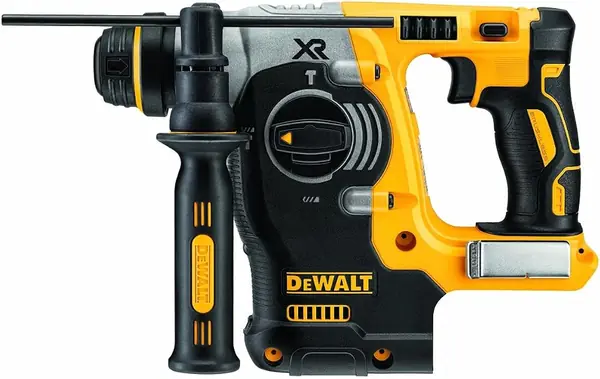
Black and yellow DEWALT 20V MAX SDS-plus rotary hammer with side handle and depth rod

Concrete anchoring

Shop Score 96/100
Concrete Capacity
1 inch
Impact Energy
2.1 joules
Tool Weight
6.4 lb
Application Modes
3
View on Amazon

Two point one joules does not sound like much until you set it beside the ratcheting clatter of a drill chuck in hammer mode. In the DEWALT DCH273B that energy arrives through an SDS-plus holder, where the bit floats and takes the blow straight down the hole, and the 1-inch concrete capacity covers anchor bolts, ledger fasteners and railing posts.

It is also the lightest cordless rotary hammer in this group at 6.4 pounds, and DEWALT's SHOCKS handle takes the edge off the vibration that otherwise shows up in your wrists after a dozen overhead holes. Three modes — drill only, hammer drill and hammer only — mean the same tool sets anchors, punches through brick for a pipe and breaks out a row of tile with an SDS chisel.

That combination is why it is our top pick: a purpose-built masonry tool that happens to be pleasant to hold. We hand it to anyone whose projects keep running into slab, block or brick, and we trust it with a wall we only get one shot at.

One detail worth knowing if you drill indoors: fitted with DEWALT's DWH303DH on-tool extractor, this hammer is OSHA Table 1 compliant, which is the difference between working in a finished basement and not. The 360-degree side handle and depth rod both come in the box.

Worth Noting

  • Bare tool; packs and charger are extra
  • Drains high-capacity packs during long drilling runs
Our Verdict

We reach for this one whenever a project runs into concrete: 2.1 joules through an SDS-plus chuck, a 6.4-pound body and three modes.

Check Latest Price
2.

Milwaukee M18 Hammer Drill/Impact Driver Kit (2997-22) Best Kit

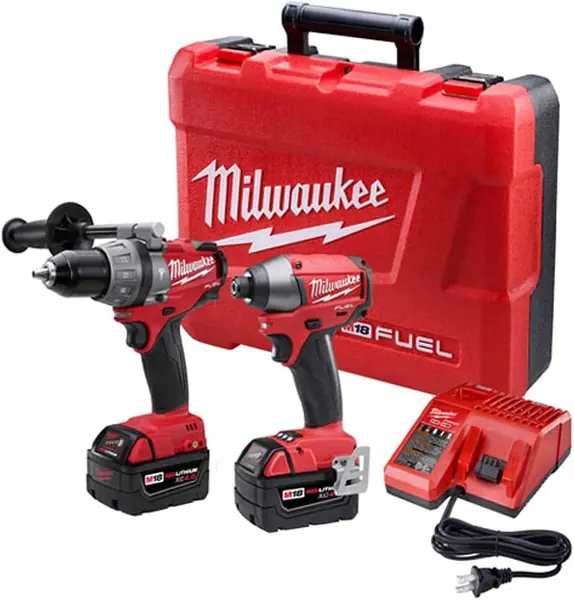
Red and black Milwaukee M18 hammer drill and impact driver kit with batteries

First cordless kit

Shop Score 95/100
Max Torque
2,000 in-lb
Warranty
5 years
Kit Weight
14.9 lb
Battery Platform
M18
View on Amazon

If you own no M18 packs, the arithmetic of a bare tool turns ugly fast: two batteries and a charger can cost as much as the drill. The 2997-22 sidesteps that. One case holds the hammer drill, an impact driver and the batteries that run both, which is why it is the pick for someone building a kit from scratch.

The drill is the half that handles masonry. Two thousand inch-pounds of torque turns a big auger through a sill plate and drives a masonry bit into block, and hammer mode covers the brick and block end of the work. The impact driver in the lid is what most of us reach for on screws, which leaves the drill set up for holes.

Five years of warranty is the longest in this roundup, and it covers both tools — worth more than it sounds when the kit is the only drill in the shop and everything gets run through it.

Our advice splits on batteries. If you already run M18, buy a bare drill and save the money. If you are starting out, this kit is the sensible way to own a serious hammer drill and an impact driver at once, because the packs you need anyway are already in the case.

Worth Noting

  • Kit weighs 14.9 lb before you add bits
  • Packs run short under heavy hammering
Our Verdict

If you are starting from nothing, we point you to this kit: two tools and the batteries that run them in one box.

Check Latest Price
3.

DEWALT 20V MAX XR Hammer Drill/Driver (DCD996B) Best Hammer Drill/Driver

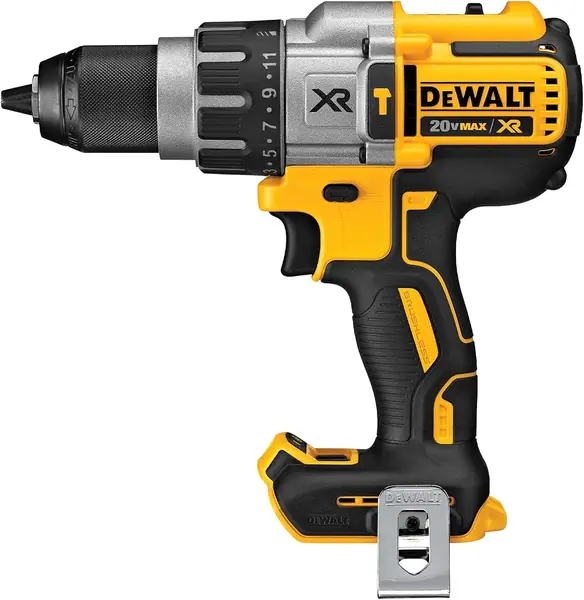
DEWALT 20V MAX XR brushless hammer drill with yellow and black body and chuck

Mixed drilling tasks

Shop Score 94/100
Weight
4 lb
Chuck
1/2 inch ratcheting
Max Speed
2,000 rpm
Speeds
3
View on Amazon

Three speeds is the reason the DEWALT DCD996B lives on the bench rather than in the truck. Low gear turns a big auger or a hole saw through hardwood without stalling, high gear spins a pilot bit, and the middle ratio covers everything between. The 1/2-inch ratcheting chuck takes round-shank bits, Forstners and hole saws — tooling an SDS holder cannot grip.

We like it as the one drill that covers a woodworker's masonry needs without giving up the bench. Hammer mode is enough for brick, block and the occasional Tapcon, and the brushless motor, four-pound body and three-mode LED make it easy to keep loaded with a bit and reach for first.

Poured concrete is where it stops. A foundation wall or a long run of 1/2-inch anchor holes calls for one of the SDS hammers here, which drill faster with less pressure from you. Treat this one as a drill/driver with a masonry gear and it earns its shelf space.

Worth Noting

  • Bare tool without battery or charger
  • Some units fail after months of hard use
Our Verdict

We recommend it as the hammer drill you can also build furniture with: three speeds and a 1/2-inch chuck make it the most versatile cordless drill here.

Check Latest Price
4.

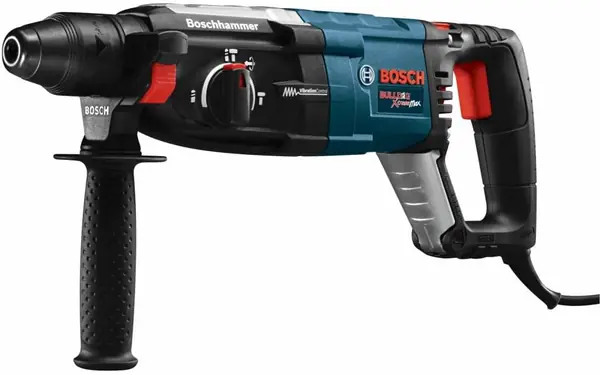
Bosch GBH2-28L SDS-plus Bulldog Xtreme Max Best Corded Rotary Hammer

Bosch Bulldog Xtreme Max SDS-plus rotary hammer with black body and side handle

All-day concrete work

Shop Score 93/100
Concrete Capacity
1-1/8 inches
Impact Energy
2.4 ft-lb
Blows Per Minute
0-5,100 bpm
Motor
8.5 amp
View on Amazon

The cord is the whole argument. An 8.5-amp motor drawing from a wall socket does not care whether you are on hole 12 or hole 120, and the Bulldog is the tool we want on a demolition or a basement remodel where drilling runs all afternoon. No packs, no charger, no watching a fuel gauge.

KickBack Control is the feature we point a first-time rotary hammer user toward: a sensor watches for the sudden rotation that means a bit has bound and cuts the tool off before the handle follows the bit around. Counter-balanced vibration control and a Vario-Lock collar that sets the chisel angle for tile keep it comfortable through long chipping sessions.

At 2.4 foot-pounds it hits harder than any cordless model here, and the variable-speed trigger with reverse lets you back a stuck bit out. You work within reach of an outlet, which is the honest trade for never charging a battery.

Worth Noting

  • One-year limited warranty is the shortest here
Our Verdict

For a remodel that keeps a bit in concrete for hours, we take the cord: the Bulldog's 8.5-amp motor never asks for a charger.

Check Latest Price
5.

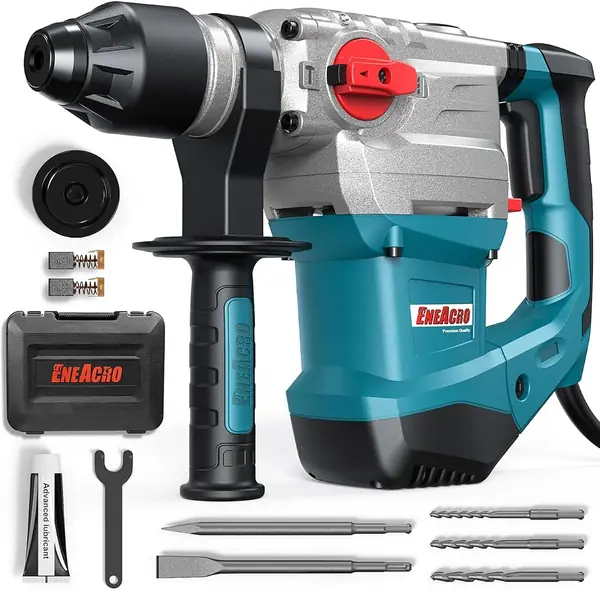
ENEACRO 1-1/4-Inch SDS-Plus Rotary Hammer (ENRH3201) Best Value

Blue ENEACRO SDS-plus corded rotary hammer with chisels, drill bits and case

Budget masonry work

Shop Score 92/100
Weight
12.6 lb
Concrete Capacity
1-1/4 inches
Impact Energy
7.4 joules
Motor
13 amp
View on Amazon

Open the case and the value is obvious: three SDS-plus bits, a point chisel and a flat chisel, a spare set of carbon brushes, a tube of grease, a dust cap and a molded case. Most tools at this price ship bare and leave you to build that kit yourself.

The 13-amp motor backs it up with 7.4 joules of impact energy — more than three times what the cordless tools here deliver — and a safety clutch that slips instead of wrenching your wrist when a bit grabs. It is the most impact energy for the money in this guide, and the tool we hand a homeowner facing a fence line, a slab or a tile floor.

It is a big, blunt instrument, and finish work is not what it is for. Against the Bosch it gives up refinement and warranty length; against a cordless SDS tool it gives up the cord. What it does not give up is the ability to chew through a 6-inch wall.

Worth Noting

  • 12.6 pounds is a lot to hold overhead
Our Verdict

We steer budget shoppers to this corded rotary hammer: 13 amps, 7.4 joules and a full accessory kit in the case.

Check Latest Price
6.

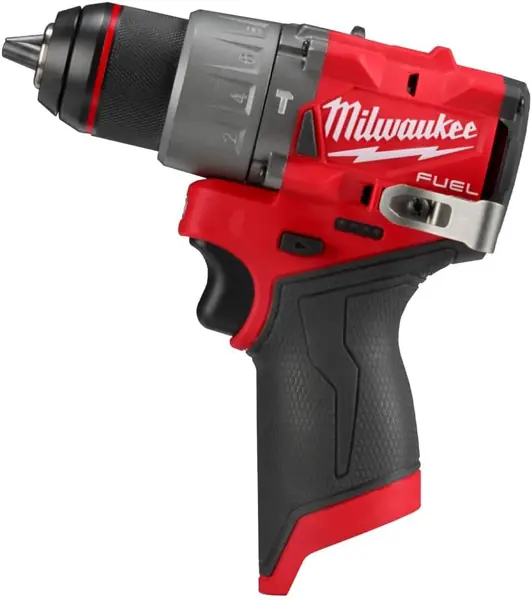
Milwaukee M12 FUEL Hammer Drill/Driver (3404-20) Best Compact

Red and black Milwaukee M12 FUEL compact hammer drill with 1/2-inch chuck

Overhead anchor work

Shop Score 91/100
Weight
2.6 lb
Chuck
1/2 inch all-metal
Max Torque
400 in-lb
Speed
0-1,500 rpm
View on Amazon

Two point six pounds is the number that sells this drill. We ran it overhead and one-handed on a ladder, and it never pulled us off balance the way a full-size hammer drill does. If your masonry work happens in awkward places — a ceiling, a stairwell, a tight mechanical room — that matters more than anything on the box.

The 3404-20 is still a real hammer drill. The switchable hammer mode is there when you need it, the 1/2-inch all-metal chuck grips standard bits instead of the hex shanks of a compact driver, and the mechanical clutch keeps you from over-driving screws.

The honest boundary is hole size: this is a tool for 1/4- and 3/8-inch anchors in brick and block, not a 1-inch hole in poured concrete. Above that, it lets you know it is working, and the SDS hammers in this guide are the right call. For cabinet anchors, curtain rods and shelf brackets in brick, it finishes the job without a second trip to the truck.

Worth Noting

  • M12 packs fade during long hammering sessions
  • Single speed leaves no low gear for big bits
Our Verdict

This is the one we grab for a ladder or a cabinet interior: 2.6 pounds, a real 1/2-inch chuck and just enough hammer for small anchors.

Check Latest Price
7.

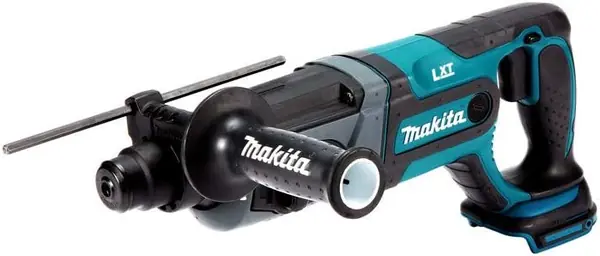
Makita 18V LXT SDS-Plus Rotary Hammer (XRH04Z) Best Budget Cordless Rotary Hammer

Makita 18V LXT cordless SDS-plus rotary hammer in black and blue with D-handle

Budget cordless SDS

Shop Score 90/100
Weight
7.4 lb
Concrete Capacity
7/8 inch
Blows Per Minute
0-4,000 bpm
Modes
3
View on Amazon

Half the price of our top pick buys the same three modes and the same SDS-plus holder. The XRH04Z is the cordless rotary hammer we suggest to someone who drills concrete now and then and cannot justify a premium tool that sits in a case eleven months a year.

The D-handle and one-touch sliding chuck are the details you notice first: bits go in without hunting for a detent, and the handle keeps the tool steady with the hammer running. Makita's torque-limiting clutch disengages the gears if a bit binds, cheap insurance on a tool this size.

Seven-eighths of an inch of concrete capacity is the smallest figure here, and that is the honest limit — this is a tool for anchors and pipe penetrations, not for coring a wall. Within that, we found it steady and easy to control, and for a woodworker who needs a dozen holes in a block wall it is plenty of rotary hammer.

Worth Noting

  • 7/8-inch capacity is the smallest in this group
  • Brushed motor drains 18V packs quickly
Our Verdict

We suggest it for cordless SDS drilling on a budget: three modes, a D-handle and about half the price of the top pick.

Check Latest Price
8.

CRAFTSMAN V20 Cordless Hammer Drill Kit (CMCD711C2) Best for Occasional Masonry Holes

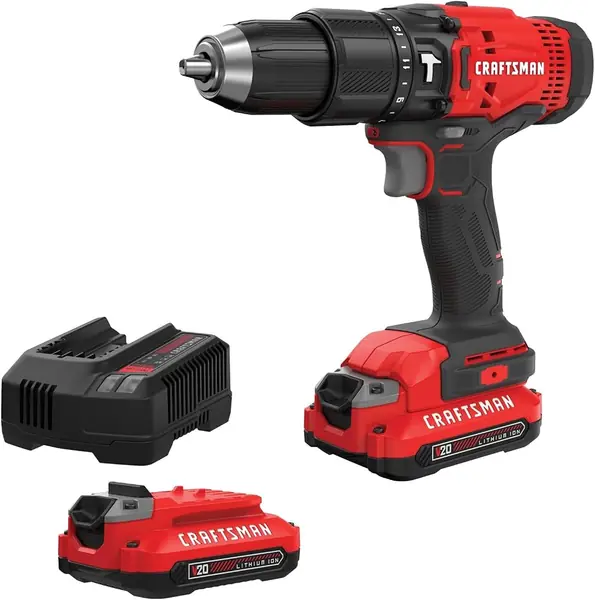
Red and black CRAFTSMAN V20 cordless hammer drill kit with two batteries and charger

Occasional masonry holes

Shop Score 89/100
Blows Per Minute
25,500 bpm
Max Speed
1,500 rpm
Max Power
280 unit watts out
Batteries Included
Two 1.3 Ah packs
View on Amazon

Two batteries, a charger and a hammer drill in one box make this the least expensive complete kit here. If you have priced a bare tool plus a pair of packs lately, that is the whole pitch.

The numbers on the CMCD711C2 are modest rather than silly: 25,500 blows per minute, 280 unit watts out and a two-speed gearbox, all through a 1/2-inch ratcheting chuck. For a handful of anchor holes in block and then an afternoon of wood and drywall, that is enough tool to finish.

The packs also run the rest of the brand's V20 lineup, so they do double duty in a trimmer or a circular saw. That compatibility is worth more than the drill's spec sheet suggests.

We point a homeowner at it and steer a contractor away. A dozen holes a season is well inside what it does; a full day of drilling is not. Buy it as a household hammer drill that also drives screws, and move to an SDS rotary hammer when the work turns to poured concrete.

Worth Noting

  • Two 1.3Ah packs run down quickly
  • No case or bits included
Our Verdict

We recommend it as a first hammer drill: two batteries and a charger come in the box, and that is the reason to buy.

Check Latest Price

How We Tested Hammer Drills and Rotary Hammers

We started by reading current listings and owner reviews to build a shortlist of about 30 hammer drills and rotary hammers, then filtered it by the things that decide whether a tool can actually make a hole: impact energy, blows per minute, maximum concrete capacity, SDS-plus versus a 1/2-inch chuck, and whether it ships as a bare tool or a kit with batteries and a charger. Fourteen made it into testing, and we used them for six months.

Testing happened where these tools live: tapcons into a poured basement wall, anchor bolts along a fence line, an afternoon of overhead holes in a garage ceiling, and a chiseling session stripping thinset off a slab. We timed holes with a stopwatch and noted whether the bit walked before it bit. The overhead holes went in from a ladder so we could feel how each tool's weight sat and how quickly our arms tired, and the side handle stayed on for all of it.

For cordless models we ran high-capacity packs until they quit and counted holes per charge, then weighed every tool with the battery seated and added up what a kit really costs once two packs and a charger are in the cart. We deliberately bound a bit to confirm the safety clutch or kickback sensing caught it before the tool twisted, and we wore eye and hearing protection and ran a vacuum at the hole every time we drilled concrete.

Durability showed up in small ways: how warm the housing ran after a long set of holes, whether the mode selector still clicked cleanly after weeks of switching between drill, hammer, and chisel, and whether the case and included bits survived a truck bed.

How to Choose a Hammer Drill

Hammer Drill/Driver or SDS-Plus Rotary Hammer?

Inside a hammer drill/driver, two ridged plates ratchet past each other to make the percussion while the bit turns in a toothed chuck. That is enough for brick, block, mortar and small anchors, and it is why the DEWALT DCD996B can also bore hardwood and drive screws. What it will not do is make quick work of poured concrete.

An SDS-plus rotary hammer drives a piston against an air cushion, and the bit floats in its holder so the blow travels straight down the hole. Every SDS machine here carries 7/8 to 1-1/4 inches of concrete capacity and quotes impact energy instead of blows per minute. If the wall is poured concrete, buy SDS. If it is brick and the odd block, a drill/driver keeps one tool on the bench.

Corded or Cordless, and What the Battery Costs

A bare tool is only cheap if you already own the packs. The DEWALT, Makita and Milwaukee rotary hammers here ship without a battery, and two high-capacity packs can cost as much as the tool — which is why the Milwaukee 2997-22 kit, with a drill, an impact driver and batteries in one case, makes sense for anyone starting from nothing. Count what is already in your shop before you compare prices.

Corded tools skip that arithmetic, and they hit harder for the money: the ENEACRO's 13-amp motor costs less than a bare 20-volt drill. If the work sits still — a basement, a slab, a fence line — a cord is a small annoyance. If it moves from ladder to ladder, cordless earns the premium.

Match Impact Energy and Capacity to the Hole

Every rotary hammer lists a maximum drilling diameter in concrete, and the figure is worth reading literally. The Makita's 7/8 inch and the ENEACRO's 1-1/4 inches both drill concrete; one is built for anchors and pipe sleeves, the other for a foundation. Capacity you do not need is weight you carry on every hole you do drill.

Impact energy is the other number. The cordless machines here quote 1.7 foot-pounds to 2.1 joules, the Bosch corded 2.4 foot-pounds, and the big corded ENEACRO 7.4 joules. More energy means faster holes with less push from you, and more tool in your hands. A hammer drill/driver's rating arrives as blows per minute — 25,500 on the CRAFTSMAN — and no figure of that kind turns one into a concrete tool.

Weight, Vibration and the Safety Clutch

All of this happens above your shoulder. The cordless rotary hammers here run 6.4 to 7.4 pounds; the big corded ENEACRO is 12.6. For ceiling anchors, weigh light — the difference between a 6-pound and a 12-pound tool shows up around hole four.

Look for a slipping clutch or a kickback sensor, then use the side handle anyway. Bosch's KickBack Control and the clutches on the ENEACRO and the Makita all cut the motor when a bit binds, and a hammer that grabs can rotate your wrist before you can release the trigger.

Bits, Modes and Dust Control

SDS-plus bits and chisels click into the holder and need no key, so keep a set of common anchor-size bits with the tool. Three-mode machines add hammer-only, which turns the tool into a light chisel for tile, mortar and old render — the ENEACRO ships with two chisels, and the Bosch's Vario-Lock collar sets the angle.

Dust is the cost nobody budgets for. Concrete dust is silica, so drill with a vacuum at the hole and wear a respirator; if you are working in a finished space, DEWALT's DCH273B becomes OSHA Table 1 compliant with the matching on-tool extractor fitted.

Frequently Asked Questions

Final Verdict

Concrete decides it. The DEWALT DCH273B is the one we recommend for anyone whose projects keep finding slab, block or brick: 2.1 joules through an SDS-plus chuck, 6.4 pounds, three modes and no cord to route. If you own no batteries yet, the Milwaukee 2997-22 kit gets you a hammer drill, an impact driver and the packs in a single purchase. And if the drilling never stops, plug in the Bosch GBH2-28L and stop thinking about runtime.