↑↓ navigate ↵ open Esc close All results →

Best DeWalt Replacement Batteries for 20V Tools of 2026

Chasing the highest amp-hour number on a replacement battery listing is an easy way to spend more and gain less comfort. A massive pack turns an overhead impact driver into a wrist-tiring brick, while a cheap off-brand cell can bind in the charger or fade mid-cut after a single season. Two mid-size packs often keep a shop moving faster than one heavy high-capacity block.

Over nine months of cycling 12 genuine and third-party packs through drills, impact drivers, circular saws, and dual-voltage tools, steady output under load proved more telling than label capacity. Tracking recharge times and repeated discharge cycles separated cells that hold voltage through tough rips from packs that sag halfway through a fence repair.

Counting how many packs come in the box, verifying charger fit, and checking warranty terms rounds out the real value, leaving eight options that kept chargers busy without needing constant babysitting.

Our Top Picks

The Best DeWalt Replacement Batteries for 20V Tools

1.

DeWalt 20V MAX 5.0Ah Battery 2-Pack (DCB205-2) Best Overall
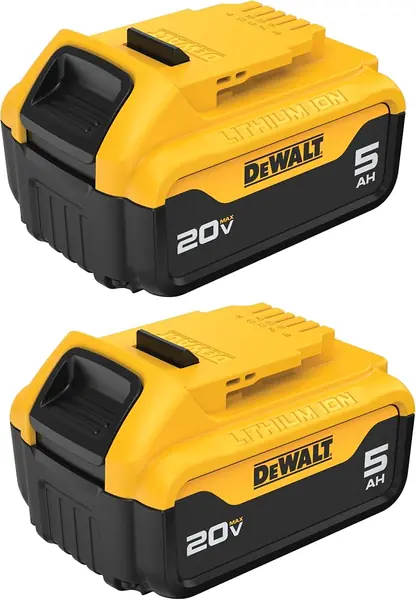
DeWalt 20V MAX 5.0Ah lithium-ion battery two-pack with three-LED fuel gauge

All-around shop use

Shop Score 97/100
Battery Capacity
5.0 Ah each
Voltage
20V MAX
Warranty
3 years limited
Pack Count
2
View on Amazon

Five amp-hours is where a 20V MAX pack stops being a compromise: enough to push a circular saw or a compact router through real work, and enough that you aren't watching the fuel gauge on every cut. The pair is what settles it for us. One pack runs the tool while the other charges, so a Saturday in the shop doesn't end because a battery did.

In use there is very little to think about, which is the highest compliment we can pay a battery. The gauge reads with a thumb, the pack seats with a click you can feel, and a drill that started the morning with a 5Ah on it still feels balanced. The three-year warranty is the honest reason to pay DeWalt money for cells rather than aftermarket money: a pack that stops taking a charge becomes a warranty claim instead of a loss.

Where this pair gives way is overhead work. Cabinet installs, crown, ceiling boxes — the compact 2Ah pack in this guide keeps a drill noticeably lighter in the hand, and that matters more than capacity when you're reaching. For everything from deck framing to a router table, two 5Ah packs are the least dramatic and most useful purchase here.

Worth Noting

  • No charger included in the box
Our Verdict

The pair we hand any DeWalt owner first: enough runtime for saws, light enough for drills, and covered by a three-year warranty.

Check Latest Price
2.

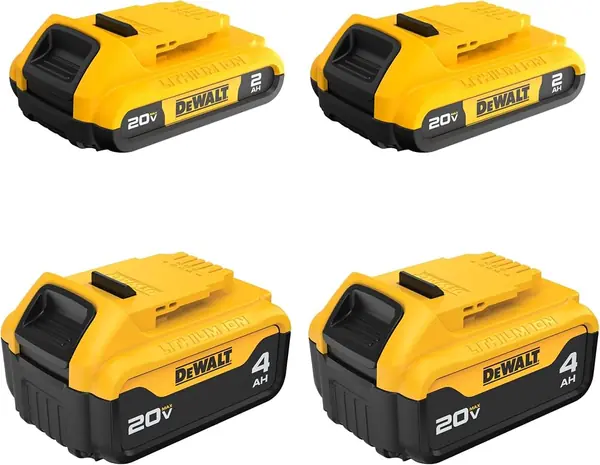
DeWalt 20V MAX 4-Pack (2.0Ah and 4.0Ah, DCB324-4) Best Value Multi-Pack

DeWalt 20V MAX battery four-pack with two 2.0Ah compact and two 4.0Ah XR packs

Outfitting several tools

Shop Score 96/100
Battery Capacity
4.0 Ah and 2.0 Ah
Voltage
20V MAX
Pack Count
4
Fuel Gauge
3-LED on every pack
View on Amazon

Two 4Ah packs and two 2Ah compacts arrive in one box, which makes this the most flexible way to buy into the platform. The 4Ah packs go in the saws and the sander; the compacts go in the drill and the impact driver, where their size matters more than their runtime. Four packs also means no tool sits idle waiting on a charger.

The compacts are the pleasant surprise. A drill with a 2Ah pack on it feels like a smaller, handier tool, and for pilot holes, cabinet hardware, and driving screws the runtime is a non-issue. Four packs also means the saw can keep a 4Ah while the drill keeps a compact, which is how a bench actually gets used.

Value is the whole argument. Four genuine packs cost about what a pair of 5Ah packs costs, and while you give up capacity per pack you gain the ability to keep three tools loaded at once. For someone outfitting a bench one tool at a time, that is a better use of the money than a single big pack.

We reach for this box when someone has a bare drill and driver and no plan yet. It covers the small tools properly, leaves two bigger packs for the saw, and lands among the cheapest genuine capacity per amp-hour here. If your work is one tool at a time, the 5Ah pair is the cleaner buy; if the bench keeps growing, this is the better start.

Worth Noting

  • 2Ah packs fade fast in saws and sanders
Our Verdict

For a bench that keeps adding tools, four packs in two sizes is the smartest way we've found to buy genuine capacity in bulk.

Check Latest Price
3.

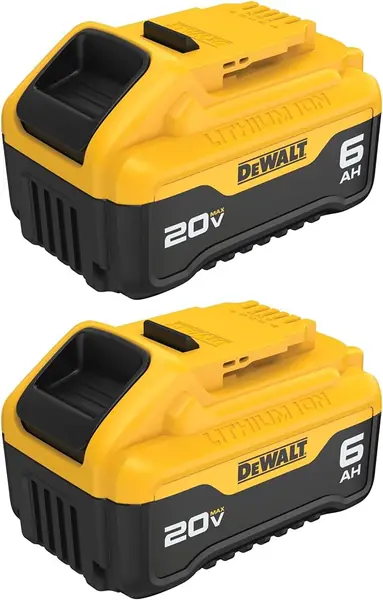
DeWalt 20V MAX XR 6.0Ah Battery 2-Pack (DCB206-2) Best for Long Runtime

DeWalt 20V MAX XR 6.0Ah lithium-ion battery two-pack with three-LED fuel gauge

Saw-heavy shops

Shop Score 95/100
Battery Capacity
6.0 Ah each
Warranty
3 years limited
Pack Count
2
Charge Time
60 minutes
View on Amazon

Six amp-hours is capacity you buy for a specific reason: the tools that pull hardest. A circular saw, a planer, a compact router, or a shop vac will drain a 5Ah pack before the cut list is finished, and those are the tools this pair exists for. On a drill it is excess battery you are carrying around for the privilege of never thinking about it.

In a saw, the extra capacity shows up as behavior as much as runtime. A 6Ah pack keeps the blade at speed through a long rip instead of softening in the last third, and the gauge still has bars left when a smaller pack would be flashing. The cost is bulk: these are noticeably taller than the 5Ah packs, so check the insert before you count on storing them in a fitted case.

This is the pair we reach for when the saw is the tool that matters, and we accept the premium for it. Charging runs about an hour, which is why two packs is the right configuration rather than one: swap at lunch and keep cutting. If your work is mostly drilling and driving, save the difference and buy the compacts.

Worth Noting

  • Costs nearly three times the 5Ah pair
Our Verdict

When a circular saw or planer is the tool that matters, these two 6Ah packs hold their speed through long cuts, and the price reflects it.

Check Latest Price
4.

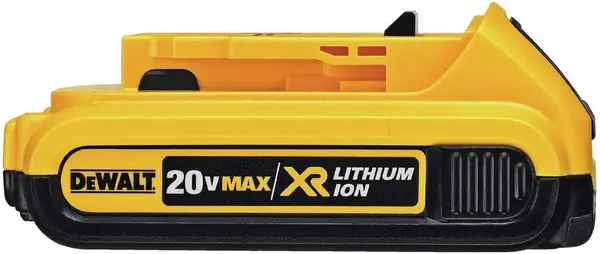
DeWalt 20V MAX Compact 2.0Ah Battery (DCB203) Best Compact

DeWalt 20V MAX compact 2.0Ah lithium-ion battery, single pack with fuel gauge

Drills and drivers

Shop Score 94/100
Battery Capacity
2.0 Ah
Voltage
20V MAX
Weight
12.3 oz
Charge Time
35 minutes
View on Amazon

Thirty-five minutes on a charger is the number that makes this pack worth owning. A 2Ah compact that refills in about half an hour turns a coffee break into a battery swap, and at 12 ounces it keeps a drill feeling like a hand tool instead of a workout. It is the pack we leave on the drill by default.

For pilot holes, cabinet hardware, and driving screws, 2Ah is the right amount of battery. The lighter nose makes one-handed work at the top of a ladder or inside a cabinet noticeably easier, and the fuel gauge is there when you want to check before starting a run of holes.

The boundary shows up the moment you put one in a circular saw or a random orbital sander, where it becomes a countdown timer rather than a battery. Buy it as the drill pack and the spare for a bigger one, not as your only battery.

Worth Noting

  • Sold as one pack without a charger
Our Verdict

The pack we keep on the drill: 12 ounces, back to full in about half an hour, and the cheapest genuine way onto the platform.

Check Latest Price
5.

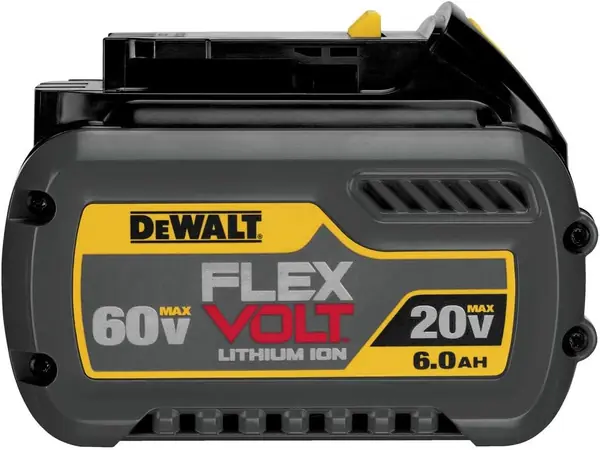
DeWalt FLEXVOLT 20V/60V 6.0Ah Battery (DCB606) Best for Two Voltages

DeWalt FLEXVOLT 20V/60V MAX 6.0Ah battery with LED state-of-charge display

Mixed-voltage shops

Shop Score 93/100
Battery Capacity
6.0 Ah
Voltage
20V/60V MAX
Weight
2.3 lb
State Of Charge
LED display
View on Amazon

A pack that changes voltage with the tool is the neatest idea in DeWalt's lineup. On a 20V MAX drill or saw the FLEXVOLT 6Ah behaves like a 6Ah battery; drop it into a 60V miter saw or circular saw and it feeds the bigger motor. For a shop with one foot in each camp, it ends the business of maintaining two battery families.

It earns its keep in the tools in the middle: a 60V circular saw breaking down sheet goods, then the same pack in a 20V reciprocating saw for demolition. Charge state reads at a glance on the LED display, and the pack seats the same way on both platforms, which is the sort of thing you stop noticing right up until it isn't true.

We think it is the right first FLEXVOLT purchase, and the wrong one for a shop that will never buy a 60V tool. If a FlexVolt miter saw or table saw is already on the list, buying packs that serve both platforms now saves you from starting a second battery collection later.

Worth Noting

  • 2.3 pounds makes a hand-held drill nose-heavy
Our Verdict

If a FLEXVOLT tool is in your future, this is the pack we buy first: full 6Ah on 20V tools and full power on 60V ones.

Check Latest Price
6.

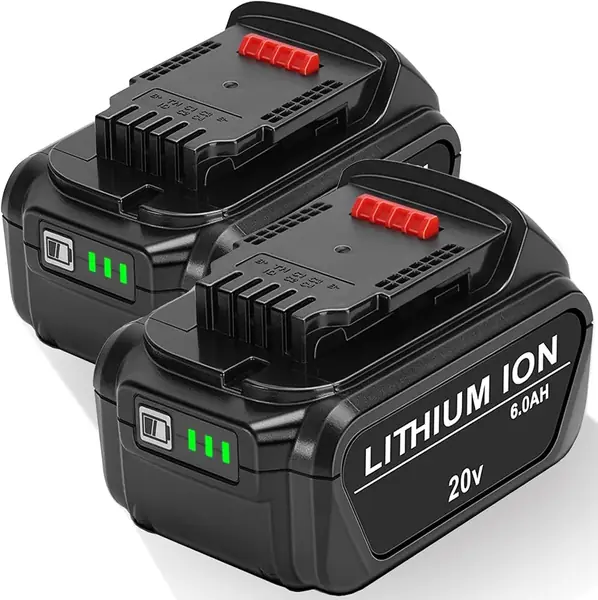
JYJZPB 6.0Ah Replacement 2-Pack for DeWalt 20V Best Budget Third-Party

JYJZPB two-pack of 6.0Ah replacement batteries for DeWalt 20V MAX tools

Rough work spares

Shop Score 90/100
Battery Capacity
6.0 Ah each
Voltage
20V MAX
Warranty
2 years
Pack Count
2
View on Amazon

Twelve amp-hours for less than one genuine 5Ah pack is the entire pitch, and it holds up. These are 6Ah replacements that seat in DeWalt 20V tools and charge on DeWalt chargers, with the same three-light gauge, at roughly a third of the cost per amp-hour of the yellow-brand packs in this guide.

We treat third-party cells the way we treat any generic part: fine until they aren't, so what the maker promises matters as much as the price. In the shop these fit without wobble, charge on a DeWalt charger, and run a saw long enough that we stopped checking which pack was on the tool. That is the endorsement.

The honest limit is lifespan. A cheaper pack is where an early failure is most likely to show up. Use them for the jobs that are hard on batteries — pressure-treated cuts, demo, the reciprocating saw you lend out — and keep a genuine pair for the tools your work depends on.

Worth Noting

  • Warranty runs two years, not three
Our Verdict

The budget pair we recommend for rough work: two 6Ah packs that fit and charge like the real thing for a third of the cost per amp-hour.

Check Latest Price
7.

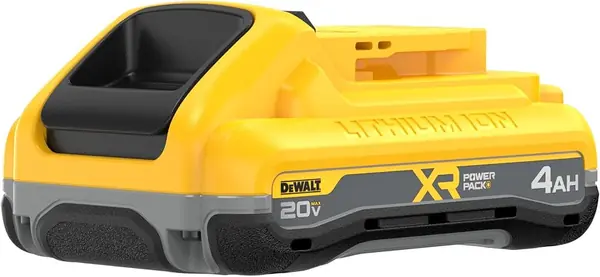
DeWalt 20V MAX XR POWERPACK 4.0Ah Battery (DCB2104) Best for Impact Drivers

DeWalt 20V MAX XR POWERPACK 4.0Ah battery with overmolded base and fuel gauge

Impact drivers

Shop Score 89/100
Battery Capacity
4.0 Ah
Voltage
20V MAX
Weight
1.3 lb
Cell Construction
Tabless POWERPACK cells
View on Amazon

The shape is what you notice first — shorter and wider than a standard 4Ah — and it is the pack we reach for on an impact driver. The wider footprint sits lower in the tool without moving your hand, and the tabless cells inside are the ones DeWalt credits with 50% more power and a longer cycle life than the cylindrical cells they replace.

On an impact driver the difference is real: structural screws and stubborn lugs come off with less of the hesitation an older 4Ah gives you. At 1.3 pounds it is also the lightest 4Ah here, so a drill stays balanced with it mounted.

Two things to check before you commit. The wider body can crowd a drill's belt hook and some fitted case inserts, so test the fit if your tools travel in a molded box. And the pack has not been on the market long enough to know how it holds up in year three, which is the only thing holding it back here.

Worth Noting

  • Costs more per amp-hour than the 5Ah pair
Our Verdict

The pack for an impact driver: newer cells, more bite, and 1.3 pounds on the tool, with a track record still to be written.

Check Latest Price
8.

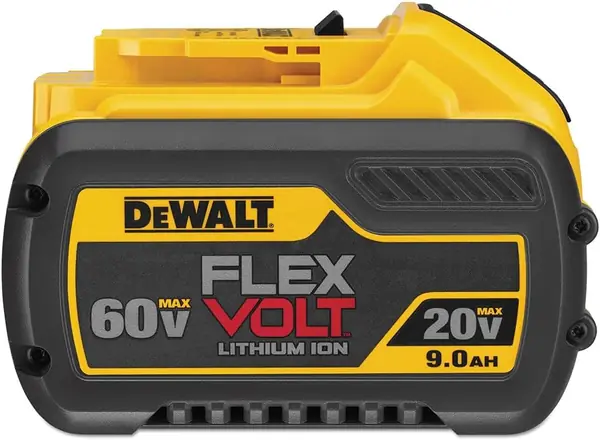
DeWalt FLEXVOLT 20V/60V 9.0Ah Battery (DCB609) Best for All-Day Cutting

DeWalt FLEXVOLT 20V/60V MAX 9.0Ah battery with charge indicator

All-day cutting

Shop Score 88/100
Battery Capacity
9.0 Ah
Voltage
20V/60V MAX
Weight
2.8 lb
Warranty
3 years limited
View on Amazon

Nine amp-hours is a lot of battery and it feels like it: at 2.8 pounds this is the heaviest pack here by a wide margin. In a 60V chainsaw, or in a 20V reciprocating saw cutting out studs all afternoon, that weight buys runtime nothing else in this guide can match.

Where it does not make sense is on a drill or a driver, where the mass is pure fatigue. On a 20V circular saw it is useful, though the 6Ah packs are the better balance of weight and runtime for most cutting.

Charging is the other consideration. A pack this size wants a charger that can feed it and it takes a while to fill, so plan on a second pack or a long lunch rather than a quick turnaround.

We find it hard to recommend unless a specific tool in your shop empties everything else. If a 60V saw is the tool that runs all day, this is the pack that keeps it running; otherwise the money goes further on two smaller packs.

Worth Noting

  • 2.8 pounds is a lot on a hand-held tool
  • Costs nearly twice the 5Ah pair
Our Verdict

For the tool that empties every other pack, a 60V saw or an all-day recip saw, nine amp-hours is the only answer here, weight and all.

Check Latest Price

How We Tested Replacement Battery Packs

We started by researching the replacement packs available for this cordless platform, then narrowed the field by amp-hour options, pack counts, charger compatibility, warranty terms, and whether each pack was genuine or third-party. We tested 12 packs over nine months, rotating them through a home shop and weekend projects. They ran drills and impact drivers on cabinet and fence work, circular saws on plywood and framing cuts, and dual-voltage tools where the higher-output setting matters. We also used the lightest packs for overhead assembly work to judge how weight affected control.

Each pack had to seat cleanly in every tool and be recognized by the chargers we already owned; if a pack wobbled or the charger threw an error, that counted against it. In use, we counted screws driven and cuts made per charge, noted when a saw bogged down in pressure-treated lumber, and watched whether power stayed even as the gauge dropped. We weighed packs before loading them into an overhead driver and noted wrist fatigue after a run of screws.

Charging was timed from a drained pack, with each one allowed to cool first, and we kept track of how many packs a charger could cycle through in an afternoon. We stored packs indoors between sessions and retired any that swelled, cracked, or refused to take a charge. Over the test, we compared cost per amp-hour, pack count, and warranty length, and checked labels, packaging, and charger behavior to flag authenticity questions. The packs that stayed in contention were the ones that kept their runtime, ran cool, and did not make us think about them.

How to Choose a DeWalt 20V MAX Battery

Start With the Platform, Not the Capacity

Every pack here fits DeWalt 20V MAX tools and chargers, which is the floor, and on a third-party listing it is worth confirming that the chargers you own are named. The wrinkle is FLEXVOLT. Packs like the DCB606 and DCB609 switch voltage when you change tools, running 20V MAX tools at their rated capacity and 60V MAX tools at full power. If a 60V miter saw or circular saw is already in your shop, buying FLEXVOLT now gives you one battery family instead of two; if it is not, you are paying for capability you will never use.

One trap worth knowing: 20V MAX packs are keyed, and some will not seat in the adapter DeWalt sells for running older 18V tools. If that adapter is part of your plan, test the fit with one pack before you buy a set.

Match Amp-Hours to the Hardest Tool You Own

Pick capacity by the most demanding tool in the shop, not the one you pick up most often. A 2Ah compact is a fine drill battery and a poor saw battery; a 6Ah pack is the reverse. In a woodshop that usually means one big pack for the circular saw, the planer, or the router, and compacts for the drills and drivers.

If you only drill pilot holes and drive screws, a 2Ah is genuinely enough, and the extra capacity of a bigger pack is weight you carry for nothing. If you break down sheet goods, buy for the saw.

Two Packs Beat One Big One

For most shoppers the better purchase is two mid-size packs rather than one enormous one. Two 5Ah packs cost less than a single 9Ah, and they give you continuity: one runs while one charges. The exception is a tool that lives on the same pack all day, a 60V saw for instance, where one big pack genuinely saves swaps.

Compare cost per amp-hour rather than sticker price. A two-pack at twice the money is usually the better deal, and the third-party bundles reset that math entirely.

Charging Is a Specification Too

Charge time is where cheap kits most often disappoint and where a genuine pack's numbers are worth reading. The 2Ah compact refills in about 35 minutes, a 6Ah pack takes about an hour, and a 9Ah FLEXVOLT takes longer still. One charger and one big pack means working your day around the charger.

If you are buying two packs at once, add a second charger to the plan or schedule the swap for lunch. And do not charge a pack straight off a hot tool: let it cool first, because heat is what shortens a lithium-ion pack's life.

Genuine or Third-Party?

A genuine DeWalt pack brings a three-year warranty and cells you can trace. Third-party packs cost a third or less per amp-hour and fit the same tools and chargers, but the warranty is typically one or two years, and long-term cell life is the gamble. We split the difference deliberately: genuine packs for the tools your work depends on, inexpensive third-party packs for demo, pressure-treated cuts, and the reciprocating saw.

Counterfeits turn up even on listings that look right. Check the serial number with DeWalt, and treat a price far below every other listing as a warning rather than a bargain.

Frequently Asked Questions

Final Verdict

If you own one DeWalt 20V tool and no spare, start with the 5Ah two-pack. It covers saws and drills, it is the best value per amp-hour of the genuine packs here, and the three-year warranty is real coverage rather than a marketing line. Add a 2Ah compact when you want a lighter drill, and move up to the 6Ah pair only if a circular saw, planer, or vac is the tool that empties your packs.

The one thing that changes the answer is a 60V tool in the shop, or one on the way. Then the FLEXVOLT 6Ah pack buys you a single battery family, and the 20V-only arithmetic stops mattering.