↑↓ navigate ↵ open Esc close All results →

Best Drill Bit Organizers of 2026

Shoppers often buy a magnetic drill bit organizer assuming the magnet anchors the tray to a tool chest drawer, only to watch the whole rack skate sideways and dump a hundred bits the first time the drawer snaps shut. A magnetic base holds bits in their slots, not necessarily the holder to steel—while faint size labels turn a hundred near-identical holes into another round of guessing.

End-of-project frustration usually starts in a coffee can of loose twist bits when a 7/64-inch bit stays buried and you settle for a 1/8-inch hole instead. Testing 16 organizers over four months in a garage drawer, a truck side box, and a ladder-carried tool bag showed how much drawer clearance, clear stamping, and snug retention sleeves save you from rebuying duplicates you already own.

Across fractional twist bits sorted by 64ths, rows of 1/4-inch hex driver bits, and trays with room for odd fasteners, these five organizers keep the right size under your thumb on the first grab.

Our Top Picks

The Best Drill Bit Organizers

1.

Drill America 10550 Drill Bit Index Best Overall
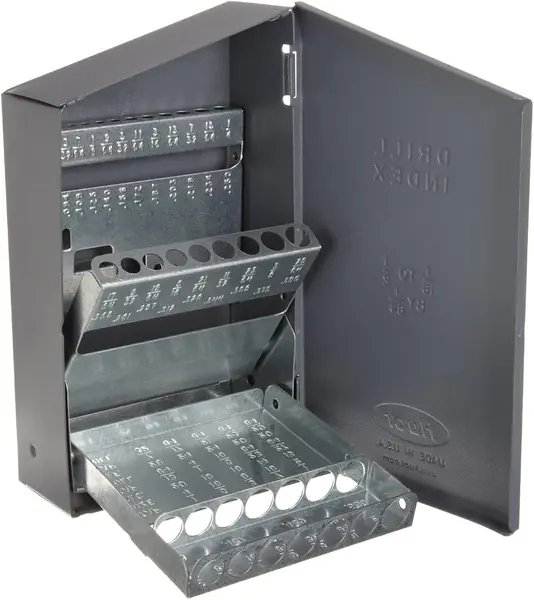
Drill America 29-slot steel drill bit index case with stamped fractional size labels

Fractional twist bits

Shop Score 94/100
Cover
Snap-lock steel cover
Bit Range
1/16-1/2 by 64ths (29 Sizes)
Case Material
Heavy gauge steel with epoxy baked-on coating
Drawer Clearance
Fits a 2-inch-deep drawer
View on Amazon

Twenty-nine holes, one for every fractional size from 1/16 inch to 1/2 inch in 64th steps, each drilled to its own diameter and stamped with the size beside it. That single idea is why we keep this index within reach: you go straight to the size you named instead of stirring a pile of loose bits. The case is heavy-gauge steel with a baked epoxy finish, and it has the solid, dead-flat feel of tool-room hardware.

For a woodworker with a full fractional set and a cracked plastic case, this is the organizer we hand over first. It does one thing a molded set case can't: when you snap a 3/16 bit you drop in a replacement, and an empty hole tells you what's missing instead of hiding the gap behind a closed lid. It also slides into a drawer about 2 inches deep, which is where ours lives.

Two limits come with it. The slots are cut for jobber-length fractional bits, so metric, wire-gauge, and 1/4-inch hex drivers have no home here; this is the twist-bit half of your collection, not all of it. And the cover is a snap-on steel lid rather than a hinged case, so carry it loaded with a hand under the front.

Worth Noting

  • Fractional jobber bits only, no metric sizes
  • Size stampings are small and hard to read
Our Verdict

For a full fractional set of twist bits, we think this steel index is the one to buy: a labeled slot for every size, a case that survives the shop, and no plastic hinges to break.

Check Latest Price
2.

ERNST Bit Boss Best for Hex Bits

ERNST Bit Boss black plastic hex bit tray with rows of upright bit slots

Hex driver bits

Shop Score 93/100
Length
14.9 inches
Capacity
90 bits, short and long
Bit Type
1/4-inch hex
Material
Solvent-resistant plastic
View on Amazon

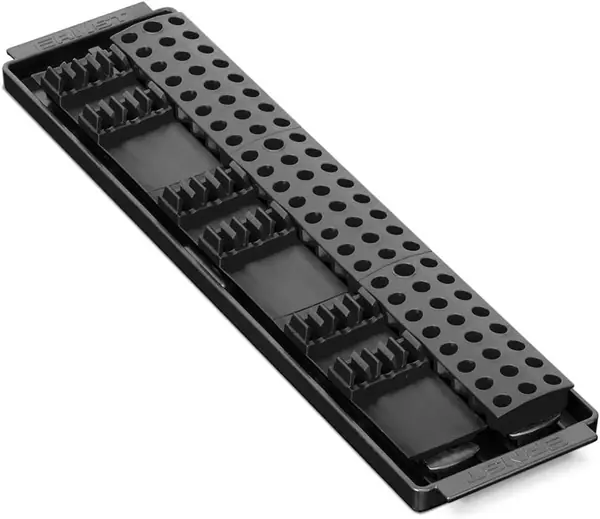
We turned the Bit Boss over the bench and shook it, the test that separates a bit tray from a bit pile, and nothing let go. Each slot is a taper-lock clip that pinches the shank of a 1/4-inch hex bit, and that grip is why this is the rack we recommend for driver bits.

It's built for a box that moves. At 14.9 inches long and 2.6 inches wide the tray lies flat with the bits standing up, so you can read the row at a glance and pull one out with two fingers. Measure your drawer first, since bits stand proud of the tray and need clearance above them. It's freestanding, too, with no magnet to stick to the side of a chest.

Ninety slots take short and long bits side by side, which is the part we appreciate most: no more separate boxes for stubby drivers and long extensions. The plastic is solvent resistant for garage and body-shop work, and it's molded in Oregon. It looks like a shop tool and wears like one.

Worth Noting

  • Holds 1/4-inch hex bits only
  • Almost 15 inches long for a drawer tray
Our Verdict

We reach for the Bit Boss whenever the bits are 1/4-inch hex: the clips hold through a bounced toolbox, and 90 slots cover short and long drivers alike.

Check Latest Price
3.

CASOMAN 1/4-Inch Hex Bit Organizer Best Budget

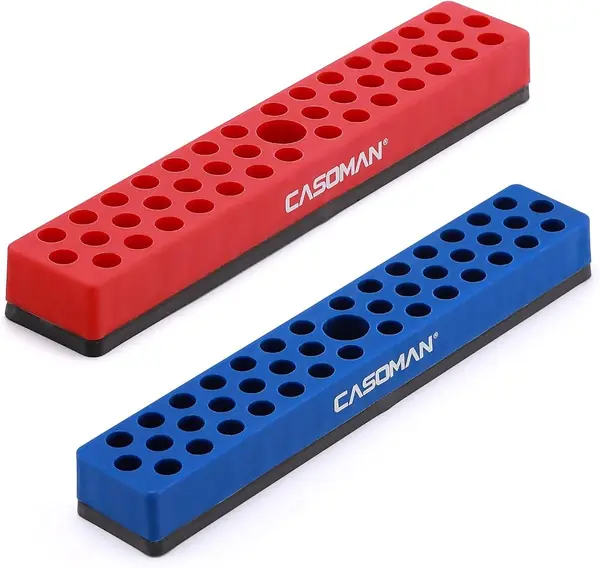
CASOMAN red and blue magnetic hex bit racks with rows of 1/4-inch holes

Budget hex storage

Shop Score 92/100
Length
7 inches
Capacity
86 holes per rack, 2 racks
Base
Magnetic with rubber coating
Bit Type
1/4-inch hex
View on Amazon

Two magnet-backed racks, 86 holes each, for less than most single organizers in this group. That's the pitch, and it holds up: one rack on the side of a chest and one in a drawer, and a pile of loose hex bits stops rolling around.

The base is a strong magnet under a rubber pad, and it grips steel through a drawer liner without marking paint. The open, semi-sided design lets you pull a bit one-handed instead of working a lid, and the racks work upside down or on their sides as well as flat. We like the color split, too: red for standard bits, blue for the specialty ones.

Laid flat or stuck to the side of a chest, bits stay where you put them. Tip a loaded rack fully over and a few work loose, so we wouldn't drop one in a bag; that's a job for a closed case. For the money, these are the easiest way to turn a drawer of loose hex bits into rows.

Worth Noting

  • Fits only 1/4-inch hex driver bits
Our Verdict

Our budget pick for hex bits: two magnet-backed racks that stick to a chest or lie in a drawer, and enough holes to end the loose-bit drawer for good.

Check Latest Price
4.

Olsa Tools Extra Large Hex Bit Organizer Best for Large Bit Collections

Olsa Tools black extra-large hex bit organizer pad with a grid of bit holes

Large bit collections

Shop Score 91/100
Length
6.57 inches
Capacity
120 hex bits
Base
Rubberized magnetic
Warranty
Lifetime
View on Amazon

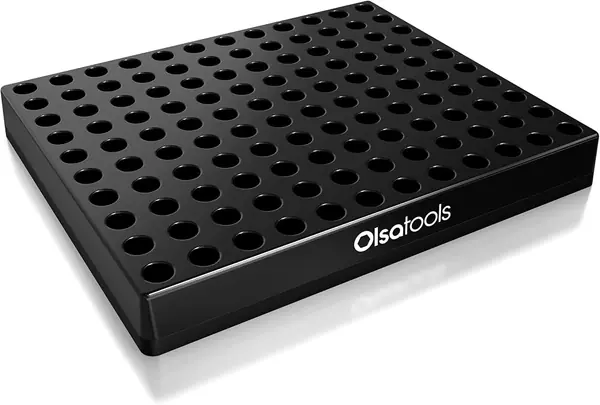
One hundred twenty holes in a pad about six and a half inches long: the Olsa packs more bit storage into less bench space than anything else here. The grid runs short and long bits in separate rows, so a stubby Torx driver doesn't vanish between two long extensions.

The base is rubberized and magnetic, which keeps the pad from skating across a bench or scratching a chest, and the polypropylene is impact resistant rather than brittle. Olsa backs it with a lifetime warranty, the only one in this group.

Retention is where we hesitate. The holes are cut generously, so bits rattle in place and some ride out on their own once the pad is tipped; the base magnet holds the rack down, not the bits in. Laid flat in a drawer it's the roomiest option here, but it's also the pick that sheds the most if you carry it around the shop.

Worth Noting

  • Loose holes let bits rattle and drop out
Our Verdict

Buy the Olsa for the hole count and keep it flat in a drawer; it holds the biggest collection here, though the loose holes make it a poor traveler.

Check Latest Price
5.

DEWALT ToughCase+ Medium Case Best for Loose Bits

DEWALT ToughCase+ yellow small parts case with clear lid and eight compartments

Loose bits

Shop Score 90/100
Lid
Clear with clip latch
Weight
11.8 oz
Dimensions
9.84"L x 9.84"W x 0.98"H
Compartments
8 with movable dividers
View on Amazon

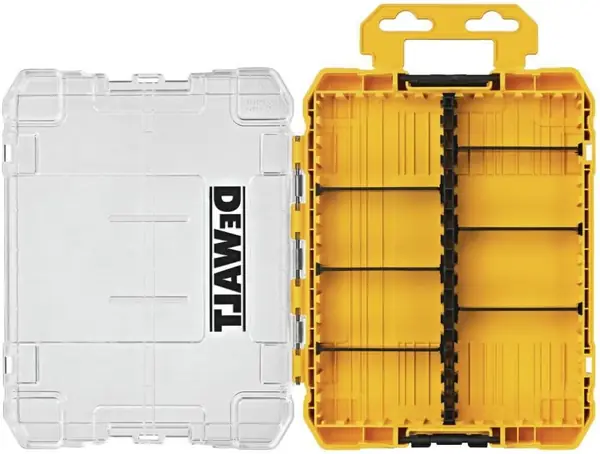
Call this one what it is: eight compartments, dividers that slide where you want them, and no sized holes anywhere. We keep it for the bits that don't belong in an index, the orphans and duplicates and the five identical Phillips bits that arrived with five different drivers, and it's the best place here for that job.

The clear lid lets you see what's inside without unlatching, the clip latch shuts with a snap, and the whole case weighs under a pound. The DEWALT ToughCase+ is roughly ten inches square and about an inch deep, and it clicks together with other ToughCase+ boxes so a stack of them handles like one unit. Screws, wall anchors, and sockets disappear into it as readily as bits.

Paired with a steel index it covers a whole drawer: the index for the sizes you reach for by name, this for everything that doesn't have a name. That division of labor is what we ended up using it for.

Worth Noting

  • Latches can pop open if bumped in a bag
Our Verdict

We recommend it as the catch-all for loose bits and orphan hardware, not a size index: the movable compartments and clear lid do that job better than any rack here.

Check Latest Price

How We Chose and Tested Drill Bit Organizers

We built the shortlist by reading listings the way a shopper does — shank type first, then stated capacity, then footprint — and weeded out anything whose dimensions wouldn't clear a shallow tool chest drawer. Sizes and slot counts came off the packaging and got checked against real bits, because a tray that claims 120 holes and won't take a long bit isn't delivering 120 of anything. We ordered 16 organizers and tested them for four months.

Every organizer was loaded with the bits it was built for, then tipped 90 degrees, shaken for half a minute, and carried by the lid across the garage to see whether bits held or rained out. For the magnetic racks, we checked two separate things: whether the bits stayed seated, and whether the rack itself stayed put on the bench or slid off its base when nudged. Cases rode in a truck side box over washboard gravel roads and sat in a canvas bag that went up a ladder, which is where weak latches announce themselves.

We measured each one against the drawer it was headed for before loading it, then tried the real task with the case on a shelf: call out a size, find it, and pull it without dumping the row next to it. Labels were read at arm's length under garage light, and we opened and closed each latch and hinge repeatedly, noting which ones loosened or needed two hands. Packed weight and bulk decided portability, and we compared price against the number of slots that actually held a bit securely — the honest measure of value.

How to Choose a Drill Bit Organizer

Match the Organizer to the Shank

Two kinds of bits are in play. Round twist bits in fractional sizes want an index, a case with a hole drilled and labeled for each diameter in 64th steps so you can read down the row to the size you named. Quarter-inch hex driver bits want a rack, a grid of hex holes that holds them shank-up where you can pull one out with two fingers. A 120-hole hex rack will not hold a 3/16-inch twist bit: the hole is cut for a hex shank, and a round bit drops through or rattles.

Before you order, count which kind you actually own. If it's both, plan on two organizers, a steel index for the twist bits and a tray or rack for the hex bits, rather than one compromise that serves neither. Then measure your longest bit, because extensions and long jobber bits need an open tray or a case with room above the slot.

A Magnet Holds the Rack, Not Necessarily the Bits

Magnetic racks sell on the strength of the base magnet, which is doing one job: keeping the rack stuck to the side of a steel chest so it doesn't slide. Whether the bits stay in the holes is a separate question, answered by how tightly the holes are cut and whether there's a clip. That's why one rack can feel welded to a toolbox and still spill the moment it's tipped, and it's the first thing we check on any magnetic design.

For a box that travels, mechanical grip beats magnetism: the taper-lock clips on the Ernst tray and the sized holes of a steel index both hold by shape. For a drawer that never moves, a magnetic rack is fine and usually cheaper.

Measure the Space Before the Slot Count

An organizer that doesn't fit is one you won't use. Three numbers decide it: drawer depth with the bits loaded, since bits stand proud of an open tray; the length of the tray against the length of the drawer; and the depth of a closed case against the drawer's clearance. The Drill America index needs about 2 inches of drawer depth, while the Ernst tray runs 14.9 inches long and wants room above it.

Magnetic racks are the exception, because they can live on the side of a chest, the lid of a toolbox, or the frame of a cart, which is where they make the most sense in a small shop. If your box is aluminum or a non-magnetic stainless, plan on a drawer instead.

Labels, Latches, and What Lasts

An index only works if the markings are right. Look for a readable size at every slot, because an organizer that ships with fewer labels than it has holes turns every lookup into a guess, and one with labels on the wrong drawer is worse than blank. If the markings wear, re-mark the case rather than living with it.

For the long haul, a steel case with a baked coating handles drops, coolant, and a damp garage, while polypropylene racks won't rust and wipe clean with a rag. Closure matters most if the case leaves the bench: a snap lid is fine in a drawer, but a latch that stands proud of the lid can pop open against anything else in a bag.

Frequently Asked Questions

Final Verdict

The Drill America index is the organizer most woodworkers should buy first: it turns a fractional set into a labeled row you can read at a glance, and the steel case outlasts the plastic one it replaces. If your bits are mostly 1/4-inch hex, skip it and get the Ernst Bit Boss instead, because those clips hold through a bounced toolbox in a way no magnetic rack manages.

And if your drawer holds both kinds, buy one of each. Two organizers, each doing its own job well, beat a single box that does neither.