↑↓ navigate ↵ open Esc close All results →

Best Finish Carpenter Tool Belts of 2026

Capacity on a spec sheet means little once a tool belt is worn through an eight-hour trim day. Overbuilt rigs invite extra fasteners and tools that drag on the hips and lower back, while poorly shaped nail pockets spill every time a carpenter bends down for a mitered return, buckles creep loose after lunch, and low hammer loops snag on ladder rungs.

Six months of wearing 12 leather, suede, canvas, and polyester belts through baseboard and casing runs, door hangs, and punch-list work showed that layout and adjustability beat raw pocket count. Sliding a heavy pouch just two inches forward on the belt can take strain off a sore hip, and stiffer materials prove their value by still holding open in month three.

Removable pouches and clean waist-range sizing let a finish carpenter scale from a full-time trim rig down to a stripped-down punch-list setup without carrying dead weight.

Our Top Picks

The Best Finish Carpenter Tool Belts

1.

Occidental Leather FatLip Tool Bag Set Best Overall
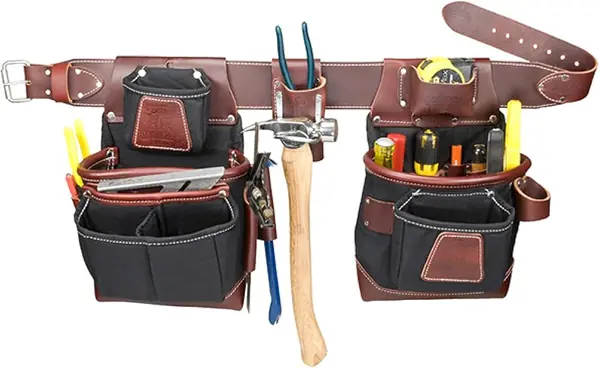
Occidental Leather FatLip tool bag set in brown leather and black nylon with deep pouches

Full-time trim work

Shop Score 95/100
Weight
5.2 lb
Belt
3-inch Ranger work belt
Bag Depth
10 inches
Pockets And Holders
25
View on Amazon

Ten inches of bag depth sounds like a spec until you are bent over a cabinet run with a fistful of 15-gauge nails. The FatLip mouth stays open on its own, so a handful goes in without a look, and the full leather boot along the bottom stops points from working through the seam. Those two details decide whether a fastener bag survives a trim package or dumps it on the floor.

That no-spill design is why this is the set we recommend to anyone who does trim and cabinetry for a living. The holders are hand-specific: a fastener bag on the left for nails, nail sets, and a cat's paw, a tool bag on the right for the hammer, chisels, and knife, with a 2-in-1 tool and hammer holder between them. There's no guesswork about where a tool belongs.

Twenty-five pockets and holders is more storage than finish work strictly needs, and we noticed the extra room mostly in how the bags hold their shape. Padded two-ply walls stay upright when they're half empty, so nothing slides into a corner you can't reach. The 3-inch Ranger belt is a leather work belt rather than webbing with a buckle sewn on, and that is most of why a loaded rig stays where you put it.

Break-in is real. The leather arrives stiff, and it takes weeks of daily wear before the bags mold to your hip and quiet down. If you hang trim twice a month that trade isn't worth it; if you're in it every day, the cost spreads out fast.

Worth Noting

  • Heavy at 5.2 pounds before tools
Our Verdict

Our pick for full-time trim and cabinetry work: the deep stay-open bags and hand-specific holders mean fewer trips back to the truck and less hunting at your hip.

Check Latest Price
2.

CLC 5605 Carpenters Combo Tool Belt Best Removable-Pouch Setup

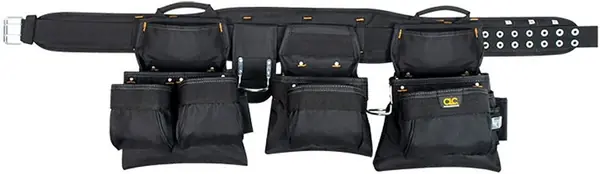
CLC Custom Leathercraft 5605 black carpenter combo tool belt with padded belt and pouch set

Mixed trim workdays

Shop Score 94/100
Pockets
18
Waist Range
29 to 46 inches
Weight
3.5 lb
Belt
5-inch padded with roller buckle
View on Amazon

Every part of this belt comes off. The pouches, the holders, and the apron itself unclip from the 5-inch padded belt and go back wherever you want them, so a day of hanging doors can start with two bags and a tape and finish with all eighteen pockets when the punch list gets long. That flexibility is why we point to it as the one belt for carpenters who mix trim, punch lists, and the occasional framing day.

The ballistic poly is the other half of the argument. It doesn't need the break-in the leather sets do, it stays light at 3.5 pounds, and it shrugs off the caulk, adhesive, and paint that follow a trim carpenter around. What it won't do is mold to your hip the way oil-tanned leather eventually does, and on the longest days we felt that difference.

Little things are well thought out. The carry handle on the apron lets you lift the whole loaded rig off the floor without spilling it, and the double-tongue steel roller buckle cinches down hard without needing two hands.

Sizing deserves a warning at the bottom of the range. The belt covers 29 to 46 inches, but cinched near the small end the padding bunches under one hip. Measure over the clothes you work in, and expect to spend a few minutes finding a setting that lies flat before you load it up.

Worth Noting

  • No dedicated pencil or knife slot
Our Verdict

The belt we point to when one rig has to cover trim, punch lists, and framing: the pouches come off and the padded belt stays comfortable through all of it.

Check Latest Price
3.

STRONGLAD 6-Pocket Leather Tool Belt Best Compact Leather

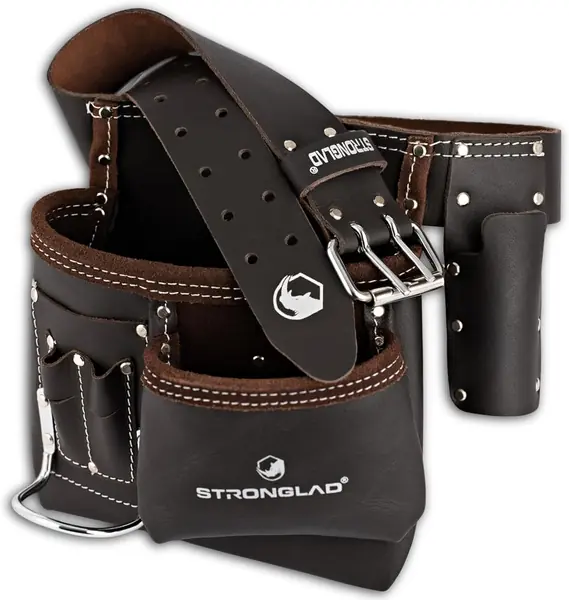
STRONGLAD dark brown oil-tanned leather tool belt with six-pocket pouch and buckle belt

Trim and installs

Shop Score 93/100
Pockets
6
Waist Range
29 to 46 inches
Material
Oil-tanned leather
Pouch Dimensions
8"W x 9"H
View on Amazon

Six pockets is not much until you count what a trim carpenter actually reaches for. This belt carries a nail pocket, a main pocket deep enough for a drill or a hammer, two pencil sleeves, and a flat slot sized for a utility knife, and then it stops, which is the point.

The oil-tanned leather is the real thing. It arrives stiff, it smells like a saddle, and after a week or two of wear it starts taking the shape of your hip. Rivets and heavy stitching sit at the corners where a pouch usually peels open first, and the 8-by-9-inch pouch is small enough to stay clear when you crouch to shim a jamb.

We like it as a second belt for trim and cabinet installs, where you're carrying a tape, a knife, a pencil, and a handful of brads rather than a full nail load. What surprised us is how little it moves: with six pockets there's no leverage pulling it off your hip, so it stays put through an entire install. It is not the belt for a big casing run, where you want more fastener room.

Worth Noting

  • Short buckle tongue can work loose
Our Verdict

For trim and cabinet installs where a full rig is in the way, we reach for this compact leather belt — it carries the essentials and stays out of the way.

Check Latest Price
4.

LEFOR·Z 27-Pocket Tool Belt Most Storage for the Money

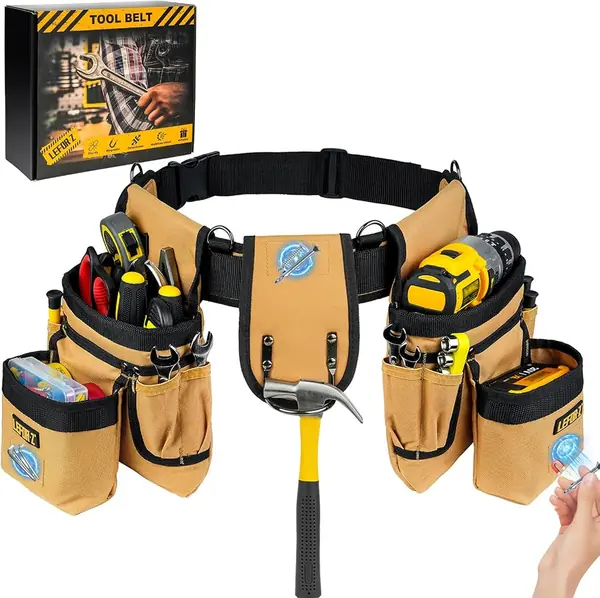
LEFOR·Z brown and black nylon tool belt with three detachable pouches and magnet panels

Remodels and tear-outs

Shop Score 92/100
Pockets
27
Waist Range
31 to 48 inches
Weight
1.94 lb
Magnet Zones
3
View on Amazon

Twenty-seven pockets arrive slightly overwhelming. Two rows face out from each pouch, three magnet panels sit on the pouch fronts and the hammer holder, and the first thing we did was drop a handful of screws on a magnet to see whether they stayed. They did.

The three pouches unclip with quick-release buckles and can be moved or left in the truck. Bare, it weighs 1.94 pounds, which is light enough to forget until you start filling pockets.

Twenty-seven is more storage than finish work calls for, and we found ourselves loading it just because there was room. A trim carpenter who likes a lean belt will end up leaving a pouch behind, which is exactly what the detachable design is for.

We think of this as the belt for the remodeler who does trim one week and demo the next — a lot of capacity for the money and enough flexibility to shrink it down. It isn't leather and it won't age into leather, but it does the job a leather rig costs several times as much to do.

Worth Noting

  • Belt works loose as you move
Our Verdict

If you want the most pockets for the least money, this is the rig we hand over — the pouches come off, so it shrinks for trim work.

Check Latest Price
5.

AWP Carpenter Tool Rig Best with Suspenders

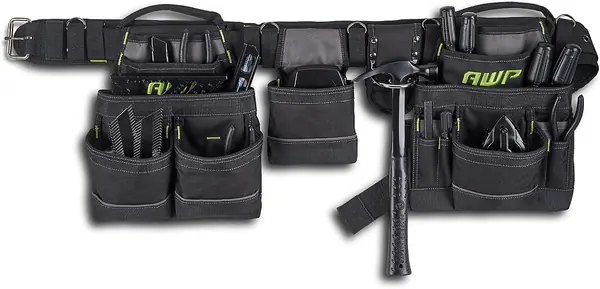
AWP black polyester carpenter tool rig with padded suspenders and eighteen-pocket waist belt

Overhead trim work

Shop Score 91/100
Material
600 denier polyester
Suspension
Padded air-mesh suspenders
Maximum Waist
50 inches
Pockets And Loops
18
View on Amazon

The suspenders are the reason to look at this rig. Padded air-mesh runs over the shoulders and across the back, and it takes the weight off your hips, which matters if you spend a morning running crown with your arms overhead. Eighteen pockets and tool loops hang off the waist belt underneath, tiered so the smaller pockets sit above the deep ones.

We like it for carpentry that mixes overhead work with bench work, and for anyone whose hips complain after a long day in a conventional belt. The 600 denier polyester is tough but it won't break in the way leather does, and it's worth confirming the suspenders are actually in the box before the return window closes.

Worth Noting

  • Waist sizing is unpredictable across the range
Our Verdict

When your work is overhead, the suspenders here earn their keep: padded air-mesh moves the load to your shoulders and off tired hips.

Check Latest Price
6.

Dickies 5-Pocket Tool Belt Pouch Best for Small Jobs

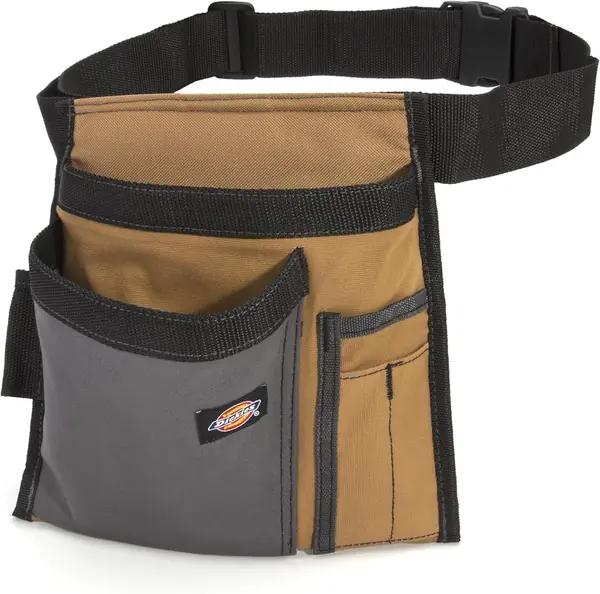
Dickies tan canvas five-pocket tool pouch on a webbed belt with plastic buckle

Small jobs

Shop Score 90/100
Pockets
5
Waist Range
32 to 52 inches
Material
Heavy-duty canvas
Belt
Webbed with high-impact plastic buckle
View on Amazon

Which hip you wear it on decides how this pouch works. It's a single five-pocket canvas pouch on a webbed belt, so a right-handed carpenter gets fasteners on the left and a free right hip for the hammer and tape, or the reverse if you keep nails on your strong side.

We keep it around for punch lists and small jobs. Two large main pockets take a hammer and a bundle of shims, a screwdriver loop and a plier pocket handle the tools you grab constantly, and the small slip pockets hold a pencil and a knife. The heavy canvas softens quickly with use, and the high-impact plastic buckle is easy to work with a glove on.

The belt runs 32 to 52 inches, which covers nearly everyone, and the whole thing rolls up into a toolbox drawer when you're done. What it isn't is a full rig: five pockets fill fast once nails, a tape, and a cat's paw want the same space, which is why ours lives in the truck as a second belt.

Worth Noting

  • Five pockets fill fast when carrying fasteners and multiple tools
Our Verdict

For punch lists and one-room trim jobs, this is the belt we grab: a single canvas pouch, a wide-adjusting belt, and nothing extra swinging around.

Check Latest Price
7.

CLC IP489X 3-Pocket Suede Nail Belt Best for Small Finish Jobs

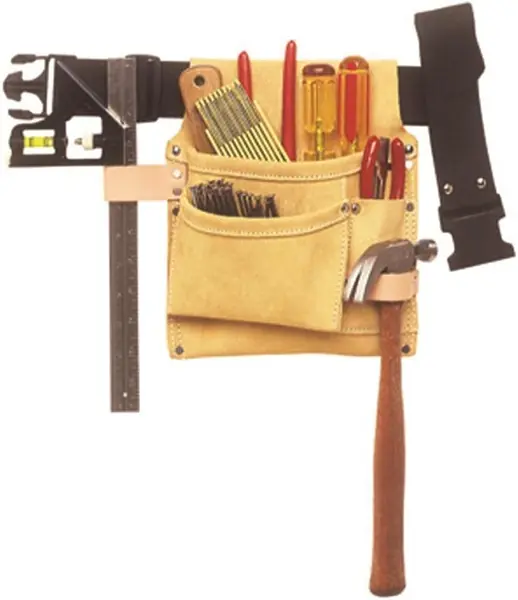
CLC tan suede three-pocket nail and tool bag with poly web belt and hammer loop

Small finish jobs

Shop Score 89/100
Pockets
3
Waist Range
29 to 46 inches
Weight
12.8 oz
Material
Suede leather
View on Amazon

Suede, three pockets, and a two-inch web belt: this is the shape most carpenters picture when they hear nail belt. It suits small work in finished rooms — a rehang, a stair rail, a run of baseboard — where you don't want a rig swinging into fresh drywall.

Two main pockets hold nails, fasteners, and a hammer, a smaller pocket takes pliers, pencils, or a nail set, and a leather loop and strap on the side carry a hammer and a tape. At 12.8 ounces it barely registers on your hip, and the quick-release buckle comes off in one motion at the end of the day.

We reach for this one when the belt needs to disappear. The suede softens and darkens with use, and ours has taken on the shape of the tools it carries — the kind of wear that reads as a career rather than damage. It's a light way to carry a trim load, and on small jobs that's the whole argument.

Worth Noting

  • Narrow hammer loop fits trim hammers only
Our Verdict

For small trim jobs in finished rooms, we like this light suede nail belt — it holds the essentials and stays out of the way on a ladder.

Check Latest Price
8.

LEFOR·Z 14-Pocket Single Pouch Belt

LEFOR·Z black and brown nylon single-pouch tool belt with adjustable buckle belt

First tool belt

Shop Score 88/100
Pockets
14
Waist Range
31 to 48 inches
Weight
15.9 oz
Pouch
Single detachable pouch
View on Amazon

One pouch, one hip, nothing on the other side. Fourteen pockets of nylon and a detachable pouch on a belt that runs 31 to 48 inches, and the left half of your waist stays free for a hammer, a square, or nothing at all.

The layout covers the trim basics: a deep main pocket, a nail pocket, a steel hammer hole, an electrical tape tether, a tape clip, and a magnet for bits and fasteners, with smaller sleeves for pencils and a knife. The pouch unclips, so it can go to the bench with you when the install moves indoors.

At 15.9 ounces it's light enough to wear all day, and the widened belt spreads what little weight there is across your hips instead of digging in at one spot. The belt is the weak link — it rolls and softens under a full load — but because the pouch unclips, the fix is a stiffer belt you probably already own.

We hand this one to people setting up a first belt or working around the house, where fourteen pockets cover everything a trim project asks for. The tape rides on a metal clip rather than a fabric loop, which we prefer: a tape comes off a clip faster than it comes out of a loop.

Worth Noting

  • Included belt softens and rolls under a full load
Our Verdict

If you're building a first belt for home trim projects, this is the one we suggest — fourteen pockets, a light pouch, and a price that leaves room for tools.

Check Latest Price

How We Tested Tool Belts for Trim Work

We started with spec sheets and owner reviews, then narrowed the field by pouch layout, stated waist range, material, and whether the pouches come off, keeping a spread of leather, suede, canvas, and polyester rigs so we could compare how each type breaks in.

Twelve belts went out with us over six months of finish work: baseboard and casing runs on three houses, two door-hang days, a window seat build, and a long punch-list stretch. Each belt was loaded for the day's job with a hammer, a 25-foot tape, nail sets, pencils, a knife, and a block plane, then kept on from setup to cleanup, ladder trips included.

On the job we weighed each belt loaded and noted where the mass sat on the hips, and we walked a measured waist range to see whether the padding landed where the sizing chart promised and whether the buckle crept after a few hours of up and down. We bent over to pick up dropped nails and checked whether the fastener pockets kept them, and whether the magnetic strips actually held a handful of 16s. We also checked hang height against ladder rungs, watched for hammer loops that snagged cords, and kept each load balanced left to right.

Over the following weeks we tracked break-in: how stiff the leather felt on day one versus after a month of sweat and sawdust, whether the nylon and polyester rigs sagged at the pockets, and how quickly a belt with quick-release pouches came down to a bare strap at the truck. The belts that made the list held their shape, kept fasteners in when we folded over, and were still comfortable well past the sixth hour.

How to Choose a Finish Carpenter Tool Belt

Match the Rig to Finish Work

Finish carpentry asks for close to the opposite of a framer's setup. You carry a few dozen fasteners and a lot of small tools, so a deep bag that swallows a pound of 16-penny nails mostly buries the nail set you need right now. What we look for is one pocket deep enough that fasteners don't spill when you bend over, a dedicated tape clip, a hammer loop sized for a 16-ounce trim hammer, and pencil sleeves you can find without looking.

More pockets is not automatically better. A nail belt with four well-placed pockets beats a twenty-seven-pocket rig that tempts you to carry the whole truck up a ladder.

Get the Belt Right Before Anything Else

Two-inch webbing with a plastic buckle is fine for a homeowner with a punch list. If the belt goes on eight hours a day, a wider leather work belt or a padded belt in the 3- to 5-inch range spreads the load across your hips instead of cutting into them, and a double-tongue roller buckle holds tension better than a friction buckle.

The trap is the sizing range. Nearly every belt here advertises a broad spread of waists, but padding bunches at the small end and the rig sits sloppy at the top end. Measure over the clothes you actually work in and treat both ends of the range as approximate.

Leather, Nylon, or Polyester

Leather molds to your hip, stands up on its own when empty, and improves for years — but it is heavier, stiff for the first few weeks, and costs more. Ballistic nylon and polyester are lighter and cheaper, need no break-in, and shrug off caulk, adhesive, and paint; they also stay flat against the body instead of wrapping it.

We reach for leather for daily trim and cabinetry work, and for nylon or polyester on occasional projects and on jobs where the belt goes on and off a dozen times a day.

Pouches That Come Off Earn Their Keep

Quick-release buckles and detachable pouches let one belt do several jobs: strip it to two bags to hang doors, clip the fastener bag back on for a casing run. Check that the pouches actually detach rather than being sewn on, and that what's left behind is still a belt you can wear comfortably.

The other half of the equation is weight. A five-pound leather set carrying twenty pounds of tools behaves nothing like the same belt tried on empty, so load it the way you'd work before you decide.

Frequently Asked Questions

Final Verdict

For anyone who does trim and cabinetry for a living, the Occidental Leather FatLip set is the one we recommend. Ten-inch bags that hold themselves open, hand-specific holders, and a leather belt that keeps a heavy rig where you put it are worth the premium when the belt goes on five days a week.

If that's more belt than your work justifies, the CLC 5605 covers mixed days for a fraction of the cost and lets you strip the pouches off, and the STRONGLAD six-pocket is the compact leather belt we take on installs where a full rig just gets in the way.