↑↓ navigate ↵ open Esc close All results →

Best Dust Separators for Shop Vacs of 2026

Anyone who has sanded drywall or planed a board knows how a shop vac filter dies: a caked layer of fine dust, fading suction, and a clog you dig out mid-project. A dust separator puts a cyclone between hose and vac so the debris spins into a bucket before it ever reaches the filter. The cone shape matters far less than two duller questions: will it cuff onto your hose, and will the lid seal hard enough to hold vacuum?

We ran 12 separators for nine months in a garage shop, swapping them between a 1-7/8-inch hose, a 2-1/2-inch high-flow vac, and a rolling tool cart. I mounted my first one on a bucket that flexed every time the vac kicked on, a cheap lesson in how much the bin underneath matters.

None of these make a shop vac HEPA-rated; fine dust still calls for a proper filter and a respirator. What they do is keep your filter off the replacement schedule and your suction where it started, whether you are cutting a lid into a pail or unboxing a system that arrives sealed.

Our Top Picks

The Best Dust Separators for Shop Vacs

1.

Oneida Air Systems Dust Deputy DIY Best Overall
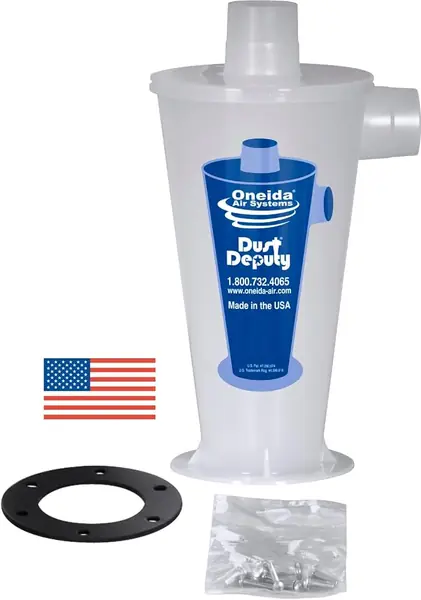
Oneida Dust Deputy DIY clear cyclone cone with foam gasket and mounting hardware

Any wet/dry vac

Shop Score 94/100
Material
Anti-static resin
Dimensions
15.5 x 9.3 x 7.4 inches
Mounts To
Any airtight bucket or barrel
Port Size
2-inch tapered
View on Amazon

Oneida ships this as a cone, a foam gasket and a bag of hardware, and the bucket, lid and hose are yours to arrange. That sounds like a chore, and for the first hour it is one. It is also the reason the Dust Deputy DIY sits at the top of our list: the collection bin is whatever you can seal, so a five-gallon pail under a bench and a drum in a permanent shop are the same purchase.

The machine is about as simple as the category gets. Centrifugal force throws material against the wall of the cone, it drops into the bin, and clean air carries on to the vac. What we watched during testing was the filter, and after planing and routing sessions the dust was in the bucket while the filter looked like it had been sitting on a shelf.

The tapered 2-inch ports take a range of push-on fittings, which is why this cone has ended up on so many different vacuums. If your hose has a 2-1/2-inch cuff, plan on an adapter, or step up to the 2.5 version below, which is built around that hose. Wood dust, drywall dust, cooled ash, metal shavings and water all go through it.

Reach is what earns it the top spot. There is no wet/dry vac it can't be plumbed into, including the one you buy next, and the bin can grow from a bucket to a drum as your work does. It is also the separator with the deepest body of use in this group, which means the mounting tricks are already worked out.

Worth Noting

  • Thin plastic can crack under hose strain
Our Verdict

Our default pick: it is the least expensive true cyclone in this group, it adapts to any wet/dry vac, and you decide how big the bin gets.

Check Latest Price
2.

Dustopper PRO Dust Collector Best for 5-Gallon Pails

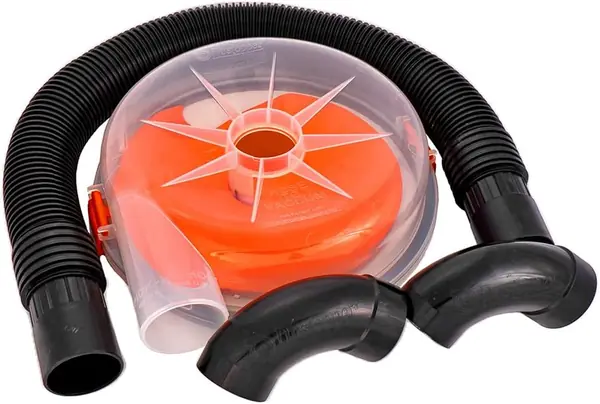
Dustopper PRO low-profile clear separator lid with two orange sweep elbows

Bucket-based shops

Shop Score 93/100
Material
Anti-static resin
Included
Two high-flow sweep elbows
Fits
Standard 5-gallon pails
Port Diameter
2.25 inches outside
View on Amazon

Setting the Dustopper PRO on a five-gallon pail takes about as long as putting a lid on a bucket, because that is essentially what it is. A hollow-core EPDM gasket does the sealing, the low housing keeps the whole stack at bench height, and we like that there is nothing to plumb, clamp or silicone before the first chip flies.

The two sweep elbows are the part that surprised us. Ordinary 90-degree fittings strangle airflow; these are shaped to keep the airstream turning, and one goes on the tool side and one on the vac side, so both hose runs are handled out of the box. On drywall dust the bucket took the load and the vac's filter came out of it barely marked.

Five gallons is the right size for a one-person shop and light enough to carry out to the curb, though it fills faster than you expect under a planer. The design is built around the standard pail and nothing else, so a barrel or a drum is out. As a way to get separation onto a vac you already own, it is the least fussy one we know.

Worth Noting

  • Gasket can work loose from the lid
Our Verdict

We reach for this one when the shop is a five-gallon pail and a vac: it seals on in seconds and the elbows do the plumbing.

Check Latest Price
3.

DEWALT 6 Gallon Dust Separator DXVCS002 Best All-In-One System

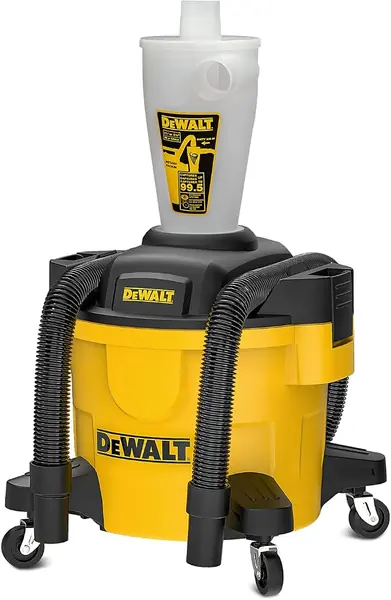
DEWALT dust separator with yellow six-gallon bucket hose and four casters

One-piece setups

Shop Score 92/100
Dimensions
15.9 x 15.9 x 31.4 inches
Mobility
Four casters
Capacity
6 gallons
Included Hose
1-7/8 inch
View on Amazon

Open the box and you get a wheeled tank rather than a lid: a six-gallon poly bucket, a lid with two latches and two handles, four casters, a 1-7/8-inch hose and a pair of hose holders. Apart from an adapter your tools may want, there is nothing else to buy.

Assembly is a one-time job with a screwdriver. After that the unit rolls, and the casters turned out to be the part that changes how you work: the separator follows the miter saw instead of living in one corner, and the latches come off quickly at emptying time.

What we appreciate most is that it removes the bucket question entirely. Every other pick here asks you to source a pail or a drum and get the lid to seal; this one arrives sealed, and the tank has stayed airtight under a vac's pull. It is the pick for someone who would rather spend money than an afternoon building a cart.

The hose is the one thing to sort out before you start. The 1-7/8-inch end does not match every tool port, DeWalt's own tools included, so order adapters with the unit rather than discovering the mismatch mid-project. Once they are on, the run from tool to tank is short and the whole thing moves as one piece.

Worth Noting

  • Six-gallon tank fills quickly on planing work
Our Verdict

Buy this one if you want the whole thing in a single box: tank, casters, hose, and no bucket to source.

Check Latest Price
4.

Cen-Tec Systems Quick Click Separator Best for Fine Dust

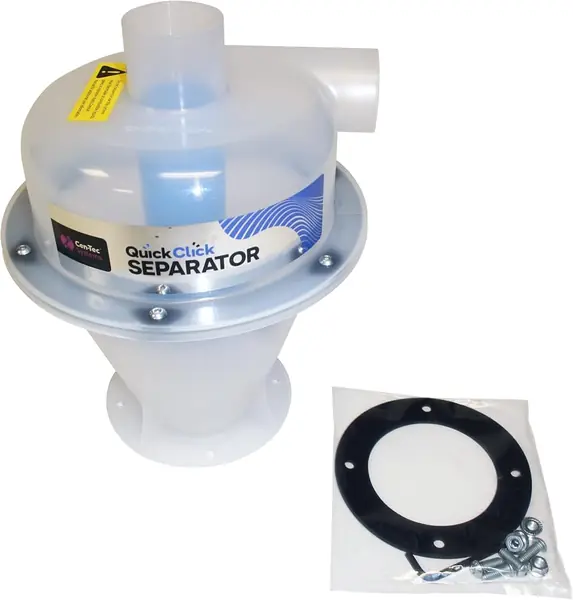
Cen-Tec Quick Click translucent separator with rubber gasket and baffle plate

Fine sanding dust

Shop Score 91/100
Weight
3.4 lb
Hose Fit
2-1/4 or 2-1/2 inch
Mounting
Commercial rubber gasket
Separation
Concave baffle plate
View on Amazon

Most separators here are straight cones. The Quick Click adds a concave baffle beneath the lid that shields the outlet from the dust cloud spinning below it, and the difference shows up with powders: drywall sanding dust, concrete dust, anything fine enough to stay airborne.

We like this one for exactly that work. The rubber mounting gasket is heavier than the foam discs on the retrofit cones, the 8-inch housing gives the airstream room to turn, and it takes both 2-1/4 and 2-1/2-inch shop vac hoses without a drawer of adapters. Our listing is the separator alone; the same unit is sold with a five- or 12-gallon bin, which is the version to get if you have no barrel to mount it on.

The gasket is the thing to plan around, because it seals against the bin rather than biting into it. That calls for a stiff container: a thin 20-gallon tub flexes under suction and the seal goes with it, where a heavy-duty bucket or a steel drum holds. Choose the bin first and this separator is a quiet, effective one.

Worth Noting

  • Sold without a collection bin or barrel
  • Gasket seal requires a rigid container that resists flexing
Our Verdict

For sanding dust and drywall, we think this is the separator to beat: the baffle catches what a bare cone lets through.

Check Latest Price
5.

Mullet Tools Cyclone Dust Collector Best for a Rolling Setup

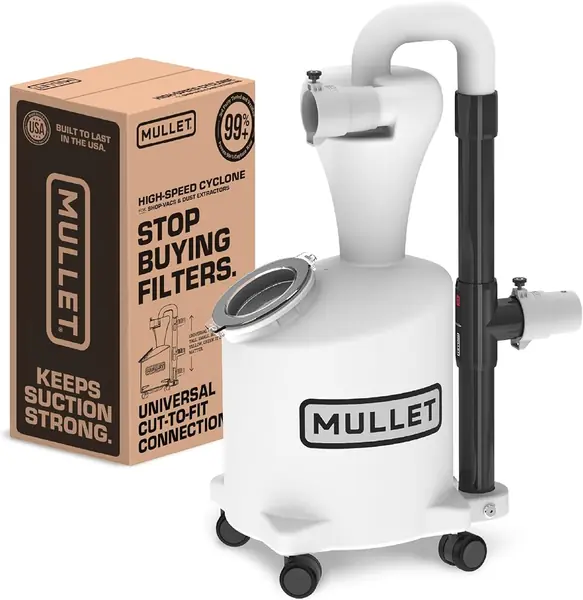
Mullet Tools white one-piece cyclone dust collector on casters with hose adapters

Mobile tool carts

Shop Score 90/100
Ports
Two hose adapters included
Mobility
Casters included
Body
One-piece parabolic cyclone
Connection
Cut-to-fit rigid PVC
View on Amazon

The Mullet is the most expensive retrofit cyclone here short of the Festool, and the only one that arrives as a piece of furniture: a thick-walled one-piece cyclone on casters, with a rigid PVC joint cut to your hose size. We winced at the price and stopped wincing somewhere around assembly.

That rigid joint is the point. Once the PVC is trimmed and pushed onto your cuff, you have an airtight, mechanical connection that does not pull apart when you drag the vac across the floor — no tape, no bungee, none of the lash-up that most bucket builds turn into. The body is noticeably thicker than the retrofit cones, and the parabolic shape keeps a fast spin even with fine dust.

Where it earns its money is movement. If an afternoon takes you from the planer to the table saw to a router table, a unit that rolls alongside you and empties through a clear port is worth the premium, and the casters are the reason. If your vac lives in one spot, the cheaper cones separate just as well for a fraction of the outlay.

Worth Noting

  • Cut-to-fit PVC leaves little room for measuring error
Our Verdict

Worth it if you move between tools all day: we like the thick plastic and the rigid joint, and you pay for both.

Check Latest Price
6.

Oneida Air Systems Dust Deputy 2.5 DIY Best for 2.5-Inch Hoses

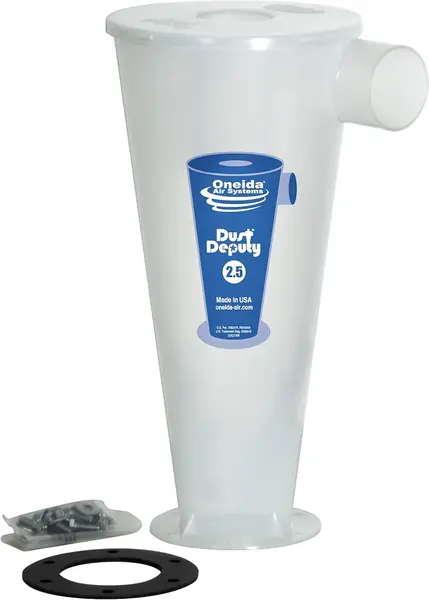
Oneida Dust Deputy 2.5 DIY clear cyclone with three-inch flange and foam gasket

High-flow shop vacs

Shop Score 89/100
Included
Cyclone, gasket and hardware
Dimensions
8.5 x 7.63 x 15.63 inches
Hose Fit
2.5-inch cuffed hose
Mounting Flange
3-inch inside diameter
View on Amazon

This is the Dust Deputy built around a 2-1/2-inch hose. The ports take a cuffed hose directly, the mounting flange is three inches across, and the body is sized to move more air than the small cones. Oneida's claim of up to double the airflow is directional rather than exact, but the direction is right.

Mounting is the same drill as the DIY version: a hole in a lid, the foam gasket, and bolts through the flange. From there it behaves like the cone above — chips drop out of the spin, the filter stays clean, and the bucket fills instead of the vac.

Airflow is where it earns its place. A 2-1/2-inch hose clamped onto a tapered 2-inch port is a bottleneck, and if you have been running adapters to make the smaller cone work, this removes them in one step. For a 1-7/8-inch hose, the cheaper DIY is just as effective. Whichever you choose, hang the bucket so the hose weight pulls on the lid rather than sideways on the cone.

Worth Noting

  • Needs a 3-inch hole cut in your lid
Our Verdict

We steer 2.5-inch hose owners here: bigger fittings, less restriction, and the same cyclone that made the original's name.

Check Latest Price
7.

Peachtree Woodworking Cyclone Separator Kit Best for Four-Inch Ducting

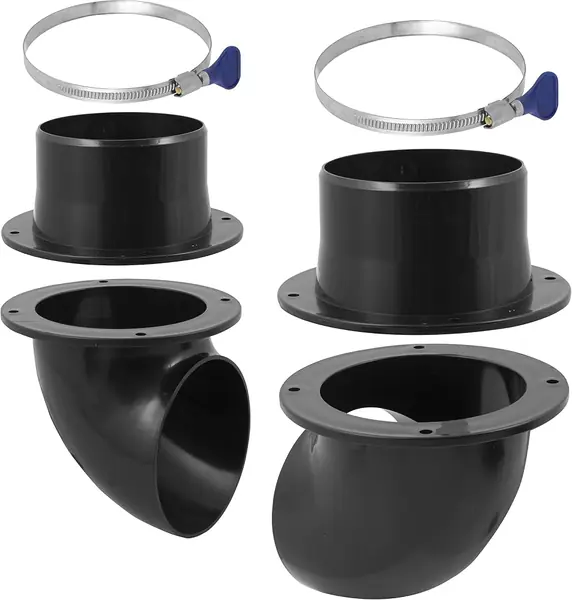
Peachtree cyclone separator kit with black four-inch ports elbows and hose clamps

Four-inch ducting

Shop Score 88/100
Weight
1.5 lb
Included
Two top ports and two elbows
Ports
Four-inch
Hardware
Turn-key hose clamps
View on Amazon

Four-inch ports put this kit in a different lane. It is built to sit between a dust collector and a barrel, or between a shop vac and a barrel if you are willing to step the hose down, and it does that with two top ports, two bottom elbow ports and turn-key hose clamps for the joints.

It earns its place as the inexpensive route to a two-stage system: bolt the flanges to a barrel lid, run a bead of silicone around each one before you tighten the clamps, and the barrel stops being a garbage can and starts being the first stage of your dust collection. On a drum it goes a long time between empties, and the silicone is the difference between a good seal and a whistle.

The catch is the shop vac half of the brief. A four-inch port on a 2-1/2-inch hose is a step down at both ends, you will need reducers, and on a small vac that plumbing costs airflow. If your shop already runs four-inch ducting, none of that applies, and this is the least expensive way we know to build a proper two-stage.

Worth Noting

  • Kit ships without hose or container
Our Verdict

A good buy if you run four-inch ducting; on a shop vac you will be adapting down and giving up some airflow.

Check Latest Price
8.

Festool CT Cyclone CT-VA-20 Best for Festool CT Extractors

Festool CT Cyclone flat aluminum pre-separator for CT 26 36 and 48 extractors

Festool CT extractors

Shop Score 87/100
Weight
15.4 lb
Material
Aluminum
Fits
CT 26/36/48 extractors
OSHA Table 1
With a certified CT extractor
View on Amazon

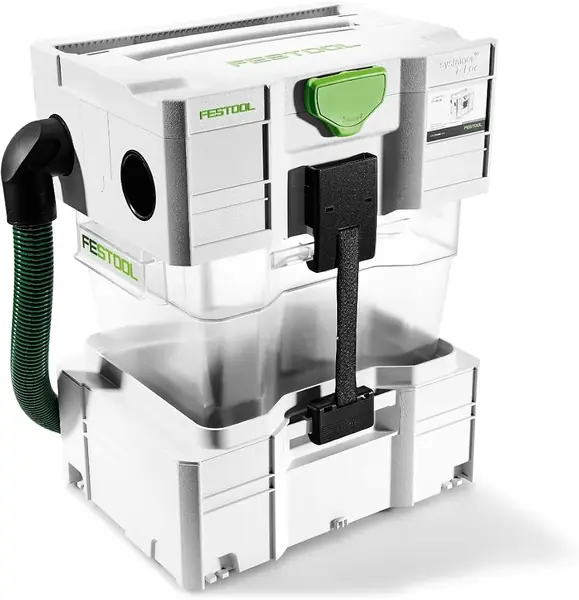
If the extractor in your shop says Festool on it, this is the pre-separator designed to sit on top of it. It clips into a CT 26, 36 or 48, stacks under a Systainer, and keeps its flat cyclone body low enough that the whole column still rolls under a bench.

What it buys is the expensive part of the system: filter bags and HEPA filters. Coarse dust and debris drop into the cyclone's own bin instead of the bag. Festool states that the combination meets OSHA's Table 1 for silica dust when it is paired with a certified CT extractor, which matters if you cut stone or concrete for a living.

The trade is airflow. Every separator adds a restriction and this one is no exception; on a mid-size extractor the loss is noticeable, and it is the price of keeping the bag and the filter clean. Emptying is quick, since the bin drops out of the stack, and it takes more material than the flat shape suggests.

We recommend it inside the Festool ecosystem and nowhere else, because everything good about it — the clipping, the stack height, the compliance claim — is tied to those extractors, and none of it transfers to a shop vac. Check your model against the fit list before you order; the mount is not universal.

Worth Noting

  • Does not fit the CT-15 extractor
  • Costs far more than any other separator here
Our Verdict

The pre-separator to buy if you already run a Festool CT and bill for finish work; it protects the expensive bags and filters.

Check Latest Price

How We Tested Dust Separators

We started with the hose, not the cyclone. We pulled port dimensions and the list of included adapters for every separator we could find, then shortlisted the ones that would cuff onto 1-7/8-, 2-1/4- and 2-1/2-inch hoses without a drawer of extra fittings. Price, bin mounting and whether a unit showed up sealed or asked us to cut a lid rounded out the shortlist, so it ran from bare DIY cones to a complete wheeled system.

Twelve separators spent nine months in a two-car garage shop, moved between a table saw, a router table, a random-orbit sander and a rolling tool cart. We cut pine and MDF, sanded drywall, and emptied planer shavings by the bucketload. The vacs kept their HEPA filters in, we wore respirators for the fine-dust runs, and after a wet pickup we emptied and dried the bin and separator completely before any dry work.

Every session ended with the vac opened up so we could see how much fine dust had actually reached the filter. We watched lids for lift and gaskets for whistle under vacuum, squeezed bucket walls to see how much they flexed, and nudged each unit with a sideways tug on the hose to check whether a narrow pail would tip.

A handheld anemometer at the hose end told us how much airflow each cyclone cost, and we timed assembly, from cutting a lid to bolting on a flange. At the end of nine months we repeated the tug test and inspected ports and gaskets for cracks or stretch, then dumped each bin over a trash can to see how cleanly it emptied.

How to Choose a Dust Separator for a Shop Vac

Start With Your Hose, Not the Cyclone

Measure the outside diameter of your shop vac hose before you order anything. Hoses run 1-7/8, 2-1/4 and 2-1/2 inches at the cuff, and a tapered 2-inch port will grip some of them and fight the rest. Adapters are cheap individually and add up fast, so if you run 2-1/2-inch cuffs, buy a separator with 2-1/2-inch fittings.

The trap is the word universal. A four-inch kit is sized for dust collector ducting and needs reducers at both ends before a shop vac hose goes anywhere near it. Count the adapters in your head before you check out; that is where the friction lives.

The Seal Matters More Than the Shape

A cyclone separates by spinning the air, and any leak at the lid breaks the spin. Foam gaskets work well on a stiff lid; a thin or warped bucket lid flexes under suction and the seal travels with it. Run a bead of silicone around flange joints, choose a heavy-duty bucket or a drum with a flat rim, and check that the latches pull the lid down evenly.

If the separator whistles or the bin lifts, you have a leak rather than a weak cyclone, and no amount of vacuum power will fix it.

Pick the Bin Before You Pick the Brand

Two purchases happen at once: the separator and the container under it. Five gallons is the sweet spot for a garage shop, light enough to carry and small enough to live under a bench; long planing sessions want a drum. Some units arrive with their own tank — the DEWALT is the one here that does — and most do not.

Emptying style matters as much as size. A drum means tipping a full lid, a pail means carrying, and a bag liner means neither. Whatever you choose, the bin is part of the system, so a container that flexes or a lid that won't sit flat will undo a good cyclone.

Low-Profile Lids Versus Full Cyclones

A lid-style separator sits at bucket height and slides under a bench; a full cyclone stands well above its bin and makes a narrow bucket top-heavy when you tug the hose. Taller cones move more air, which counts on a high-flow vac, but only if the bin underneath is stable.

If the unit rides on a cart with the vac, height costs nothing. If it lives in a corner and gets dragged out by the hose, low and wide is easier to live with.

Fine Dust, Filters, and What a Separator Can't Do

These units keep dust out of the filter. They do not make a shop vac safe for fine dust. Sanding drywall or cutting concrete puts silica and fine wood powder in the air, and a cyclone only stops that material from packing your filter; you still want a HEPA-rated filter and a respirator.

What you can expect on a healthy vac is far fewer filter cleanings and much longer filter life. A separator is a filter saver, not a dust extractor.

Frequently Asked Questions

Final Verdict

The Dust Deputy DIY is what we tell most people to buy. Any wet/dry vac, any bin you can seal, and the lowest price of any true cyclone in this roundup — it is the default for good reason.

If you would rather set a lid on a five-gallon pail than build a mount, the Dustopper PRO is the neater answer. If you want the tank, casters and hose in one box, the DEWALT. And if your hoses wear 2-1/2-inch cuffs, go straight to the Dust Deputy 2.5.