↑↓ navigate ↵ open Esc close All results →

Best Commercial Shop Vacs of 2026

Sheetrock dust settles on everything, and that's usually the moment a borrowed vacuum stops being enough. A commercial shop vac has to swallow a bucket of gypsum dust without choking, pull standing water out of a low corner, and stay quiet enough that the homeowner in the next room doesn't wince. What it fixes is the stop-and-go: fewer dumpster runs, fewer filter swaps, fewer minutes fighting a hose that pops off its coupler.

We ran 12 shop vacs for eight months across a cabinet shop, a stair-heavy renovation, and a couple of wet basements, and peak horsepower — the number most listings lead with — turned out to be the least useful one on the box. Airflow and water lift say far more about fine sawdust versus a bucket of wet debris.

The picks below run from a bench-side vac you can lift with one hand to a two-motor industrial unit on casters, since a one-person trim crew and a production floor don't need the same machine. What they share is a tank you can empty without a fight.

Our Top Picks

The Best Commercial Shop Vacs

1.

Vacmaster VJH1211PF 12-Gallon Best Overall
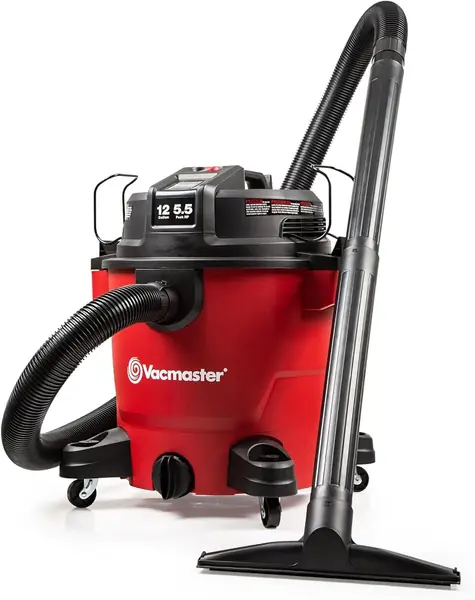
Vacmaster 12-gallon red wet/dry shop vacuum with four casters and on-board hose storage

High-volume shop cleanup

Shop Score 91/100
Capacity
12 gallons
Peak Horsepower
5.5
Power Cord
20 feet
Maximum Suction
60 inches
View on Amazon

Twelve gallons and 5.5 peak horsepower for about the price of a five-gallon vac is the short version, and it is why the Vacmaster ended up at the top of our list. A 20-foot cord crosses a two-car garage without an extension cord, and the hose, cord, and tools all have a home on the tank, so the machine stays assembled between jobs instead of in three pieces on a shelf.

Suction is where it earns the money. Pulling sawdust through a drum and cyclone is the job that separates a shop vac from a household canister, and this one keeps the dust moving rather than letting it stall in the hose — we came back to it for exactly that. Twelve gallons also means the tank gets emptied at the end of a session rather than in the middle of one, and at 24 pounds with four casters and four handles it goes up stairs and around tight corners without a fight.

The kit is generous for the money — nine pieces, including a cartridge filter and a dust bag for dry work — and it stores on the machine instead of in a bucket somewhere. We also like that the tank is polypropylene rather than steel: on a concrete floor and around a truck bed, plastic takes knocks that leave a stainless tank dented, and it cannot rust after a wet pickup gets forgotten.

For fine sanding dust, run the bag inside the tank along with the cartridge. It catches most of the spoil before it reaches the pleats, and that is the difference between tapping a filter out once a week and replacing it every couple of months.

Worth Noting

  • Lid latches and hose couplers wear first
Our Verdict

We recommend it to any shop that wants big-tank capacity without a premium price: strong suction, a 20-foot cord, and a home on the machine for every tool.

Check Latest Price
2.

RIDGID 1610RV 16-Gallon Stainless Best for Stairs and Rough Ground

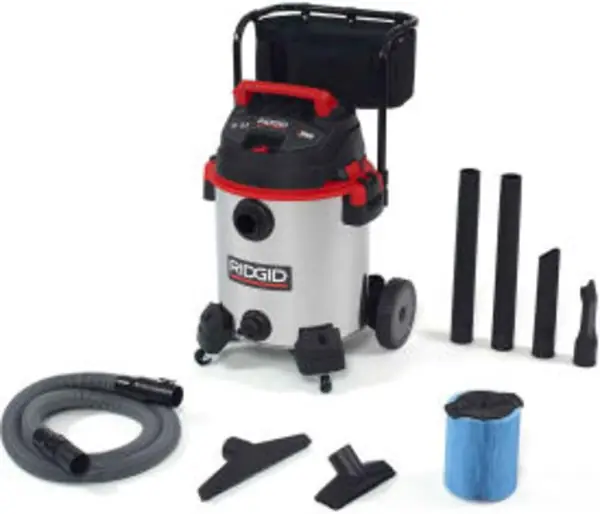
RIDGID 1610RV red stainless steel wet/dry vacuum on a wheeled cart with push handle

Stair-heavy jobsites

Shop Score 90/100
Capacity
16 gallons
Peak Horsepower
6.5
Hose Length
8 feet
Noise Level
70 dB
View on Amazon

RIDGID builds this one on a steel cart with a push handle and rear wheels big enough to climb a curb, and that chassis is what sold us. If your work moves between a truck bed, a basement, and a client's back hallway, the cart does more for you than another half horsepower ever will.

Behind the cart sits a 16-gallon stainless tank and a 6.5 peak horsepower motor — more tank and more motor than the other steel vac here. The 8-foot hose snaps in and out at both ends, the blower port pushes sawdust out of a doorway in a couple of passes, and a rated 70 dB means you can hold a conversation while it runs.

One design detail to plan around: the exhaust exits on the same side as the hose inlet, so blow-off dust can scatter the debris you were about to pick up. Keep the tank a few feet back from the pile, or use the blower port deliberately to clear a doorway before you start, and it stops being an issue.

Worth Noting

  • Square cart takes more floor space than a canister
Our Verdict

We point contractors here when the vac has to travel: a 16-gallon steel tank on a cart that rolls up stairs instead of being carried.

Check Latest Price
3.

DEWALT STEALTHSONIC 5-Gallon (DXV05P) Best for Quiet Indoor Work

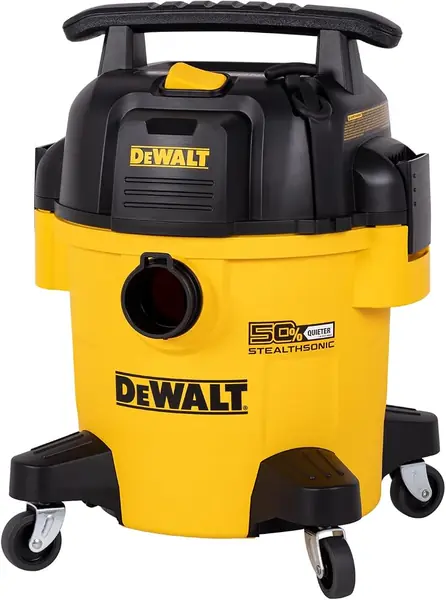
DEWALT STEALTHSONIC yellow and black five-gallon wet/dry shop vacuum with four casters

Quiet indoor work

Shop Score 89/100
Capacity
5 gallons
Peak Horsepower
4
Noise Level
65 dB
Weight
18.3 lb
View on Amazon

Sixty-five decibels is the number that makes this DEWALT worth its price. The STEALTHSONIC pulls 4 peak horsepower while running quietly enough to hold a conversation over, and in a finished house or an occupied shop that is the difference between cleaning up now and cleaning up after everyone else leaves.

The rest of the machine is built to be carried rather than dragged: 18.3 pounds, four casters, a 7-foot hose, and an accessory kit that covers floors, corners, and the gap between a truck seat and a console. Nothing about it feels like a scaled-down big-box vac, which is part of why we keep reaching for it instead of a canister.

What we noticed is how often it comes out. Because it is quiet and light, it gets used for the ten-minute cleanup that a twelve-gallon tank never gets wheeled out for, and it has become the vac that lives by the bench while a bigger machine stays by the door for heavy days.

Worth Noting

  • Five gallons needs emptying often on debris-heavy jobs
  • Four peak horsepower is modest for a big cleanup
Our Verdict

This is our top pick when vacuuming where people are working: 65 dB of quiet with enough suction for punch-list and bench cleanup.

Check Latest Price
4.

Shop-Vac 12-Gallon Stainless Best for Wet Pickup

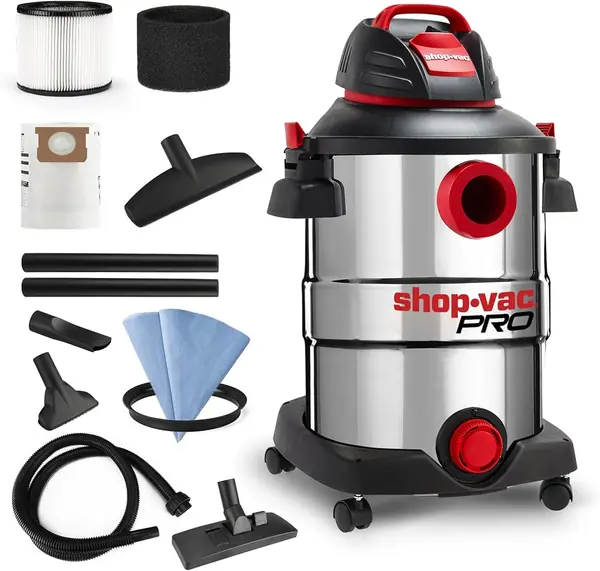
Shop-Vac 12-gallon stainless steel wet/dry vacuum with drain port and four casters

Wet pickups

Shop Score 88/100
Capacity
12 gallons
Peak Horsepower
6.0
Power Cord
18 feet
Hose Length
7 feet
View on Amazon

When there is water on the floor, the question stops being about airflow and becomes about how twelve gallons of it leaves the tank. This Shop-Vac answers with a drain port, a stainless tank, and a foam sleeve in the box — the three things that turn a wet pickup from a two-person job into a one-person one.

The dry side is covered too. Six peak horsepower, a 7-foot hose, and an 18-foot cord give you over 25 feet of working reach, and the box includes a cartridge filter, a filter bag, three extension wands, a 10-inch wet/dry nozzle, a gulper nozzle, and a crevice tool. The tank is metal, which in a shop is the distinction that matters: it takes a knock from a wheelbarrow without cracking the way plastic can.

We reach for this one whenever the mess is wet, and it is the wet/dry vac we pick when the tank is going to sit outside between jobs; stainless and a drain port make that routine instead of a chore. It is not the quiet one — 80 dB is the loudest rating in this group — but that only matters if the work is indoors with someone else in the building.

Worth Noting

  • Motor failures are the risk for full-time commercial use
  • Only three on-board slots for six tools
Our Verdict

We pick it for water: a stainless tank, a drain port, and a foam sleeve turn a wet pickup into a one-person job.

Check Latest Price
5.

Farag Janitorial JM773 21-Gallon Best for High-Volume Cleanup

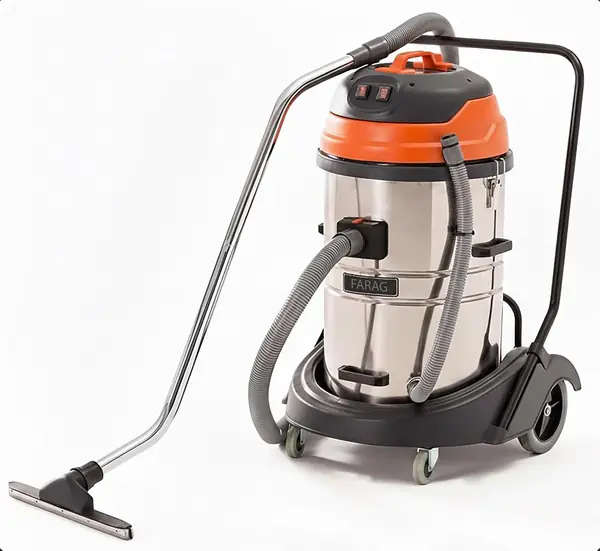
Farag Janitorial 21-gallon industrial wet/dry vacuum with dual motors and large tank

High-volume industrial cleanup

Shop Score 87/100
Capacity
21 gallons
Power
2000 watts
Motors
2
Airflow
225 CFM
View on Amazon

Two motors, 2000 watts, and 225 CFM feeding a 21-gallon tank: this is less a shop vac scaled up than a janitorial machine that happens to be sold in the same aisle. Nothing else in this group carries this much capacity or this much motor, which tells you what Farag built it for.

Volume is where it pays. When debris comes off a planer, a floor sander, or a tear-out in bucketfuls rather than scoopfuls, twenty-one gallons and a second motor mean you keep working instead of stopping to dump a small tank. For a commercial shop generating that kind of waste all day, the extra money buys time, and time is the whole argument.

The listing is thin where we usually lean on it — no hose length, cord length, or weight — so confirm what comes in the box before you order, and plan a parking spot near an outlet you do not share. A 21-gallon tank is not something you carry to the far end of a building once it is full.

Worth Noting

  • Costs more than any other vac here
Our Verdict

For shops that fill a tank in a day, its two motors, 225 CFM, and 21 gallons are built for industrial volume.

Check Latest Price
6.

DEWALT DXV09PA 9-Gallon Best for One-Person Jobsites

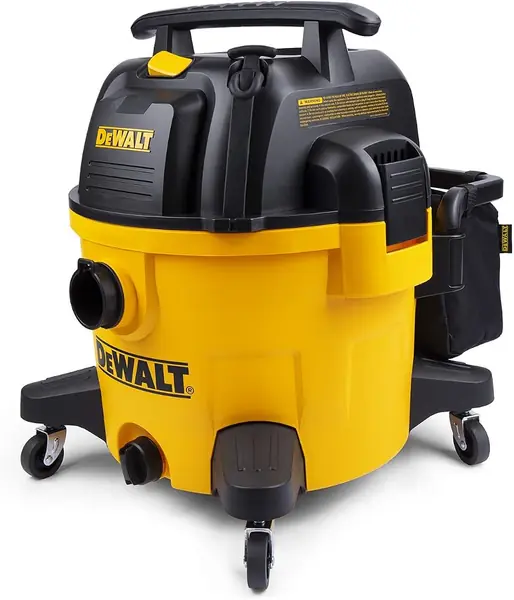
DEWALT nine-gallon yellow wet/dry shop vacuum with rubberized casters and accessory bag

One-person jobsites

Shop Score 86/100
Capacity
9 gallons
Peak Horsepower
5
Power Cord
10 feet
Blower Port
Built in
View on Amazon

Nine gallons is the size that slides behind a truck seat and still swallows a day's debris, and the DXV09PA is the most polished version of that idea here: a 5 peak horsepower motor, rubberized casters, a 10-foot cord with its own wrap, and an accessory bag that keeps the wands together.

The blower port is more useful than the spec suggests. Three adapters turn the vac into an air pump, so the machine that pulls sawdust out of a cabinet corner can also blow it off a bench, out of a tool's cooling vents, or off a driveway. We like a vac that handles the second job without a second tool.

Nine gallons is also the honest boundary: enough for a day of punch-list work and second fixings, not enough for a tear-out, and that is the trade against the twelve- and sixteen-gallon machines. Inside that range it is the easiest of these to live with — the casters roll over cords, and everything you need travels in the bag.

Worth Noting

  • Ten-foot cord is short for a large shop floor
Our Verdict

We like it as the one-vac answer for a truck: nine gallons, a real blower, and casters that roll over a shop floor.

Check Latest Price
7.

WECLEAN V7 4-Gallon

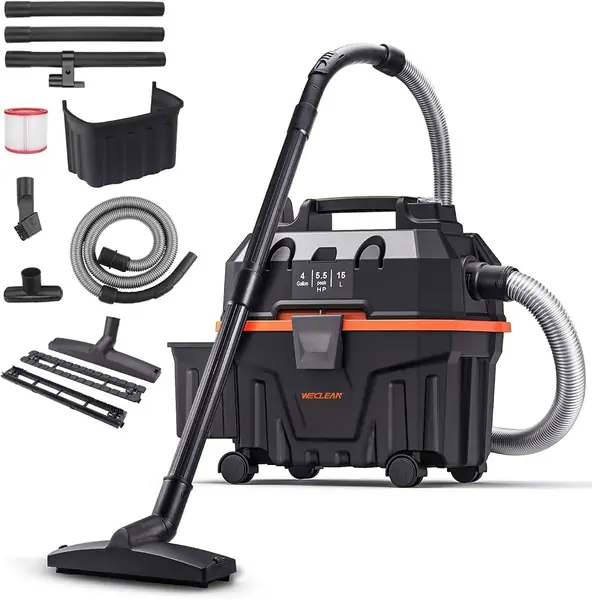
WECLEAN V7 black four-gallon wet/dry shop vacuum with hose and extension wands

Bench-side cleanup

Shop Score 82/100
Capacity
4 gallons
Power Cord
18 feet
Maximum Suction
70 inches
Motor
1200 watts
View on Amazon

Four gallons, a HEPA filter, and three speeds in an 18-inch body: the WECLEAN V7 is the machine you pick up with one hand for the mess you just made, not the one you wheel out for a season of work.

Reach is better than the size suggests. An 18-foot cord, a 5-foot hose, and three wands add up to more than 24 feet of working distance, so it can sit in a doorway while you get to the far end of a room. The three speeds earn their place too: low for dusting a bench, high for a truck's carpet, and the HEPA filter keeps fine dust out of the air you are breathing.

Four gallons is enough for a bench, a car interior, and a small repair, and it is not a demolition vac. Treat that as the boundary of what this one is for rather than a flaw; WECLEAN backs it with a one-year warranty and a filter that is easy to get to.

What we like most is that it is small enough to keep out. A vac that lives on a shelf next to the bench gets used for the ten-second cleanup, while a big canister waits until someone remembers it. For the money, that habit is worth more than the capacity you give up.

Worth Noting

  • No cord wrap on the body
Our Verdict

Keep it right by the bench: small enough to leave out, with real suction and a HEPA filter.

Check Latest Price

How We Tested Commercial Shop Vacs

We started with spec sheets, not reviews: tank size and material, hose and cord length, whether the lid had a drain port or a blower port, how complete the accessory kit looked, and what replacement filters and bags cost. That list narrowed to 12 machines before anything was unboxed.

For eight months those 12 vacs lived where shop vacs actually live: a cabinet shop that generates a bag of fine sanding dust a day, a stair-heavy gut renovation, two wet basements, and one occupied house where the owner was working from home. We ran each one until its airflow visibly dropped in fine dust and noted how much debris went in first, which tests capacity and filter loading together. Then we poured water into a low corner, switched to the foam sleeve, and timed the pickup — emptying through the drain port where there was one and by tipping where there wasn't.

Durability we tested badly on purpose: latches dropped onto concrete, hoses yanked sideways at the coupler, tanks banged into doorframes, and every unit rolled up a flight of stairs and over a threshold to see whether one person could manage it full. Noise got measured at ear height, and then a second person tried to hold a conversation over it. No vac picked up water without its foam sleeve in place, and no lid came off a plugged-in machine.

Filters and bags got tallied as a yearly cost rather than a one-time purchase, because a cheap vac with pricey filtration isn't cheap. The picks are the machines that held suction longest, emptied easiest, and didn't make us leave the room.

How to Choose a Commercial Shop Vac

Match Tank Size to the Job

Capacity decides how often you stop, and stopping is what costs you money. Twelve gallons of water weighs about a hundred pounds, which is why the big machines here ride on casters and why a drain port matters more than another half horsepower. Five gallons is the right answer for punch-list work in occupied houses and the wrong one for a tear-out. If you cannot lift a full tank, buy a drain port or buy smaller: the machine you can empty alone is the one you will use.

Read the Power Numbers for What They Are

Peak horsepower is measured at the point a motor stalls, so it is a marketing figure rather than something you can compare across brands; watts and amps tell you what the machine actually draws. Water lift and CFM describe behavior. High water lift pulls heavy wet debris out of a low spot, airflow moves sawdust down a long hose, and the 225 CFM machine in this group is the one built for volume. Match the number to the mess, not to the sticker.

Choose the Tank Material Before You Compare Prices

Stainless costs more and dents; polypropylene costs less, shrugs off knocks, and cannot rust. Neither changes suction. Decide by what the tank has to survive. A steel wet/dry vac that sits on a concrete shop floor and gets left damp still needs draining and drying, while a plastic tank that rides in a truck bed will outlast a steel one that gets thrown in and out. Pick the tank to the abuse, then compare what is left.

Weigh Wheels, Handles, and Reach

How a full vac moves matters more than how it sounds on paper. Big rear wheels and a push handle get a loaded cart up a curb or a stair tread; four small casters are better on a flat slab and a smooth apron. For reach, add hose to cord: a 7-foot hose with an 18-foot cord gives you 25 feet before you move the machine, roughly the length of a two-car garage. Anything less and you are moving the vac instead of cleaning.

Plan for Fine Dust and Noise

A cartridge handles dry debris and a foam sleeve handles water; a paper bag inside the tank keeps both cleaner and is worth the recurring cost in a shop that makes fine sanding dust. Noise is the specification buyers skip and then regret. The machines here range from 65 dB to 80 dB, which is the difference between talking over the vac and waiting for it to stop. If the work happens in someone's home, that number decides more than airflow.

Frequently Asked Questions

Final Verdict

The Vacmaster VJH1211PF is the one we point most people to: twelve gallons, real suction, and a 20-foot cord for about the price of a five-gallon machine, with a wear item or two you will replace long before the motor.

Buy the RIDGID instead if the vac has to go up and down stairs and over rough ground every day, and the Shop-Vac if the work is mostly water — its stainless tank and drain port make wet cleanup a one-person job.