↑↓ navigate ↵ open Esc close All results →

Best Dust Collection Hoses of 2026

Nominal 4-inch ports and 4-inch hose cuffs rarely share exact tolerances across brands, and a loose fit leaks fine dust straight back into the air before a chip ever reaches the impeller. Wall construction creates the other surprise: steel wire extruded inside PVC keeps a hose round under full suction, while thinly taped coils collapse and choke airflow mid-cut.

Weighing, kinking, and dragging 12 hoses over eight months behind a planer throwing curls, a router table, and a shop vac stepped down to 2-1/2 inches showed that clear walls make clogs far easier to spot than opaque tubing. With diameter, length, and joint sealing dictating performance across both fixed mains and short mobile runs, matching the hose starts with measuring the port it feeds.

Our Top Picks

The Best Dust Collection Hoses

1.

Fulton Woodworking Tools 4-Inch x 50-Foot PVC Hose Best Overall
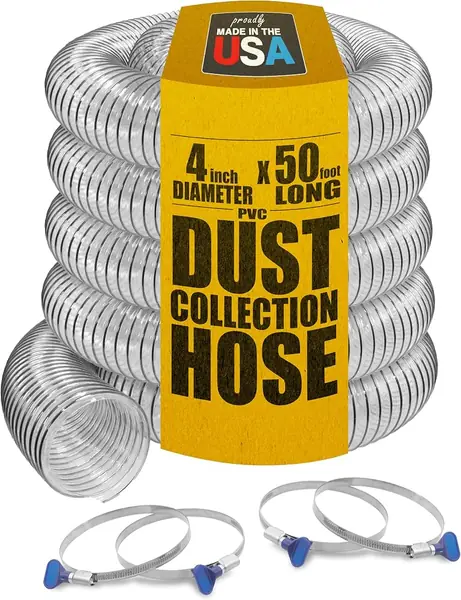
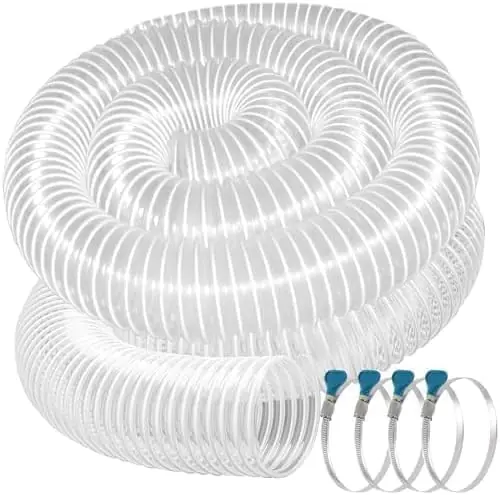
Fulton Woodworking Tools clear 4-inch PVC dust collection hose coil with four thumbscrew clamps

Long fixed runs

Shop Score 93/100
Length
50 ft
Diameter
4 in.
Included
Four thumbscrew hose clamps
Material
Clear PVC with embedded steel coil
View on Amazon

A 50-foot roll is what makes this hose look like the expensive option, and it is also the reason it is our top pick. Buy it once and you can cut drops for the table saw, the jointer and the planer, with four thumbscrew clamps in the box so the first run goes up the day it arrives. For a shop with a fixed collector and more than one machine, that is the whole job in one order.

The wall is the part we care most about. The steel coil is extruded inside a single wall of clear PVC rather than taped over the outside, and the difference shows up at the machine: the hose stays round when a blast gate is wide open on one branch, and it takes the sharp, fresh offcuts a jointer throws without holing. A section that pinches shut costs airflow on everything downstream, which is the failure we watch for first in a 4-inch hose.

Clear walls earn their money in the first week. You watch chips travel, so you notice the clog forming at an elbow instead of discovering it as weak suction three tools later. The coil gives you a ground path if static in your ducting bothers you, and the hose seats on the magnetic quick-change fittings some shops run at the machine end.

One honest caveat about the size: 50 feet is a commitment. With one bench and one tool, the 20-foot hoses here cost less and leave you without a coil to store in the rafters. We keep coming back to this one for the shop that is still adding machines and would rather buy hose once.

Worth Noting

  • 50-foot roll is bulky and excessive for single-tool shops
  • Higher upfront cost than shorter 20-foot hoses
Our Verdict

Our top pick for a shop with a fixed collector: 50 feet of clear, coil-reinforced 4-inch PVC, four clamps included, and a wall that stays round under full suction.

Check Latest Price
2.

Cen-Tec Systems 94709 Quick Click Hose Kit Best for Power Tools

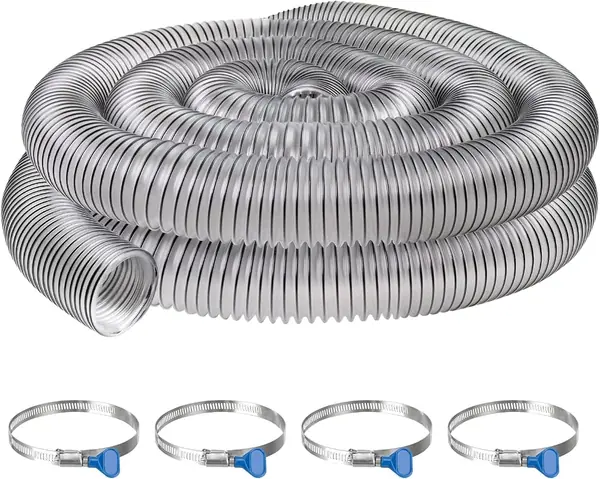
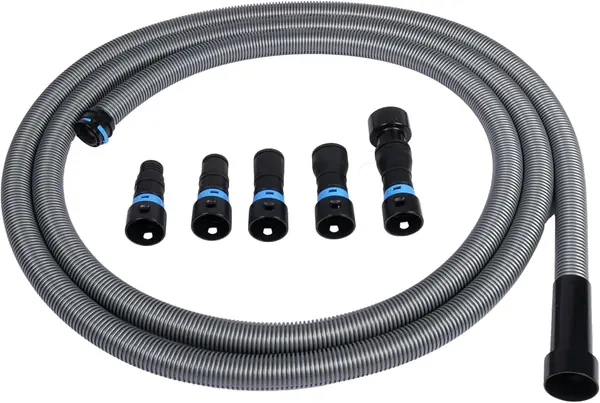
Cen-Tec Systems silver 16-foot TPE dust hose with multi-brand power tool adapter set

Power tool ports

Shop Score 91/100
Length
16 ft
Diameter
1-1/4 in.
Included
Multi-brand power tool adapter set
Material
Thermoplastic elastomer (TPE)
View on Amazon

The problem this kit answers is the drawer of adapters that fit nothing. Sixteen feet of 1-1/4-inch hose arrives with a stepped set of fittings from 3/4 inch through 1-1/2 inch, inside and outside, plus a collar with an acetal clip for the bayonet ports on tools and a tank end shaped for a shop vac outlet.

We think it is the best of these for tool-level dust, and the hose is why. Thermoplastic elastomer with a smooth bore, a wall that pops back after you step on it, and enough flex that it bends around a bench leg instead of bunching under suction. Smooth matters on a sander in particular: a ribbed hose packs dust into the corrugations and slowly closes itself off.

The quick-click collar is the part to know about. It seats with a positive click on most ports and swaps tools in a second, but on a low-vibration sander it can work loose mid-pass, and the collar is fussier with gloves on than a plain push-on end. Put a clamp or a wrap of tape on the joint you never change and save the click for the tools you swap constantly.

Reach is the other thing you are buying. Sixteen feet lets the vac sit outside the cut line, around the corner or under the bench, which is the difference between hooking up and just holding the hose. Check the tank port before you order: it needs to measure 2-1/4 inches inside for the tank end to seat.

Worth Noting

  • Adapters don't fit every vac and tool port
Our Verdict

The kit we recommend when the problem is tool ports: 16 flexible feet and an adapter set that reaches sanders, routers and most shop vacs without a drawer of fittings.

Check Latest Price
3.

POWERTEC 70143 4-Inch x 20-Foot Hose Best for a Single 4-Inch Run

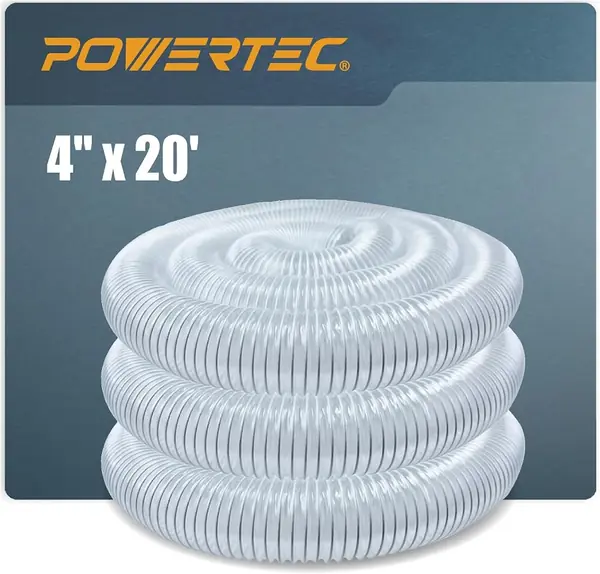
POWERTEC 70143 clear 4-inch by 20-foot PVC dust hose with spring steel coil

One 4-inch run

Shop Score 90/100
Length
20 ft
Diameter
4 in.
Weight
8.95 lb
Material
Clear PVC with spring steel wire
View on Amazon

Twenty feet of 4-inch hose is the length most shops actually need: far enough to reach the first machine from a collector, or to make the flexible last leg of a run that is otherwise hard pipe. What you handle is clear PVC over a spring-steel coil, and about nine pounds of it.

This is the hose we reach for when one good 20-foot run is the whole job and a 50-foot roll is overkill. The wall is half a millimeter of clear PVC, supple enough to swing between machines without wrestling it, and the coil springs back after a step instead of staying flat. Nine pounds of 4-inch hose drags on a bench tool less than a stiffer one does, and we did not mind trading a little heft for that.

Fit deserves a check before you cut anything. Hose sold as 4-inch tends to run a hair under, and a 4-inch fitting tends to run a hair over, so a hose that will not seat is usually a measuring problem rather than a bad hose. Compare the outside diameter of your fitting with the outside diameter of the hose end, and warm a stubborn end before you twist it on.

Where it beats the cheaper 4-inch hose here is the coil, which holds its shape through repeated moves and stays round under full suction. Where it loses to our top pick is simple: one run, and no spare.

Worth Noting

  • Hose only, no clamps in the box
Our Verdict

Buy this when one 20-foot 4-inch run is the whole job: a clear, spring-coiled hose we trust to stay round, as long as you add clamps.

Check Latest Price
4.

Qucship 4-Inch x 20-Foot PVC Hose Best Value 4-Inch Hose

Qucship clear 4-inch by 20-foot PVC dust collection hose with four turn-key clamps

Budget 4-inch runs

Shop Score 89/100
Length
20 ft
Diameter
4 in.
Included
Four turn-key hose clamps
Weight
5.99 lb
View on Amazon

Four clamps come in the box, which not every 4-inch hose here can say, and this is the least expensive route to 20 feet of clear 4-inch PVC in this group. That is the pitch: a complete run for less than the midrange hoses ask.

The hose packs down hard, with a quoted 3:1 compression, so 20 feet coils into a loop you can hang out of the way, and at 5.99 pounds it moves from the bench to the saw without a second trip. The walls are clear and the carbon steel coil keeps the hose from folding shut under suction. Turn-key clamps are the weak part of the kit: they pull down unevenly, and a stripped one will not hold a seal on a 4-inch fitting. A pair of worm-gear clamps from the hardware drawer settles that.

Even counting that swap, this is the 4-inch hose we point a home shop at first. The spring in the coil is the reason: stretch it across the floor, drag it around a corner, and it comes back round. The wall holds up better than the price suggests.

Set against the other 20-foot 4-inch hose here, this one adds four clamps and asks less for the hose; the POWERTEC has a heavier wall and ships bare. Either gets a home shop running this weekend.

Worth Noting

  • Lighter wall than the premium 4-inch picks
Our Verdict

We point budget-minded shops here: 20 clear 4-inch feet and four clamps, with a wall that suits a home shop better than a planer running all day.

Check Latest Price
5.

JIANBENKJ 2-1/2-Inch x 20-Foot PVC Hose Best 2-1/2-Inch Hose

JIANBENKJ clear 2-1/2-inch by 20-foot PVC dust hose with four hose clamps

Shop vac step-downs

Shop Score 86/100
Length
20 ft
Diameter
2-1/2 in.
Included
Four hose clamps
Weight
4.14 lb
View on Amazon

Not every port in a shop is 4 inches. Benchtop tools, shop vacs and the small collector in a one-car garage take a 2-1/2-inch hose, and this is 20 feet of clear PVC at 4.14 pounds with four clamps in the box.

The JIANBENKJ hose is thickened PVC over a carbon steel coil, and it behaves the way a hose should behind a shop vac: it does not collapse when the vac pulls hard, and it stays limber enough to loop around a bench leg. It is a light hose for its length, which matters when the whole thing is hanging off a benchtop tool rather than lying on the floor.

For stepping a shop vac down to a tool, this is the hose we reach for. The price sits at the bottom of this group, the coil has real spring, and 20 feet is enough to leave the vac in the corner. Sizing is nominal on every hose in this list, so measure the port and the hose end before you order; a snug fit plus a clamp is what holds a seal.

The trade is volume for reach. A 2-1/2-inch hose moves less air than a 4-inch main, so run it the last few feet to a tool rather than overhead across the shop, and do not expect it to clear planer chips the way a 4-inch line does.

Worth Noting

  • 2-1/2-inch diameter moves less air for heavy planer chips
  • Nominal sizing requires measuring ports before ordering
Our Verdict

For a shop vac or a 2-1/2-inch drop, we like this light, clear 20-footer — cheap enough to buy two and stiff enough not to collapse.

Check Latest Price
6.

Peachtree 10-Foot Power Tool Hose Kit Best for Sanders and Routers

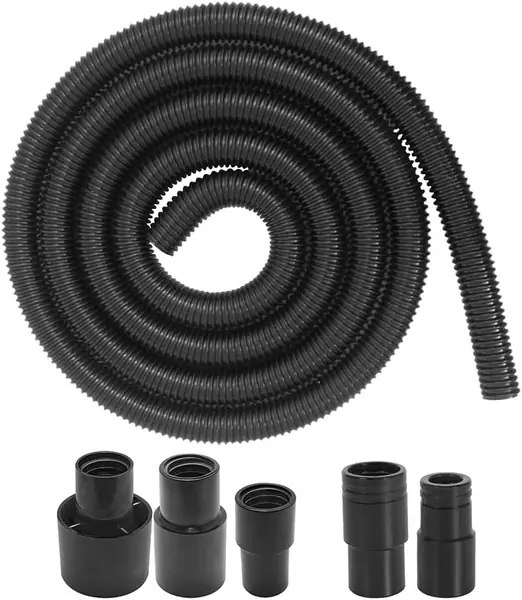
Peachtree Woodworking Supply black 10-foot rubber dust collection hose with five threaded fittings

Sanders and routers

Shop Score 85/100
Length
10 ft
Diameter
1-3/16 in. OD
Included
Five threaded fittings
Weight
1.74 lb
View on Amazon

A 1-3/16-inch hose looks like a toy beside a 4-inch main, and that is exactly why we keep it at the bench: it plugs a random orbital sander or a trim router into a shop vac without dragging the tool around. Ten feet of rubber, 1.74 pounds, and five threaded fittings is the whole idea.

The hose is soft enough to follow a sander across a panel without looping back, and it resists kinking when you turn a corner. The Peachtree fittings thread onto the hose end instead of pushing in, which keeps them from working loose mid-pass, and the small bore keeps airspeed up so fine dust makes it to the vac instead of settling in the hose.

Port sizes are the wild card, so have two numbers in hand before ordering: the tool port's inside diameter and the vac outlet's outside diameter. The thread-on fittings swap without tools, which is what makes a kit this small worth keeping in a drawer.

What surprised us is how much a light hose changes sanding. The tool stops throwing dust back at your hand, and the hose is small enough that you forget it is clipped on halfway through the first panel.

Worth Noting

  • Ten feet is bench length only
Our Verdict

What we reach for on a sander or trim router: a light 10-foot hose with thread-on fittings that keeps the small-port dust moving.

Check Latest Price

How We Tested Dust Collection Hoses

We started by sorting the category by diameter, since a hose is only useful if it meets the port it's headed for: 4-inch mains, 2-1/2-inch shop vacs and step-downs, and the smaller tool ports on sanders and routers. From there we filtered the field by wall construction, length, whether clamps came in the box, and price, then bought 12 hoses and put them to work over eight months.

Every hose went onto a collector or a shop vac and stayed there through real jobs — milling lumber on the jointer and planer, ripping on the table saw, shaping at the router table, sanding. We measured each end with calipers against the port it was meant to fit and noted where a nominal size ran tight or loose. The clamps that came with each hose went on, and we checked the joint for leaks by feel and by the dust trails left around it. Each hose was weighed on a scale, then hung on a tool to see how much it pulled while we worked.

To judge wall construction, we ran each hose at full suction and watched whether the coil held the tube round or the walls sucked flat. We dragged hoses across the floor while moving a tool to find where they kinked, ran them over sharp chips and offcut edges, and checked clear walls for buildup after a long session. Static got the same treatment: with a wire run from the coil to the collector frame, as it would be in a shop, we watched for the snap and cling that means a charge is building. Hoses were routed along walls and overhead, never across a walking path.

How to Choose a Dust Collection Hose

Start With the Port, Not the Label

Diameter decides whether a hose does anything at all. Four inches is the size of a dust collector main and the machines hanging off it — table saw, jointer, planer. Two and a half inches is the shop vac and small-drop size, and 1-1/4 inch is for the ports on sanders, routers and biscuit joiners.

The trap is that none of those numbers is a measurement. Hose sold as 4-inch can run under, and a 4-inch PVC fitting can run over, which is how a hose ends up not seating on any port in the shop. Measure the outside diameter of the port and the outside diameter of the hose end, and buy the fit rather than the label.

The Wire Coil Is the Hose

Almost every hose here is PVC or rubber around a steel coil, and how that coil is built decides how long the hose lasts. Extruding one wall of PVC around the wire holds up better than wrapping tape or film over the coil, because the seam on a wrapped hose is where a split starts. Spring in the coil keeps a stepped-on section from staying pinched, and a flattened hose costs suction on every tool downstream. Clear walls earn their place for the same practical reason: you see a clog building before you go hunting through the ductwork.

Length, and the Airflow a Long Run Costs

Buy the length the run needs. Ten feet is a bench hose, 20 feet reaches the first machine from a collector, and 50 feet makes sense only if you are cutting several drops off one roll. Flexible hose moves less air than the same length of hard pipe, so a long sagging run is the worst place in the system to economize.

Weight is worth a glance too. The 20-foot 4-inch hoses covered here run from about six pounds to nine, and all of it hangs on the tool and your wrist while you work.

Clamps, Fittings and the Seal at the Joint

Most leaks in a shop's dust collection happen at a joint, and the clamp in the box is often the cheapest part of the kit. Thumbscrew and turn-key clamps are fine for a hose that never moves; if one strips or pulls down unevenly, a worm-gear clamp seals better for the price of a hardware run. At the tool end, adapters do the work: a set with five or six stepped fittings covers more tools than one with two, and a quick-click collar beats a push-on end when you swap machines constantly.

Static, Grounding and Hose Handling

Dry wood dust moving through PVC builds static, and in winter you will feel it at the hose end. The steel coil gives you somewhere to send it: if the coil runs end to end, a wire from the coil to the collector frame bleeds the charge off. Keep the hose out of walkways, where it gets kicked, crushed and tripped over.

Frequently Asked Questions

Final Verdict

Buy the Fulton 4-inch roll for a shop with a fixed collector and more than one machine. The coil holds its shape under full suction, the clear wall shows a clog forming before suction drops, and the four clamps in the box finish the first run the day it lands.

If the work is tool ports rather than a main line, the Cen-Tec kit's 16 feet and adapter set do what a 4-inch hose cannot. For a single 20-foot run without a spare roll in the rafters, the Qucship comes with clamps and the POWERTEC has the heavier wall.