↑↓ navigate ↵ open Esc close All results →

Best Dust Hoods for Miter Saws of 2026

Making a few cuts of baseboard in a closed garage coats the bench, the miter saw, and everything nearby in a gray film, because standard saw ports miss most of the upward plume. A dust hood captures that airborne spray at the head before it drifts into the rafters—though it only supplements a respirator and safety glasses rather than replacing them.

Port diameter consistently outweighed hood volume across twelve hoods tested over eight months, ranging from a 1.2-pound ABS box to a fabric surround on stanchions: a compact shroud with an unrestricted 4-inch opening out-pulled wide tents choked down to a shop-vac adapter. Different shop footprints dictate the rest, from fixed wall stations to portable jobsite setups and tight benches with zero rear clearance.

Our Top Picks

The Best Dust Hoods for Miter Saws

1.

Rousseau 5000 Dust Solution Best Overall
Rousseau 5000 silver nylon dust hood with mounting stanchions for miter saws

Fixed saw stations

Shop Score 90/100
Weight
8 lb
Port Size
4 in. OD
Storage
Folds into a carry bag
Mounting
Stanchions included
View on Amazon

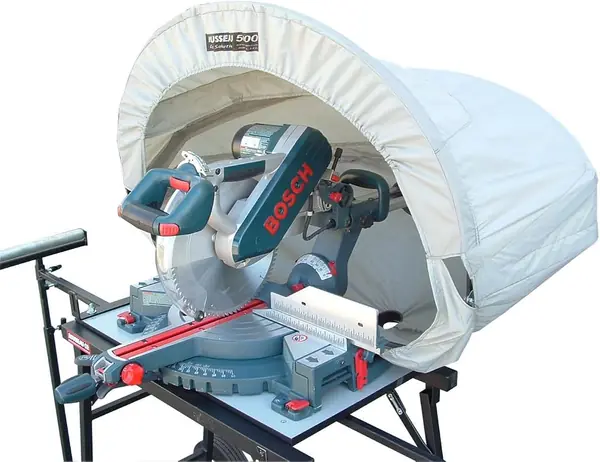
A miter saw throws dust out of the blade slot in a wide spray, and most hoods sold for one are boxes you park somewhere in the hope that the plume finds them. The Rousseau 5000 mounts instead: two stanchions carry a nylon hood that pops up around the cutting area, and interior baffles turn the airflow toward a 4-inch port. Mounted, baffled, and ducted together is a combination nothing else here offers, and it is why this is our top pick.

What settled it for us is how much of the cutting envelope the hood closes off. Set up around a 10- or 12-inch saw, it puts fabric on the back and both sides, so the spray hits nylon rather than the bench. Heavy sawdust drops into the base of the hood, the fines follow the baffles to the port, and the mound that normally builds up under the saw mostly stops forming. It won't catch everything, because no hood does, but it changes how much sweeping follows a run of trim.

Two things to plan for. Fitting is saw-specific: the stanchions don't line up with every saw or stand, the printed instructions don't cover much, and you may end up drilling your own holes. Budget an evening rather than ten minutes. And when you swing the table to a miter angle, the saw turns out from under the fabric and dust can slip past the sides, so the hood is at its best on square cuts.

Folding is the feature we came back to. The hood collapses into a carry bag, so it isn't a permanent obstacle in a small shop; you can set it up for a run of casing and put it away afterward. This is a premium hood, and the price is the honest trade, since what you're paying for is fabric, frame, and folding rather than electronics.

Worth Noting

  • Premium price for a fabric hood
Our Verdict

We recommend the Rousseau 5000 for a fixed miter saw station: it mounts around the blade, ducts fine dust to a 4-inch collector, and folds away between projects.

Check Latest Price
2.

POWERTEC 70122 Big Gulp Dust Hood Best Budget

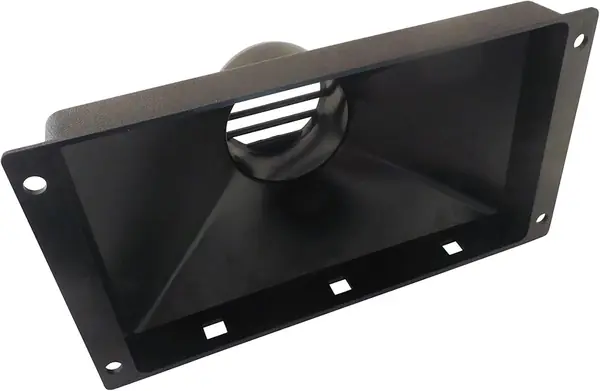
POWERTEC 70122 Big Gulp ABS dust hood with wide opening and rear port

DIY dust surrounds

Shop Score 89/100
Weight
1.2 lb
Material
ABS plastic
Port Size
4 in. OD
Hood Opening
13 x 16 in.
View on Amazon

Thirteen inches by sixteen is a wider mouth than anything else here, and that is the entire case for the Big Gulp. It's one molded ABS scoop with a 4-inch port at the back, and it goes wherever the dust goes: on the bench behind the saw, on a shelf below it, or at the open end of a surround you build yourself. There's no frame, no bracket, and no stand in the box.

That last part is the honest trade. A miter saw throws dust up and forward out of the blade slot, so a hood sitting behind the saw only works if you give it walls to aim into. We think of this as the capture end of a shop-built enclosure: box the back and one side with plywood, cut an opening for the hood, and the saw station starts behaving like a dust collector instead of a broom problem. That's a weekend of work and a permanent improvement.

Two practical notes. The port is 4-inch outside diameter, which is collector territory; a shop vac needs a reducer, and a big hose stepped down to a small vac loses the velocity that carries fine dust, so plan on a collector if you want the fines gone. And at 16 inches across, the hood needs room behind the saw, so on a bench pushed against a wall, measure before you cut plywood.

What keeps it useful is that it isn't dedicated to one machine. The same hood that backs up a miter saw can sit under a drill press or behind a lathe, so it doesn't become scrap if you rebuild the saw station. That flexibility is what we're really recommending here, more than the plastic.

Worth Noting

  • No stand or mounting bracket in the box
  • 4-inch port needs a reducer for a shop vac
Our Verdict

We keep the Big Gulp on this list for the woodworker who will build the surround: it turns a plywood box behind the saw into a working dust hood.

Check Latest Price
3.

MOOFI Miter Saw Dust Collector Hood Best with a Work Light

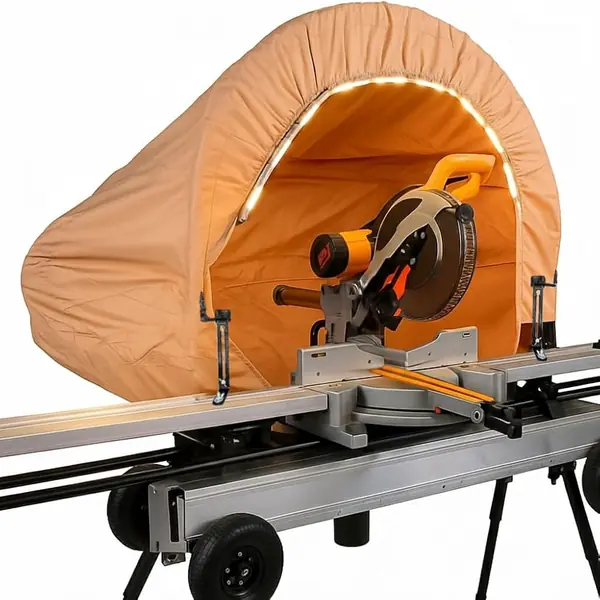
MOOFI khaki Oxford fabric miter saw dust hood with built-in LED light

Dim garage shops

Shop Score 84/100
Weight
7.96 lb
Material
Oxford fabric
Saw Fit
Most 10 in. and 12 in. miter saws
Lighting
Built-in LED
View on Amazon

The light is what makes this one worth a look. A miter saw usually sits with its blade in shadow, under a shelf or against a wall or with the motor casting a shadow across the cut line, and the MOOFI puts a strip of LEDs inside the hood aimed at the cutting area. In a garage shop with one overhead bulb behind you, that is a real improvement, and no other hood here has it.

Around the light is a foldable Oxford fabric hood that drops over a 10- or 12-inch saw, gathers what the blade throws in the bottom, and hangs from a rafter hook between jobs. It goes up in minutes without drilling or brackets, which is more than we can say for the mounted hoods here. For a saw that moves between the bench and the truck, that's the right trade to make.

The reservation is the connection. The listing mentions a vacuum hookup but doesn't publish a port size, so we can't tell you whether a shop vac hose clips straight on or needs an adapter. Check the fitting before you order, because a fabric hood with no suction is a containment tent, not a dust collector. Footprint deserves a look too: the skirt is wide, and on a small benchtop saw it can cover most of the table. Measure both, and this one either fits your setup neatly or it doesn't.

Worth Noting

  • Hose fitting isn't specified in the listing
  • Wide fabric skirt covers a small bench
Our Verdict

We like the MOOFI for a dim garage or a saw tucked under a shelf: the built-in LED lights the cut line while the fabric hood catches the dust.

Check Latest Price
4.

FastCap SawHood Best for Jobsite Trim Work

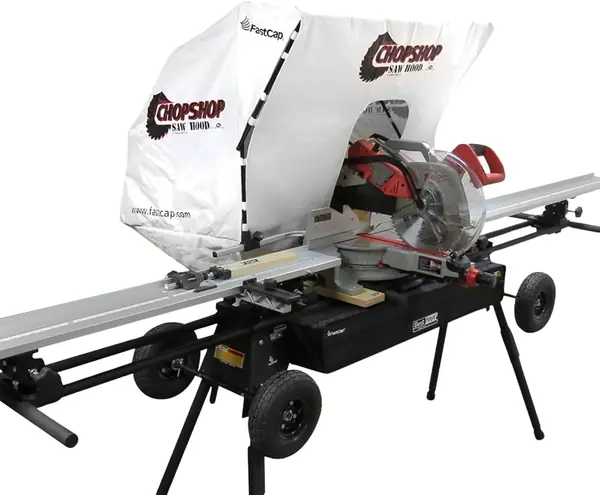
FastCap SawHood white fabric dust hood fitted over a miter saw

Jobsite trim work

Shop Score 83/100
Weight
15.2 lb
Saw Fit
Miter saws, chop saws, lathes, wet saws
Color
White
View on Amazon

A tent is the right mental picture: fabric sides, a light aluminum frame, and a floor pocket that catches what the blade throws. The SawHood drops over a miter saw or chop saw, closes off the back and both sides, and lets the sawdust fall into the fabric instead of across the floor. Setup runs a few minutes, and there is nothing to wire, plug in, or hook up.

For a certain kind of work that's exactly right. Cabinet installers and trim carpenters cut in other people's houses, where dragging a vacuum and a hose across a finished floor is more trouble than the dust. The SawHood keeps the plume inside the fabric, folds down afterward, and doubles as a cover for the saw when you're working outside, something none of the ducted hoods here can do.

Fitting is the fussy part. The support poles locate in the saw's accessory holes, and those sit in different places on different brands; where they don't line up, you're making brackets or drilling a stand. The frame is also light enough that it shifts if you bump it hard, so it's a hood you set up deliberately rather than knock around.

Cleanup is where it wins us over. Instead of chasing a drift of fines around the shop, you lift the hood, tip the pile into a bucket, and you're finished. That's the least fussy containment setup here, and the reason it stays in the truck.

Worth Noting

  • No port for a vacuum or dust collector
Our Verdict

The SawHood earns its place for cabinet installers: it drops over the saw, holds the dust in the fabric, and needs no vacuum at all.

Check Latest Price
5.

Taytools 73479 ABS Dust Hood Best for Compact Saw Benches

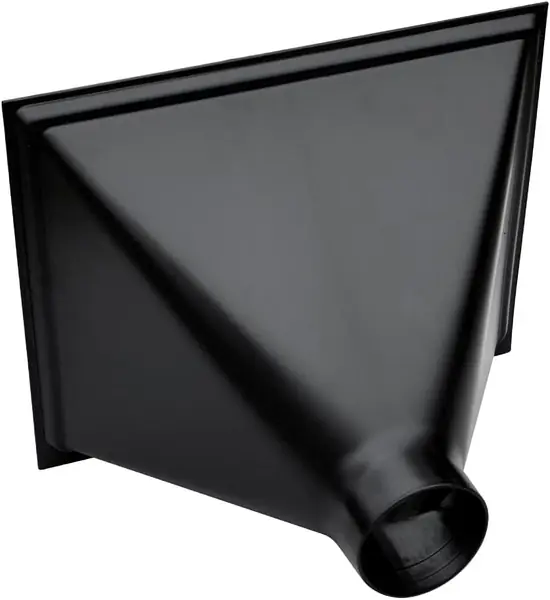
Taytools 73479 compact ABS plastic dust hood with tapered 4-inch opening

Compact saw benches

Shop Score 81/100
Weight
15.2 oz
Material
1/8 in. thick ABS
Hood Size
13.5 x 7 x 6 in. deep
Port Opening
3.800" to 3.970" OD
View on Amazon

Where the Big Gulp is a wide scoop that needs a surround to earn its keep, this one is small enough to bolt to the machine. At 13-1/2 by 7 by 6 inches deep it's a fraction of that hood's mouth, with mounting holes along one edge and clamp slots on the other, so it screws to a bench, a surround, or a bracket you make, right where the dust leaves the blade.

The size is both the point and the limit. A 7-inch-tall opening has to sit close to the cut to catch anything, which suits a benchtop saw with a tight footprint and does not suit a 12-inch slider that needs a wide envelope. Close is effective; far is useless. Before you commit, decide where the hood can actually sit relative to the blade.

The plastic is 1/8-inch ABS, thicker than most catch hoods this size, and the inlet tapers from 3.800 to 3.970 inches outside diameter so a 4-inch flexible hose slips on with a clamp or a tapered quick-connect. There is a screen across the opening to keep big chips out of the hose, and at 15.2 ounces the whole thing hangs on a couple of screws.

Where we see it earning a place is at the end of a box you have already built, or on a sander and drill press that don't justify a dedicated machine. It won't rescue a saw with no room for a surround, but as a throat for a small station it is tidy, inexpensive, and out of the way.

Worth Noting

  • Small opening needs a close-fitting surround
Our Verdict

We reach for the Taytools hood where a full-size scoop won't fit: it bolts close to the blade and ducts to a 4-inch hose.

Check Latest Price

How We Tested Miter Saw Dust Hoods

We started with research, gathering every hood currently sold for miter saws and sorting them by mounting method, port size, and the saws each was built to fit. Models whose hardware or opening ruled out a standard bench — nothing to bolt to, no way to meet a 4-inch hose — didn't make the cut. That left twelve hoods, spanning a light ABS shell and a folding fabric surround on stanchions.

For eight months we ran them at a garage saw station and hauled a few to job sites. Each got the same workout: a stack of 1x4 pine, then a run of MDF baseboard, cut first at 90 degrees and then at 45-degree miters and bevels. After each pass we looked at what had landed on the saw table, the bench behind it, and the floor, and how much was still hanging in the air.

We slipped a 4-inch collector hose over every port, then a shop vac hose and whatever adapter came in the box, noting where a connection needed tape or a shim. We pushed each saw against a wall to see how much bench depth the hood ate and whether the table could still swing through its full miter range, and we timed a solo setup using only the printed instructions. Clips and seams got tugged; every folding hood went into its bag and back out a dozen times. Value came last — what a hood caught against what it cost, and how much fiddling it took to get there.

Throughout, each hood went on around the saw as designed. We never removed a blade guard or hold-down to make room, and we flagged hoods that crowded the guard at full bevel. No hood we tested made a respirator optional, either — the fine dust that stays airborne is the dust that matters, so the glasses and the mask stayed on.

How to Choose a Dust Hood for a Miter Saw

Mounted Hoods vs. Hoods That Sit Behind the Saw

There are two families here, and they solve the problem at different ends. A mounted hood attaches to the saw or its stand and wraps fabric or plastic around the cutting area, which is how the Rousseau 5000, the MOOFI, and the SawHood all work. A freestanding hood is a scoop you position near the blade, like the Big Gulp and the Taytools hood, and it only performs once you have built walls for it to aim into.

If the saw lives in one spot and you want a hose on it, buy a mounted hood. If you are comfortable with a jigsaw and want the least expensive route to real capture, a plywood surround plus a scoop hood will outperform a mounted hood that never quite lines up with your saw.

Ports, Hoses, and the Collector Behind Them

A 4-inch outside-diameter port is the standard for a dust collection hood because it matches 4-inch flexible hose and the airflow a collector produces. Shop vacs run 1-1/4 to 2-1/2 inches and need a reducer to fit. That reducer is where a lot of setups go wrong: stepping a big port down to a small vac hose cuts the air velocity that carries fine dust, so you collect the chips that fall and leave the fines hanging in the air.

Decide which machine you are buying for before you buy the hood. A collector behind a 4-inch port is the setup that keeps up with a miter saw. If all you own is a shop vac, look for a hood that publishes a fitting to match it, and expect that hood to be a chip catcher rather than an air cleaner.

Clearance for the Swing, the Slide, and the Wall

Measure three things before ordering. Does the saw need to swing the table 45 degrees each way with the hood in place, and does the fabric or frame stay clear when it does? On a sliding saw, does the carriage travel clear the hood at full extension? And how much room is behind the saw, since a wide scoop hood is often deeper than the bench space people have.

Push the saw out from the wall if you can. Forcing a hood into a gap that is already too tight is how a good hood ends up on a shelf.

What Wears Out, and What to Check Before You Store It

Fabric hoods fail at the fasteners first: hook-and-loop strips lose grip in a cold shop, clips bend, and seams collect fines that turn into a crust. Rigid ABS hoods crack when something heavy lands on them or when a hose gets yanked sideways, so give the port some strain relief where the hose meets it.

Whatever you buy, empty it before it goes into storage. A hood folded away with sawdust still in it is a mess the next time you open it up, and a thick layer of fines in a fabric pocket is the hardest part to clean out later.

Frequently Asked Questions

Final Verdict

For a miter saw that stays in one place, the Rousseau 5000 is the hood we recommend: it mounts around the blade, drives dust to a 4-inch collector, and folds out of the way between runs. It costs more than the scoop hoods, and it is worth it when the saw never moves.

The exception is the shop that will never own a collector. There the FastCap SawHood contains more of the mess than a ducted hood with nothing attached to it, and it packs into a truck.