↑↓ navigate ↵ open Esc close All results →

Best Shop Vac Attachments of 2026

Most shop vac accessories look identical on a pegboard until suction builds and a loose collar pops straight off the hose. Because nominal shop vac diameters sit close enough to look interchangeable while differing by fractions of an inch, a secure friction or locking collar matters far more than an oversized accessory count.

Four months of running 14 attachments — starting each test by tugging on the fitting with the motor running — showed how quickly weak plastics give up. Bristles that shed, wands that fold under carpet drag, and sander adapters that whistle air rob suction before debris ever reaches the tank, whether clearing shavings under a table saw, reaching between car seats, or pulling standing water off concrete.

Durable kits focus on tight-sealing collars, swaps easy enough to manage in work gloves, and enough rigid reach to finish the mess without chasing dropped nozzles.

Our Top Picks

The Best Shop Vac Attachments

1.

Shop-Vac 9064300 1.25-Inch Cleaning Kit Best Overall
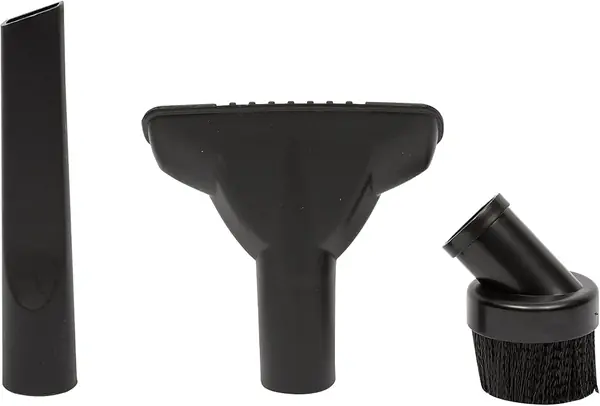
Shop-Vac 9064300 cleaning kit with round brush, crevice tool and gulper nozzle

Starter nozzle set

Shop Score 94/100
Hose Fitting
1-1/4 in.
Debris Type
Dry dust, crevices, bulk debris
Included Tools
Round brush, crevice tool, gulper nozzle
View on Amazon

Three nozzles, one small box, and a shop vac that suddenly handles more than a heap of shavings: that is the trade this Shop-Vac kit makes, and it is the one we hand to anyone starting from nothing. You get a round brush for dusting a bench top or a blind, a crevice tool for the gap between the table saw and the wall, and a wide gulper nozzle for pushing bulk debris across a flat floor. Nothing else in this group covers that many jobs in a single purchase.

Everything hinges on the fitting. These are 1-1/4-inch tools, sized for the smaller hoses on compact wet/dry vacs and many household canisters, not the 2-1/2-inch hose on a big roll-around unit. They also read small in the hand — the round brush is a detailing brush, not a floor brush — which is exactly right for car interiors and pellet stove corners and underwhelming if you pictured a full-size cleaning set. Put a ruler across the end of your hose before you order.

The plastic is light, and this is not the last set you will buy; at this end of the market a worn brush is a shrug rather than a loss. What keeps us coming back is the gulper nozzle, which swallows a pile of planer shavings that would choke the crevice tool, and the fact that all three pieces hang together in one place on the shelf. Small vac, small shop: start here.

Worth Noting

  • 1-1/4-inch fitting only, no help on 2-1/2-inch hoses
Our Verdict

We recommend this kit as the default first purchase for a 1-1/4-inch hose: three useful nozzles, and the gulper alone earns back what the set costs.

Check Latest Price
2.

Cen-Tec Systems 94709 Quick Click Hose Kit Best for Power Tool Dust Collection

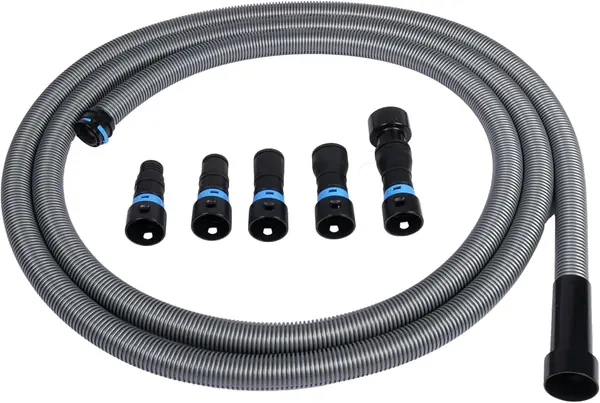
Cen-Tec 16-foot silver shop vacuum hose coiled with assorted black tool adapters

Power tool dust

Shop Score 93/100
Hose Length
16 ft.
Hose Diameter
1-1/4 in.
Hose Interior
Smooth, crushproof
Tool Adapters
3/4 to 1-1/2 in.
View on Amazon

A bag of adapters and a hose is the least glamorous purchase in this guide and the one that changes a shop most if you sand, route, or cut indoors. The hose runs 16 feet of 1-1/4-inch commercial-grade tubing with a smooth interior, so shavings and dust slide through instead of catching on a rib, and it is crushproof enough to survive being stepped on or rolled over in a driveway.

What sold us is the combination of length and flexibility: the vac stays parked by the door while you work at the bench, and the hose bends around a saw's table without kinking shut. The adapter set is genuinely broad, with collars and bayonet fittings reaching ports from 3/4 inch up to 1-1/2 inches and covering the usual brands — DeWalt, Makita, Bosch, Ryobi, Milwaukee, Porter-Cable. We were also impressed by how much sanding dust never became airborne at all.

Two hitches. The quick-click collars are the weak link: with gloves on, swapping from sander to router is fiddly, and on a low-vibration tool a collar can work its way loose mid-task. And the tank end expects a 2-1/4-inch inside-diameter port, so measure yours first, because a handful of vacs — Milwaukee among them — are a poor match at that joint. Everything else about this kit feels like it should cost more than it does.

Worth Noting

  • Quick-click collars work loose on some tools
  • Tank end needs a 2-1/4-inch port
Our Verdict

For catching dust at the tool rather than the floor, we consider this the strongest pick here — provided your vac's tank port measures 2-1/4 inches.

Check Latest Price
3.

Shop-Vac 9061400 Extension Wands Best for Reach

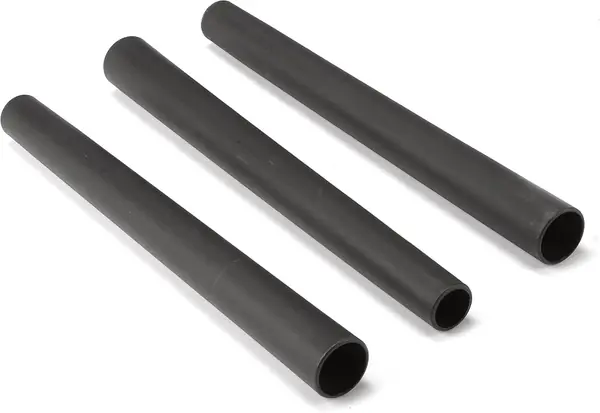
Shop-Vac 9061400 black polypropylene extension wands, three tapered sections for 1.25-inch hoses

Reaching floors

Shop Score 92/100
Material
Polypropylene
Set Count
3 wands
Wand Diameter
1-1/4 in.
View on Amazon

A flexible hose is a wonderful thing until you need to push. It bows, the nozzle skates, and you end up on your knees to get under a bench. Thread a rigid section onto the end and the whole thing behaves like a tool instead of a snake, which is the entire case for keeping a few wands around.

This is a three-pack of 1-1/4-inch polypropylene wands that join end to end, so you can run one for close work, two to reach the floor standing up, or all three to get at the top of a dust collector or a ceiling fan. The ends are tapered, which lets them wedge into a range of hoses and accessories that are nominally the same size but not identical in practice. Sections are shorter than the wands a full-size vac ships with, and the three of them stack into a corner of the shelf.

We keep one on the hose more or less permanently, because the difference between stooping and not stooping turns a two-minute cleanup into something you actually do. The trade is durability: the walls are thin, the plastic is not the tough stuff used on premium wands, and a stepped-on section can crack. Treat them as consumables that cost less than your back and they earn their shelf space.

Worth Noting

  • Thin polypropylene can crack if stepped on
Our Verdict

If you have a compact vac and a bad back, we rate these wands the most useful comfort upgrade in this group.

Check Latest Price
4.

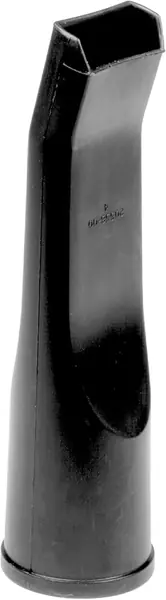
WORKSHOP WS25003A Car Nozzle Best for Car Interiors

WORKSHOP 2-1/2-inch black car nozzle with flat angled head for shop vacuums

Car interiors

Shop Score 91/100
Hose Fitting
2-1/2 in.
Second Use
Blower nozzle on exhaust port
Nozzle Length
9.5 in.
View on Amazon

The nose is the whole story: a flat, slightly angled head about nine and a half inches long with a narrow mouth, slim enough to slide under a car seat and along the channel beside a table saw's miter slot. It is not a crevice tool and it is not a floor nozzle. It is the shape you reach for when the gap is long and shallow and too wide for a crevice tool to clear in a hurry.

On a 2-1/2-inch hose it seats firmly and stayed put through a full car interior, which is more than we can say for some of the universal adapters here. The second job is the one we did not expect to use much: run the hose into the vac's exhaust port and this becomes a blower nozzle for clearing sawdust off a bench or grit off a driveway. It focuses the airflow instead of scattering it.

Where it loses ground is a deep, narrow corner, which is crevice-tool work, and it needs a 2-1/2-inch hose or wand to do anything at all. For car carpets, pedal wells, door jambs, and the machined channels of a saw, it is the attachment we grab first and the one that gets borrowed.

Worth Noting

  • Awkward in deep, narrow corners
Our Verdict

Anyone cleaning vehicle interiors or machine channels on a 2-1/2-inch hose should own one; we find it reaches the flat gaps a round nozzle misses.

Check Latest Price
5.

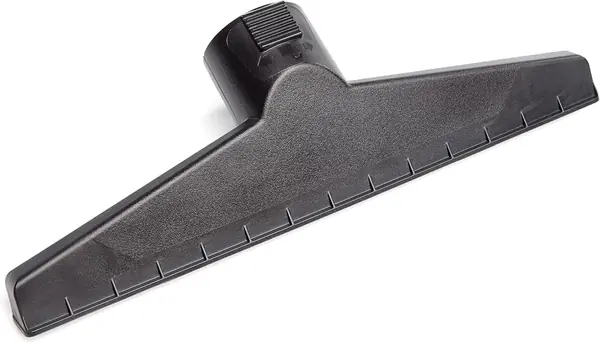
CRAFTSMAN CMXZVBE38621 Wet Nozzle Best for Wet Messes

CRAFTSMAN 14-inch black wet nozzle with rubber squeegee edge for shop vacuums

Wet floors

Shop Score 90/100
Hose Fitting
2-1/2 in.
Edge
Rubber squeegee
Nozzle Width
14 in.
View on Amazon

When water is spreading across a basement floor, the tool you want is fourteen inches of rubber squeegee on the end of a hose. This is the attachment we reach for first after a water heater lets go: one pass pulls a wide sheet of water into the tank instead of pushing it around, and the rubber edge leaves less film behind than an open hose does.

The body is industrial-grade plastic built for heavy use, and the 2-1/2-inch collar fits Craftsman's own vacs plus most other wet/dry units with the same hose size. It weighs under half a pound, so it does not drag the hose down as you steer it around a corner or along the base of a wall, and the fourteen-inch mouth means fewer passes over the same wet patch.

Its limits are obvious once you say them out loud: a squeegee is for liquid, and dry shavings will pile up in front of it. This is an addition to a kit rather than a replacement for one. If your shop floods once a decade, borrow a wet nozzle; if the basement has taken on water twice, buy this one and keep it next to the vac with the foam filter.

Worth Noting

  • Squeegee design is no use on dry debris
Our Verdict

For wet pickup on a hard floor, we take this squeegee nozzle over a bare hose every time.

Check Latest Price
6.

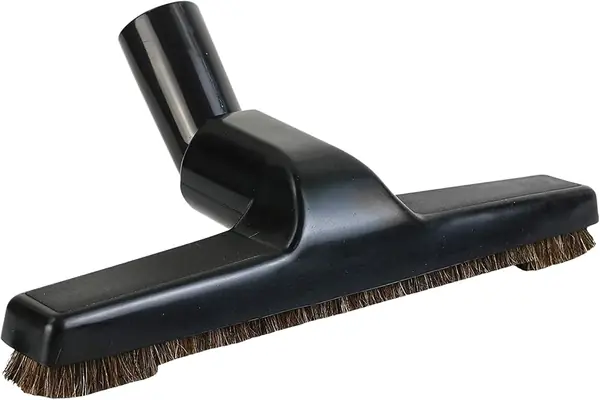
Selgo 10-Inch Floor Brush Best for Hard Floors

Selgo 10-inch black floor brush with soft bristles and 32 mm fitting

Hard floors

Shop Score 89/100
Hose Fitting
1-1/4 in. (32 mm)
Bristles
Soft
Brush Width
10 in.
View on Amazon

A hard plastic nozzle dragged across a finished floor is how you find out what a scratch looks like in raking light. This brush puts soft bristles between the vacuum and the surface, with no metal anywhere on the head, so it can work hardwood, tile, and the concrete shop floor without leaving a mark behind.

Ten inches of width covers a room faster than a round brush, and the low profile slides under a bench or a shelf where a full-size floor nozzle will not go. The fine bristles lift dust and pet hair rather than pushing it ahead of the head. One thing we noticed on a smooth sealed floor is that strong suction can pin the head down; ease off the airflow and it glides again.

The fitting is the catch: 1-1/4 inches (32 mm), which covers compact shop vacs and most household canisters but not a 2-1/2-inch hose without an adapter. We like it best as the finishing tool in a small shop — brush the bench area and the floor around it, then hang it up — and it is an easy addition to a kit that otherwise stops at the nozzle.

Worth Noting

  • 1-1/4-inch fitting only, so no 2-1/2-inch hoses
Our Verdict

We like this as the floor brush for a compact vac: soft enough for a finished floor, wide enough to matter.

Check Latest Price
7.

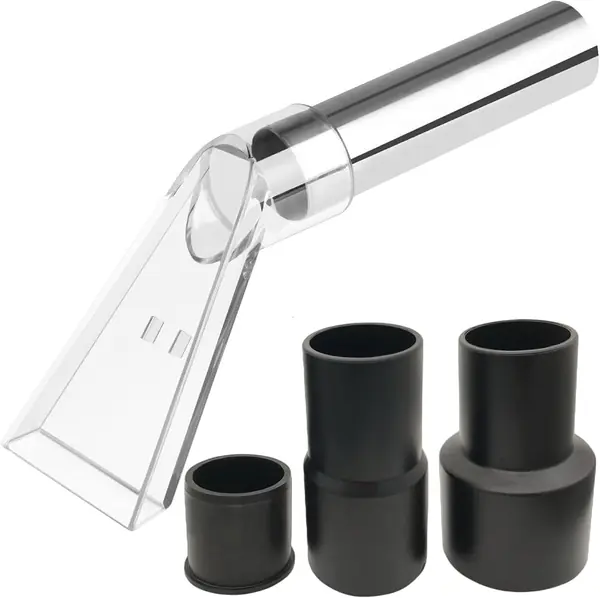
Happy Tree Shop Vac Extractor Kit

Happy Tree extractor wand with clear head, stainless tube and three hose adapters

Carpet extraction

Shop Score 88/100
Tube
1-1/2 in. stainless steel
Length
14.3 in.
Adapter Sizes
1-1/4, 1-7/8 and 2-1/2 in.
View on Amazon

This is the piece that turns a wet/dry vac into something that behaves like a carpet extractor: a clear-headed wand on a stainless tube, with adapters that step down to fit 2-1/2-, 1-7/8-, and 1-1/4-inch hoses. You spray and scrub your upholstery or car seats with cleaner, then run this over the fabric and watch the dirty water come up the tube.

The clear head is what makes it useful rather than merely functional; you can see how much water is lifting and, more to the point, when to stop before the cushion is soaked. The stainless tube does not flex when you press down on a seat, and the adapter set covers the three common hose sizes without a trip to the hardware store.

It is a suction tool, not a sprayer. The solution goes on first, by hand or with a sprayer, and the wand pulls it back out with the dirt, so budget as much time for application as for extraction. Read the vac's manual on wet setup before the first pass.

The fit is good rather than perfect; on a 1-1/4-inch hose the collar stays put but waggles, which is worth a wrap of tape before you start. We think it earns its hook if you have kids, dogs, or cloth car seats, and it hangs in the same spot as the vac rather than living in a closet with the rented machines.

Worth Noting

  • Collar waggles on 1-1/4-inch hoses
Our Verdict

We think it's worth having if you shampoo car seats or a couch yourself; it turns the vac you already own into an extractor.

Check Latest Price
8.

WORKSHOP WS12502A Crevice Tool Best for Tight Crevices

WORKSHOP 1-1/4-inch black crevice tool with slim tapered tip for shop vacuums

Tight crevices

Shop Score 87/100
Hose Fitting
1-1/4 in.
Material
Polypropylene
Weight
1.44 oz
View on Amazon

Of everything in this group, this is the least expensive piece and the one that gets used most. A 1-1/4-inch crevice tool is what most compact shop vacs should ship with and often don't, and losing the original is the usual reason people go looking for a replacement.

The shape is straightforward: a long slim body with a narrow tip that reaches window tracks, the gap between seats, the slot under a baseboard, and the space behind a bench. At 1.44 ounces it stays on the hose without dragging it off the bench, which matters more than it sounds when you are working one-handed in a footwell.

Nominal sizing is where these get tricky. The collar is called 1-1/4 inches, and on hoses that measure a true 1-1/4 inches outside diameter it can be loose enough to pull off mid-job; a couple of wraps of electrical tape on the hose end tightens it. Check the fit before you start rather than after the tool drops behind the bench.

What we appreciate is that it does one thing without apology: it reaches where nothing else will, and it does not pretend to move a pile of shavings. Buy two, one for the shop and one for the car, and expect the tip to wear round before anything else does.

Worth Noting

  • Loose fit on some true 1-1/4-inch hoses
Our Verdict

We keep one on the hose; if your vac is 1-1/4-inch and your shop has gaps, it's the tool you'll reach for weekly.

Check Latest Price

How We Tested Shop Vac Attachments

We started by measuring the hoses and wands on the wet/dry vacs we already own, because most of the frustration in this category comes down to a collar that's the wrong diameter. From there we screened candidates by their stated fitting, the parts that wear out first, how cheaply a replacement can be swapped in, and whether the tool claimed coverage across more than one hose size. Then we tested 14 attachments over four months.

Each one went onto a matching hose and wand, got a twist and a hard pull backward with the vac running, and we watched for collars that crept, wobbled, or needed a wrap of tape to hold suction. We timed how fast each tool came off and went back on mid-task with work gloves on, and on the power-tool hose we fitted the adapter stack to a random orbital sander and a router and checked the joints for leaks.

Testing happened where the mess does: the garage floor after a sanding session, the seat rails and floor mats of two cars, a laundry-room puddle, and the hard floors and rugs inside the house. Before any liquid pickup we pulled the cartridge filter and fitted the foam sleeve per the manufacturer's instructions, and we followed the vac makers' guidance rather than treating a general-purpose vac as a stand-in for a rated dust extractor on fine sanding dust.

Brushes went over upholstery and hard floors until they either shed or didn't, and we checked bristle stiffness against the surface they were meant for. Crevice tools were weighed in hand and tried on the narrowest gap between our car seats, wand sets were laid end to end to see how far a floor nozzle actually reached, and every plastic collar got dropped, bent, and used again so we could see which fittings stayed tight after a month of real work.

How to Choose Shop Vac Attachments

Measure the Hose Before Anything Else

Wet/dry vacs run on three hose sizes that matter: 1-1/4 inch on compact and cordless units, 1-7/8 inch on some mid-size models, and 2-1/2 inch on the big roll-around tanks. A tool built for one will not seat on another, and universal in a listing usually means it fits a range of household canisters. Wrap a tape around the outside of your hose end and write the number down before you shop.

Nominal sizing is looser than the numbers suggest. A 1-1/4-inch tool on a 1-1/4-inch hose is sometimes a slip fit and sometimes a rattle, which is why the cheapest fix in this guide is a roll of electrical tape. Adapters work, but each one adds a joint that can pull apart when you are stretched under a bench.

Match the Head to the Debris

Crevice tools are for gaps, brushes are for surfaces, wide nozzles are for volume, and squeegees are for liquid. Most kits shortchange one of those, so we look at which shapes a set actually contains rather than how many pieces it claims; three good shapes beat six that duplicate each other.

If you sand and rout, add a car-style nozzle for long shallow channels, which the round tools skip over. If water is a possibility in your shop or basement, a squeegee nozzle is the addition we never regret, and it is the one tool here whose whole job is worth having on the shelf unused for a year.

Wands and Hoses Buy Reach, Not Suction

A flexible hose gets you around corners; a rigid wand lets you push. Three tapered wands cost about what a decent brush does and do more for your back than any other accessory here, and they break down small enough for a shelf bin.

Hose length is a trade. Sixteen feet lets the vac stay parked in the corner of the shop, but every added foot and every adapter collar costs a little airflow at the nozzle, so a long hose with a stack of adapters will feel softer than the short hose the vac came with. Buy the length you will use, not the longest one sold.

Bristles and Plastic Decide How Long It Lasts

On brushes, density matters more than stiffness. A sparse brush pushes dust ahead of itself and sheds bristles into the mess, which is the most common way a cheap brush disappoints. Soft bristles belong on finished surfaces and delicate grilles; stiff ones belong on rubber mats and concrete.

Collars are the other wear point. Thin polypropylene cracks at the fitting, and a tool that pops off mid-job ends up in a drawer. At the low end of this category, treat attachments as semi-disposable and judge them on fit first and finish second.

Wet Pickup Needs Its Own Nozzle and Its Own Setup

A squeegee nozzle is only half of the wet-weather kit. The vac itself has to be switched to wet mode, with the dry cartridge filter out and the foam sleeve on, or you will be shopping for a filter as well. Keep the wet nozzle and the wet filter in the same place so the changeover happens in one trip.

Dry debris and water can share a tank, but they cannot share a filter configuration. If your shop floods seasonally, set the wet parts aside as a small kit of their own rather than rooting through the bucket every time.

Frequently Asked Questions

Final Verdict

For most shops, the Shop-Vac 9064300 kit is the place to start: three nozzles that handle dusting, gaps, and bulk debris for less than the price of one specialty tool. Check your hose diameter first, because it only serves 1-1/4-inch fittings.

If your real problem is dust coming off a sander or a router, skip the nozzles and put the money into the Cen-Tec hose kit instead — it changes what the vac can do rather than how you clean up after it. On a 2-1/2-inch hose, the Craftsman wet nozzle and the Workshop car nozzle are the first two additions worth making.