↑↓ navigate ↵ open Esc close All results →

Best Woodshop Air Filtration Systems for Fine Dust of 2026

Ten minutes after the last cut is when you notice it: fine dust still hanging at eye level. A shop air filtration system pulls that cloud out of the room between projects and overnight. The trouble is the CFM number on the box tells you little on its own — oversized for your space, a unit just makes noise; undersized, it runs all afternoon and never quite clears the room.

We ran six units through eight months in a working garage shop, and the spec that surprised us most wasn't the fan but the filter stack. A pre-filter you can pull and rinse keeps airflow where it started, and media that's easy to find and cheap to replace matters more over a few years than a big number on the housing. We also checked remotes and timers before mounting anything overhead, since a unit you can't reach without a ladder stops getting used.

The picks below cover a one-car garage and a shop with real ceiling height, and each hangs from joists with the hardware in the box. All of them supplement at-the-tool collection and a respirator; none replaces either.

Our Top Picks

The Best Woodshop Air Filtration Systems for Fine Dust

1.

DEWALT DWXAF101 Air Filtration System Best Overall
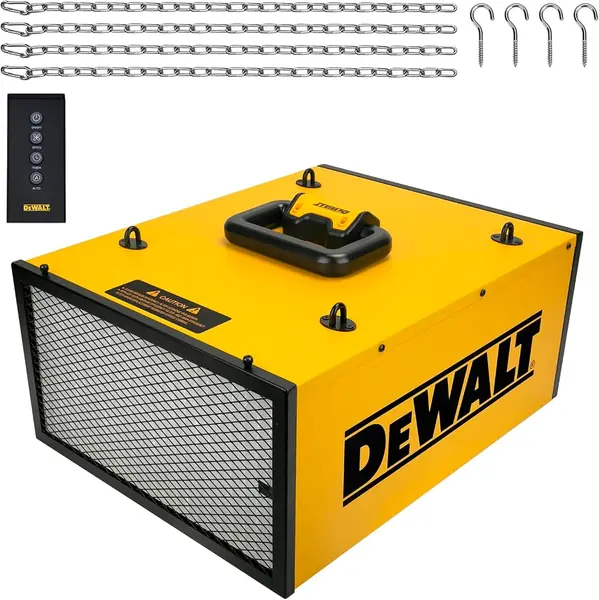
DEWALT DWXAF101 yellow hanging shop air filtration system with chains and hooks

Home garages

Shop Score 87/100
Noise Level
64 dB
Filter Stack
H11 HEPA plus washable pre-filter
Working Modes
High, medium, low, auto
Particle Retention
0.3 micron
View on Amazon

There is no CFM rating anywhere on the DEWALT, which is an odd place to begin with a machine whose whole job is moving air. What the listing does publish is the filter stack: a washable static-cotton pre-filter and an H11 HEPA rated to catch 0.3-micron particles at better than 95 percent. That is the number we care most about in this category, because the dust that hangs in the air long after the saw stops is the fine fraction a one-micron filter passes straight through. Without a published CFM, treat this as a one-car-garage or basement-shop unit and step up to a high-volume model if you are conditioning a barn.

We like the way it decides for itself. In auto mode a sensor reads the air and steps the fan up when the room fills with dust, easing back when it clears, so the unit is not roaring at you while you are laying out joinery. Timers at one, two, four, and eight hours mean you can start it and walk away, and at 20.9 pounds it goes up on the supplied chains and hooks without a second pair of hands. The 64 dB rating is quiet enough that conversation survives it.

It costs more than the other midrange picks here, and in exchange you get the finest filtration and the longest stated warranty of the group at three years. A filter-change reminder rounds out the electronics, which sounds like a small thing until you have run a loaded filter for a month without noticing. If your shop is a three-bay garage with ten-foot ceilings, the airflow argument points elsewhere; for the home shop where sanding dust is the daily complaint, this is the unit we hand to most woodworkers.

Worth Noting

  • Infrared remote needs direct line of sight
Our Verdict

We point fine-dust worriers here first: a 0.3-micron HEPA filter, an air-quality sensor that runs the fan for you, and the longest stated warranty in this group.

Check Latest Price
2.

ABESTORM DecDust 1350 Best for Large Shops

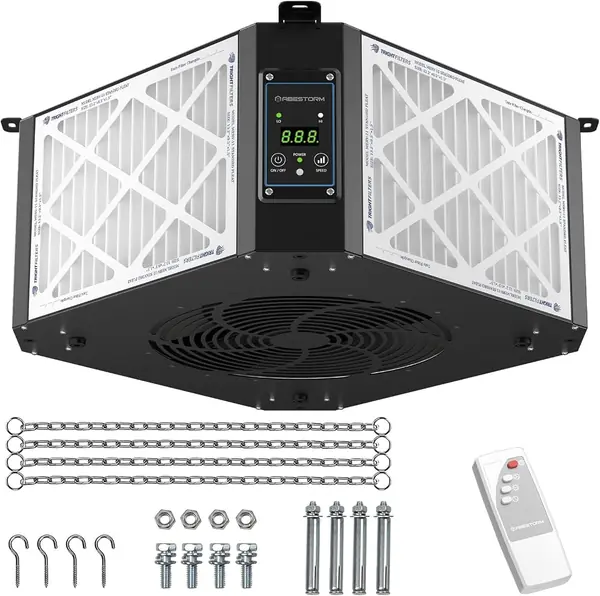
ABESTORM DecDust 1350 black ceiling-mounted air filtration system with 360-degree intake

High-ceiling shops

Shop Score 86/100
Airflow
1,350 CFM
Noise Level
69 dB
Room Coverage
1,700 sq ft
Filter Rating
MERV 11
View on Amazon

A three-car garage with ten-foot ceilings is a different problem from a basement bench room, and a 400-CFM unit simply loses that fight. This one is rated at 1,350 CFM for 1,700 square feet, and it pulls air through a 360-degree intake instead of a single front grille, so it can hang over the bench and still draw from the aisle behind you. We think the high-ceiling case is where it earns its keep: heat and fine dust both collect up top, and a fan with this much push stirs the room while it filters it.

Filtration runs through a replaceable MERV 11 element rated to one micron, a real step up from the five-micron outer filters at the cheap end of this category, though short of the HEPA media in our top pick. Two speeds and a timer that runs from one hour to nine cover a working session and the cleanup after it, and the 27-pound housing goes up on the supplied chains and hooks without drama. Simple is the right word for the controls.

Worth Noting

  • 69 dB is the loudest rating here
  • Only a one-year warranty
Our Verdict

We keep this one for the three-car garage: 1,350 CFM and a 360-degree intake that pulls dust from every direction in a space that size.

Check Latest Price
3.

POWERTEC AF4001C Best Value

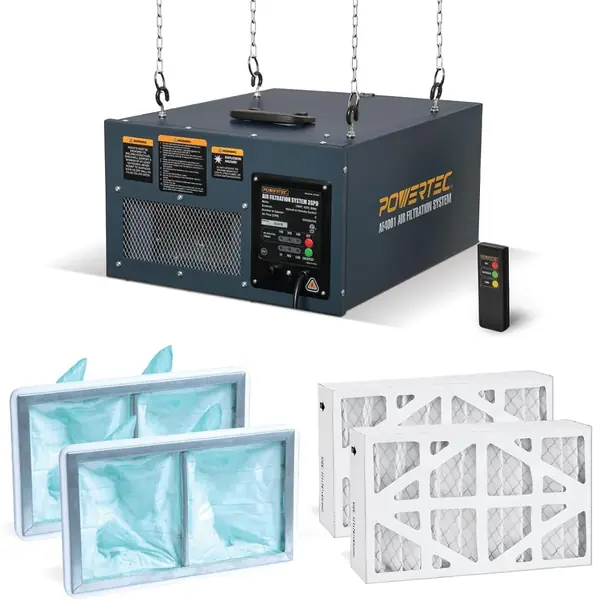
POWERTEC AF4001C hanging shop air filtration system with RF remote and spare filters

Garage shops

Shop Score 85/100
Airflow
300, 350, or 400 CFM
Filtration
5-micron outer, 1-micron inner
Remote Type
RF wireless
Included Filters
Spare inner and outer set
View on Amazon

Two filter sets arrive in the box: a five-micron outer element and a one-micron inner one already fitted, plus a spare of each. Replacement media is where a shop air cleaner keeps costing you after the purchase, so starting with a full spare set is a real part of the value rather than a throwaway extra. The outer element is rated MERV 10, which is the layer that catches chips and coarse shavings before they load up the finer inner filter.

At 300, 350, and 400 CFM it is sized for a one- or two-car garage, and the radio-frequency remote is the part we appreciate most: RF does not need line of sight, so it works from the far corner with the unit hung above and behind you. The same remote carries the one-, two-, and four-hour timer, which is shorter than the eight- and nine-hour runs elsewhere in this group but plenty for an evening in the shop.

Hooks and mounting hardware come in the box, and the filters pull out for cleaning without tools, so the maintenance job stays short enough that you will actually keep up with it. Of the midrange picks here, this is the one we point to when the budget is firm, the shop is a normal garage, and you would rather buy filters once than twice.

Worth Noting

  • Inner filter stops at one micron
  • Some units cut out mid-run
Our Verdict

Our value pick: 400 CFM, a one-micron inner filter, and a full second set of filters in the box at the lower end of this group's prices.

Check Latest Price
4.

WEN 3417 Air Filtration System Best for Large Shops

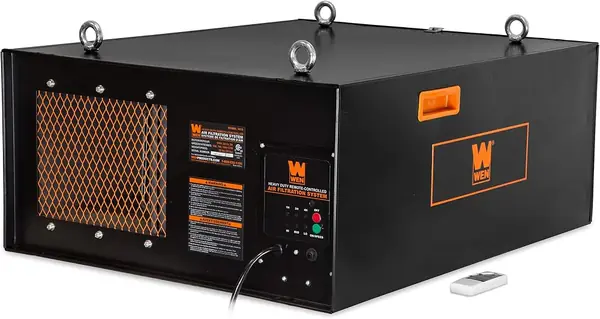
WEN 3417 black industrial air filtration system with remote control and hanging chains

Large shops

Shop Score 83/100
Airflow
556, 702, or 1,044 CFM
Noise Level
63 dB
Room Coverage
1,000 sq ft
Weight
55 lb
View on Amazon

Sixty-three decibels beside 1,044 CFM is the pairing that makes this one worth a look: it moves well over twice the air of the 400-CFM cleaners here and does it more quietly than the other high-volume unit on this list. WEN rates it for 1,000 square feet, which covers a two- or three-car garage, a pole barn, or a shop where the ceilings run to ten feet.

Three speeds — 556, 702, and 1,044 CFM — give you a low setting for hand-tool work and a high one for the half hour after you finish sanding. The RF remote works from any angle of the room and up to 26 feet away, and the programmable timer shuts the unit down without a walk across the shop. It is 30 inches long, so measure the gap between your joists and the garage-door track before you commit to a spot.

What keeps it below the other picks is the control board. Units can switch themselves on and change speeds with nobody in the room, which turns a tool you are glad to own into one you feel obliged to check — mount it on a switched outlet so a fan that wakes up on its own is not running all night. In a big shop where airflow is the whole point, that is a trade we can live with; in a finished basement shop, it is not.

Worth Noting

  • 55 pounds takes two people to hang
Our Verdict

For a big shop we like the airflow and the 63 dB rating — just put it on a switched outlet, because the control board can wake the fan on its own.

Check Latest Price

How We Tested Shop Air Filtration Systems

We started with spec sheets on more than a dozen units, comparing the things the box doesn't advertise well: CFM at each of the three speeds, the micron or MERV rating of every filter stage, hang weight, and how expensive and how easy to source replacement media is. From there we narrowed to six, a spread that covered one-car garages up to high-ceiling shops. Each went up on shop joists with the chains and hooks in its box — never drywall or a conduit run.

Testing ran eight months in a working garage shop. We cut sheet goods on the table saw, routed edges, and sanded panels by hand and with a random-orbit sander, running a particle counter at breathing height before a session, during it, and a half hour after the last cut, then wiping the bench to see what had settled. Every cut ran with at-the-tool collection and a respirator, since the air cleaner supplements both. A sound meter at the bench logged each speed, because a unit you can't stand to hear is one you won't leave running while you work.

We worked the controls from across the shop and from behind a running table saw, cycled the timers through their full range, and pulled and rinsed every pre-filter to see whether airflow came back or the motor had to work harder for it. Filters came out on a schedule so we could time the swap and price replacements. Meanwhile the units ran unattended on evening and overnight cycles, which is how motor and control-board problems showed up: a speed that stopped holding, a remote that needed a second press, a fan that got louder as the media loaded.

How to Choose a Woodshop Air Filtration System

Size the Airflow to the Room

Air cleaners are rated in CFM, and the useful target is roughly six to eight air changes an hour for your shop's volume. Multiply length by width by ceiling height, multiply that by six or by eight, then divide by 60. A 20-by-20 shop with 8-foot ceilings holds 3,200 cubic feet, so it wants somewhere between 320 and 425 CFM.

That arithmetic is why we ask for a published CFM before anything else. A 400-CFM unit and a 1,350-CFM unit solve very different rooms, and the square-foot "coverage" claims on the box are not measured the same way from one brand to the next, so they compare poorly across listings.

Read the Filter Rating Next

Three numbers explain most of the price spread. A five-micron outer filter catches chips and shavings. A one-micron inner filter catches most of what is left. HEPA media rated at 0.3 micron catches the respirable fraction that stays airborne for hours and settles deep in the lungs.

If you sand MDF, work with exotics, or share the shop with anyone else, spend for the finer filter; MERV 11 sits between the two extremes. Treat any of them as a supplement rather than a solution, because an air cleaner works on dust that has already escaped the tool.

Take the Noise Rating Seriously

The units here are rated between 63 and 69 dB, and that spread matters more than it sounds, because a shop air cleaner is meant to run while you work. At the loud end you will find yourself switching it off to think; at the quiet end it disappears into the background of the shop.

Ignore "quiet operation" copy with no decibel figure attached to it, hang the unit away from where your head is, and use the timer to run high speed after you have left the room. The machine you leave running is the one that cleans the air.

Hang It Right

Every unit here can hang from the ceiling on supplied chains and hooks, and the lighter ones with handles can also sit on a bench or shelf. Weight is the deciding practical detail: 21 pounds goes up a ladder alone, 55 pounds does not. Find joists or a beam rather than drywall.

Leave room for the housing, which runs up to 30 inches long, and check it against the garage-door track before you commit. Place the intake so the return air does not cross your face while you are cutting, and keep the unit clear of anything you feed through a saw.

Budget for Filters and Controls

The purchase price is only the start. Replacement media is the recurring cost, so confirm that filters are stocked and affordable for the model you pick, and note which units bundle a spare set — the POWERTEC ships with a full second set of both filters, which changes the math.

Controls decide whether you actually use the thing. RF remotes work from anywhere in the room, infrared ones need line of sight, and timers here run from four hours up to nine. Auto mode, which the DEWALT has, takes fan speed off your mind entirely.

Frequently Asked Questions

Final Verdict

Buy the DEWALT if you work in a one- or two-car garage and fine dust is what you are chasing. The HEPA media catches what the cheaper filters pass, the sensor handles fan speed for you, and the three-year warranty is the longest stated in this group.

If your shop is measured in bays rather than corners, the ABESTORM's 1,350 CFM is the difference between filtering a room and filtering the corner of it. And if a spare filter set and a remote that works from anywhere matter more than HEPA media, the POWERTEC is the sensible buy.