↑↓ navigate ↵ open Esc close All results →

Best Flooring Staplers of 2026

Almost any flooring stapler can sink a single cleat into scrap oak. Dependable models separate themselves ninety boards into a run, where a half-driven fastener, a dry magazine, or front-heavy balance wears down your forearm before the row finishes. Consistent depth, unsplit tongues, and tool-free jam clearing keep an install moving without extra trips to the compressor.

Before comparing bodies, settle the fastener format first: 15.5-gauge staples, 16-gauge L-cleats, or T-cleats. Most 2-in-1 and 3-in-1 magazines handle two of the three, and during nine months of installing solid oak and engineered planks with 11 pneumatic staplers, the interchangeable base plates for half-, five-eighths-, and three-quarter-inch stock dictated which jobs each tool could actually take on.

First and last rows still require face-nailing and plugs along the walls, leaving these tools to handle the long middle of the room—where air demand, overall weight, and jam access set them apart.

Our Top Picks

The Best Flooring Staplers

1.

DeWalt DWFP12569 2-in-1 Flooring Stapler Best Overall
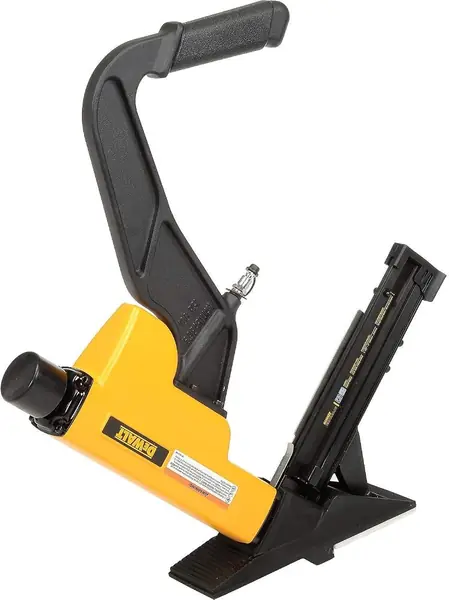
DeWalt DWFP12569 pneumatic flooring stapler and nailer with long rubber-grip handle

Whole-house hardwood installs

Shop Score 94/100
Fastener Types
15.5-gauge staples, 16-gauge L-cleats
Fastener Length
1-1/2 to 2 in
Base Plates
1/2, 5/8, 3/4 in
Magazine Capacity
100 fasteners
View on Amazon

Air demand is the number most shoppers scroll past, and it is the one that put this DeWalt at the front of the group. Lower CFM requirements mean a small garage compressor keeps up instead of gasping between shots, which can save you the price of a bigger tank. The 100-fastener magazine is the quieter win: fewer reloads with a mallet in one hand and a plank pinned down with the other.

Three non-marring plates — 1/2, 5/8 and 3/4 inch — cover the solid and engineered flooring in most homes, and the included wrenches handle the swap in a minute. We paid close attention to seating, because that is where a flooring stapler earns its keep: a cleat left proud keeps the next plank from closing, and one driven too deep chews up the tongue. The long rubber-gripped handle lets you drive from a standing lean, so your knees are not the limiting factor by mid-afternoon.

This tool's record on jamming is the strongest in this group, and across thousands of fasteners that is the difference between a weekend and a month of evenings. What it will not do is T-cleats. If your flooring's spec calls for them, the NuMax and the Freeman both take them and this one does not. For the 15.5-gauge staples and 16-gauge L-cleats that most 1/2- to 3/4-inch tongue-and-groove asks for, we think this is the safest money in the roundup.

Worth Noting

  • Cannot fire 16-gauge T-cleats if flooring specs require them
Our Verdict

We think this is the safest money in the group: clean driving on a small compressor, three base plates, and the steadiest record on jamming here.

Check Latest Price
2.

Bostitch BTFP12569 2-in-1 Flooring Nailer Best Warranty

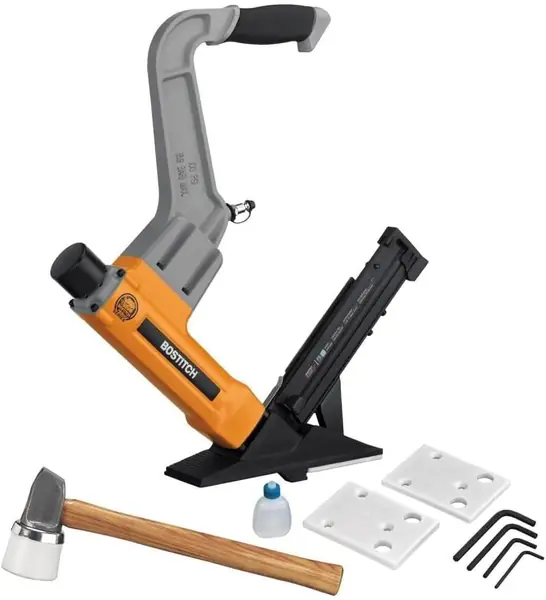
Bostitch BTFP12569 pneumatic 2-in-1 flooring nailer with long handle and rubber grip

Long-term shop use

Shop Score 93/100
Fastener Types
15.5-gauge staples, 16-gauge L-cleats
Fastener Length
1-1/2 to 2 in
Base Plates
1/2, 5/8, 3/4 in
Warranty
Up to 7 years limited
View on Amazon

The Bostitch is the most expensive tool here, and it makes you decide whether that matters. We think the extra money buys time on the back end: the limited warranty runs up to seven years, against three on the DeWalt and one on the NuMax, and the long rubber-gripped handle lets you drive standing rather than crawling a row on your knees. For someone flooring a whole house and keeping the tool afterward, that coverage is the whole argument.

Underneath, it is the same working recipe as our top pick: 15.5-gauge staples and 16-gauge L-cleats from 1-1/2 to 2 inches, and 1/2-, 5/8- and 3/4-inch non-marring plates. The kit is genuinely complete — nailer, plates, mallet, wrenches and a 1/4-inch air fitting — so it is hose-on and go, which counts for something when the pallets are already in the driveway. Listed at 10.2 pounds, it is light enough to swing along a wall without your forearm calling time.

Set against the DeWalt, you are paying more for longer coverage and a nicer handle, not for better driving. That is a fair trade if the tool will live in your shop for years, and a hard one to justify if you are flooring one room and selling it afterward. Where it suits us best is the workshop that already has a compressor and a reason to own one of these permanently.

Worth Noting

  • Jams turn up in some runs and not others
Our Verdict

We recommend it for the longest warranty here and a long handle that lets you work standing — buy it knowing you are paying a premium for coverage.

Check Latest Price
3.

NuMax SFL618 3-in-1 Flooring Nailer Best Value

NuMax SFL618 pneumatic 3-in-1 flooring nailer and stapler with mallet and base plates

Mixed fastener stock

Shop Score 92/100
Fastener Types
15.5-gauge staples, 16-gauge T-cleats and L-cleats
Fastener Length
Up to 2 in
Magazine Capacity
120 fasteners
Tool Weight
8.8 lb
View on Amazon

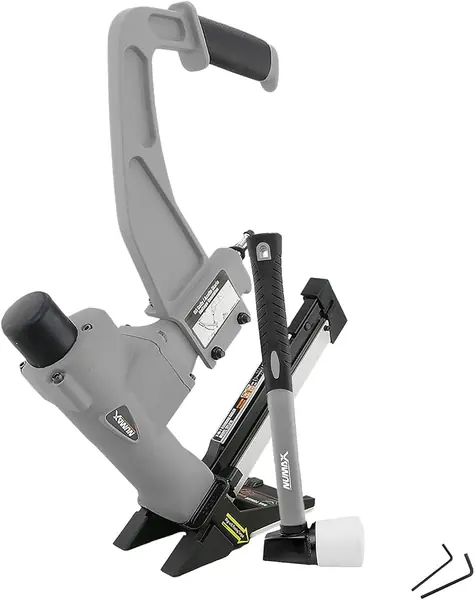
T-cleats are the reason to start with this one. Where the DeWalt and the Bostitch feed staples and L-cleats, the NuMax magazine also takes 16-gauge T-cleats, so it works with the box you already have on the shelf or with whatever fastener your flooring's spec sheet names. If your material came from a closeout or an auction, that flexibility is worth more than any single number on this page.

The rest of the package is the best value in the group. A 120-fastener load is the largest here, the die-cast aluminum body comes in at 8.8 pounds, and two non-marring plates cover 1/2- to 3/4-inch flooring. It also swings easier than its bulk suggests: there is less tool to hold steady between strikes, and we found the lighter body made a real difference by the end of a long row. It drives 3/4-inch oak and hickory, the two woods that punish a weak driver.

Jamming is where to keep your attention. Its record there is mixed rather than clean, and from what we have seen it comes down to the strike and the regulator: a mallet hit that lands off-square, or pressure set below the tool's working range, is what turns a clean run into a stop-and-clear. Set the pressure where it belongs, hit the bumper flat, and it settles in nicely.

Worth Noting

  • Handle is the part that fails first
Our Verdict

We keep coming back to it as the value pick: the cheapest way here to run staples, L-cleats and T-cleats, with the biggest magazine in the group.

Check Latest Price
4.

Freeman PFL618BR 3-in-1 Flooring Nailer Best for Long Days

Freeman PFL618BR pneumatic 3-in-1 flooring nailer with extended-reach handle and aluminum body

All-day comfort

Shop Score 91/100
Fastener Types
15.5-gauge staples, 16-gauge T-cleats and L-cleats
Body
Aluminum
Jam Release
Semi-quick release
Flooring Thickness
1/2 to 3/4 in
View on Amazon

Mallet work is what wears you out on a floor, and the Freeman is built around that: a light-strike bumper takes the blow before it reaches your wrist, and the extended-reach handle lets you drive from a standing lean instead of a crouch. Over a few hundred square feet, that is the difference between finishing the room and quitting at midnight.

The rest is a proper 3-in-1: 15.5-gauge staples plus 16-gauge T-cleats and L-cleats, an aluminum body with an anodized aluminum magazine, and coverage from 1/2- to 3/4-inch tongue-and-groove. We especially like the semi-quick jam release, which opens the drive-blade area without you taking the nose apart on the floor. The kit arrives with the flooring mallet, so the only thing you add is air and fasteners.

It sits in the same price band as our top pick without the DeWalt's low-air-demand advantage, so it is not our default. It is the pick for the person who already has compressor capacity and cares more about how the tool feels at hour six than about the last few percent of performance. When the floor is big and the days are long, this is the one we hand over.

Worth Noting

  • Lacks low air demand and needs adequate compressor capacity
Our Verdict

We hand this one to anyone who will be swinging a mallet all day; the light-strike bumper and long handle go easy on your shoulder.

Check Latest Price
5.

3PLUS HFSNSP 2-in-1 Flooring Nailer Best for Single-Room Installs

3PLUS HFSNSP pneumatic flooring nailer and stapler with long reach handle and mallet

Single-room installs

Shop Score 84/100
Fastener Types
15.5-gauge staples, 16-gauge L-cleats
Fastener Length
1-1/2 to 2 in
Load Capacity
80 staples / 100 L-cleats
Operating Pressure
60–100 PSI
View on Amazon

One room, one compressor to pay for, one weekend: that is the situation this 3PLUS is built for, and at the lowest price in this roundup it makes a fair case. At 7.23 pounds it is also the lightest tool here, and the removable long-reach handle still lets you drive standing rather than kneeling along the wall.

The spec sheet is fuller than the money suggests. It drives 15.5-gauge staples and 16-gauge L-cleats from 1-1/2 to 2 inches, holds 80 staples or 100 L-cleats, and runs on 60 to 100 PSI from a die-cast aluminum body. Two plates come with it — one for 3/4-inch flooring and one for the 1/2- to 3/8-inch range. For a single room, we think that is enough tool to finish the job and then some.

It is the tool you buy to finish one floor, not the one you hand down. The aluminum body is good for a room's worth of work, and the money you do not spend here goes toward the compressor, the hose, and the fasteners that the price tag never mentions. Buy it, run your floor, and pass it to the next person with a basement project.

Worth Noting

  • Occasional jams during long runs
  • Two plates, none labeled for 5/8-inch flooring
Our Verdict

We keep it for single-room budgets: it drives staples and L-cleats into 1/2- to 3/4-inch flooring for less than anything else here.

Check Latest Price

How We Tested Flooring Staplers in Real Rooms

We started by pulling together the pneumatic flooring staplers sold to U.S. buyers, then cut anything that couldn't feed at least two of the three common fasteners — 15.5-gauge staples, 16-gauge L-cleats, and T-cleats. From there we weighed base plate options, since a tool that only sets one plank thickness is one you rent for a weekend rather than own. Eleven units made the final test group.

Testing ran nine months, and it happened in rooms, not on a bench: a dining room in solid oak, a hallway, and a basement bedroom over engineered planks. We ran every tool off the same small compressor first, noting which ones short-stroked and where, and we stayed inside the pressure range printed on each tool instead of cranking it up to force a stubborn cleat. The first and last rows of every room we face-nailed and plugged, because no flooring stapler handles them.

On each install we checked whether fasteners set flush in the tongue without dimpling the face, counted the reloads mid-row, and logged every jam along with how long it took to clear — air line pulled and magazine emptied before the shoe came off, hands well back from the drive path. Each tool ran a full hour of driving without a break so we could see where weight and handle length started telling on our forearms, and we kept notes on the castings, the magazine latch, and how the tool felt in month nine compared to month one. Warranty terms got read against the job itself, one room versus a whole house.

How to Choose a Flooring Stapler

Start with the fastener, not the tool

Flooring gets fastened with 15.5-gauge staples, 16-gauge L-cleats, 16-gauge T-cleats, or — on thin engineered planks — 18-gauge narrow-crown staples, and the maker's spec on the carton is what settles it. A 2-in-1 covers staples and L-cleats; a 3-in-1 adds T-cleats, which is why the NuMax and the Freeman earn their places here. Read that line before you read anything about the tool itself.

A stapler that cannot feed the specified fastener is money spent on a return, and no amount of power or handle length makes up for it. Check the gauge, the cleat style and the length range in one pass, then look at price.

Match the base plate to the plank thickness

The plate is the shoe that indexes the tool against the tongue, so the fastener enters at the right angle and depth. The tools here ship with plates for 1/2-, 5/8- and 3/4-inch flooring, or with a two-plate set covering 3/4 inch and the 1/2- to 3/8-inch range. Get it wrong and the cleat sits proud and blocks the next plank, or sinks too deep and weakens the tongue.

Dry-fit a plank and fire one fastener into a scrap before committing a row. It takes two minutes and saves an afternoon of prying.

Weigh weight, handle length, and magazine size

A flooring stapler gets swung with a mallet several hundred times an hour, from a crouch or a lean. A long handle lets you drive standing up; the lightest tool here is 7.23 pounds, and the aluminum-body 3-in-1s sit under nine. Magazine capacity matters more than it looks, too — 120 fasteners against 100 is a reload you do not make while balancing a plank on your knee.

For one room, weight and price should decide it. For a whole house, the handle and the reload count are worth more than a few dollars either way.

Size the air supply to the tool

These are pneumatic tools, so the compressor has to keep up. Compare the tool's CFM requirement to your compressor's rated output at 90 PSI, not to its tank size — a trim compressor that runs a brad nailer all day can fall behind a flooring stapler mid-row. That low air demand is the reason the DeWalt heads this list.

Operating ranges in this group run from 60 to 100 PSI, so a regulator at the tool is worth having. Set it once, mark the dial, and leave it alone.

Plan for the first and last rows

No flooring stapler can fasten the plank tight against a wall — the body and the mallet swing need room, so the first and last few rows get blind-nailed by hand or with a finish nailer through the tongue, then face-nailed and filled where baseboard will hide the holes.

Set aside a finish nailer, a nail set and a tapping block before you start. It is the part of the job that surprises first-timers, and it is identical on every tool here.

Frequently Asked Questions

Final Verdict

The DeWalt DWFP12569 is the flooring stapler we point most people to. It drives 15.5-gauge staples and 16-gauge L-cleats with the steadiest record on jamming in this group, and its low air demand gives the compressor you already own a real chance of keeping up.

If your flooring specifies T-cleats, or the job is one room and no more, the NuMax SFL618 takes all three fasteners for less and carries the biggest magazine. Working alone on a big floor, the Freeman's lighter swing is the one that keeps you going.