↑↓ navigate ↵ open Esc close All results →

Best Flooring Nailers of 2026

A flooring nailer only proves itself out in the open field of a room, where boards pull tight, mallet swings get shorter near walls, and a misfeed ruins a plank already cut to fit. Reliable fastener feeding, a shoe that seats squarely against the tongue, and consistent drive depth on the hundredth board matter far more than catalog specs.

Testing nine pneumatic nailers over eight months across solid hardwood, engineered planks, and patched-in hallway boards reinforced a hard lesson for first-time buyers: a multi-fastener gun is only as versatile as the base plates in the box. The plate—not the tool body—determines whether the shoe aligns cleanly on 1/2-inch, 5/8-inch, or 3/4-inch stock.

From quick single-room installs and thin engineered floors to full solid-hardwood runs, the five ranked models differ mainly in included plates, air efficiency, and how fast a jam clears without halting the row.

Our Top Picks

The Best Flooring Nailers

1.

Freeman PFL618BR Flooring Nailer Best Overall
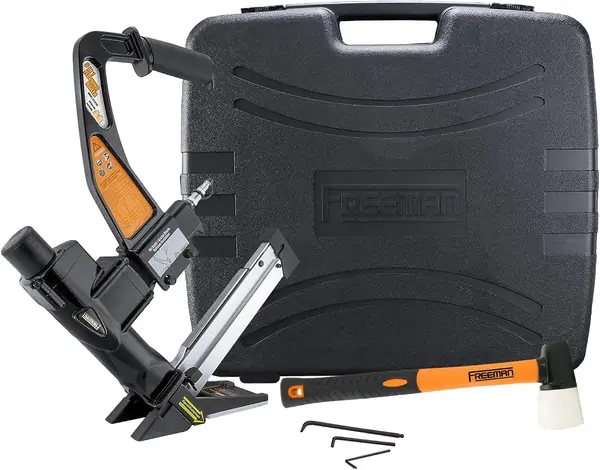
Freeman PFL618BR pneumatic flooring nailer in black with long-reach mallet and molded storage case

Solid hardwood floors

Shop Score 93/100
Tool Weight
11.5 lb
Fastener Types
16-gauge T-cleats, L-cleats and 15.5-gauge staples
Warranty
7-year limited
Flooring Thickness
1/2 to 3/4 inch
View on Amazon

Three fasteners in one magazine — 16-gauge T-cleats, 16-gauge L-cleats and 15.5-gauge flooring staples — is the reason this one lands at the top of our list. Flooring manufacturers name the fastener they want in the installation instructions, and the lumberyard rarely stocks every option in every length. A tool that swallows whatever is on the shelf keeps the job on this weekend's schedule instead of waiting on an order. The magazine holds a full strip of 120, so reloads are few.

It earns the spot on the floor, too. In our runs it set 2-inch cleats into 3/4-inch oak at a consistent depth with only the occasional jam, and the semi-quick release exposes the driver blade without a teardown. The two non-marring base plates cover 1/2-inch through 3/4-inch flooring and swap in seconds. Ours arrived with the mallet, adjustment wrenches, air fitting and a molded case — the case matters more than it sounds, since loose storage is how base plates disappear.

At 11.5 pounds it is the heaviest of the mallet-actuated tools here, and the mass sits forward in the head where the blow lands. The extended handle keeps you standing instead of kneeling, a difference your knees notice by the end of a room. How it holds up past a few jobs is the one thing we cannot vouch for, and the seven-year limited warranty is what keeps that from being a real worry.

Worth Noting

  • Heaviest of the mallet tools here
Our Verdict

We recommend the Freeman PFL618BR as the default flooring nailer: it takes all three common flooring fasteners and backs the tool with a seven-year limited warranty.

Check Latest Price
2.

NuMax SFL618 Flooring Nailer Best Value

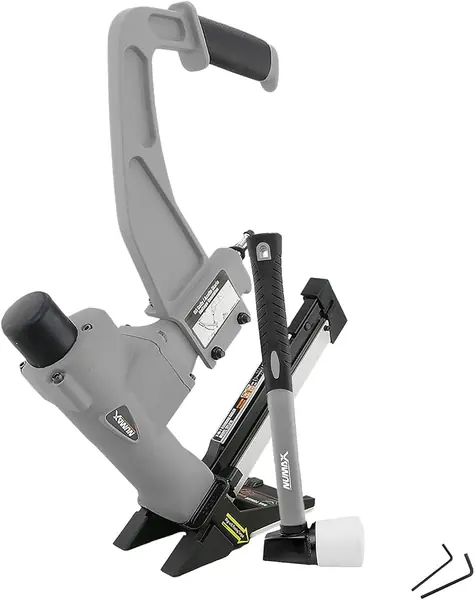
NuMax SFL618 pneumatic 3-in-1 flooring nailer in gray with long-reach fiberglass mallet and base plates

Budget one-room installs

Shop Score 92/100
Tool Weight
8.8 lb
Fastener Types
16-gauge T-cleats and L-cleats, 15.5-gauge staples
Warranty
1-year limited
Flooring Thickness
1/2 to 3/4 inch
View on Amazon

The SFL618 is the least expensive mallet-actuated tool in this group, and it still takes all three flooring fasteners. That pairing is the whole argument: T-cleats, L-cleats and 15.5-gauge staples without paying for a premium badge. For a homeowner doing one floor, the math is hard to argue with.

What convinces us is how much work it gets through. It drives 2-inch cleats into 3/4-inch oak without asking much of a small pan-handle compressor, and the 8.8-pound body is the lightest of the cleat-driving tools here. The long fiberglass mallet is heavier than it looks and does a good share of the work for you.

Jams happen, and the quick release gets you back to work without hunting for a tool. The full-strip 120-fastener magazine means reloads do not break your rhythm, and changing between cleats and staples is a magazine swap rather than a second purchase — the part we appreciate most on a one-floor job.

Worth Noting

  • One-year limited warranty
  • Handle failures can end a session early
Our Verdict

We point budget-minded buyers at the NuMax SFL618, which takes every common flooring fastener and weighs less than any other cleat-driving tool here.

Check Latest Price
3.

DEWALT DWFP12569 Flooring Nailer Best for Long Installs

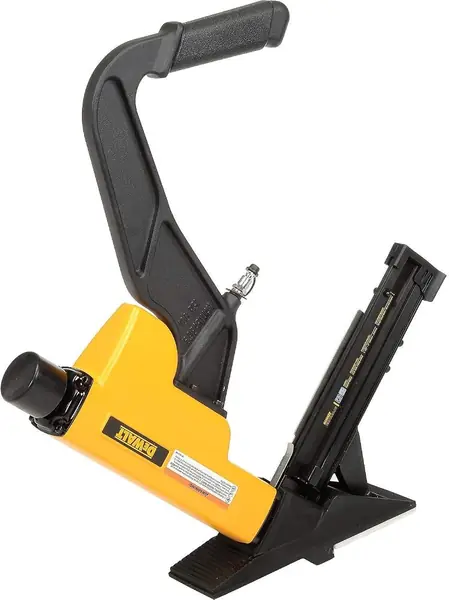
DEWALT DWFP12569 2-in-1 pneumatic flooring tool with interchangeable base plates and flooring mallet

Long single-room runs

Shop Score 91/100
Tool Weight
10.6 lb
Fastener Types
16-gauge L-cleats and 15.5-gauge staples
Warranty
3-year limited
Base Plates
1/2 in, 5/8 in, 3/4 in
View on Amazon

The DWFP12569 drives 15.5-gauge staples and 16-gauge L-cleats, and DeWalt sells it as a flooring stapler — which is honest, because stapling is half of what it does. Check which fastener your flooring maker specifies before you go further. If the instructions say staples or L-cleats, this tool covers the whole job.

Consistency is where it earns its place. This tool has the cleanest jam record in the group, and the set stayed even across long courses, so we stopped checking every tenth fastener. At 10.6 pounds it moves easily along a row, and the lower CFM draw keeps a small pancake compressor from running nonstop.

Here is the trade that decides it for us. DeWalt and Bostitch sell what is effectively the same flooring tool — same base plates, same 2-inch capacity, same mallet and air fitting in the box — and this one costs less. For a single house with staples or L-cleats, that is the version we buy.

Worth Noting

  • No T-cleat setting
  • Three-year warranty trails the Bostitch's seven
Our Verdict

Buy the DWFP12569 if you need staples and L-cleats and want the most consistent, jam-light runs; the missing T-cleat option is the only real cost.

Check Latest Price
4.

Bostitch BTFP12569 Flooring Nailer Best Warranty Coverage

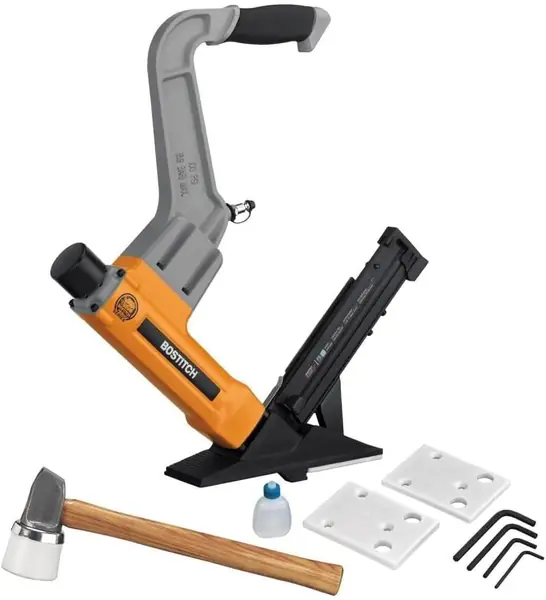
Bostitch BTFP12569 2-in-1 flooring nailer with three interchangeable base plates and flooring mallet

Long-term ownership

Shop Score 90/100
Tool Weight
10.2 lb
Fastener Types
16-gauge L-cleats and 15.5-gauge staples
Warranty
7-year limited
Base Plates
1/2 in, 5/8 in, 3/4 in
View on Amazon

Seven years of limited warranty is the longest coverage in this group, and it is the reason to pick the BTFP12569 over the near-identical DeWalt. For a tool that may sit in a garage between projects, that difference is closer to an insurance policy than a spec line.

The rest is genuinely pleasant to use. At 10.2 pounds it is the lighter of the two 2-in-1s here, and the long rubber-grip handle lets you drive fasteners standing up rather than on your knees. It takes 16-gauge L-cleats and 15.5-gauge staples, and the three non-marring base plates cover 1/2-inch, 5/8-inch and 3/4-inch flooring. The mallet, wrenches and 1/4-inch air fitting are all in the box, so day one costs you fasteners and a hose.

You do pay for that coverage. This is the most expensive tool we recommend, and the DeWalt does the same work for less money with a shorter warranty. We point it at anyone who expects to keep a flooring nailer for a decade of projects, or who would rather lean on a manufacturer's coverage than pay for a repair out of pocket.

Worth Noting

  • Takes staples and L-cleats only
Our Verdict

We recommend the Bostitch BTFP12569 to anyone who will keep a flooring nailer for years, because seven years of coverage outlasts every other tool here.

Check Latest Price
5.

3PLUS HFS509040SP Flooring Stapler Best for Thin Engineered Planks

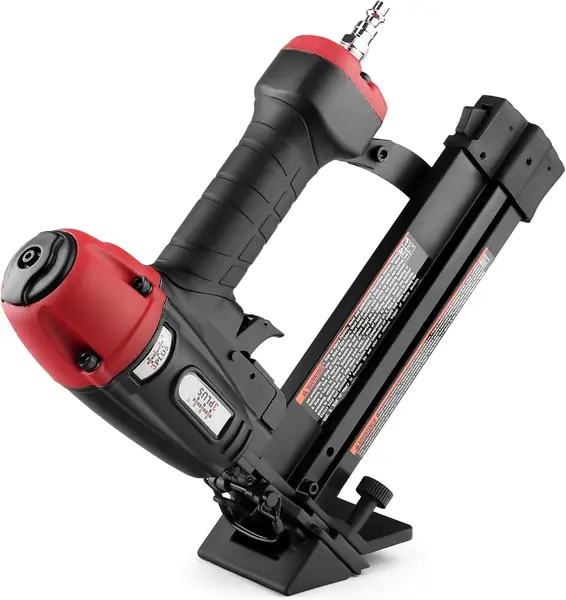
3PLUS HFS509040SP 18-gauge pneumatic flooring stapler and brad nailer in black and red

Thin engineered planks

Shop Score 88/100
Tool Weight
3.5 lb
Fastener Types
18-gauge brads and 1/4-inch crown staples
Flooring Thickness
1/4 to 5/8 inch
View on Amazon

The first and last rows are hand work no matter what you buy, because the base plate on a mallet-actuated tool holds the head off the wall. This one's slimmer shoe gets close in both directions, so there is less kneeling over a scrap block at the edges of a room.

Where it stops is thickness. The HFS509040SP is built for 1/4-inch to 5/8-inch engineered and solid flooring, and it drives 18-gauge brads and 1/4-inch crown staples rather than the 15.5- and 16-gauge flooring fasteners the other tools here use. On 3/8-inch engineered planks that is exactly right — it set fasteners consistently through a room's worth of thin stock in our testing, with the tool-free depth wheel doing the adjusting.

At 3.5 pounds it is the only tool here you can hold overhead, which matters for a ceiling or a soffit in bamboo or thin engineered stock. With the flooring shoe off it becomes a plain 18-gauge brad nailer, so it keeps earning shelf space after the floor is done. Just don't buy it for 3/4-inch oak; the range stops short and no adjustment closes the gap.

Worth Noting

  • Drives brads and staples rather than cleats
Our Verdict

We like the 3PLUS for 1/4-inch to 5/8-inch engineered flooring and nothing heavier; it is not a substitute for a 3/4-inch solid hardwood nailer.

Check Latest Price

How We Tested Flooring Nailers, Board by Board

We built the shortlist from the specs that decide whether a tool works on your floor at all: which fasteners it drives, the plank thicknesses it covers, and whether the base plates and mallet come in the box or cost extra. From there we filtered by price and availability and landed on nine pneumatic nailers, which we ran for eight months on solid oak in a living room, engineered planks in a basement bedroom, and repair patches along a hallway.

Every tool ran off the same compressor at the pressure its manual specified, with eye and hearing protection on, hands clear of the shoe, and oil applied on the schedule the manual gave. We counted fasteners between jams and timed how long each one took to clear — always disconnecting the tool from the air line first — then checked seating depth by running a straightedge along each seam and feeling for a proud head. Base plates got swapped to match 1/2-, 5/8-, and 3/4-inch flooring, and we noted how much fumbling a changeover took.

We weighed each tool on a kitchen scale, measured handle length, and worked full rows to see how weight and reach combined after an hour of swinging a mallet. We also finished the first and last rows at the wall, where the shoe can't reach, to see what each tool left us doing by hand. After roughly 1,200 fasteners apiece we inspected o-rings, shoes, and mallet faces for wear, logged each warranty term, and priced every tool against a week's rental to judge value.

How to Choose a Flooring Nailer

Start With the Fastener

Flooring manufacturers name the fastener in their installation instructions: 15.5-gauge staples, 16-gauge L-cleats or 16-gauge T-cleats. The flooring decides this, not the tool — engineered products often call for staples, while solid strip flooring usually wants cleats. A 3-in-1 magazine that takes all three costs more but spares you a Saturday spent hunting a specific fastener in a specific length.

The trap is buying the nailer first and reading the flooring spec second. If you already know you are stapling or shooting L-cleats, a 2-in-1 like the DeWalt or the Bostitch does the same work for less money.

Match the Base Plates to the Flooring

Standard solid hardwood runs 1/2 inch to 3/4 inch, and the mallet-actuated tools here ship with non-marring base plates for those thicknesses. Fit the wrong plate and the fastener either rides high or blows through the tongue. Thin engineered stock is a different class of tool: 1/4-inch to 5/8-inch material takes an 18-gauge flooring stapler like the 3PLUS, which drives brads and narrow-crown staples instead of flooring cleats.

Check the stated range against the thickness printed on your boxes before you order. A nailer that covers the top of the shelf rarely covers the bottom, and the marketing copy rarely says so.

Weigh Handle Length Against Tool Weight

These are mallet-actuated tools: a weighted mallet strikes the bumper and the tool fires, so you never pull a trigger. Weight cuts both ways. Our picks run from 8.8 to 11.5 pounds; the heavier ones put more mass behind the blow and ask more of your shoulders by the end of a room.

The long handles exist so you can work standing, and that is the biggest comfort difference between these and hand-nailing. We care about handle length more than almost any other specification, especially once a room passes a few hundred square feet.

Plan for Jams and Upkeep

You will jam eventually — a dry tool or a fastener that meets a hidden nail will do it. The release design decides whether that costs you a minute or a teardown, so we favor a semi-quick or quick release that exposes the driver blade without pulling the magazine apart. A full strip of about 120 fasteners keeps reloads from interrupting a course.

Oil the tool before each session the way the manual specifies, and blow dust out of the magazine between rooms. A little upkeep is the difference between a nailer that lasts a floor and one that lasts a decade.

Frequently Asked Questions

Final Verdict

The Freeman PFL618BR is the flooring nailer we recommend first. It shoots all three common flooring fasteners, so the flooring you want — not the tool you already bought — decides what goes in the magazine, and seven years of warranty covers the long-term question we cannot answer.

If the total outlay matters more than coverage, the NuMax SFL618 does the same three-fastener job for less. And if your boxes say 3/8-inch engineered, skip both and get the 3PLUS.