↑↓ navigate ↵ open Esc close All results →

Best Finish Nailers of 2026

Driving finish nails by hand turns careful trim work into a gamble, where one off-center hammer blow dents the face of soft molding or splits a board already coped to fit. A finish nailer eliminates both mistakes in one trigger pull, resting flat on the profile and sinking the head just below the surface for a pinpoint putty hole.

Nine months of running 12 pneumatic and cordless finish nailers on baseboard, crown, chair rail, and cabinet trim across a shop and two home renovations revealed what spec sheets leave out. Magazine jams halfway through a cope cut and proprietary fastener costs separate smooth daily drivers from tools that stall a room installation.

Choosing between air and battery power comes first, followed by gauge and balance: 15-gauge angled nails anchor heavy casing and baseboard, 16-gauge nails keep holes tiny in delicate profiles, and tool weight shows up fast when splicing crown overhead.

Our Top Picks

The Best Finish Nailers

1.

Metabo HPT NT65MA4 15-Gauge Finish Nailer Best Overall
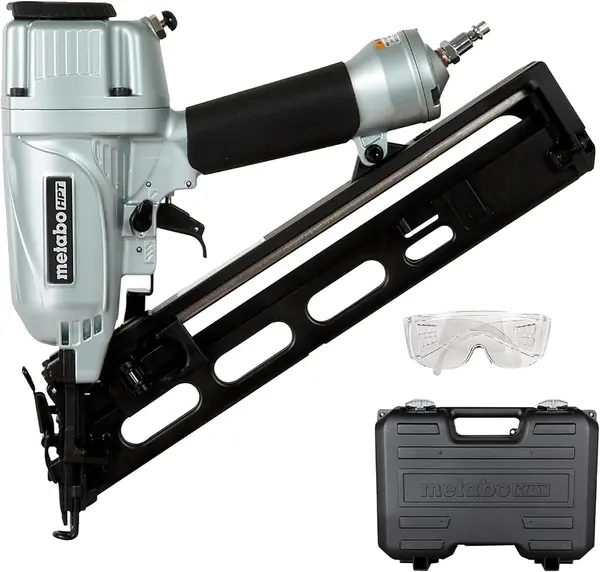
Metabo HPT NT65MA4 blue pneumatic 15-gauge angled finish nailer with magazine and carry case

Trim and baseboard

Shop Score 93/100
Power Source
Pneumatic
Fastener Range
15-gauge angled DA, 1-1/4 to 2-1/2 in
Weight
4.2 lb
Warranty
5 years
View on Amazon

Inside corners are where a finish nailer shows its manners. This one's angled magazine cants the body away from the wall, so the nose sits flat on the casing and your knuckles clear the drywall — a small thing until you're running a room of baseboard and the alternative is setting the last two inches by hand. At 4.2 pounds it's light enough for overhead crown without your forearm burning, and it drives 15-gauge DA nails from 1-1/4 to 2-1/2 inches, which covers everything from shoe mold to built-up casing. That combination is why it's the gun we hand people first.

The extras are better than the price suggests. You get a no-mar tip, safety glasses, a 1/4-inch NPT plug, and a hard case. The integrated air duster turned out to be the feature we reached for most: one press clears sawdust off a chair rail before the next piece goes up, and you stop hunting for a vacuum. The selective actuation switch flips between sequential and contact fire without a tool, and the exhaust turns a full 360 degrees so it isn't blowing dust back in your face in a finished room.

What keeps it at the top is the feed. Nails land where you point them, and the gun hasn't given us a reason to take it apart. The fastener matters too: 15-gauge angled DA nails are the most widely stocked finish nails there are, so you can buy a box at any lumberyard and change brands without drama. That's a small thing the day you buy it and a big one the Saturday you run out halfway through a wall.

Worth Noting

  • Requires a compressor and air hose
Our Verdict

The finish nailer we point most trim carpenters to: light in the hand, steady in the feed, and inexpensive for what it does.

Check Latest Price
2.

DEWALT DCN660B 20V MAX Finish Nailer Best Cordless

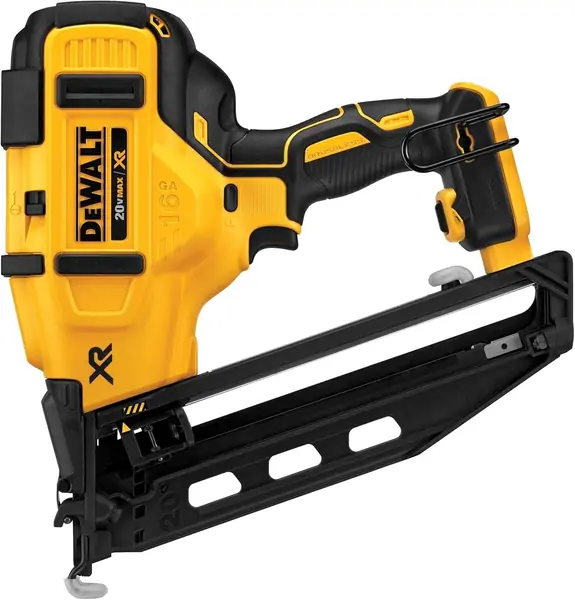
DEWALT 20V MAX 16-gauge angled cordless finish nailer with tool-free depth dial

Cordless trim work

Shop Score 92/100
Power Source
DEWALT 20V MAX battery
Fastener Range
16-gauge angled, 1-1/4 to 2-1/2 in
Motor
Brushless
In The Box
Tool only
View on Amazon

The case for going cordless is simple: no compressor to drag out, no hose snagging on a sawhorse, and no reason to leave the gun at home when a friend asks for help hanging a door casing. The DCN660B is the one we take in that situation. It drives 16-gauge angled nails from 1-1/4 to 2-1/2 inches off a DEWALT 20V MAX pack, with a brushless motor, tool-free depth adjustment, and a tool-free jam release that pops the nose open mid-run.

What surprised us is how little it gives up to air. You hear the motor spin up before each shot, and that short lag is the one place a pneumatic still feels quicker, but the nail lands where you point it and the depth holds from piece to piece. Battery life never became the thing that stopped us, which is high praise for a nailer. Loading is straightforward, and the trigger switches between sequential and contact fire without a tool.

Where it changes the job is in occupied houses and finished rooms: no compressor cycling in the corner, no hose dragging across a refinished floor, no cord to trip over. If your trim work happens a room at a time between other tasks, that convenience is worth more than any line on the spec sheet. And if you already own 20V MAX tools, the packs from your drill fit this slot, which softens the sting of a bare-tool box.

Worth Noting

  • Tool only
  • Heavier in the hand than the pneumatics here
Our Verdict

The cordless finish nailer we reach for when there's no compressor on site: accurate, quiet, and easy to live with.

Check Latest Price
3.

Metabo HPT NT65M2S 16-Gauge Finish Nailer Best for Fine Trim

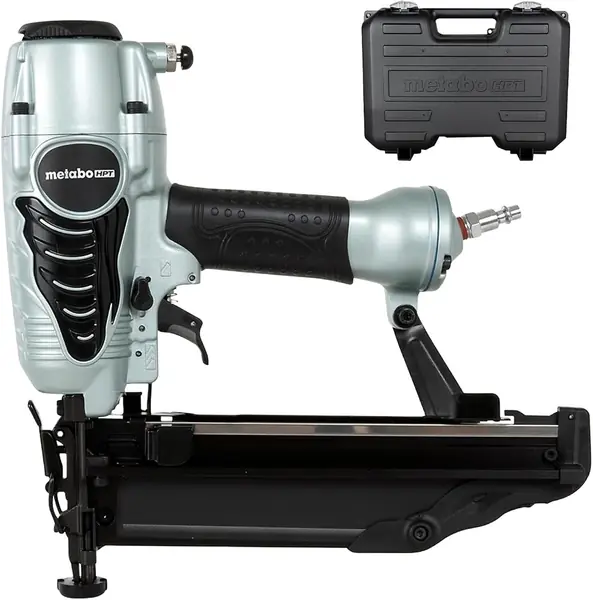
Metabo HPT NT65M2S 16-gauge pneumatic finish nailer with air duster button and hard case

Fine interior trim

Shop Score 91/100
Power Source
Pneumatic
Fastener Range
16-gauge, 1 to 2-1/2 in
Weight
3.7 lb
Warranty
5 years
View on Amazon

Next to the 15-gauge gun above, this one leaves a smaller hole and weighs about half a pound less — 3.7 pounds against 4.2 — and those two differences explain most of who should buy it. On paint-grade casing, chair rail, and cabinet trim, where the stock is thin and every head is going to show through the paint, we prefer it. The 16-gauge nail is thinner with a smaller head, so there's less putty and less sanding when you're done.

The range also runs down to 1 inch, where the 15-gauge guns here stop at 1-1/4, so thin panel molding and face frames are on the table. Power isn't the compromise you might expect from the smaller gauge: it sets 2-1/2-inch nails into hardwood trim without the waffling a brad gun gives you. It gets the same thoughtful extras as its bigger sibling, too — the air duster button, a selective actuation switch, a no-mar tip, and a hard case — along with the same five-year coverage.

Where it runs out of road is thick material. A 16-gauge nail doesn't carry the shank that 15-gauge does, so on wide baseboard, door jambs, stair treads, and anything outside, the heavier nail from the top pick is the safer bet. Keep it for paint-grade interior work and it's the gun we reach for first — light enough to hold overhead, quick to load, and clean enough at the surface that finishing goes faster.

Worth Noting

  • Occasional jams with some nail brands
Our Verdict

Our pick for fine interior trim: the lightest gun here, with a smaller 16-gauge hole to fill afterward.

Check Latest Price
4.

3PLUS HDA1564SP 15-Gauge Finish Nailer Best Budget

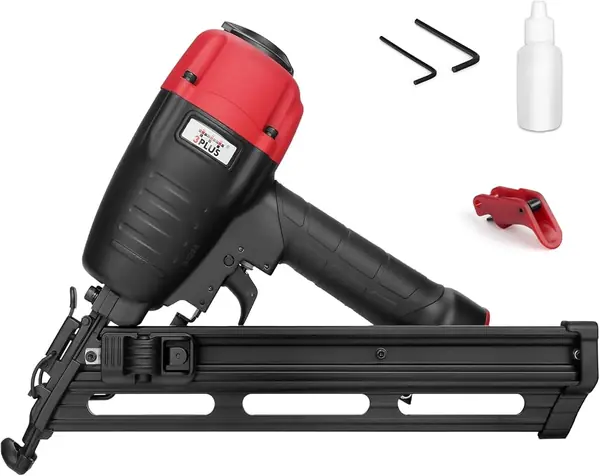
3PLUS HDA1564SP black and red 15-gauge angled pneumatic finish nailer with depth adjustment wheel

Budget trim work

Shop Score 90/100
Power Source
Pneumatic
Fastener Range
15-gauge DA, 1-1/4 to 2-1/2 in
Weight
5.51 lb
Trigger
Interchangeable single-shot or bump fire
View on Amazon

The HDA1564SP is the cheapest gun here, and it isn't a toy. It fires 15-gauge angled DA nails from 1-1/4 to 2-1/2 inches, has tool-free depth adjustment, a no-mar tip, and a work contact element that keeps it from firing until the nose is pressed against the work. For a homeowner hanging baseboard and casing in a couple of rooms, that is the whole feature list that matters.

We went in expecting to be annoyed and mostly weren't. The exhaust turns out of your face, the depth wheel holds its setting from one piece of casing to the next, and the interchangeable trigger lets you set the gun up for single shots or bump fire depending on how much trim is in front of you. The nose is compact enough to get into cabinet corners, and the no-mar tip kept our painted offcuts clean.

Feeding is where the price shows. Over a long run it's less consistent than the guns above, and the occasional double-fire means pulling a nail and filling the hole. Keep the magazine clean, use strips that fit properly, and it settles into a rhythm; treat it as a weekend tool rather than a production gun and the trade is fair. Like any pneumatic, it also wants a few drops of air tool oil in the inlet before a session.

Worth Noting

  • Heaviest pneumatic here at 5.51 pounds
Our Verdict

The least expensive way onto this list, and a sensible first finish nailer for a homeowner with a couple of rooms of baseboard to hang.

Check Latest Price

How We Tested Finish Nailers

We built the shortlist by sorting the field by gauge and power source, then dropping anything with a narrow fastener range, a magazine that needed a wrench to change angle, or a warranty too short for hard use. That left 12 tools, a mix of pneumatic and battery models in 15- and 16-gauge, and we bought each at retail rather than borrowing samples.

Over nine months those nailers trimmed out a basement, hung crown in a stairwell, ran chair rail down a hallway, and cased a dozen doorways. We weighed each on a kitchen scale and, more usefully, held it overhead in a firing position for a slow count of sixty to see how fast the front end dropped. We drove 2-1/2-inch nails into pine, MDF, and oak and checked whether the head sat below the surface without crushing the grain.

Feed separated them. We ran full strips and partial strips, mixed nail brands, logged every jam, misfire, and dry fire, and timed the clear, with the air disconnected or the battery out first, always. Inside corners got their own test, setting crown and base miters to see how the angled magazine and nose reached the tight side. Each tool's two actuation modes got used the way they're meant to be, single-shot on a cope and bump fire along a long run.

At nine months we checked which depth settings still held after drops, hose drags, and a few thousand nails, and we totaled what each tool cost to run in nails, oil, and batteries. Eye protection stayed on throughout, no work contact element was ever bypassed, and no fastener went into material thinner than the nail. What earned a place on the list wasn't the lightest or the cheapest tool but the one that never interrupted a cut.

How to Choose a Finish Nailer

15 Gauge or 16 Gauge

A 15-gauge nail carries more shank and leaves a hole about the size of a pencil eraser. That holding power is what you want in thick baseboard, door jambs, stair treads, and anything outdoors. A 16-gauge nail is thinner with a smaller head: less bite in dense material, but noticeably less filling and sanding on paint-grade casing and cabinet trim. Every gun here tops out at 2-1/2 inches, so if a job calls for a longer fastener, this whole class is the wrong tool for it.

Magazine angle matters as much as gauge at the end of a run. An angled magazine cants the body away from the wall so the nose sits flat in an inside corner; a straight body is handier in tight vertical spots but clumsier for the last few inches of baseboard. If you're buying one gun for a whole house, buy the angled 15-gauge and accept a little more filling.

Air or Battery

A pneumatic nailer is lighter, simpler, and far cheaper than a cordless one, but the compressor is the real purchase. A small pancake or hot-dog compressor will run a finish nailer all day; you don't need the tank a framing gun wants. If you already own one, there's little reason to pay for batteries.

Cordless buys you a finished room with no hose across the floor and no compressor cycling in the corner. The trap is the box: most cordless nailers at this level are bare tools, so compare the whole kit — gun, battery, charger — before you decide the cordless option is close in price.

Weight and Balance

The pneumatics here run from 3.7 to 5.51 pounds, and the cordless gun carries a battery up top on top of that. A pound doesn't sound like much until the gun is above your shoulder for an afternoon of crown molding. We prefer to carry a light gun and take a second pass than to fight a heavy one on a ladder.

Balance counts as much as the number. Mass that sits low and forward steadies a vertical run; mass up in a battery makes waist-high baseboard easy and overhead work a chore. Hold one before you commit if overhead trim is a big part of the job.

Nails, Feeding, and Upkeep

Most feeding trouble starts with the nail strip rather than the gun. Finish nails are collated at an angle, and a box stored damp or a strip cut a little wide will jam a tool that has run thousands of good nails. If a gun that has been reliable suddenly misfires, change the box before you take the tool apart.

Pneumatics want a few drops of air tool oil in the inlet before each session and a clean magazine; cordless guns want a charged pack and a dry place to sit. A tool-free jam release is worth having — clearing a stuck nail with a hex key on a ladder is nobody's idea of a good afternoon.

Frequently Asked Questions

Final Verdict

Nine times out of ten we put the Metabo HPT NT65MA4 in the hands of someone hanging trim. It's light, it feeds without drama, it takes the most common finish nail on the shelf, and it costs a fraction of a cordless setup. The tenth time is when there's no compressor within reach — then the DEWALT DCN660B is the pick, and never running a hose across a refinished floor is worth the premium.

Buy the 15-gauge if your list is thick baseboard, door jambs, stair treads, or exterior trim. Buy the 16-gauge NT65M2S instead if the work is fine interior casing and cabinetry where a small head and a light gun matter more than holding power.