↑↓ navigate ↵ open Esc close All results →

Best 16-Gauge Finish Nailers of 2026

Dependable 16-gauge finish nailers disappear into the job: a 2- to 2-1/2-inch nail sinks cleanly, the head seats flush or slightly below the surface without bruising soft pine, and the trim never pulls loose a week later. Frustrating guns leave proud heads that force a hammer-and-punch fix—or jam mid-stick just as overhead crown goes into place.

Nine months of trimming a basement rec room, casing doors, and fastening crown overhead with 12 models showed how much magazine geometry, power source, and tool weight shape the workday. Straight versus angled strips dictate clearance in tight corners, tool-free depth wheels vary wildly in precision, and a bare pneumatic gun carries a very different real cost once a compressor, hose, or battery kit enters the picture.

Choosing between pneumatic lightness and cordless convenience comes down to whether the gun stays hooked to shop air or moves room to room for door hanging and trim work.

Our Top Picks

The Best 16-Gauge Finish Nailers

1.

Metabo HPT NT65M2S Best Overall
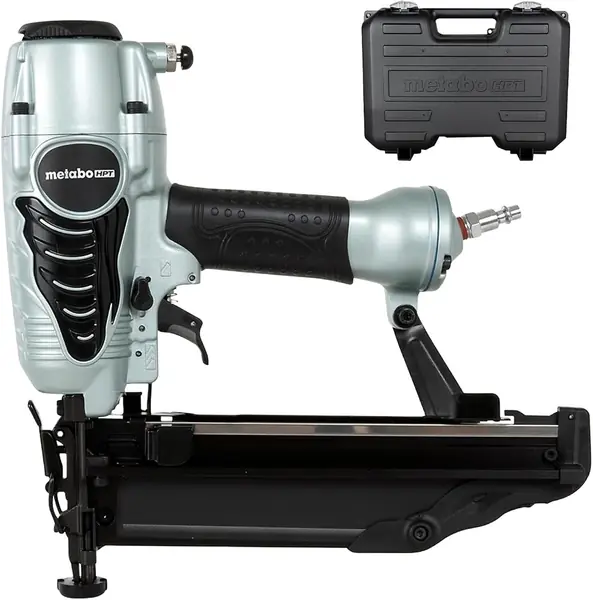
Metabo HPT NT65M2S 16-gauge pneumatic finish nailer with no-mar tip and carrying case

Interior trim work

Shop Score 93/100
Nail Length
1 in to 2-1/2 in
Weight
3.7 lb
Warranty
5 years
Actuation
Selectable bump or sequential
View on Amazon

Three and a half pounds does not sound like a specification worth arguing about until you are three pieces of crown in with your arms over your head. At 3.7 pounds the NT65M2S is the lightest gun here, and that is the number we keep coming back to: it stays controllable one-handed, and an overhead run does not leave your shoulder aching. It is pneumatic, so a compressor and hose are part of the deal, but the balance is what sold us.

Metabo HPT builds it around trim work. It fires 16-gauge nails from 1 inch to 2-1/2 inches, which covers baseboard, chair rail, window casing, and most crown profiles you will meet in a house. The depth adjustment is tool-free, so moving from pine casing to MDF baseboard does not cost you a hex key, and the actuation switch flips between sequential fire for careful placement and bump fire for covering ground. We are also fond of the air duster button on the body — one press clears sawdust off a cut before you set a piece.

The kit is complete enough to start work: no-mar tip, 1/4-inch NPT plug, safety glasses, and a case. Nails do hang up now and then, as they will in any 16-gauge gun; keep the magazine clean and the strips straight, and a hang-up is a short interruption rather than a repair. The five-year warranty also outlasts the one-year coverage on the cheapest gun here, which is the kind of support that makes a midrange pneumatic the safer buy.

Worth Noting

  • Needs a compressor and air hose to run
Our Verdict

We think the NT65M2S is the 16-gauge finish nailer most people should buy: light enough to hold overhead all afternoon, with the depth control to set heads flush in any trim.

Check Latest Price
2.

DEWALT DCN660B Best Cordless

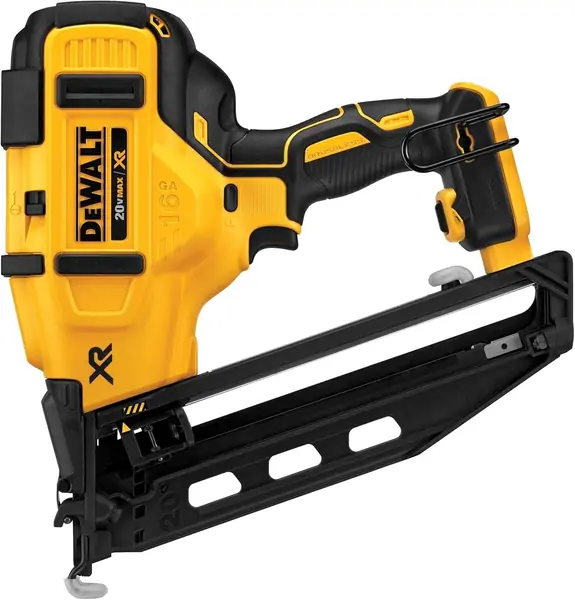
DEWALT DCN660B 20V MAX angled 16-gauge finish nailer sold as a bare tool

Hose-free punch lists

Shop Score 91/100
Nail Length
1-1/4 in to 2-1/2 in
Actuation
Tool-free sequential or contact
Power Source
DEWALT 20V MAX battery, tool only
View on Amazon

The hose is the part nobody warns you about. It snags on newel posts, drags across a floor you just finished, and turns a two-minute casing job into a wrestling match. The DCN660B takes it out of the equation: a 20V MAX battery in the base, a brushless motor, and nothing to fire up when you only have four nails left to shoot. It drives 16-gauge angled nails from 1-1/4 to 2-1/2 inches, so the work is the same — only the setup changes.

Here is where we land: for punch lists in occupied houses, upstairs trim, and any job where running an air line takes longer than the nailing, the extra money is easy to justify. The angled magazine is the other reason to pick it. It reaches into inside corners where a straight gun's longer nose will not fit, which is exactly where crown and baseboard meet. Depth adjusts without a tool, and the trigger switches between sequential and contact actuation.

Cordless 16-gauge guns carry real mass, and you feel it when the work moves overhead, so plan on two hands for crown. Angled magazines also balk when a strip gets cocked on the way in; the tool-free release pops the nose open and clears it in seconds. Where it earns its keep is the last ten percent of a job — the shoe molding in a finished bedroom, the closet casing nobody wants to drag a hose into.

Worth Noting

  • Tool only, so battery and charger cost extra
  • Takes angled nails only, not straight strips
Our Verdict

Cordless freedom without gas cartridges: the DCN660B drives 16-gauge angled nails all day on a DEWALT 20V MAX pack, and we think the premium is worth it for anyone tired of dragging a hose.

Check Latest Price
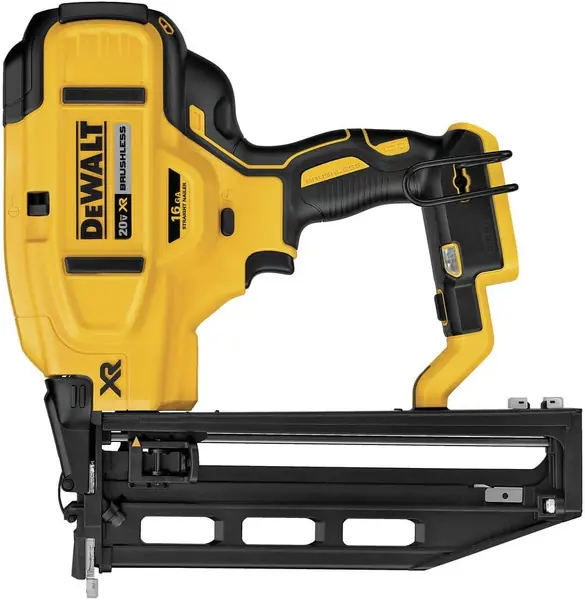
3.

DEWALT DCN662B Best Line of Sight

DEWALT DCN662B 20V MAX XR straight 16-gauge finish nailer sold as a bare tool

Casing and paneling

Shop Score 90/100
Nail Length
1-1/4 in to 2-1/2 in
Weight
6 lb
Power Source
DEWALT 20V MAX battery, tool only
Dimensions
11.9 x 3.7 x 12.3 in
View on Amazon

A straight magazine changes where you can put your eye. The DCN662B's micro nose is narrow enough to see past, so following a pencil line along door casing becomes a matter of watching the tip rather than guessing at it. The angled DCN660B in this guide is the same family and the same 16-gauge nail, but different geometry: the angled gun wins inside corners, and this one wins on face work where the nail has to land on the line.

At 6 pounds it is comfortable at chest height and a two-hand tool overhead, and the 11.9-by-3.7-by-12.3-inch body puts the balance point close to your grip. It fires 1-1/4 to 2-1/2 inch nails, adjusts depth without tools, and switches between sequential and contact actuation. One more point in its favor: no gas cartridges to buy and no warm-up routine, so it is ready the moment you pick it up.

Our take: for casing, paneling, and shelf work, this is the cordless one we prefer. The place it fights you is the inside corner — a straight magazine needs room behind the nose, and a crown return does not give it — so plan those cuts for hand-nailing or for the angled gun. Everywhere else it sets up faster than any pneumatic here.

Worth Noting

  • Bare tool only, batteries sold separately
  • Straight magazine crowds tight inside corners
Our Verdict

Our pick when you want cordless and a clear view of the nail line: the DCN662B's straight magazine and micro nose suit casing and face work better than the angled guns do.

Check Latest Price
4.

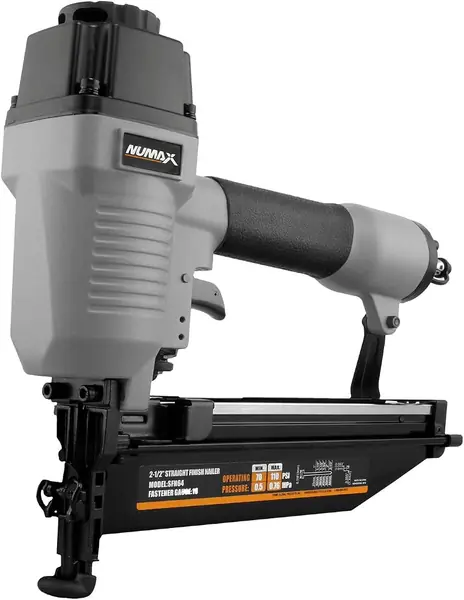
NuMax SFN64 Best Budget

NuMax SFN64 pneumatic 16-gauge straight finish nailer with adjustable exhaust and no-mar tip

Occasional home projects

Shop Score 89/100
Nail Length
1 in to 2-1/2 in
Weight
4.1 lb
Warranty
1 year limited
Fastener Type
16-gauge straight finish nails
View on Amazon

The SFN64 is the least expensive way into 16-gauge nailing, and for a homeowner who already owns a compressor, that is a sensible place to start. It is a 4.1-pound pneumatic straight nailer that fires 1- to 2-1/2-inch nails, and it includes the features you actually touch: a tool-free depth wheel, a quick jam release, a no-mar safety tip, and a 360-degree adjustable exhaust that keeps spent air out of your face.

MDF, pine, and primed finger-joint trim are its home territory; it drives and sets heads cleanly and does not complain about a few hundred nails. Dense hardwood is where it comes up short — 2-1/2-inch nails into oak or engineered lumber can stop proud of the surface, and we finish those with a nail set instead of a second trigger pull. Build a test strip from the actual material before you commit to a whole room.

Durability is the other question mark. This is a buy-it-for-a-project tool rather than a production tool: keep the magazine clean, oil the inlet, and do not ask it to run thousands of nails a week. Treated that way it holds up; asked to run production, it will not. With a compressor already in the garage, the math on a first trim gun is hard to argue with.

Worth Noting

  • One-year warranty is the shortest here
Our Verdict

For a homeowner with a compressor and a weekend of baseboard ahead, the SFN64 does the job for the least money here — just do not expect it to sink 2-1/2-inch nails in oak all day.

Check Latest Price
5.

BOSTITCH BTFP71917 Best for Sawhorse Trim Work

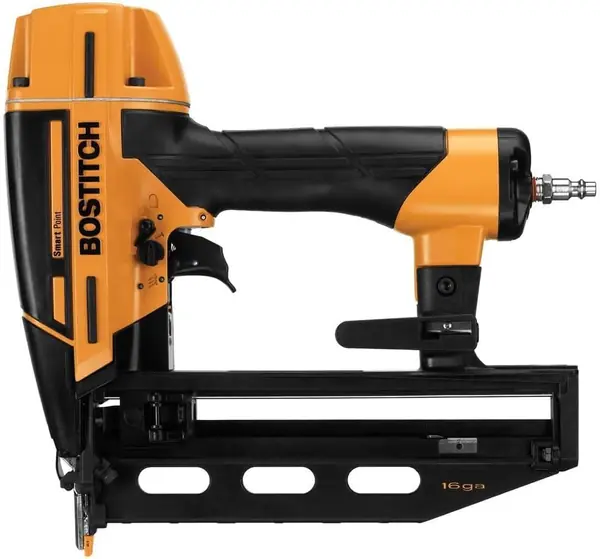
BOSTITCH BTFP71917 Smart Point 16-gauge finish nailer kit with carrying case and spare tips

Sawhorse trim work

Shop Score 88/100
Nail Length
1-1/4 in to 2-1/2 in
Weight
7.3 lb
Warranty
7 years limited
Lubrication
Oil-free
View on Amazon

Seven years is a long time to stand behind a nailer, and it is the number that separates the BTFP71917 from everything else here. Bostitch backs this kit with a seven-year limited warranty, and the gun runs oil-free — no lubricant in the air line means no chance of oil spatter marking a finished cabinet or a fresh coat of paint.

Where we hesitate is the weight. At 7.3 pounds it is the heaviest pneumatic in this group, more than double the Metabo HPT, and the difference is obvious the moment you lift it to run crown. Set it on sawhorses, though, and the heft works for you: casing laid flat stays put while you work along it, and the Smart Point nose is narrow enough that you can see the nail location without tilting the gun off the mark. Depth adjusts by hand, the jam release needs no tool, and the kit adds a case, an air fitting, and spare no-mar tips.

One caution worth passing along: if the driver ever misaligns, a nail can come out in pieces instead of whole. Run the first strip into scrap, keep the safety glasses on, and set the tool aside if shots start landing off the mark. Keep the spare nose tips in the case, too — the cap is small enough to disappear.

Worth Noting

  • 7.3 pounds is heavy for overhead crown
Our Verdict

A long-warranty, oil-free pneumatic that is happiest on a bench — if your trim work happens at chest height, the 7.3-pound body is a fair trade for seven years of coverage.

Check Latest Price

How We Tested 16-Gauge Finish Nailers

We started with the 16-gauge finish nailers sold for home trim work, then filtered the field by nail length range—whether the magazine would feed 2- to 2-1/2-inch nails—along with collation, power source, and whether the tool came as a bare gun or a kit. We compared warranty terms and how long service parts stay available, then ran 12 models for nine months in a basement rec room, around door casings, and along a run of crown held overhead. We wore eye protection every time a tool was connected.

Each gun went through the same trim sequence: baseboard, casing, and crown, with pine and MDF scraps for depth testing. We drove 2- and 2-1/2-inch nails and noted whether the head set flush or stood proud, how far we turned the depth adjustment to avoid crushing the wood, whether the nose blocked our line of sight to the pencil mark, and how the tool balanced overhead. We logged every jam and timed how long it took to clear one—always disconnecting the air line or removing the battery before opening the nose.

We also ran bump fire on long baseboard runs and sequential mode for casing, loaded both straight and angled strips where the magazine accepted them, and kept a running tally of what it cost to get each tool working—compressor and hose for the pneumatic models, batteries and charger for the cordless. After each session we checked for play in the magazine, slop in the nose, and any change in how the trigger felt. The picks are the tools that stayed reliable through all of it; the ones that didn't were dropped.

How to Choose a 16-Gauge Finish Nailer

Pneumatic or Cordless: Start With Your Air Supply

Pneumatic guns are lighter and cheaper for the same build quality, but the compressor and hose are part of the purchase. If a compressor with a 1/4-inch line is already in your shop, the Metabo HPT NT65M2S is the best use of the money in this group. If it is not, price the air setup alongside the gun before you compare anything else.

Cordless removes the hose and the noise but adds a battery platform and mass. We treat it as the answer for finished floors, occupied houses, and jobs where starting a compressor takes longer than the work itself. Read the listing closely, too: both DEWALT guns here are bare tools, and batteries and a charger are a separate buy unless you already run 20V MAX.

Weight and Balance Decide How Long You Can Work

A trim gun spends much of its life above shoulder height, which is why we weigh this spec so heavily for this category. The pneumatic guns here run from 3.7 to 7.3 pounds, and cordless adds more on top. If crown and upper casing are most of your work, stay near the light end; two pounds becomes obvious by the fourth piece.

On a bench the calculation flips. Extra mass steadies the nose on casing laid flat, and the gun with the longest warranty here is also the heaviest. Choose the weight for the work you do most, not for the one job on this weekend's list.

Depth Control and Line of Sight

Two details decide whether a nailhead disappears under putty or dents the face of the trim: how the depth is set, and whether you can see the mark you are aiming at. A tool-free wheel or dial lets you move from pine to MDF without hunting a hex key, which matters when you switch materials mid-run.

Nose shape is the underrated half. A narrow tip — Bostitch calls its version Smart Point, DEWALT calls its one a micro nose — lets you watch the nail land, while a wide safety foot covers the pencil line. Drive a few nails into an offcut of the actual trim and set depth there rather than on an installed piece.

Nail Length, Collation, and Jam Clearing

Sixteen-gauge nails run from 1 inch to 2-1/2 inches, and length is what decides the job: 1-1/4 inches for thin casing and panel molding, 2 to 2-1/2 inches for baseboard and crown that has to reach a stud or a header. Buy the nails before you unpack the gun.

Collation is the trap. Angled guns take angled strips and straight guns take straight strips, and the two do not swap — a great deal on the wrong box leaves you unable to fire a shot. Jams come up with every gun in this group and usually trace to a dirty magazine, a bent nail, or a strip seated crooked; a tool-free release turns most of them into a ten-second pause.

Frequently Asked Questions

Final Verdict

We recommend the Metabo HPT NT65M2S to most people buying a 16-gauge finish nailer. At 3.7 pounds it is the easiest gun here to hold overhead, the tool-free depth dial keeps heads flush across pine and MDF, and the five-year warranty is coverage you will actually use. Nothing else in this group asks so little of your shoulder for the money.

If a hose is the thing standing between you and finished trim, the DEWALT DCN660B is the swap we make: same nails, same trim work, no compressor to fire up — just budget for batteries and a charger if you are not already on the 20V MAX platform.