↑↓ navigate ↵ open Esc close All results →

Best Pneumatic Nail Guns of 2026

Every pneumatic nail gun works within two hard limits: the exact fastener gauge or collation angle it accepts, and the airflow your compressor can sustain at working pressure. Match both cleanly and trim, framing, or roofing moves with one-handed precision; miss either and you spend the afternoon pulling bent shanks, patching double-fires, or driving proud heads home with a hammer.

Testing a dozen nail guns over eight months across casing, crown molding, a framed wall, shed shingles, and tight closet cabinetry highlighted how rapidly balance and jam resistance outweigh sticker price. A gun that outruns its air tank leaves fasteners half-set, while a nose heavy at shoulder height wears down accuracy by the twentieth board.

Spanning 18-gauge brad nailers, 15-gauge angled finish guns, framing stick nailers, and coil roofers, the seven models ahead match common fasteners with consistent, clean drives.

Our Top Picks

The Best Pneumatic Nail Guns

1.

BOSTITCH Smart Point 18-Gauge Brad Nailer (BTFP12233) Best Overall
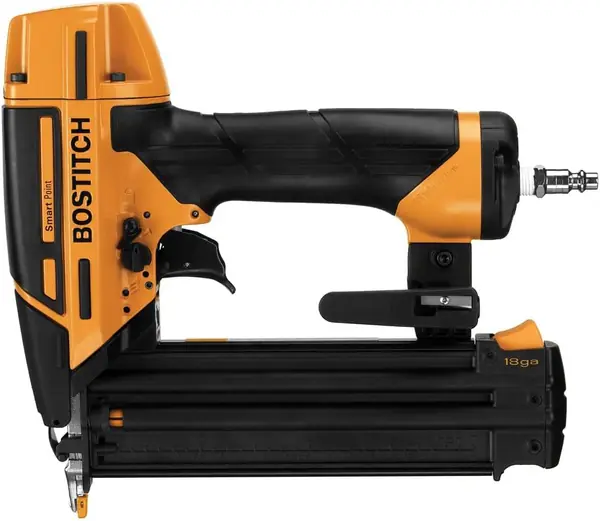
BOSTITCH Smart Point 18-gauge pneumatic brad nailer with no-mar tips and carrying case

Trim and molding

Shop Score 97/100
Weight
5.16 lb
Nail Range
5/8 in. to 2-1/8 in., 18 gauge
Warranty
7-year limited
Lubrication
Oil-free
View on Amazon

Two and one-eighth inches is what decided this one for us. That is the longest brad in this group, an eighth more reach than the DEWALT or the Makita, and it is the difference between fastening a doubled casing and merely denting its face. The narrow Smart Point nose is the other half of the same idea: it puts the brad where you are looking instead of where the housing lets you.

The oil-free motor earns its keep on pale wood. Prefinished maple and white primed trim show every drop that leaves an exhaust port, and this gun does not put one there. The spare no-mar tips in the case protect the surface, and the tool-free jam release is a latch you pop with a thumb, so a hung brad is a ten-second interruption rather than a walk back to the truck for a hex key.

Seven years is the longest warranty on this page, well past the three- and five-year terms on the Makita and Metabo guns, and it is the reason this one stays bolted to our bench while the rest get lent out. Set the depth on a scrap of your actual trim, load a full stick, and it will run a whole house of casing without asking for anything.

Worth Noting

  • Heaviest 18-gauge gun here at 5.16 pounds
Our Verdict

This is the brad nailer we tell most people to buy: the longest fastener range here, an oil-free motor, and seven years of coverage.

Check Latest Price
2.

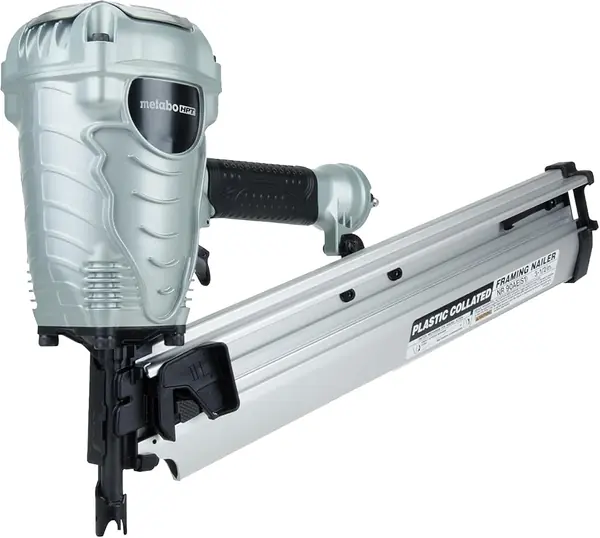
Metabo HPT NR90AES1 21-Degree Framing Nailer Best Framing Nailer

Metabo HPT NR90AES1 21-degree pneumatic framing nailer with included safety glasses

Framing and sheathing

Shop Score 96/100
Weight
7.5 lb
Nail Range
2 in. to 3-1/2 in., 21-degree plastic collated
Warranty
5-year
Actuation
Selective sequential or contact
View on Amazon

Seven and a half pounds is the frame of reference for everything else here. A framer gets carried at chest height for hours, so the pound and a bit this gun saves over the 8.6-pound NuMax is not a spec-sheet nicety; it is the difference between finishing the sheathing before the light goes and coming back in the morning.

The selective actuation switch is the feature we reached for most. Sequential fire while you are setting a truss, contact fire once the wall is flat and the pace matters, and one flip between them. Depth adjusts tool-free at the nose, the head guard comes off for clearing, and the five-year warranty is the longest of any framer on this page. Fed a steady 90 PSI it sinks 3-inch nails flush all afternoon.

The one thing we would have a pro test-drive is the nose safety. It is built to keep the tip planted on the work, which rules out some of the high-nail work an older gun lets you do; for a homeowner sheathing a garage or nailing off a deck, that guard is exactly what you want between you and a 3-1/2-inch nail. Plastic collation throws chips, so wear the glasses that come in the case.

Worth Noting

  • Ships without a rafter hook
Our Verdict

We hand this framing nailer to anyone sheathing a wall or building a deck: 7.5 pounds, a five-year warranty, and a trigger you can switch mid-job.

Check Latest Price
3.

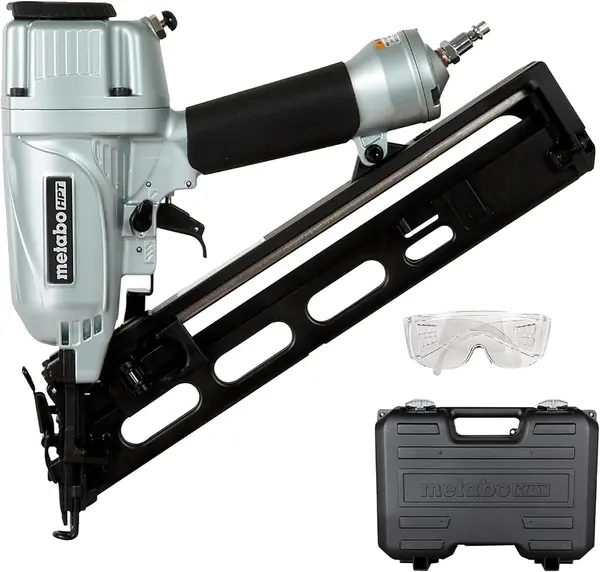
Metabo HPT NT65MA4 15-Gauge Angled Finish Nailer Best for Crown Molding

Metabo HPT NT65MA4 15-gauge angled finish nailer in blue with no-mar tip and case

Crown and casings

Shop Score 95/100
Weight
4.2 lb
Nail Range
1-1/4 in. to 2-1/2 in., 15-gauge angled
Warranty
5-year
Magazine
100 fasteners
View on Amazon

An angled magazine is the entire argument. Cant the clip away from the work and the nose sits square in an inside corner, so a crown return or a stair nosing gets its nail without your knuckles fighting the wall. We reach for this one before any straight-magazine finish gun for exactly that reason.

The rest is trim-gun housekeeping done well. It takes 1-1/4- to 2-1/2-inch 15-gauge angled DA nails, 100 to a stick, and the 4.2-pound body is light enough to hold at the end of a long run of crown. The air duster button blows sawdust out of a glue joint before you fire, the exhaust turns through 360 degrees so it is not blowing in your face, and the trigger switches between sequential and contact fire.

It will not replace a brad nailer for small work: a 15-gauge head is visibly bigger on narrow picture-frame stock, and the brad gun handles that. Keep a box of the correct DA angle on the shelf before you start a job rather than hunting for one mid-run. Where the two overlap, the brad gun does the small stuff and this one carries anything that has to hold weight.

Worth Noting

  • Takes 15-gauge angled DA nails only
Our Verdict

For crown, stair treads, and anything that meets at an angle, we reach for this 15-gauge gun before a straight-magazine nailer.

Check Latest Price
4.

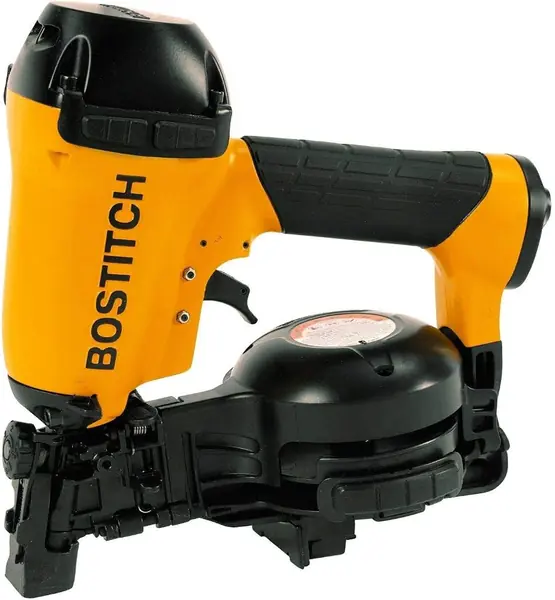
BOSTITCH RN46 Coil Roofing Nailer Best Roofing Nailer

BOSTITCH RN46 coil roofing nailer with aluminum housing and side-loading nail canister

Shingle roofing

Shop Score 94/100
Weight
5.8 lb
Nail Range
3/4 in. to 1-3/4 in. coil roofing
Warranty
1-year
Drive Force
410 in.-lb. at 100 psi
View on Amazon

Roofing is the one job here where the nailer sets the pace rather than following it. The RN46 fires on contact trip at up to 100 nails a minute and puts 410 in.-lb. of force behind each one at 100 psi, which is the number that decides whether you are still on the roof at dusk.

The details are the ones a roofer actually needs. An integrated tool-less gauge holds shingle exposure so courses stay even without chalking every line, a side-loading canister opens on one hinge for reloading out of a bundle, and a dry-fire lockout stops the gun before an empty shot damages the driver. Aluminum housing, aggressive wear guards, and skid pads are there because roofing eats tools.

What we like most is how it turns a roof into a rhythm instead of a series of decisions: bounce the nose, seat the shingle, slide down the course. We set the depth on the first square and never thought about it again, which is the highest compliment we can pay a tool that has to be used at that height. It is a specialist, and it behaves like one.

Worth Noting

  • One-year warranty is the shortest here
  • Coil roofing nails only up to 1-3/4 inches
Our Verdict

For shingles, this is the coil roofer we point to: 100 nails a minute, a built-in exposure gauge, and one-door reloading.

Check Latest Price
5.

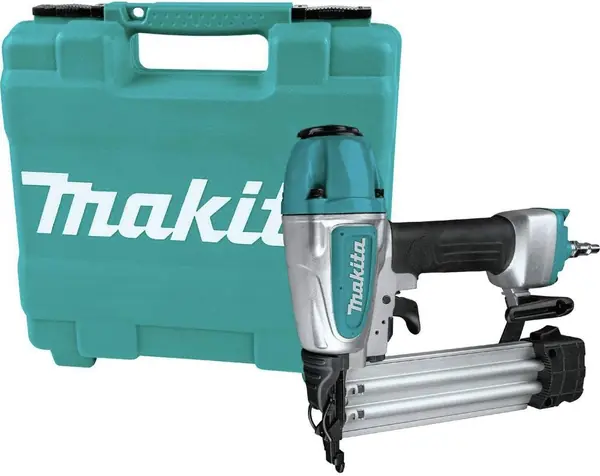
Makita AF506 18-Gauge Brad Nailer Best for Tight Spaces

Makita AF506 18-gauge brad nailer in teal with no-mar tips and tool case

Cabinet and closet work

Shop Score 93/100
Weight
2.86 lb
Nail Range
5/8 in. to 2 in., 18 gauge
Magazine
100 nails
Operating Pressure
70 to 120 PSI
View on Amazon

A narrow nose is worth more than it looks on a spec sheet. Nailing the inside of a cabinet carcass or the frame of a closet, the housing is what stops you, not the nail, and the AF506's nose is slim enough to sit between two shelves and still put the brad on the pencil mark. The cast and machined nose piece keeps it square against the work.

The feature we did not expect to use every time is the air duster. Press the button and the port blows sawdust off a glue line before you fire, which saves the forearm wipe and a step on every joint. It runs from 70 to 120 PSI, so a small compressor is not a problem, and the 100-nail magazine means fewer reloads in the middle of a run of shoe molding.

Two things to know before you load it. On hard maple the depth dial sometimes wants another click or two before a 2-inch brad sits flush, so run a test piece from the same board you are nailing. And the three-year warranty is the shortest of the trim guns on this page, which is fine for a cabinet maker and less comfortable for a gun that rides in a truck every day.

Worth Noting

  • Tops out at 2-inch brads
Our Verdict

We keep the AF506 for cabinet interiors and closet frames, where the narrow nose and built-in blower save a step.

Check Latest Price
6.

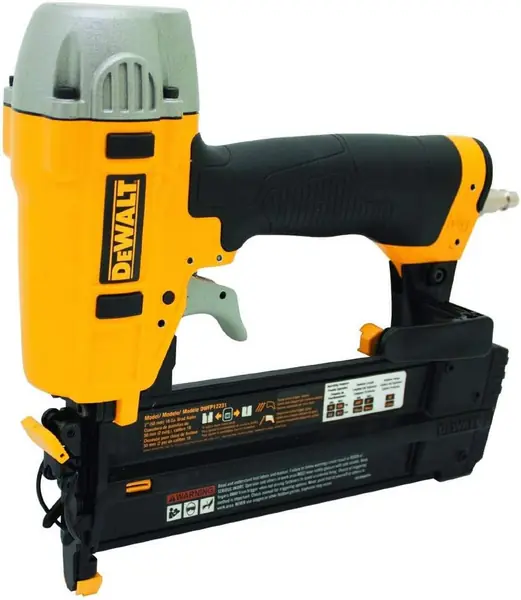
DEWALT DWFP12231 18-Gauge Brad Nailer Kit Best for Overhead Trim Work

DEWALT DWFP12231 18-gauge brad nailer kit in yellow with hard carrying case

Overhead trim work

Shop Score 92/100
Weight
2.65 lb
Nail Range
5/8 in. to 2 in., 18 gauge
Included
Carrying case and 1/4 in. fitting
Depth Adjustment
Tool-free, with detents
View on Amazon

2.65 pounds is the number. It is the lightest brad nailer here, near enough half the BOSTITCH, and it is why this is the gun that goes up the ladder and over a head for the last hour of a trim job. The rear exhaust helps too: air blows back over your wrist instead of across wet paint.

The rest is straightforward: 18-gauge brads from 5/8 inch to 2 inch, a tool-free depth wheel with detents, a tool-free jam release at the nose, and a hard case with a 1/4-inch fitting. We like detents better than a free-spinning dial, because you can find yesterday's setting by feel instead of hunting for it on the first piece of the day.

Two limits. It stops at 2-inch brads, so anything thicker than 3/4-inch stock wants the BOSTITCH or a 15-gauge gun. And the detents that make the depth wheel handy still need a scrap of your actual trim to dial in, since an 18-gauge head sits differently in pine than in oak. Work that scrap first and the rest of the job is boring, which is what you want.

Worth Noting

  • Long-term durability is the weak spot
Our Verdict

The lightest brad nailer in this set at 2.65 pounds, and our pick for anyone nailing trim over their head.

Check Latest Price
7.

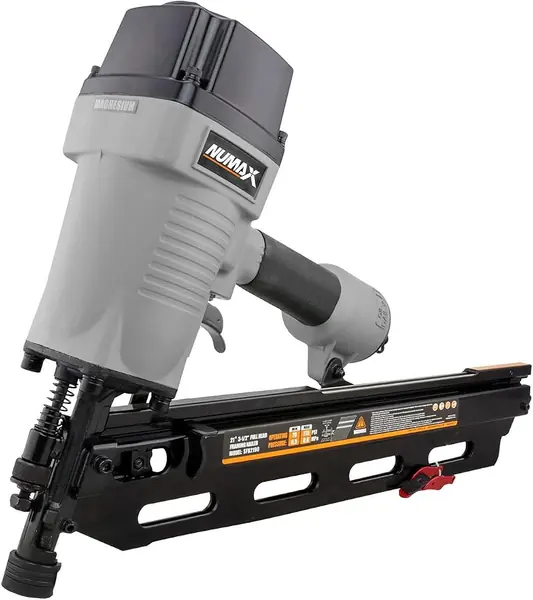
NuMax SFR2190 21-Degree Framing Nailer Best for DIY Framing

NuMax SFR2190 21-degree framing nailer with hardened steel drive blade and adjustment tools

DIY framing

Shop Score 91/100
Weight
8.6 lb
Nail Range
2 in. to 3-1/2 in., 21-degree full round head
Firing Modes
Sequential or bump fire
Air Requirement
2.5 CFM at 90 PSI, 3-gallon tank
View on Amazon

The most useful line on this nailer's box is the compressor spec: 2.5 CFM at 90 PSI and a tank of at least 3 gallons. A one-gallon hot dog will fire a dozen nails and then start leaving heads proud, and that is a compressor problem people blame on the gun. Check yours before you order, and check the CFM rating rather than the tank size alone.

What you get for a framing-nailer budget is a full-size tool: 21-degree plastic collated full round heads from 2 to 3-1/2 inches with a 0.113- to 0.131-inch shank, a dual-mode trigger with both a sequential and a bump-fire trigger in the box, an anti-dry-fire mechanism that protects the drive blade when a stick runs out, tool-free depth, and a 360-degree exhaust.

Fed steady pressure it does real work. Three-inch nails sink flush, 3-1/2-inch ring shanks hold on a deck, and it will rattle through a basement's worth of framing in a weekend. It also carries the shortest coverage here, a one-year term with a 30-day wearable-parts window, which is the honest signal about where this tool sits in the market.

For a shed, a deck, or a basement build-out, we think the savings are worth it: the gun finishes the job and you have money left for nails. For a crew running a framer eight hours a day, the Metabo's five-year warranty is the better arithmetic, and the difference in fatigue shows up by Thursday.

Worth Noting

  • Heaviest tool here at 8.6 pounds
  • Jams on the last nails in a stick
Our Verdict

We point DIY framers here: it does the work of the Metabo for less, as long as your compressor can hold 90 PSI.

Check Latest Price

How We Chose and Tested Pneumatic Nail Guns

We built the shortlist the way a shopper with a project would, sorting guns by what they fire — 18-gauge brads for trim, 15-gauge angled finish nails for crown, plastic collated framing sticks, coil nails for shingles — then checking each one's rated pressure range and CFM demand against a compressor we would actually run it on. A gun without a depth-of-drive adjustment didn't make the cut.

Twelve guns came through the shop over eight months. They trimmed a doorway and framed a wall in the garage, hung crown and casings in a dining room, laid shingles on a shed roof, and fit between a shelf and a wall in a closet. We weighed each one on a kitchen scale, then hung it from a hook at shoulder height to feel how the balance shifted overhead.

Every gun ran at the bottom and top of its rated pressure, and we drove twenty nails in a row into scrap poplar and oak to see whether depth of drive held or wandered. Jam clearance started with the air line off and the hose bled every time; we timed how long it took and noted whether the nose opened without tools. We also watched for dry-fire, double-fires, and oil spitting onto the work.

Accuracy got its own pass: we marked a line on a board and checked where the heads actually landed. On guns with both trigger modes we switched between sequential and bump fire, pressed no-mar tips against prefinished cabinet stock, and read the warranty and the box contents before calling anything a pick. Impact-rated eye protection stayed on for every shot.

How to Choose a Pneumatic Nail Gun

Start With the Nail, Not the Gun

Gauge is diameter, and the fastener your work needs sets the gun you buy. An 18-gauge brad is a thin wire for trim, casing, and light assembly. A 15- or 16-gauge finish nail is thicker and holds baseboard or a door casing that gets bumped. A 21-degree framing nail is a 0.113- to 0.131-inch shank for structure. A 2-inch brad will not hold a stair tread, and no amount of depth adjustment fixes that.

Expect two guns eventually. The trim carpenter's pair is a brad nailer plus a 15- or 16-gauge finish nailer, one for the small stuff and one for anything carrying weight. Our top pick covers the first job, and the angled Metabo NT65MA4 covers the corners the second one reaches.

Match the Gun to Your Compressor

This is where most framing nailers disappoint their new owners. A small pancake compressor holds enough air for trim work, where you fire slowly between placements, and runs dry when you bump-fire 3-inch nails into a wall. The NuMax framer states its demand plainly: 2.5 CFM at 90 PSI and a tank of at least 3 gallons.

Check two numbers before you buy: the gun's pressure range, which runs from 70 to 120 PSI on the Makita AF506, and your compressor's CFM at 90 PSI. If the compressor's CFM sits below the gun's requirement, you get half-driven nails and a nailer that takes the blame for it.

Weigh It at Shoulder Height

Weight spans 2.65 pounds on the DEWALT brad nailer to 8.6 pounds on the NuMax framer, and the number matters in proportion to how long the tool is above your chest. For crown, ceiling trim, and cabinet uppers, weight is the first spec we check; a pound saved is worth more than a feature you use twice.

For framing the math flips. At 7.5 pounds the Metabo NR90AES1 already counts as light for a tool that drives 3-1/2-inch nails, and a lighter body usually means less capacity or a shorter stick. Balance in your hand tells you more than the scale does, so handle one before you commit if the store allows it.

Depth Control, Jams, and the Trigger

Tool-free depth adjustment is standard now, and the mechanism is what separates the good ones. A detented wheel like the DEWALT's returns to a setting you used yesterday; a free-turning dial has to be rediscovered on every piece. Tool-free jam release matters for the same practical reason: a hung brad at the top of a ladder is either a two-minute fix or a twenty-minute one.

Then there is the trigger. Sequential fire needs a deliberate press against the work for every nail, and it keeps placement honest. Contact, or bump, fire lets you bounce the nose along the surface and fire on contact. Stay in sequential for finish work until the piece is clamped and the depth is proven; bump fire on trim is how shiners end up in a face frame.

Noses, Tips, and the Scrap Test

A narrow nose and a soft tip are what keep a finish gun from leaving a crescent in the wood, and every trim nailer on this page ships with at least one no-mar tip. The narrowest nose here belongs to the Makita AF506, which is the one to reach for when the work is inside a cabinet rather than on a wall.

Before you touch the good piece, drive ten nails into a scrap of the exact trim you are installing. Depth, marring, and splitting all show up in that scrap and nowhere else, and a brad that sinks flush in pine can stand proud in oak.

Frequently Asked Questions

Final Verdict

The BOSTITCH Smart Point is the pneumatic nail gun we tell most people to buy. It fires the longest brad in this set, runs oil-free over prefinished trim, and carries a seven-year warranty nothing else here matches, all at about the same money as the plainest gun on the page.

If your project is structure rather than trim, the Metabo HPT NR90AES1 framing nailer is the pick at 7.5 pounds. And where the work is above your head all afternoon, the DEWALT earns its place on weight alone at 2.65 pounds.