↑↓ navigate ↵ open Esc close All results →

Best Nail Guns of 2026

A nail gun works best when it stays out of your way, yet every job forces a trade-off between cordless freedom and pneumatic punch. Compressor-driven nailers run all day off an existing shop tank, while battery models give up a touch of compact balance to work inside closets or up on a roof without dragging an air hose behind you.

Testing 12 nailers over nine months across trim, framing, and roofing shingles highlighted how fast poor depth control shows up — either cratering soft casing or leaving heads proud — alongside whether clearing a jam takes a hex key or a single thumb latch. Beyond power source, gauge and fastener range settle most buying debates, since an 18-gauge brad cannot replace a structural connector and a framing nailer will split finish trim on impact.

Spanning delicate pin-and-brad trim up to heavy framing and roofing, all eight models share a compact nose profile built to reach tight corners cleanly.

Our Top Picks

The Best Nail Guns

1.

BOSTITCH BTFP12233 Smart Point Brad Nailer Best Overall
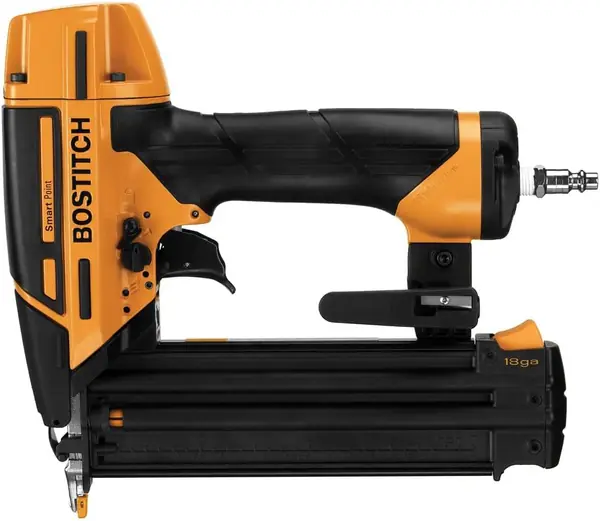
Bostitch Smart Point 18-gauge pneumatic brad nailer with carrying case and no-mar tips

Trim and molding

Shop Score 97/100
Fastener Range
5/8 to 2-1/8 in
Nail Gauge
18
Power Source
Pneumatic
Warranty
7-year limited
View on Amazon

Trim work is where a brad nailer earns its keep, and the Smart Point nose is why this one comes out of the case first. The nose is small enough to set against a casing edge while you still see the spot the brad will hit, which is the difference between a clean pin line and a nail that blows out the corner of a molding profile.

That nose, plus a 5/8- to 2-1/8-inch range, makes this the one nail gun we recommend to a buyer who wants a single tool for trim. It reaches through baseboard, crown, shoe molding, and paneling, and the extra eighth of an inch over the other pneumatic brad nailers here means a thicker assembly is still fair game. The oil-free motor matters more than the spec suggests: nothing sprays onto the wood, so a finished cabinet or a painted casing does not need a wipe-down after you fire.

The small touches are thought through too, including spare no-mar tips in the box and a belt hook with a pencil sharpener worked into it, the kind of thing you appreciate three rungs up a ladder. On paper it carries the heaviest listed weight of the pneumatic brads here at just over five pounds, and while it balances well enough that we stopped thinking about it, a ceiling's worth of crown is the one job where the DEWALT is the more comfortable tool.

Worth Noting

  • Pneumatic only so you need a compressor and hose
Our Verdict

Our pick for trim work: the Smart Point nose puts brads where you see them, and it has the cleanest record of any 18-gauge nailer here.

Check Latest Price
2.

Metabo HPT NR90AES1 Framing Nailer Best Framing Nail Gun

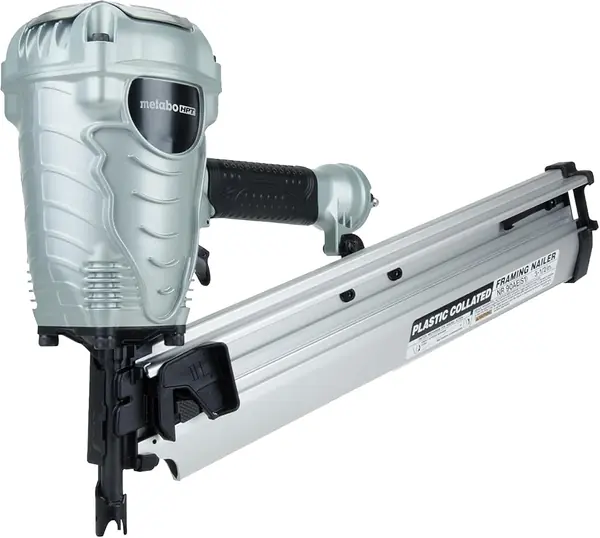
Metabo HPT NR90AES1 21-degree framing nailer with magazine and included safety glasses

Wall framing

Shop Score 96/100
Weight
7.5 lb
Fastener Range
2 to 3-1/2 in
Warranty
5 year
Nail Type
21-degree plastic collated
View on Amazon

Framing is the job on this list where weight decides how long you last, and at 7.5 pounds this is the lightest way here to drive a 3-1/2-inch nail. Reaching across a wall line or holding a stud with one hand, the gun stays steady without your wrist arguing with it — we noticed the difference at the end of a wall, not the end of a day.

It runs 21-degree plastic-collated nails from 2 to 3-1/2 inches, which covers wall framing, truss build-up, subfloor, roof decking, and sheathing. The selective actuation switch flips between sequential fire for placement and bump fire when you are laying down nails as fast as you can position the nose, and the tool-free depth dial goes from flush in sheathing to countersunk in a plate without hunting for an Allen wrench.

Plastic collation throws the occasional chip, and the safety glasses in the box are not a formality; we add a face shield for overhead work. The five-year warranty is generous for a tool that gets this dirty, and the redesigned head guard comes apart without tools when the driver needs cleaning.

Worth Noting

  • No rafter hook for hanging it on the frame
Our Verdict

If you are framing walls or sheathing a roof, this is the gun we hand you: 7.5 pounds, 3-1/2-inch nails, and no fight from the tool.

Check Latest Price
3.

Metabo HPT NT65MA4 Angled Finish Nailer Best Finish Nail Gun

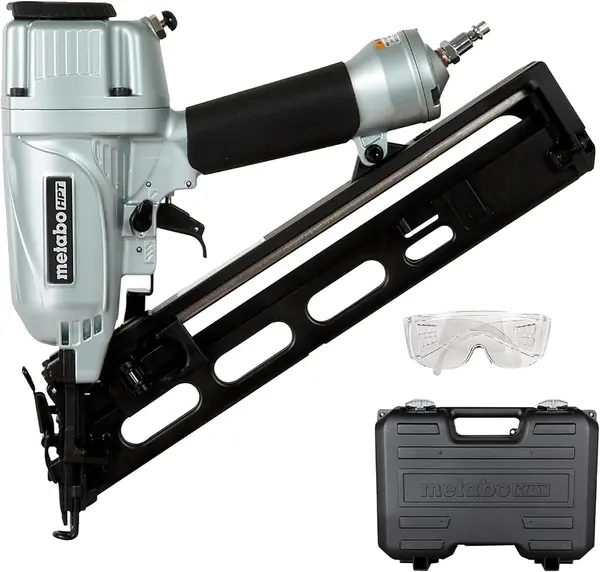
Metabo HPT NT65MA4 15-gauge angled finish nailer in blue with carrying case and no-mar tip

Crown and baseboard

Shop Score 95/100
Weight
4.2 lb
Fastener Range
1-1/4 to 2-1/2 in
Nail Gauge
15
Magazine Capacity
100 fasteners
View on Amazon

An 18-gauge brad is a pin; a 15-gauge finish nail is a fastener. The difference shows up the first time you hang crown on a ceiling that is not perfectly flat — the thicker shank and larger head hold the molding where you put it instead of letting it creep off the line overnight.

This Metabo drives 15-gauge angled DA nails from 1-1/4 to 2-1/2 inches, and the angled magazine is what matters in a room full of corners: the body sits away from the wall so the nose can meet an inside corner square, which we found matters more than raw power when you are fitting a cabinet return.

The details are aimed at finish work: a button that blows dust off the surface before you set a nail, a 360-degree exhaust you can point away from the work, and a 100-nail magazine that keeps reloads rare. The tool-free depth dial sinks a head just below the surface in pine and then backs off for oak, and selective actuation covers both placement and long runs.

Where it earns its slot is the job after the brad nailer: crown, thick baseboard, stair trim, exterior casings, anything that needs a nail with real holding power. If all of your trim is 18-gauge, this is money you do not need to spend yet; if you have watched a brad pull out of a miter, it is the upgrade that fixes the problem.

Worth Noting

  • Takes angled DA nails only and not straight strips
Our Verdict

For crown, baseboard, and anything that needs a nail with real holding power, the angled 15-gauge magazine on this Metabo is what we load.

Check Latest Price
4.

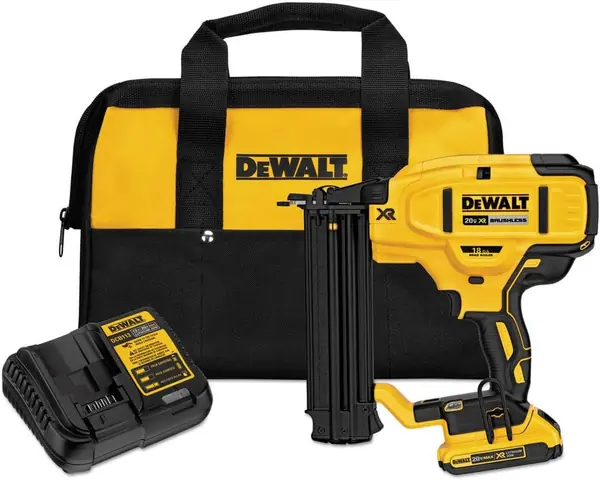
DEWALT DCN680D1 Cordless Brad Nailer Best Cordless

DEWALT 20V MAX cordless 18-gauge brad nailer in yellow with 20V battery

Cordless trim work

Shop Score 94/100
Weight
5 lb
Fastener Range
5/8 to 2-1/8 in
Nail Gauge
18
Power Source
20V MAX battery
View on Amazon

Cordless trim work changes the shape of a job. Instead of dragging a hose across a floor you just refinished, you carry the gun to the door casing, fire eight brads, and move on — and on a punch list spread across three rooms, that is most of the difference.

The DCN680D1 drives 18-gauge brads from 5/8 to 2-1/8 inches on a 20V MAX pack, with a micro nose, tool-free depth adjustment, and a tool-free jam release. The brushless motor is there for runtime as much as for power, and it fires with the same instant feel as a pneumatic — no ramp-up, no double taps.

Whether it is worth the premium comes down to one question: are you already on the 20V MAX platform? If you are, the batteries you own run it and this is the cordless trim gun we point you to. If you are not, the pack and charger stack on top of an already premium tool, and a pneumatic brad nailer with a small compressor still comes in cheaper — the trade you are making is hose-free convenience for a bigger upfront bill.

Worth Noting

  • Heavier than any pneumatic brad nailer here
Our Verdict

No hose, no compressor, no walk back to the outlet: this is the cordless brad nailer we take when the work is upstairs.

Check Latest Price
5.

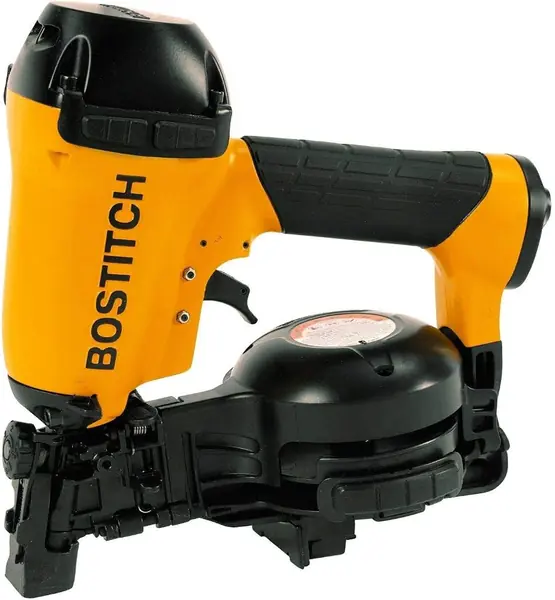
BOSTITCH RN46-1 Coil Roofing Nailer Best Roofing Nail Gun

BOSTITCH RN46 coil roofing nailer with side-loading canister and shingle gauge

Shingle installation

Shop Score 93/100
Weight
5.8 lb
Fastener Range
3/4 to 1-3/4 in
Warranty
1 year
Nail Type
Coil roofing nails
View on Amazon

Roofing is a different trade from trim, and the giveaway on this gun is the tool-less gauge on the nose: shingle exposure, not just nail depth, is what makes a roof look right and shed water. That gauge is why this is our roofing pick — it does a job that otherwise belongs to a tape measure and a chalk line.

The RN46-1 runs coil roofing nails from 3/4 to 1-3/4 inches out of a side-loading canister, and it fires on contact trip, which is how you actually work on a roof: bounce along the shingle and let the tool keep up. A zero-nail lockout stops it dry-firing when a coil runs out, carbide inserts in the nosepiece take the wear, and the aluminum housing and skid pads survive being set down on shingles all day.

At 5.8 pounds it is light enough to carry up a ladder with a bundle on your shoulder, and the one-door cover turns a reload into a five-second stop. Jams are the caveat: some coils run clean and others fight the magazine, so feed it the nails it was built around and keep the side cover clear of grit.

Worth Noting

  • One-year warranty is the shortest of these nail guns
Our Verdict

Nailing shingles rather than trim? The side-loading canister and the built-in exposure gauge make this our roofing recommendation.

Check Latest Price
6.

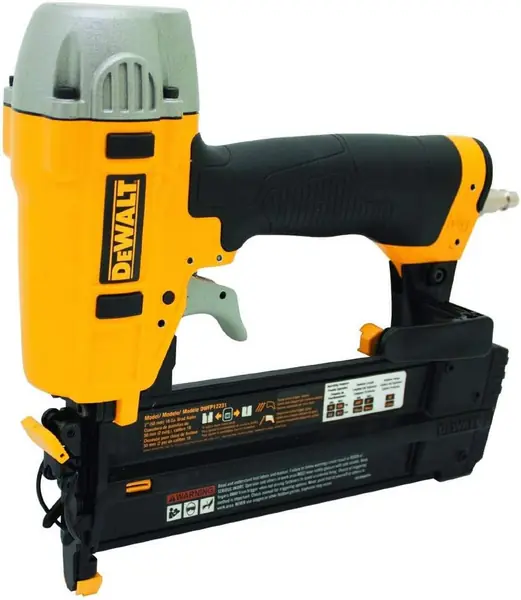
DEWALT DWFP12231 Brad Nailer Best for Overhead Trim Work

DEWALT DWFP12231 pneumatic 18-gauge brad nailer in yellow with hard carrying case

Overhead trim

Shop Score 92/100
Weight
2.65 lb
Fastener Range
5/8 to 2 in
Nail Gauge
18
Power Source
Pneumatic
View on Amazon

Exhaust is the detail nobody thinks about until a puff of oil mist lands on a cabinet face. This DEWALT sends it out the back rather than the side, which keeps the air away from the work and, up a ladder, away from your face.

The rest is a straightforward 18-gauge pneumatic: 5/8- to 2-inch brads, a tool-free depth dial with detents you can feel, and a tool-free jam release on the nose. At 2.65 pounds it is the lightest brad nailer here, and on baseboard that is the whole story — you can hold it at arm's length against a wall and keep your line straight.

Depth and jam clearing are the two adjustments you touch on every job, and both are tool-free. The nose latch opens without a hex key, which matters because every 18-gauge nailer eventually misfires on a bent brad or a strip that took on damp; the difference between a good tool and a frustrating one is how many seconds that costs.

Between this and the Bostitch, the choice is body versus nose. The DEWALT is lighter in the hand and blows exhaust away from the work; the Bostitch has the better sight line and the longer warranty. If most of your nailing happens overhead — casings, cabinet uppers, crown — the DEWALT is the one that leaves your arm fresher at the end of the day.

Worth Noting

  • Some units have failed at the trigger early on
Our Verdict

The lightest pneumatic brad nailer here, and the one we hand a first-timer who is spending a weekend up a ladder.

Check Latest Price
7.

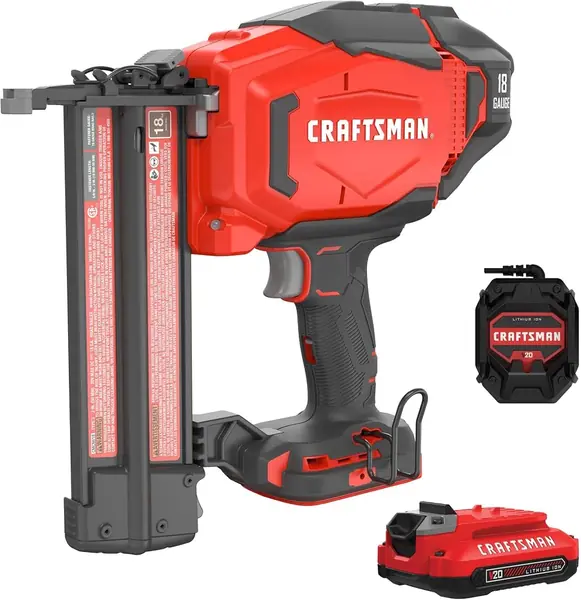
CRAFTSMAN V20 CMCN618C1 Cordless Brad Nailer Best Budget Cordless

CRAFTSMAN V20 cordless 18-gauge brad nailer in red and black with battery and charger

First cordless kit

Shop Score 91/100
Weight
7.6 lb
Nail Gauge
18
Power Source
V20 battery
Included
Battery and charger
View on Amazon

Going cordless is usually a two-part purchase: the tool, then a battery and charger that cost nearly as much again. This Craftsman kit skips the second part — the V20 pack and charger come in the box, which is what puts cordless trim work within reach of a weekend woodworker.

That kit math is why we kept it in the roundup. It drives 18-gauge adhesive-collated brads with tool-free depth and a tool-free jam-and-stall release, and the motor is rated to hold firing power across weather conditions — the difference between a cordless nailer that works in a cold garage and one that sulks.

Plan around jams: clean, straight strips and a magazine that is not overfilled go a long way. Battery life is fine for trim work, though this is not the tool you buy to run all day on a framing crew. What it is, is a complete cordless trim setup for someone who does not want to buy into a battery platform, at a price well below the DEWALT kit.

Worth Noting

  • 7.6 lb makes overhead trim a two-handed job
Our Verdict

The cordless brad nailer to buy when you are not on a battery platform yet, since the pack and charger come with it.

Check Latest Price
8.

Makita AF506 Brad Nailer Best for Detail and Corners

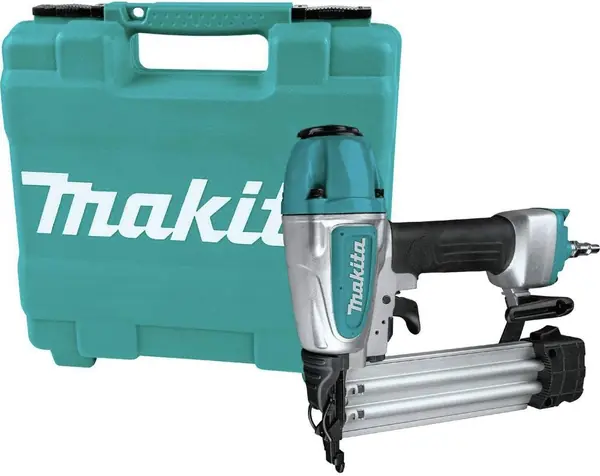
Makita AF506 18-gauge pneumatic brad nailer in teal with tool case and no-mar tips

Detail and corners

Shop Score 90/100
Weight
2.86 lb
Fastener Range
5/8 to 2 in
Nail Gauge
18
Magazine Capacity
Up to 100 nails
View on Amazon

There is a button on the side that fires a jet of compressed air, and it is the feature most shoppers scroll past. We used it constantly: a puff clears sawdust out of a miter joint or off a baseboard cap before the nose goes down, so you are not driving a brad through grit that keeps the joint from closing.

The rest is a light, narrow-nosed 18-gauge: 2.86 pounds in an aluminum body and magazine, a cast nose with a rubber no-mar tip that reaches into confined spots, a tool-free depth dial, and a magazine that holds up to 100 brads. It runs from 70 to 120 PSI, so a small pancake compressor has enough headroom.

We like it for detail work and for anyone who resents hauling a blow gun around the shop. Two things keep it behind the Bostitch: it stops at a 2-inch brad where the Bostitch takes 2-1/8, and it costs more. Depth is the setting to test first — run a few brads into scrap of the same species before you commit, because hardwood and pine want different numbers on the dial.

Worth Noting

  • Depth needs rechecking when you change wood species
Our Verdict

A light, well-mannered brad nailer with a built-in air duster that we reach for on detail work.

Check Latest Price

How We Tested Nail Guns on Trim, Framing, and Roofs

We started with every 18-gauge brad nailer, 15-gauge finish nailer, framing nailer, and roofing nailer we could find in stock, then narrowed by fastener range, power source, weight, and warranty. Anything whose magazine couldn't take the fasteners a given job called for was out; the 12 tools that survived went to a garage, a hallway, and a shed roof for nine months before we narrowed them to these eight picks.

They framed a partition wall, ran baseboard and shoe molding down a hallway, hung crown, and re-shingled that shed roof, with eye protection on for every shot and hands kept behind the magazine. We drove several hundred nails per tool into pine, poplar, and MDF, logging every jam and exactly what it took to clear it, and checking at each depth setting whether the head sat flush or dimpled the surface. Each one went on a kitchen scale, then overhead on a soffit to see how it handled one-handed.

Nose size got its own test: seated into inside corners and against a finished cabinet side, then the wood checked for crescent marks. We flipped between sequential and bump fire, held a scrap of prefinished trim near the exhaust to see where oil and air landed, and ran the pneumatics off a small pancake compressor to find which ones outran the air supply. Total cost meant adding the compressor, hose, batteries, and a box of nails to the sticker price.

How to Choose a Nail Gun

Start With the Fastener

An 18-gauge brad is for holding trim to a wall, a 15- or 16-gauge finish nail is for molding that has to stay put, a 21-degree framing nail is for structure, and a coil roofing nail is for shingles. Each is a different gun, and no single tool covers all four.

We check the length range before anything else, because it tells you what the tool can actually reach. The brad nailers here drive 5/8 to 2-1/8 inches, the finish nailers 1 to 2-1/2, the framing gun 2 to 3-1/2, and the roofing gun 3/4 to 1-3/4. If the nail your job needs falls outside that window, the tool is wrong no matter how good it is.

Air or Battery

Pneumatic tools are lighter, cheaper, and never run out of charge, but they are tethered to a compressor and a hose. The hose is the part that drags across a floor you just refinished and catches on every inside corner in the room.

Cordless costs several times as much for the same job and puts a battery's weight in your hand, but it goes where air does not: a second-floor bedroom, a rental, a punch list spread over an afternoon. We reach for cordless inside a finished house and for air in the shop. If you already own the battery platform, the math tilts toward cordless; if you own a compressor, put the difference into fasteners.

Weight, Balance, and Where the Nose Fits

Two pounds sounds trivial until it is at the end of your arm above your head. These picks run from 2.65 to 7.6 pounds, and the heavier end is fine on a bench and miserable on a ceiling. Think about the posture the job puts you in, not the number on the box.

Nose design matters just as much. A narrow cast nose with a no-mar tip lets you set a brad into a corner without denting the face you just finished, while a blunt nose with no tip pads leaves a mark on soft pine every time. On the roofing gun, the nose carries a shingle-exposure gauge, which is a different kind of useful.

Jams, Depth, and the Whole Setup

Every pneumatic nailer jams eventually, and the difference between a tool you tolerate and one you like is whether clearing it takes five seconds or a hex key. Tool-free nose latches and tool-free depth dials are worth paying for, and a depth detent you can feel saves a test shot every time you change material.

Then count the rest of the system: compressor, hose, fittings, and nails in the right collation — 21-degree plastic for framing, angled DA for 15-gauge finish, adhesive strips for the cordless brad nailers. The nailer is rarely the expensive half of the setup, but it is the half you keep the longest, so buy the one that matches the work you actually do.

Frequently Asked Questions

Final Verdict

For most people the Bostitch Smart Point is the nail gun to buy. It drives a 2-1/8-inch brad, sights as precisely as anything here, sprays no oil on finished wood, and carries the longest warranty in the group. Pair it with a small compressor and you are still into trim nailing for less than a cordless kit.

Two situations change the answer. If your nailing is mostly overhead inside a finished house, the lighter DEWALT pneumatic is the more comfortable tool, and if you are never going to own a compressor, the Craftsman kit is the least expensive way to cut the hose. Building something structural? None of the brad nailers apply — go straight to the Metabo framing gun.