↑↓ navigate ↵ open Esc close All results →

Best Nail Guns for Cabinets of 2026

Few surfaces advertise a sloppy fastener faster than a finished cabinet face. A brad that blows out the edge of a pine stile leaves a splintered scar paint cannot hide, while an overdriven nail punches a crater straight through the topcoat — leaving clean, flush placement right on the layout line as the entire job.

Running 12 nailers across 10 months of building face frames, hanging doors, and installing crown and chair rail in a garage shop and kitchens showed that gauge is the primary dividing line. An 18-gauge brad secures delicate casing and trim, whereas a 16-gauge finish nail carries heavier stock and joints subject to daily knocks, followed by the choice between air hose and battery power and what hardware ships in the box.

Tool weight is the spec most buyers skim past until holding a gun overhead one-handed on crown, though a basic pneumatic nailer kept near the bench trades hose management for zero charger downtime. Both shop-tethered air nailers and cordless trim units appear among these seven cabinet models, each suited to a different balance of tight access and mobility.

Our Top Picks

The Best Nail Guns for Cabinets

1.

Bostitch BTFP12233 18-Gauge Brad Nailer Best Overall
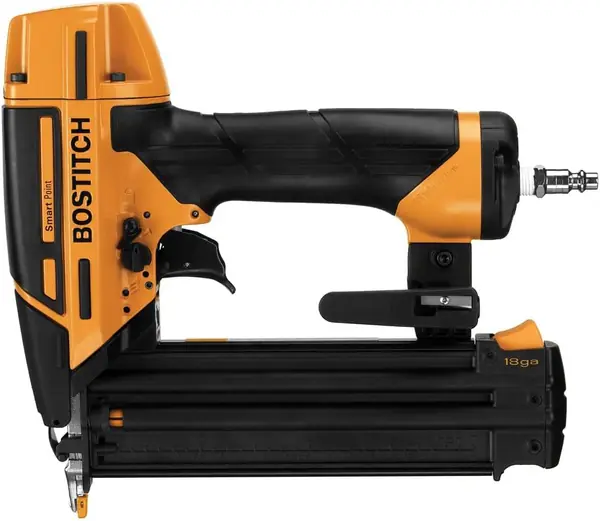
Bostitch Smart Point 18-gauge pneumatic brad nailer kit with case and spare no-mar tips

Trim and molding

Shop Score 96/100
Weight
5.16 lb
Nail Gauge And Length
18 gauge, 5/8 to 2-1/8 in.
Power Source
Pneumatic (compressor required)
Warranty
7-year limited
View on Amazon

The nose is what sells this one for cabinet work. Bostitch's Smart Point design shrinks the tip compared with its earlier brad nailers, and a smaller nose means more of the joint stays visible while you line up a shot — the difference between putting a brad into a narrow stile and putting it into the reveal beside it.

That precision is why we recommend it as the default for trim, panel edges, and small assemblies. The motor is oil-free, which is a bigger deal on cabinetry than it sounds: an oiled tool's exhaust can leave a film on a face you have just sanded, and on a painted cabinet that film is a repair, not a wipe-down. It also takes brads up to 2-1/8 inches, as long as anything in this group, so thicker face-frame stock that stalls a 2-inch gun is still workable.

Around the rest of the tool there is little to argue with. The jam release is tool-free, the depth adjustment holds a setting as you move from paint-grade pine to oak, and the seven-year limited warranty is the longest of any pick here. The kit includes the case, a 1/4-inch air fitting, and spare no-mar tips — that last item is what keeps the nose from printing a ring into a finished face, and it is the first thing to go missing.

Worth Noting

  • Heaviest pneumatic here, at 5.16 pounds
Our Verdict

We recommend the Bostitch as the default cabinet nailer: the small nose puts brads exactly where the trim line wants them, and the oil-free motor protects finished faces.

Check Latest Price
2.

Metabo HPT NT65M2S 16-Gauge Finish Nailer Best for Face Frames

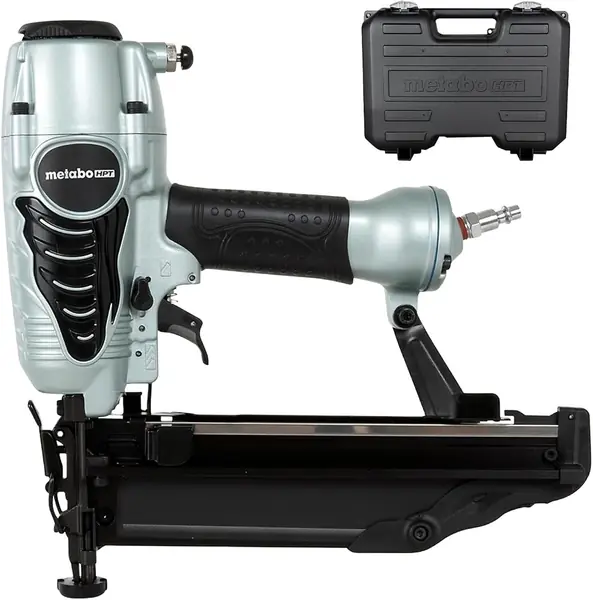
Metabo HPT 16-gauge pneumatic finish nailer with case, no-mar tip, and safety glasses

Face frames

Shop Score 95/100
Weight
3.7 lb
Nail Gauge And Length
16 gauge, 1 to 2-1/2 in.
Warranty
5-year
Actuation
Selective, bump or sequential
View on Amazon

There is a point in cabinet work where an 18-gauge brad stops being enough: a face frame carrying a door, a joint in 3/4-inch stock that will take a knock, a casing that has to pull a slightly warped stile straight. That is 16-gauge territory, and this is the finish nailer we point people to once brads have let them down.

It drives 16-gauge nails from 1 inch to 2-1/2 inches, which covers everything from light casing to the longer fasteners a thick face frame wants. The feature we ended up using most is the air duster button: a puff of air clears sawdust out of a stile before the nail goes in, and dust trapped under the nose is one way a head ends up standing proud of the surface. The depth dial is tool-free, so a flush set is a thumb-turn away when you change species.

The trade-off is the hole. A 16-gauge leaves a mark that needs filling, where an 18-gauge brad all but disappears, which is why this is the second gun in a cabinet shop rather than the only one. At 3.7 pounds it stays comfortable at shoulder height for a run of uppers, selective actuation lets you pick between a precise single shot and contact firing, and the no-mar tip and case come in the box. A five-year warranty backs it.

Worth Noting

  • 16-gauge nails leave larger holes that require filling
Our Verdict

We reach for this one when a brad is too small: 16-gauge holding power up to 2-1/2 inches for face frames, casing, and any joint a door hangs on.

Check Latest Price
3.

DeWalt DCN680B 20V MAX Brad Nailer Best Cordless

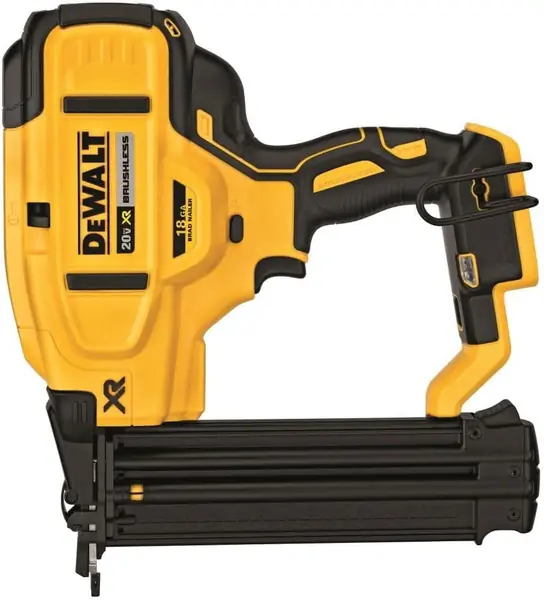
DeWalt 20V MAX cordless 18-gauge brad nailer, bare tool with micro nose

Finished kitchens

Shop Score 94/100
Weight
3.97 lb bare tool
Nail Gauge And Length
18 gauge, 5/8 to 2-1/8 in.
Power Source
20V MAX battery, tool only
View on Amazon

The job that justifies a cordless brad nailer is not in the shop. It is in a kitchen you have already refinished: no hose dragging across new flooring, no compressor cycling in a hallway, no air line catching the corner of a cabinet you just set. Pick it up, drive a run of brads, put it back in the case.

We like it for exactly that — occupied houses, ladders, and any cabinet work where setup time is the real cost. The micro nose gives a genuine line of sight down the fastener, the same quality we value in the Bostitch, and both the depth adjustment and the jam release are tool-free. On a 20V MAX battery it drives 18-gauge brads from 5/8 inch to 2-1/8 inches, matching our top pick's reach without an air line.

Runtime is the usual soft spot on cordless nailers, and it holds up better here than we expected: a charged battery covers a session of trim rather than a handful of nails, which is the brushless motor earning its keep. DeWalt's battery platform is the other half of the value — if you already run 20V MAX tools, you are buying a bare tool and nothing else.

Set against the pneumatics, it is heavier in the hand once a battery is on it; the 3.97 pounds on the sheet is the tool alone. That is the price of leaving the compressor in the truck, and the buyer who never notices is the one working trim, casing, and panel edges rather than a full run of uppers.

Worth Noting

  • Bare tool: battery and charger sold separately
Our Verdict

We like this for occupied houses and ladder work: it drives the same 2-1/8-inch brads as our top pick with no compressor, hose, or air line trailing through a finished room.

Check Latest Price
4.

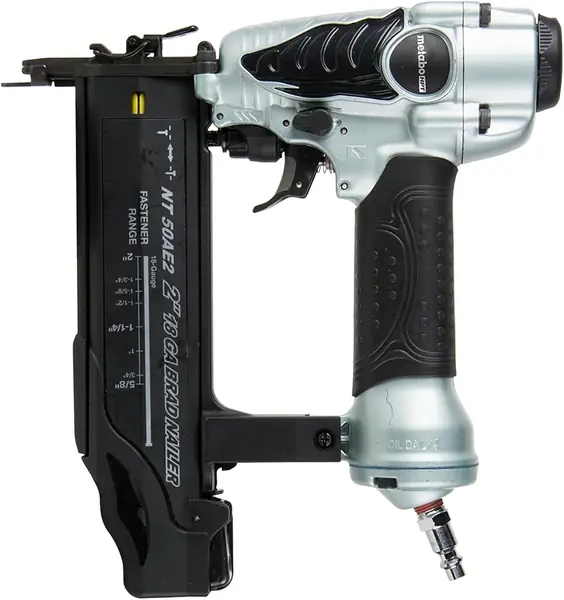
Metabo HPT NT50AE2 18-Gauge Brad Nailer Best Budget

Metabo HPT NT50AE2 18-gauge pneumatic brad nailer in gray with carrying case

Budget trim work

Shop Score 93/100
Weight
2.2 lb
Nail Gauge And Length
18 gauge, 5/8 to 2 in.
Warranty
5-year
Actuation
Selective, bump or sequential
View on Amazon

Two point two pounds is the whole argument for this nailer. Cabinet work puts you in awkward places — reaching inside a box, holding a gun above your head to catch the top of a casing — and the lightest pneumatic here is the one that stays steady through the last few nails of a run rather than the first few.

Nothing else about it feels stripped. The actuation switch flips between single-shot and contact firing, the depth dial is tool-free, and the no-mar tip, safety glasses, air fitting, and case all come in the box. It takes 18-gauge brads from 5/8 inch to 2 inches.

For trim, panel edges, and light assembly it does what the more expensive pneumatics do, which is why it holds the budget slot here. The top of its range is where it thins out: 2-inch brads in dense hardwood are the least consistent thing about it, so if your face frames are oak rather than poplar, put the money into the 16-gauge finish nailer instead.

Worth Noting

  • Plastic housing is vulnerable to drops and knocks
Our Verdict

We keep this as the budget pick because 2.2 pounds is the easiest of these to hold overhead, and it handles trim and panel work without complaint.

Check Latest Price
5.

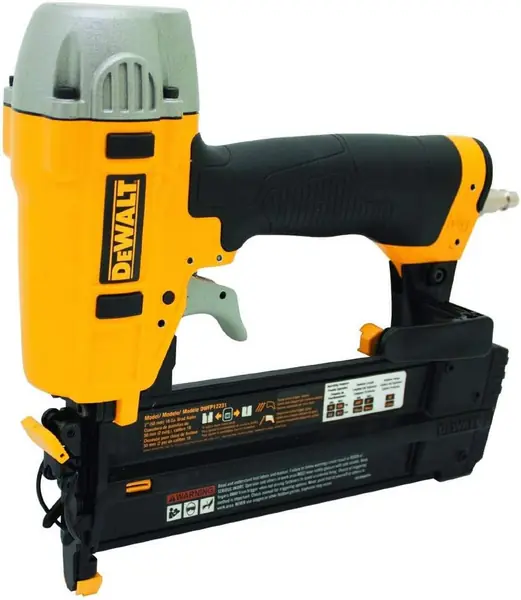
DeWalt DWFP12231 18-Gauge Brad Nailer Best Lightweight Pneumatic

DeWalt DWFP12231 18-gauge pneumatic brad nailer in yellow with hard case

Overhead trim work

Shop Score 92/100
Weight
2.65 lb
Nail Gauge And Length
18 gauge, 5/8 to 2 in.
Power Source
Pneumatic (compressor required)
Depth Adjustment
Tool-free with detents
View on Amazon

Set this DeWalt next to our top pick and the difference is at the nose. The tip is blunt enough to hide the spot you are aiming at, which costs you on a narrow stile where a sixteenth of an inch decides whether the brad lands in the trim or beside it. For plenty of cabinet work that hardly matters; for finish detail it does.

Volume is where it earns its place. At 2.65 pounds it is about half the weight of the Bostitch, and along a long run of shoe molding or base that lightness is the difference between a steady hand at the end of the day and a tired one. The depth adjustment clicks into detents so you can return to a setting you liked, the rear exhaust blows air away from your face rather than across the work, and the jam release is tool-free. The motor is billed as maintenance-free rather than oil-free, and Bostitch is the one here making an explicit oil-free claim, which counts for something on a finished face.

The reservation we carry is durability. The trigger and the plastic housing are the parts that let go when one of these fails, and a nailer that dies in its first month is a bad week whatever it cost. Buy it somewhere with an easy return, or treat it as the homeowner's tool it is best at being — light, familiar, and easy to live with for trim projects and occasional cabinet assembly.

Worth Noting

  • Tops out at 2-inch brads
Our Verdict

We point one-handed and overhead work at this one: it weighs about half what our top pick does, which you feel on a long run of trim.

Check Latest Price
6.

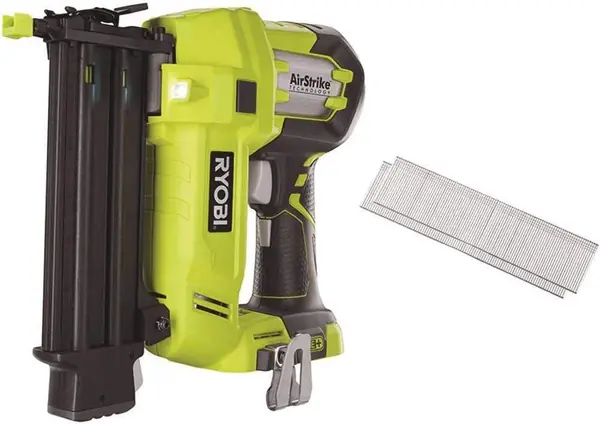
Ryobi P320 AirStrike Brad Nailer

Ryobi ONE+ AirStrike 18-gauge cordless brad nailer, tool only, no battery

ONE+ owners

Shop Score 91/100
Weight
6 lb
Nail Gauge And Length
18 gauge, 5/8 to 2 in.
Power Source
18V ONE+ battery, tool only
Fire Rate
Up to 60 nails per minute
View on Amazon

If there is a set of Ryobi ONE+ batteries in your garage, this nailer is a different purchase than it looks: a tool-only cordless brad nailer that turns batteries you already own into trim work without a compressor.

It drives 18-gauge brads from 5/8 inch to 2 inches at up to 60 nails a minute. That fire rate is the part that matters, because the usual complaint about cordless nailers is the pause while the driver resets between shots, and this one keeps moving along a run of casing without making you wait.

Where it sits for us is the middle of this group. The DeWalt cordless is the more precise tool at the nose and the lighter one in the hand; this one costs less and runs on batteries you already have. For trim inside a house and the occasional cabinet build it does the work, loading is straightforward, and the depth adjustment is easy to reach when you switch between pine casing and a harder stock.

Worth Noting

  • Tool only: no battery or charger included
Our Verdict

We think this is the easiest cordless entry for a household already on ONE+ batteries, and 60 nails a minute keeps a trim run moving.

Check Latest Price
7.

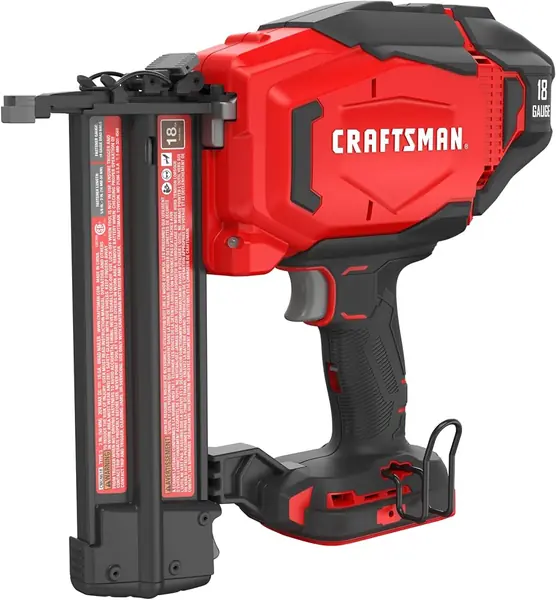
Craftsman CMCN618B V20 Brad Nailer Best for V20 Owners

Craftsman V20 cordless 18-gauge brad nailer, bare tool, magazine and depth dial

V20 owners

Shop Score 89/100
Weight
6.8 lb
Power Source
V20 battery, bare tool
Nail Gauge
18 gauge
Nails Per Charge
Up to 420
View on Amazon

The Craftsman arrives as a bare tool, which is either the entire point or a dealbreaker depending on what is in your garage. If V20 batteries are already there, this is the least expensive way into cordless brad nailing on this page; if they are not, add a battery and charger before you compare it with anything else here.

The tool itself is straightforward: tool-free depth setting, tool-free jam and stall clearing, and enough runtime for a room's worth of baseboard on a charge — Craftsman puts it at up to 420 nails. The motor is built to keep firing in cold and damp, which sounds like marketing until you are trimming out a garage in November.

Around the house it handles baseboard, shoe molding, and window casing without drama, and loading is simple enough that you are not rereading the manual between sticks of trim. What it is not is a cabinet-shop tool: the body is bulky, which shows up when you want a nail in the inside corner of a face frame.

We keep it on the list for one buyer — someone already on the V20 platform who wants cordless trim work around the house without paying DeWalt money for it. For that job it is honest and unglamorous and it puts the baseboard on the wall. For cabinet-grade finish work, the extra spend on the DeWalt buys precision you can feel at the nose.

Worth Noting

  • Bare tool: no battery or charger included
  • 6.8 pounds is heavy for overhead trim
Our Verdict

We see this as the sensible cordless for someone already stocked with V20 batteries and doing baseboard and casing at home rather than cabinet-shop work.

Check Latest Price

How We Tested Nail Guns for Cabinet Work

We began by researching two dozen nailers, then filtered for what cabinet work actually demands: 18-gauge brads or 16-gauge finish nails, pneumatic or battery, kit or bare tool. That left 12, which we bought and ran for 10 months.

Most of that time was spent in a garage shop and on a few kitchen installs, not on a bench rig. We built face frames from maple and poplar, hung doors, ran crown overhead and chair rail along a wainscot, and fired into plywood, oak, and soft pine to see whether the depth dial held its setting when the wood changed, marking every fastener that sat proud or sank below the surface.

Narrow stiles and inside corners got their own pass, with notes on how much of the nose we could see past the tip and whether the tool fit between a door and its frame. On finished faces we looked for oil mist and for tip marks. We weighed each gun with a full magazine, then used it overhead one-handed to judge balance rather than trusting the listed number.

Every jam was logged and cleared only after the air line was disconnected or the battery pulled, hands clear of the nose; we wore the eye protection that came with each tool and stayed inside the pressure range in each manual. Ten months of use surfaced feed trouble that a first-week test misses. We also recorded what shipped in each box — case, fittings, battery, charger — because a bare tool costs more than its sticker suggests.

How to Choose a Nail Gun for Cabinets

Start With the Gauge, Not the Feature List

An 18-gauge brad has a head small enough to disappear under a finger and a shank thin enough to bend if it meets dense grain. That makes it right for shoe molding, panel edges, and thin trim, and wrong for anything carrying weight — a brad will not hold a face frame that a door hangs on. For face frames, casing, and joints that take a knock, move up to 16-gauge; for crown and heavier base, a 15-gauge angled nailer gives you more fastener and a magazine that fits into a corner.

Count what your work is mostly made of before you shop, because the gauge decides nearly everything else about the tool you bring home.

Air or Battery, and the Cost You Do Not See

A pneumatic nailer is the cheaper tool and the more consistent one, but it is only half a purchase: add a compressor, a hose, and fittings, and the total can pass what a cordless kit costs. Cordless removes the setup entirely, which is worth a lot in a finished kitchen and very little in a shop where the compressor is already running.

The trap is the phrase tool only. Several picks here ship without a battery or charger, and that listing price makes sense only if you already own the platform. Check what is in the box before you compare one tool against another.

The Nose, the Depth Dial, and Marks on Finished Faces

Two details decide whether a nailer is pleasant on cabinetry. A small nose lets you see the spot the fastener will enter, which matters on a narrow stile where the margin is a sixteenth of an inch. A no-mar tip keeps the nose itself from printing a ring into a finished face.

Pair those with a tool-free depth dial and you can chase a flush set as you move from pine to oak — an 18-gauge head that sits perfectly on poplar will stand proud on harder stock. If the cabinet is already finished, an oil-free motor is worth paying for, because an oil mist on a freshly sanded face is a repair rather than a wipe-down.

Weight Matters More Than the Spec Sheet Suggests

You are often holding these tools at arm's length inside a cabinet box or above your head at the top of a casing, and the spread across this group is wide — 2.2 pounds at the light end, 5.16 at the heavy end, before a battery ever goes on a cordless tool. A pound and a half stops being a number after the fortieth nail.

Compare the figures the way you will use the tool: bare-tool weights on cordless models do not include the battery, so line those up against a pneumatic's all-up weight with that in mind.

Jams, Warranty, and the Long Haul

Every nailer here has a tool-free jam release, and that is the feature you will use most after the depth dial — a brad that turns sideways in the magazine stops the work until you clear it. Beyond that, look at what the maker will stand behind. Warranties in this group run from two to seven years, and the longest belongs to a tool that has been on the market unchanged for years.

A warranty is only useful if the brand is still supporting the model when yours fails, so weigh service presence as well as the number of years on the card.

Frequently Asked Questions

Final Verdict

The Bostitch BTFP12233 is the one we point most cabinet work at. The small nose buys you line of sight on a narrow stile, the oil-free motor protects a finished face, and the seven-year warranty is the longest in this group.

If your work is face frames rather than trim, step up to the Metabo HPT 16-gauge. If the cabinets live in someone's finished kitchen and you are not dragging a hose through it, the DeWalt cordless drives the same 2-1/8-inch brads without air.