↑↓ navigate ↵ open Esc close All results →

Best Nail Guns for Fencing of 2026

Buying a framing nailer or fence stapler before checking collation angle and staple gauge is the quickest way to stall a fence build on the first rail. When gun and fasteners disagree, the tool jams mid-run or leaves heads standing proud of the board while the compressor cycles behind you, instead of settling into a steady load-set-fire rhythm.

Nine pneumatic framing nailers and fencing staplers drove fasteners into pressure-treated pine, cedar pickets, and long spans of woven wire over eight months of spring post-setting and fall repairs. Collation dictates the hardware you have to stock: 21-degree plastic strips feed stick nailers, wire-wound coils load high-capacity coil guns, and dedicated fencing staplers drive heavy 9-gauge staples into posts.

Air demand trips up first-time buyers just as often, since CFM requirements at 90 PSI quickly overwhelm a small pancake compressor built for brad nailers. Wood framing, tight budgets, woven-wire fencing, and lighter overhead runs are all represented across these four tested models.

Our Top Picks

The Best Nail Guns for Fencing

1.

Metabo HPT NR90AES1 Best Overall
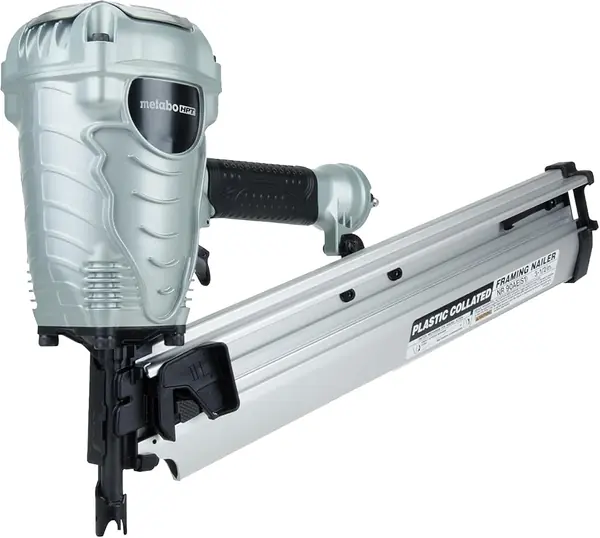
Metabo HPT NR90AES1 21-degree plastic-collated framing nailer with magazine and safety glasses

Wood fence framing

Shop Score 94/100
Weight
7.5 lb
Warranty
5 years
Nail Type
21° plastic collated, 2 to 3-1/2 in
Firing Modes
Selective sequential or contact
View on Amazon

Twenty-one degrees, plastic collated — that pairing is why this is the nailer we put in most people's hands for a board fence. Those sticks turn up everywhere in every length from 2 to 3-1/2 inches, so you are never one fastener short on a Saturday afternoon. The gun takes that whole span, which covers pickets, rails, and a 3-1/2-inch nail driven through a 2x rail into a 4x4 post.

Light matters out here more than it does in a shop. At 7.5 pounds this is the lightest nailer in the group, and it is the balance we kept noticing: it hangs level in the hand, so a long run of rail work does not leave your wrist fighting the nose. The selective-actuation switch lets you bump-fire down a line of rails and then flick to sequential for a gate or a corner where placement has to be exact, and the tool-less depth dial moves you between soft cedar and dense pressure-treated stock without hunting for a wrench.

The plastic that holds the nails together throws small fragments, so wear the safety glasses in the box. The guards around the nose also make steep angled shots awkward — a framer pulling a stud plumb will find it fussy, though face-nailing rails into posts, which is most of fence work, rarely asks for that angle. The five-year warranty doubles the budget pick's coverage.

Worth Noting

  • No on-board hook to hang it on a rail
Our Verdict

We hand this nailer to most people building a wood fence: it is the lightest tool here, it eats the nails sold at any lumberyard, and it has the calmest record in the group.

Check Latest Price
2.

NuMax SFR2190 Best Budget

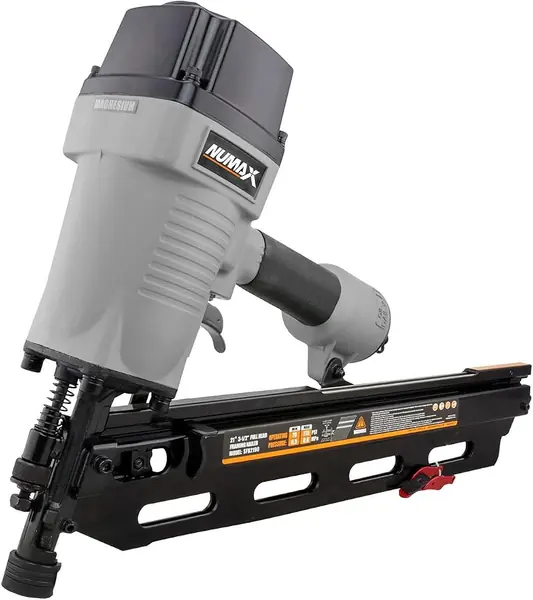
NuMax SFR2190 pneumatic 21-degree framing nailer with comfort-grip handle and adjustable exhaust

Tight-budget wood fences

Shop Score 93/100
Weight
8.6 lb
Warranty
1 year limited
Nail Type
21° full round head, 2 to 3-1/2 in
Air Requirement
2.5 CFM at 90 PSI minimum
View on Amazon

Most nailer listings make you dig for the compressor spec. NuMax prints it: a minimum of 2.5 CFM at 90 PSI and a tank of at least 3 gallons, working between 70 and 115 PSI. That is useful paperwork — you know before checkout whether the compressor in your garage can keep up, and a small pancake unit that makes those numbers will run the gun. It also shows where the ceiling sits: long 3-1/2-inch nails into dense pressure-treated stock need pressure held steady, and a compressor that sags leaves heads standing proud.

For a fence, what we like is how little this gun assumes. Both triggers ship in the box — the black single-fire one fitted for accurate placement, the red bump-fire one for running a line of rails — so you change rhythm without buying a part. The anti-dry-fire mechanism stops the tool firing on an empty stick, and the no-mar safety tip keeps a finished rail from picking up tooth marks.

The quirk is at the tail of a stick: the last three or four nails do not always feed, and you either re-fire or drop them in by hand, so top off the magazine before you climb the ladder rather than after. Nothing else about it asked for attention — set the depth once on an offcut of your rail stock and the rest of the fence moves at the pace you can carry lumber.

Worth Noting

  • Heavy at 8.6 lb, especially overhead
  • One-year warranty is the shortest here
Our Verdict

When the budget sets the decision, this is the framer we point to: it states its air needs up front, drives full 3-1/2-inch nails, and was built with wood fencing in mind.

Check Latest Price
3.

Freeman PFS9 Best for Wire Fencing

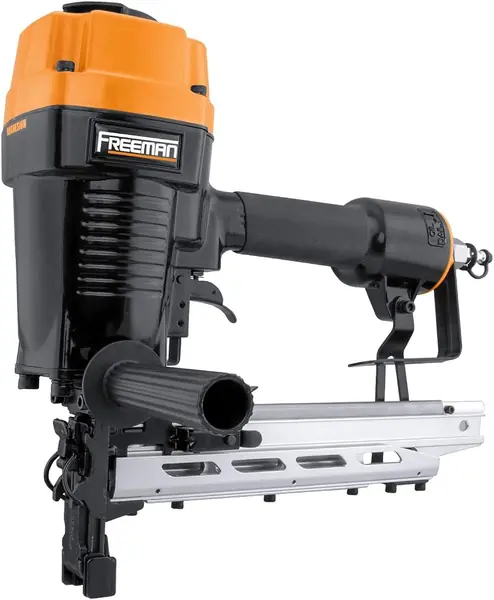
Freeman PFS9 pneumatic 9-gauge fencing stapler in orange with belt hook and blow-molded case

Wire and mesh fence

Shop Score 92/100
Weight
8.1 lb
Warranty
7 years limited
Staple Type
9-gauge, 1-1/2 to 2 in
Overall Length
19 in
View on Amazon

Wire fence is a different job from board fence, and the PFS9 is the only tool here built for it. Nine-gauge staples, 1-1/2 to 2 inches long, driven into wood posts to hold woven wire, chain link, horse and deer mesh, and insulated electric line — that is the whole brief, and it fills it. Ending the hammer-and-forearm routine is the reason we keep a stapler in the roundup at all; driving a few thousand staples by hand is a two-ibuprofen job.

The T-handle is the detail we appreciated most. It gives your off hand a second grip to pull against while the nose stays planted on a post, so you can hold wire tension with one hand and fire with the other instead of chasing slack. A belt hook and blow-molded case come in the box, and the quick jam release opens the nose for clearing rather than making you take the tool apart mid-run.

Depth is adjustable for good reason. On a soft pine post the staple sinks flush; on a hard, seasoned post the nose can stop short and leave the staple proud, and you finish it with a hammer or nudge the pressure up a little. The seven-year limited warranty is the longest of anything here, which is the number we look at for a tool that lives in a truck bed and gets rained on.

Worth Noting

  • Heavy at 8.1 lb over long stretches
  • Wants a compressor that recovers quickly
Our Verdict

For woven wire, chain link, or electric line on wood posts, this is the tool that turns a two-day hammer-and-staple job into an afternoon, and nothing else here does it.

Check Latest Price
4.

Metabo HPT NV90AGS Best for Long Fence Runs

Metabo HPT NV90AGS 15-degree wire coil framing nailer with side-load magazine

Long fence runs

Shop Score 88/100
Weight
7.7 lb
Warranty
5 years
Nail Type
15° wire coil, 1-3/4 to 3-1/2 in
Magazine
Side-load, tilt bottom
View on Amazon

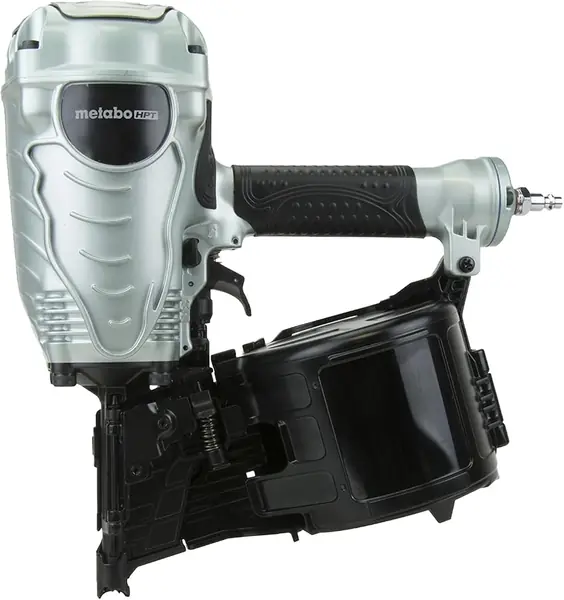
Wire coil changes the rhythm of the work. A coil rolls the fasteners tight, so you feed the magazine far less often than with a strip nailer, and the side-load, tilt-bottom magazine turns a reload into a swing and a click rather than pulling the gun off the line. On a fence with a lot of rail ends and braces, that cadence is the whole argument for spending more.

At 7.7 pounds it is barely heavier than our top pick, so the bigger fastener load does not show up as a bigger tool in your hand. It also takes nails from 1-3/4 inches up to 3-1/2, a lower floor than the other nailers here, which matters when you are fastening thinner stock or repairing a light gate. Selective actuation and the tool-less depth dial behave the way they should: flip the switch for bump firing down a run, dial the depth for a flush set in softwood.

Our hesitation is the trigger. These guns can cycle without driving a nail — you pull, nothing goes, you pull again — and on a fence line that is a rhythm you have to absorb rather than a repair you can make on the spot. Run a full coil through scrap before you take it up a ladder and keep the magazine clear of debris. Do that and the reload advantage is real; skip it and you will spend the difference in re-fires.

Worth Noting

  • Can skip a shot and cost a re-fire
Our Verdict

When a fence run is long enough that reloading becomes the job, this coil-fed framer is the one we take: light for its class, priced like a crew tool, and occasionally fussy on the trigger.

Check Latest Price

How We Tested Nail Guns for Fencing

We started with what decides whether a gun is usable at all — collation type, fastener length range, stated air requirement, weight, and warranty — and narrowed a long field of framing nailers and fencing staplers to nine we could run hard. Testing ran eight months, from a spring post-setting weekend into fall repairs, on the same jobs: rails to posts, pickets, woven wire stapled to cedar, and the overhead stretch where the tool sits above your shoulders.

We weighed each gun, then held it overhead for timed stretches and noted where the balance sat and how fast forearms complained. Each fired a full magazine at working pace, which gave us a real reload cadence, and we watched the end of every stick to see whether the last fastener fed cleanly or the gun dry-fired into the plate. When a jam happened, we timed the clear with work gloves on.

Air got its own round: each gun ran off a small pancake compressor and a larger tank to see which pairing kept pace at 90 PSI and which lagged after a few fast shots. We ran both trigger settings, sequential where hands, feet, or a ladder were close and contact where the run was clear, and compared what shipped in the box, since a case and a belt hook change the value of a tool that lives in a truck.

Durability got judged at the end: loose magazine hardware, play in the nose, and how the housing held up to dust, truck beds, and gravel. We re-read every warranty and what a service claim actually asks of the owner. Same safety rules on every gun — the supplied glasses on, hands and the nose clear, pressure and fastener limits respected.

How to Choose a Nail Gun for Fencing

Framing nailer or fencing stapler?

Two different tools get sold as fence nailers. A framing nailer drives 2- to 3-1/2-inch nails through a 2x rail into a 4x4 post, and it is what a board, privacy, or picket fence needs. A fencing stapler drives 9-gauge staples, 1-1/2 to 2 inches long, over wire, mesh, or electric line on wood posts.

Match the tool to the fence you are actually building. The Freeman PFS9 is the only stapler in this group, and the three nailers will not hold woven wire for a season — a nail pinches the wire where a staple wraps it.

Match the collation to what you can buy

Framing nails come in three collations, and the angle on the box has to match the angle on the gun: 21-degree plastic, 30-degree paper, and 15-degree wire coil. Plastic 21-degree is the easiest to find on a Saturday morning, coil gives you the most nails per load, and paper sits between them.

Check the shelf at your lumberyard before you fall for a gun; a nailer is only as useful as the fasteners you can restock. If the fence is permitted work, ask the inspector about full round head nails before ordering — clipped-head nails are not accepted everywhere.

Size the compressor before the gun

Every tool here is air-powered, and the compressor is the part buyers under-spec. Look for a stated CFM at 90 PSI — the NuMax asks for 2.5 CFM and a 3-gallon tank — then add margin for how fast you shoot.

Bump-firing 3-1/2-inch ring-shanks down a long run drains a tank faster than firing one nail at a time, and a compressor that cannot keep up leaves heads proud and stalls the tool. For a whole fence, a 6-gallon or larger tank with quick recovery is the safer buy.

Weigh it against how long you will hold it

The tools here run from 7 to 8.6 pounds, which sounds like a rounding error until you have held one at chest height into the third hour. Under 8 pounds is the comfortable zone; above that, a belt hook and a second grip start to matter as much as the number on the spec sheet.

Balance beats weight. A gun that hangs level in the hand tires you less than a tail-heavy one that is technically lighter, so handle one before you commit. Working from a ladder, buy the lightest tool that does the job.

Set up the trigger and the depth once

Two triggers, two habits. Sequential fire gives you one nail per pull with the nose pressed to the work; bump fire lets you hold the trigger and tap the nose along a run. Use sequential anywhere precise or anywhere your off hand is close, and bump fire for long flat runs of rails.

Wear the glasses that come in the box, since plastic collation throws fragments, and set depth on an offcut of your actual rail stock rather than on the first board of the fence.

Frequently Asked Questions

Final Verdict

Our pick for a wood fence is the Metabo HPT NR90AES1. It is the lightest nailer here, it takes the 21-degree plastic sticks you can buy anywhere, and it has the calmest record in the group — which is what you want hanging off a ladder with a rail in your other hand.

If wire, mesh, or electric line is on the list, buy the Freeman PFS9 instead; no framing nailer will hold woven wire. And if this is a one-time project on a fixed budget, the NuMax SFR2190 drives the same nails for less, as long as your compressor holds 90 PSI.