↑↓ navigate ↵ open Esc close All results →

Best Nail Guns for Trim of 2026

Trim carpentry rarely fails because a miter was cut poorly; it fails when a nailer blows a brad out the side of casing or jams halfway along a glued-up baseboard. Dependable trim guns sink each fastener just below the surface in one clean shot without marring softwood, repeating that consistency through hundreds of shots in an afternoon.

Eight months of shooting shoe molding, hallway casing, basement baseboards, overhead crown, and 23-gauge pins into delicate stops across 12 retail nailers showed that badge loyalty matters far less than practical fit. Matching gauge and fastener length to the joint, deciding whether a hose or battery suits tight rooms, and checking balance on the tenth overhead shot separate these six models — a lineup ranging from a two-pound pin nailer to a full cordless kit.

Our Top Picks

The Best Nail Guns for Trim

1.

DeWalt DWFP12231 Brad Nailer Best Overall
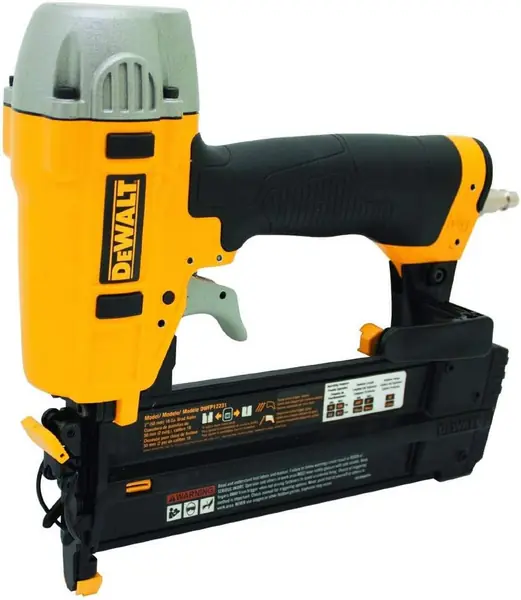
DeWalt 18-gauge pneumatic brad nailer in yellow with hard case

Overhead trim work

Shop Score 96/100
Weight
2.65 lb
Power Source
Pneumatic
Fastener Gauge
18 gauge
Fastener Length
5/8 to 2 in
View on Amazon

The 2.65-pound body is what won us over. Trim work puts a gun overhead and at odd angles, and the DWFP12231 is light enough that we can keep the nose where we want it through a long run of casing. It drives 18-gauge brads from 5/8 to 2 inches, which covers shoe molding, cabinet trim, and most small casing.

We also appreciate the tool-free depth dial and jam release. Setting a nail head just below the surface is a turn of the dial, and the detents are easy to feel when we switch from pine to oak. When a brad hangs up, the release opens without a wrench. The rear exhaust helps keep air and oil away from the work, and the hard case keeps the gun and fitting together between projects.

We like that the motor is maintenance-free; it is one less thing to think about when the gun sits for a few weeks between rooms. The tool has a simple, familiar feel that makes it easy to hand to someone who has used a brad nailer before, and the balance stays comfortable during a long run of baseboard.

We keep coming back to it because the light weight and depth control show up on every piece. It is a simple tool, and simple is what we want when a trim run has a lot of small joints.

Worth Noting

  • Requires a compressor and air hose
  • Plastic-heavy body may not suit daily jobsite abuse
Our Verdict

We recommend the DWFP12231 as the default trim gun for anyone with a compressor: it is light and precise, and the tool-free depth and jam release keep a run of trim moving.

Check Latest Price
2.

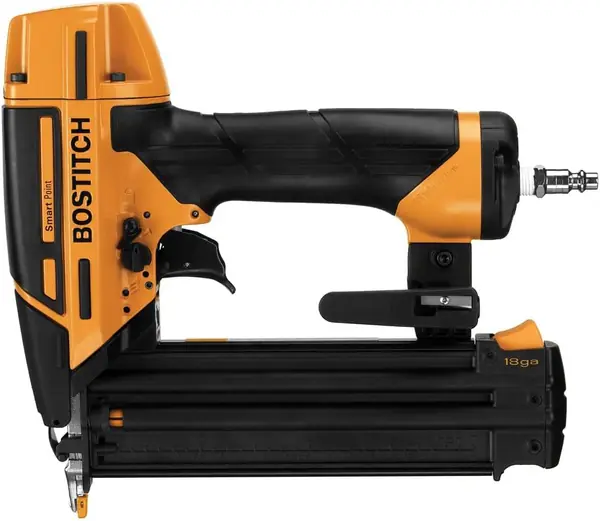
Bostitch BTFP12233 Brad Nailer Best Precision Brad Nailer

Bostitch Smart Point 18-gauge brad nailer with no-mar tips and case

Precision molding

Shop Score 95/100
Weight
5.16 lb
Power Source
Pneumatic
Fastener Gauge
18 gauge
Fastener Length
5/8 to 2-1/8 in
View on Amazon

The Smart Point nose is the reason to pick this Bostitch over the other brad nailers here. It is smaller than a typical 18-gauge nose, so we can see the fastener land in a tight inside corner of crown or a narrow cabinet reveal. It drives 5/8- to 2-1/8-inch brads, a touch more range than the DeWalt.

Oil-free operation matters for trim that will be stained or painted: there is no oil mist to blush a finish. We also like the seven-year limited warranty, which is the longest coverage in this group, and the no-mar tips that come in the case. The depth adjustment is tool-free, and the magazine is easy to load even with gloves on.

The gun has a rear exhaust and a belt hook with a built-in pencil sharpener, a small detail that made us smile but also keeps a pencil handy for marking. We also like the belt hook on a ladder: it gives the gun a place to hang without setting it on a finished sill. For precision trim and cabinetry, the smart point and oil-free motor are the features that earn it a place.

Worth Noting

  • At 5.16 pounds it tires overhead work
Our Verdict

We reach for the Bostitch when the joint is tight and the finish is visible; its small Smart Point nose and oil-free motor make it a precision pick for crown and cabinetry.

Check Latest Price
3.

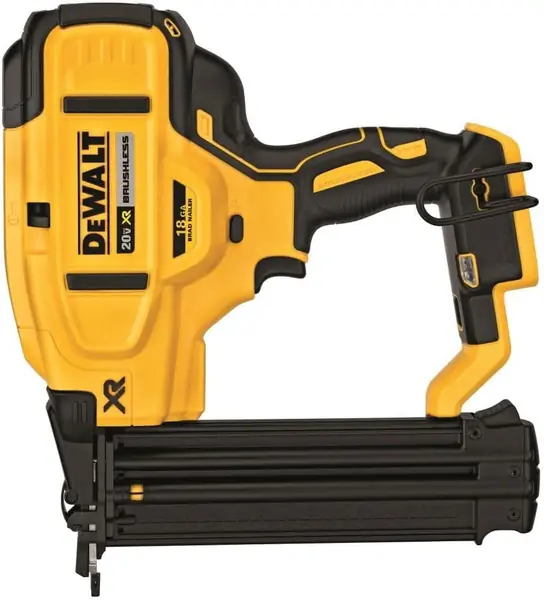
DeWalt DCN680B Brad Nailer Best Cordless Brad Nailer

DeWalt 20V MAX cordless 18-gauge brad nailer bare tool in black and yellow

Finished-room trim

Shop Score 94/100
Weight
3.97 lb
Power Source
20V MAX battery
Fastener Gauge
18 gauge
Fastener Length
5/8 to 2-1/8 in
View on Amazon

The first thing we noticed on a finished-room trim job was what was not there: no hose dragging across the floor, no compressor cycling in the hallway. The DCN680B drives 18-gauge brads from 5/8 to 2-1/8 inches and runs on DeWalt's 20V MAX batteries, so it earns its place in occupied rooms and on ladders where a pneumatic gun is a hassle.

The brushless motor and micro nose are the details that make it feel like a trim tool rather than a framing gun with a smaller magazine. The nose gives us a clear line of sight along a casing, and the tool-free depth adjustment lets us sink a head into pine without crushing the face. We also like the tool-free jam release; it is the feature we use when a thin brad folds.

The 20V MAX platform is the real draw if you already own packs; it turns the gun into a grab-and-go trim tool. We still take it when the job is in a finished space and the hose would cost more time than the battery costs money. It is not the cheapest way into cordless nailing, but it is the one we trust on a ladder with a finish nail in place.

Worth Noting

  • Bare tool; battery and charger sold separately
  • Heavier than the pneumatic picks with a battery
Our Verdict

For trim work in finished rooms where a hose is a nuisance, the DCN680B drives brads cleanly and runs on batteries you may already own.

Check Latest Price
4.

Metabo HPT NT65M2S Finish Nailer Best 16-Gauge Finish Nailer

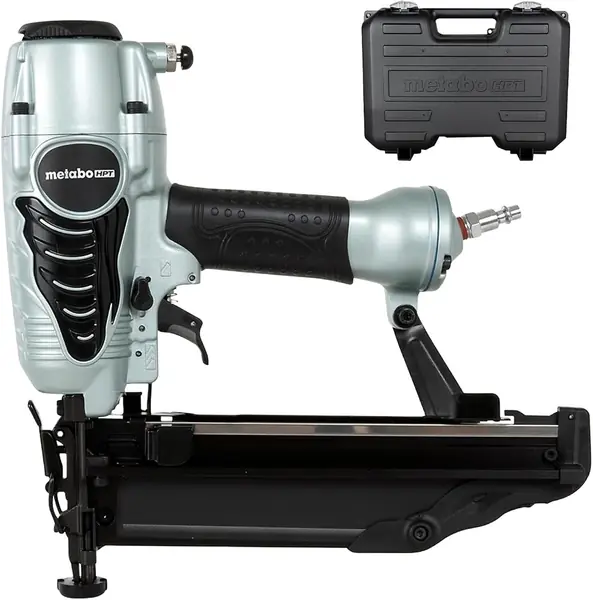
Metabo HPT 16-gauge finish nailer in green with air fitting and case

Baseboards and casing

Shop Score 93/100
Weight
3.7 lb
Power Source
Pneumatic
Fastener Gauge
16 gauge
Fastener Length
1 to 2-1/2 in
View on Amazon

When an 18-gauge brad feels too thin for the joint, the NT65M2S is the gun we pick up. It drives 16-gauge finish nails from 1 to 2-1/2 inches, so it has the holding power for baseboards, chair rail, and cabinet face frames without moving up to a bulky 15-gauge angled gun. It is the gun we choose when the wall is not perfectly straight and the trim needs to be pulled tight.

At 3.7 pounds it is balanced and easy to keep on line, and the selective trigger lets us choose sequential fire for a precise set or bump fire for a long run of baseboard. We appreciate the built-in air duster more than we expected; a quick burst clears sawdust from a corner before we set a nail. The no-mar tip and tool-free depth dial help protect a prefinished surface.

For baseboards and cabinet face frames, the extra holding power is the point. We noticed the gun is happiest when the depth is set for the material; in soft pine we turn it back a little to avoid a crushed face. The 16-gauge nail is the right compromise when an 18-gauge brad will not hold and a 15-gauge angled gun feels like too much tool.

Worth Noting

  • Requires a compressor and air hose
  • Leaves larger holes than 18-gauge brads
Our Verdict

Choose the NT65M2S when a brad is not enough: it is light for a 16-gauge gun and gives baseboards and cabinet trim real holding power.

Check Latest Price
5.

Metabo HPT NP35A Pin Nailer Best Pin Nailer

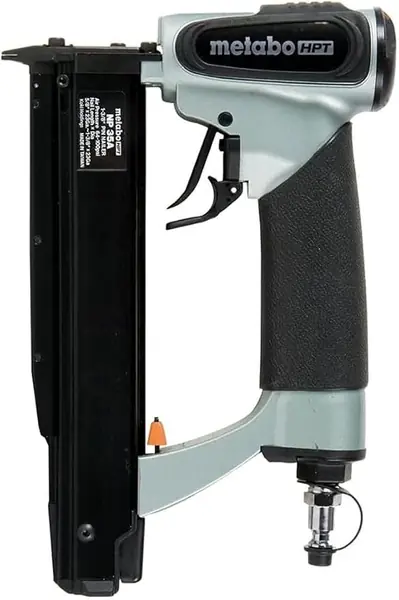
Metabo HPT 23-gauge pin nailer in green with no-mar tips

Delicate trim

Shop Score 92/100
Weight
2 lb
Power Source
Pneumatic
Fastener Gauge
23 gauge
Fastener Length
5/8 to 1-3/8 in
View on Amazon

The NP35A is for the trim you do not want to fill. It shoots 23-gauge headless pins from 5/8 to 1-3/8 inches, and the holes are small enough that we can often leave them alone on stained or clear-finished trim. It is the first gun we reach for when a pinhole would be less noticeable than a brad head.

At 2 pounds it is the lightest gun here, which makes it easy to hold against a delicate piece of glazing bead or a small return. The no-mar tips and rear exhaust protect the surface, and the magazine adjusts automatically to the pin length. The body is compact enough to fit between cabinet parts, and the lack of a visible head is the whole appeal.

The gun is at its best when the pin has a short path into the wood. We keep the depth set light and let the pin follow the glue, rather than asking it to pull a twisted board into line. For delicate trim and assembly, the small size and near-invisible hole are worth the trade.

Worth Noting

  • Maxes out at 1-3/8-inch pins
  • Not a substitute for brads or finish nails
Our Verdict

We recommend the NP35A for delicate trim and assembly where a visible nail hole would ruin the finish; it is light and precise, with pins that nearly disappear.

Check Latest Price
6.

Craftsman CMCN618C1 Brad Nailer Best Cordless Kit

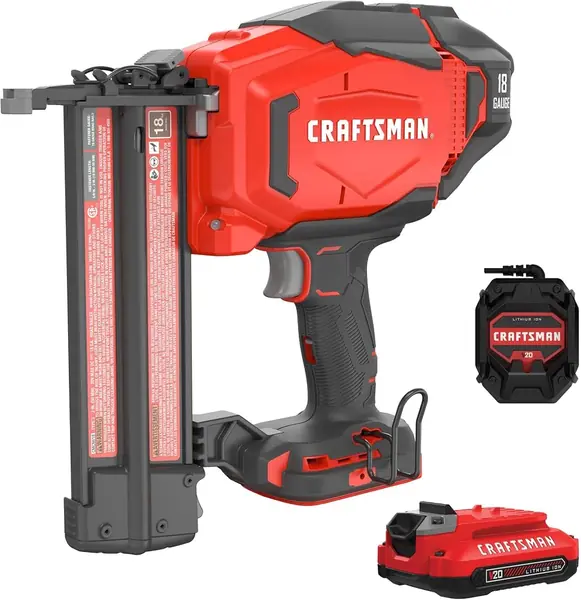
Craftsman V20 cordless 18-gauge brad nailer kit in red and black

First cordless kit

Shop Score 91/100
Weight
7.6 lb
Power Source
20V battery
Fastener Gauge
18 gauge
Kit Contents
Battery and charger
View on Amazon

The Craftsman kit is the cordless brad nailer we recommend when you want one box to get started. It includes a 20V battery and charger, so you are not hunting for a bare tool and a separate power source before your first run of quarter round.

It drives 18-gauge brads and has tool-free depth and jam settings, plus a brushless motor. The kit includes the battery and charger, so the first job does not wait on a separate purchase. For a homeowner doing a room of baseboard or a quick repair, that complete-kit convenience is the reason to choose it over a bare tool.

The trigger and balance feel more like a general-purpose cordless tool than a dedicated trim gun. We noticed the nose is bulkier than the pneumatic picks, which matters in a tight inside corner. But for a deck repair, a closet build-out, or a first trim project, the one-box setup is hard to beat. The battery and charger are the difference between a tool that sits in a box and one you can use the day it arrives.

Worth Noting

  • Heaviest gun here at 7.6 pounds
  • Can jam during long trim runs
Our Verdict

As a first cordless trim setup, the Craftsman kit puts the battery and charger in the box and handles baseboard and molding without a compressor.

Check Latest Price

How We Tested the Best Nail Guns for Trim

We started by pulling every 18-, 16-, and 23-gauge trim gun we could find from the major brands, then filtered by fastener length range, power source, weight, and what came in the box: a bare tool, or a battery and charger. We bought 12 of them at retail and put them to work for eight months.

The testing happened where trim work actually happens — a hallway of shoe molding and casing, a basement of baseboards, a run of cabinet crown nailed overhead, and delicate stops that wanted 23-gauge pins. At each joint we checked with a fingertip whether the head sat flush, below the surface, or stood proud. We counted shots per reload and, when a gun jammed, pulled the battery or disconnected the air hose before opening the nose, then timed how long clearance took and whether the next fastener fed cleanly.

Overhead work got its own round: we weighed every gun on a kitchen scale, then drove a full run of crown holding it above shoulder height and noted where the balance point sat. In corners we looked at how much of the nose we could see past the workpiece, and we backed the depth adjustment in and out on scrap pine and poplar looking for the setting that buried the head without denting the face. Both trigger modes got run on every tool, hands clear of the nose and the muzzle on the work.

For the battery guns we ran the charge to empty and timed the refill; for the pneumatic ones we noted where the air duster and fittings landed in the kit. Anything that fed poorly or lost depth by the third box of nails didn't stay in rotation.

How to Choose a Nail Gun for Trim

Match the fastener to the trim

Start with the joint, not the gun. An 18-gauge brad nailer is the trim default for casing, baseboard, and cabinet trim because it leaves a small hole and has enough holding power for most interior work. A 16-gauge finish nailer gives more bite for thick baseboard, chair rail, or face frames, while a 23-gauge pin nailer is for delicate moldings and assembly where a visible hole would show. We use the lightest fastener that will hold the piece.

Choose air or battery

Pneumatic guns are smaller, lighter, and cheaper for the same driving power, but they tie you to a compressor and hose. Cordless models cost more up front and add battery weight, yet they are the better choice in occupied rooms, on ladders, and for small jobs where setup takes longer than the nailing. If you already own a compressor, a pneumatic brad nailer is the value play; if not, price the whole air setup before you decide. The DeWalt DCN680B is the cordless pick we reach for in finished spaces.

Weight and balance matter overhead

Trim work is often overhead, one-handed, and full of small adjustments, so weight matters more than it does on a bench. A gun under four pounds is easier to keep steady along a long casing; the 2.65-pound DeWalt DWFP12231 and 2-pound Metabo NP35A are the easiest to control here, while the 5.16-pound Bostitch is a precision tool with more heft. A compact body can still be heavy once a battery is mounted, so check bare-tool weight and add the pack.

Look at the nose and depth control

A small nose improves line of sight in tight inside corners, and a tool-free depth dial lets you adjust for pine, oak, and MDF without hunting for a wrench. No-mar tips protect prefinished trim, but they only help if they stay on the nose. Oil-free operation is worth paying for on stain-grade work because it avoids oil mist on the wood. We prioritize a clear nose and a depth stop that holds its setting.

Plan for jams and fasteners

Every trim gun can jam, so buy one with a tool-free release and keep the magazine clean. Use fasteners made for the gun's gauge and length range, and do not mix brads and staples in a combo tool unless the manual says so. A jam that clears in seconds is an interruption; one that needs a wrench can mark the trim. We check the release before we start a run.

Frequently Asked Questions

Final Verdict

For most trim jobs, we start with the DeWalt DWFP12231. It is light enough to control overhead, has the depth control to set a head cleanly, and the tool-free release handles the occasional jam. If you already own a compressor, it is the simplest path to a finish-quality result.

If the job is in a finished room and you do not want a hose, the DeWalt DCN680B is the cordless alternative. For thicker baseboard or cabinet face frames, move up to the Metabo NT65M2S; for delicate trim, the NP35A. Choose the power source first, then the gauge.