↑↓ navigate ↵ open Esc close All results →

Best Pneumatic Brad Nailers of 2026

Cranking a compressor regulator past a nailer's rated pressure to force proud brads flush is a common shortcut that blasts fasteners straight through thin molding and beats up the tool's internal seals. Paired with steady air inside its published pressure window, an 18-gauge pneumatic brad nailer eliminates the hammer slips and edge splits that ruin delicate trim.

Over eight months running 12 pneumatic models through real trim and bench builds, feature count mattered far less than ergonomics and feed consistency. Every extra ounce shows up quickly once you hold a gun overhead, while a slim nose you can sight around and a smooth hand-turn depth dial prevent misfires in tight inside corners.

Covering everything from an entry-level kit to all-day casing and shop upholstery, these six nailers feed reliably through full strips without finicky jams.

Our Top Picks

The Best Pneumatic Brad Nailers

1.

Bostitch BTFP12233 Brad Nailer Kit Best Overall
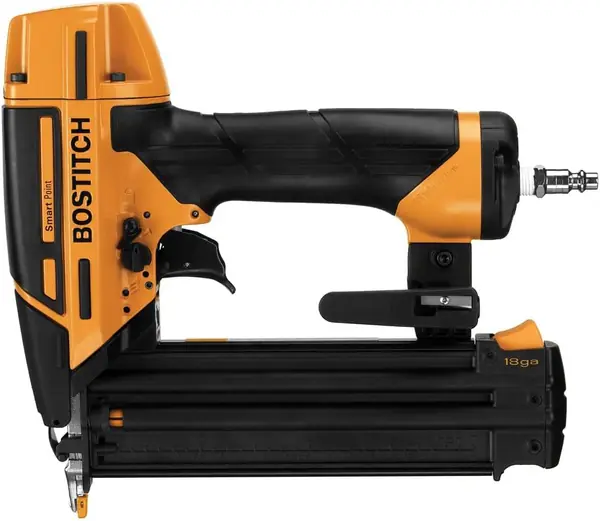
Bostitch BTFP12233 pneumatic 18-gauge brad nailer with spare no-mar tips and carrying case

Finish trim work

Shop Score 96/100
Brad Length
5/8 in. to 2-1/8 in.
Weight
5.16 lb
In The Box
Case, 1/4 in. fitting, spare no-mar tips
Warranty
7-year limited
View on Amazon

The 2-1/8-inch fastener range is the first thing that separates this Bostitch from the rest of the group. That extra eighth of an inch is what lets you pin a built-up casing stack, nail through a shim pack, or reach a miter return where a 2-inch brad bottoms out short. It also runs oil-free, so there's no oil mist settling onto bare pine or a freshly painted cabinet face — the kind of stain you only discover after the finish goes on.

Precision is the other half of the story. The Smart Point nose is noticeably smaller than a conventional brad nose, which means you can see the spot the fastener will land instead of guessing around a fat casting, and it rocks into inside corners and chair-rail returns where a wider nose blocks your line of sight. Spare no-mar tips ship in the box for the day the original gets chewed up. The depth control and trigger both feel deliberate rather than twitchy, which is what we want from a tool that spends its life within a half inch of finished wood.

What settles it for us is the combination of that reach, that placement, and a seven-year limited warranty, the longest coverage in this set. The kit arrives ready for the hose — case, 1/4-inch fitting, spare tips — and even the belt hook has a pencil sharpener built into it, a small thing we ended up using more than the hook itself.

Worth Noting

  • Heftier 5.16 lb body tires overhead runs
Our Verdict

We recommend the Bostitch as the default trim nailer: it shoots the longest brad here, places it precisely through a small nose, and carries a seven-year warranty.

Check Latest Price
2.

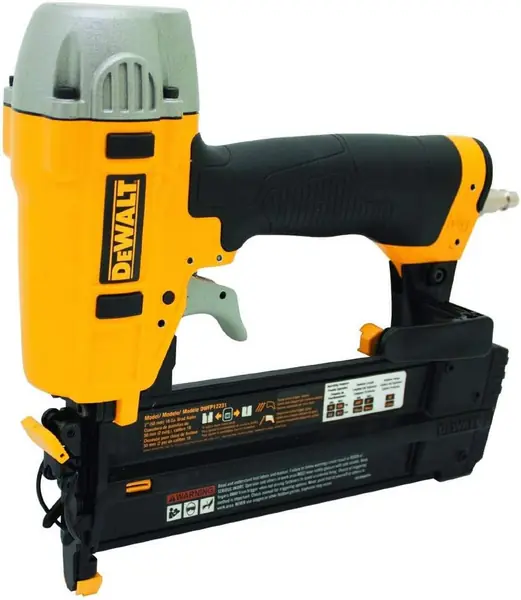
DeWalt DWFP12231 Brad Nailer Kit Best for High-Volume Trim

DeWalt DWFP12231 yellow pneumatic brad nailer with rear exhaust and hard carrying case

All-day trim work

Shop Score 95/100
Brad Length
5/8 in. to 2 in.
Weight
2.65 lb
In The Box
Carrying case and 1/4 in. fitting
Depth Adjustment
Tool-free, with detents
View on Amazon

At 2.65 pounds, this DeWalt is one of the lightest full-size guns in the group, and that's the number we kept coming back to on a whole-house baseboard job rather than a single cabinet run. A trim nailer gets picked up, aimed overhead, and set back down a few hundred times a day, and every ounce you're not holding at arm's length is an ounce you don't feel by late afternoon. It's the gun we're happy to hand anyone with a long punch list and an ordinary pancake compressor.

The details are set up for repetition. Depth of drive adjusts tool-free with detents, so you can click back to a setting you already liked instead of hunting for it again, and the jam release is a latch you can pop without digging through a tool bag. The maintenance-free motor is built to keep oil off the work surface, which matters on light-colored trim. Rear exhaust points the air away from your face and out of the cut line, a small thing you notice the first time you're nailing upside down under a cabinet.

It tops out at 2-inch brads, so if you routinely build up thick casing profiles, our top pick's extra eighth of an inch is the better tool. For baseboard, door and window casing, shoe mold, and cabinet backs, the DeWalt has all the reach you need, and the included case and 1/4-inch fitting get you onto the hose in about a minute.

Worth Noting

  • Feeding is less consistent than our top pick's
  • Brittle plastic parts can crack under a drop
Our Verdict

For long trim days we reach for the DeWalt: 2.65 pounds in a full-size body, tool-free depth detents, and a rear exhaust that keeps air off your face.

Check Latest Price
3.

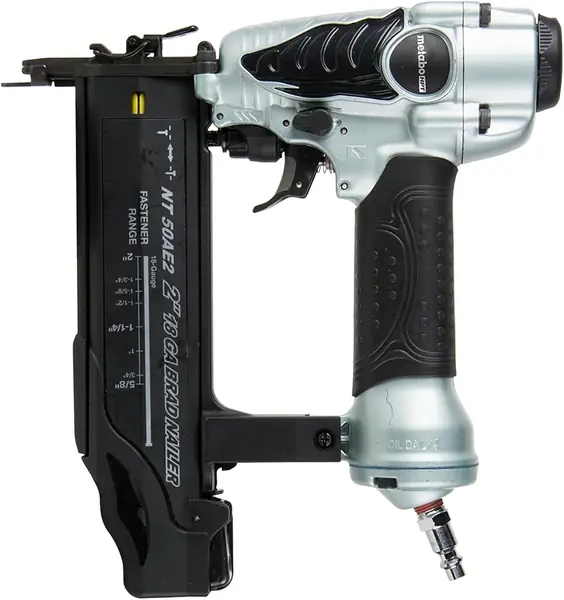
Metabo HPT NT50AE2 Brad Nailer Best Value

Metabo HPT NT50AE2 gray pneumatic brad nailer with no-mar tip and carrying case

First pneumatic nailer

Shop Score 94/100
Brad Length
5/8 in. to 2 in.
Weight
2.2 lb
Warranty
5-year
Firing Modes
Selectable bump or sequential
View on Amazon

Price is where this one starts, but 2.2 pounds is where it earns its place. That's the lightest tool in the group, light enough that an afternoon of crown molding doesn't leave your shoulder complaining, and light enough to steer with one hand while the other holds a piece of shoe mold against the wall. For a home shop that already owns a compressor, there's a lot of nailer here for the money.

The selective actuation switch is the feature we appreciate most. Flip it one way and the gun fires on contact, which is fast along a long straight baseboard; flip it back and it fires only when the trigger and nose agree, which is the mode we keep it in anywhere a brad might surface somewhere visible. The depth dial adjusts without a wrench, the no-mar tip protects the work, and the five-year warranty is second only to our top pick's.

Two inches is the ceiling on fastener length, so a 2-1/8-inch brad is out — that only matters if you're stacking thick casing profiles. Everything else in the kit is complete: safety glasses, air fitting, no-mar tip, hex wrenches, and a case, so it hangs on the hose and starts on the first project without a hardware-store run.

Worth Noting

  • Jamming can develop after a handful of uses
  • Plastic housing can shatter if the gun drops
Our Verdict

We point first-time buyers at the Metabo HPT: 2.2 pounds, a five-year warranty, and switchable bump or sequential fire at the lowest price of the big brands.

Check Latest Price
4.

Makita AF506 Brad Nailer Best for Tight Spaces

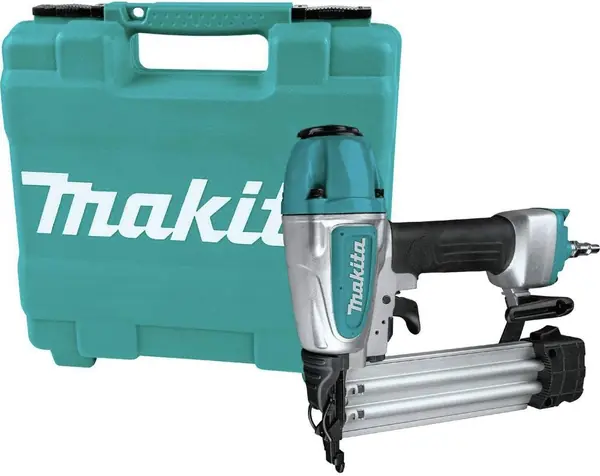
Makita AF506 teal pneumatic 18-gauge brad nailer with narrow nose and tool case

Detailed finish work

Shop Score 93/100
Brad Length
5/8 in. to 2 in.
Weight
2.86 lb
Operating Pressure
70 to 120 PSI
Magazine
100 brads
View on Amazon

Nose access is the reason this one is here. The AF506's nose is cast and machined so it sits flat against the work in places a wider gun has to be tilted into — inside corners on a cabinet face frame, the gap between a door casing and the jamb, the last few inches of a return. Tilting a nailer to fit is how brads go in at an angle and break out the side of a thin piece, so a nose that fits is a quality feature, not a convenience.

The body, magazine, and cylinder are aluminum, and it feels like a tool that expects to ride in a truck. The built-in air duster is a genuinely useful extra: a puff clears sawdust off the surface so the non-marring tip isn't riding on grit and dimpling the wood around the fastener. It runs on 70 to 120 PSI, wide enough to cover the pressure most trim work wants, and the 100-nail magazine and tool-less depth dial keep a run moving.

It's the most expensive nailer in this guide, and the premium buys access: if your work is inside corners and applied moldings, the extra money goes into the one thing you can't add to a cheaper gun later. If your week is open-room baseboard and casings, our top pick does that job for less. What we didn't expect to use as much as we did is the air duster — it turns a two-hand job into one.

Worth Noting

  • Two-inch maximum brad length limits built-up trim
  • Plastic tool case is flimsier than the nailer
Our Verdict

We pick the Makita for fussy work: its narrow nose reaches into inside corners, the built-in air duster clears the surface, and the aluminum body takes jobsite abuse.

Check Latest Price
5.

WEN 61723K Brad Nailer Kit Best Budget Kit

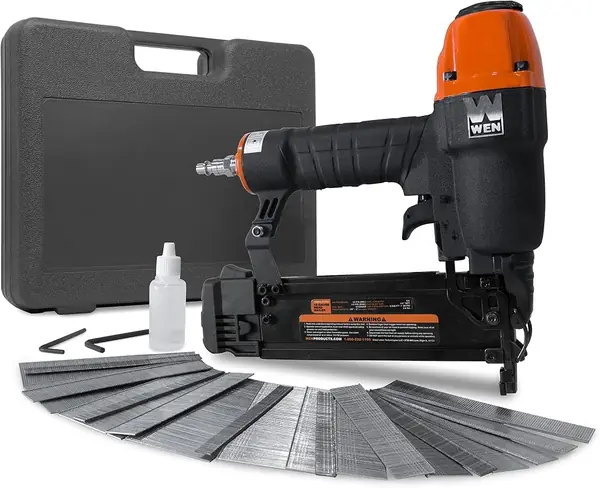
WEN 61723K pneumatic 18-gauge brad nailer with carrying case and an assortment of brads

Starting from scratch

Shop Score 91/100
Brad Length
3/8 in. to 2 in.
In The Box
2,000 brads in four lengths and a case
Operating Pressure
60 to 115 PSI
Magazine
106 brads
View on Amazon

Open the box and you have a project's worth of fasteners: 2,000 brads split across 3/8-, 3/4-, 1-, and 2-inch lengths, plus a case. For someone who doesn't yet own a drawerful of nail strips, that's the difference between buying a tool and buying a setup, which is why we recommend it as a first nail gun. The 3/8-inch minimum matters more than it sounds — it's the length for drawer bottoms, thin paneling, and cabinet backs where a 5/8-inch brad would poke straight through, and no other nailer here will take it.

The rest of the tool is honest rather than fancy: a 106-nail magazine, a gauge window so you can watch the strip run low, a depth wheel with a usable range, a rotating exhaust, and a nose latch that opens without tools when something jams. It runs 60 to 115 PSI, so the small compressor in the corner is plenty, and the inlet is the common 1/4-inch NPT fitting.

Nothing about it feels like a compromise tool. The magazine locks up tight, the castings have some substance, and 2-inch brads go into hardwood trim without the hesitation we expect from a budget gun. Between projects everything lives in the case, which is more organization than most shops manage on their own.

Worth Noting

  • No belt hook for ladder work
Our Verdict

Anyone starting from zero should look at the WEN kit: 2,000 brads in four lengths, a case, and a nailer that handles everything from 3/8 to 2 inches.

Check Latest Price
6.

WORKPRO 2-in-1 Brad Nailer/Staple Gun Best for Upholstery and Shop Work

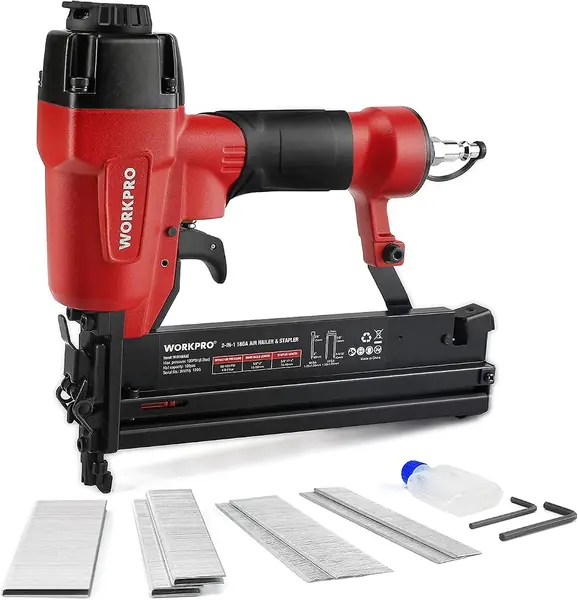
WORKPRO 2-in-1 pneumatic brad nailer and staple gun in black and blue

Upholstery and shop work

Shop Score 90/100
Brad Length
5/8 in. to 2 in.
Operating Pressure
60 to 100 PSI
Staple Length
5/8 in. to 1-9/16 in.
Included Fasteners
400 brads and 300 staples
View on Amazon

Two fasteners, one body, one hose: this WORKPRO drives 18-gauge brads from 5/8 to 2 inches and 1/4-inch crown staples from 5/8 to 1-9/16 inches, and it arrives with 400 brads and 300 staples to start. The magazine holds 100, the depth wheel adjusts by hand, the exhaust rotates a full turn away from your face, and the nose opens without tools when you need to clear a jam. It runs on 60 to 100 PSI.

Where we like it is upholstery, cabinet backs, paneling, and shop jigs — the jobs where a staple holds better than a brad and you don't want two tools fighting for bench space. Where we don't is the last pass on visible trim: a combination nose can leave a staple-width line in soft wood, which you'll be filling and sanding. Buy it for the shop and the sofa, and keep a dedicated brad nailer for the room people will see.

Worth Noting

  • Combination nose can leave a staple-width line in soft wood
Our Verdict

As a second gun on the bench, the WORKPRO makes sense: brads and 1/4-inch crown staples from one hose-fed tool, with 700 fasteners in the box.

Check Latest Price

How We Tested Pneumatic Brad Nailers

We started by pulling every 18-gauge pneumatic model we could find from brands we'd trust in a shop, then filtered by the specs that decide the work: brad length range, magazine capacity, published pressure range, weight, and what actually ships in the box. That left 12 nailers, which we ran for eight months across a hallway trim remodel, a cabinet shop, and an upholstery bench. We wore safety glasses every session and disconnected the air hose before loading brads or clearing a jam.

Each tool was hooked to the same compressor and fed full strips of 2-inch brads into poplar and oak offcuts, fired as fast as the trigger allowed, to see whether the magazine fed cleanly down to the last brad or left one standing proud. We pushed every nose into inside corners on a test casing to check reach, then looked at the wood for marks from the no-mar pad. Depth dials got adjusted with the tool in hand rather than on a bench, and we noted which ones moved in detented clicks and which ones drifted.

We weighed each nailer on a kitchen scale, then held it overhead through a run of ceiling trim to see how the balance felt after ten minutes. Both trigger modes were tried on scrap, since bump fire on a finished surface is a different tool than sequential fire. We ran each gun at the bottom and top of its stated pressure range, checked for leaks at the air fitting, and inventoried the case, fittings, no-mar tips, and fasteners. After eight months we looked for cracked housings, worn feeders, and sluggish triggers, and judged whether the warranty still covered the way the tool actually gets used.

How to Choose a Pneumatic Brad Nailer

Start With Air, Not Features

An 18-gauge brad nailer is a small air consumer, so the compressor you already own will almost certainly run one. The numbers that matter are the tool's operating range and the inlet size. Everything here hangs off a 1/4-inch air fitting, and the Makita AF506, WEN 61723K, and WORKPRO all publish ranges that start at 60 or 70 PSI, which means a pancake compressor set at 90 is enough gun supply.

What you can't skip is the regulator. Too little pressure and brads sit proud of the surface; too much and you over-drive them into soft pine. Set the pressure on a scrap of the same stock before you touch the good trim.

Nose Shape Decides Where You Can Nail

A narrow nose with a no-mar tip is the difference between nailing an inside corner flat and tilting the gun to fit — and a tilted brad enters at an angle, which is the usual reason a fastener breaks out the side of a thin casing. The Bostitch's Smart Point tip and the Makita AF506's machined nose are the two smallest here, and both come with replaceable no-mar tips for when the original gets chewed up.

The trap is trimming that tip off to reach a tighter spot. The dimple it prevents is deeper and uglier than the quarter inch of access you gain, so leave it on and tilt the work instead.

Depth Adjustment and Trigger Mode

Depth of drive should adjust without a wrench. A dial lets you fine-tune one brad at a time; detents, like the DeWalt's, let you click back to a setting you already liked after a change of material. Either beats a setscrew you have to hunt for mid-run.

If the gun also offers bump fire, treat it as a mode for long straight runs, not a default. Contact-trip firing is faster, and speed is exactly what you don't want an inch from a finished edge — switch to sequential fire for anything visible.

Weight Matters Most Overhead

The spread across this group is wide: 2.2 pounds for the Metabo HPT against 5.16 for the Bostitch. Weight you hold at arm's length is the weight that tires you, so the difference shows up in the second hour of crown molding, not the first. If your work is crown, door heads, and upper cabinets, go light.

If most of your nailing happens at hip height on baseboard, the number on the spec sheet matters less than how the tool balances in your hand — the grip and the hose hanging off the back of it.

Brad Length, Feeding, and What's in the Box

Two inches covers baseboard, casing, and cabinet work; the 2-1/8-inch range only the Bostitch carries buys you a little more bite in built-up profiles. At the other end, 3/8-inch brads handle drawer bottoms and thin paneling, and the WEN is the only gun here that takes them. Match the range to the material you actually buy.

Feeding is the specification nobody prints. A straight magazine, clean strips, and a nose that closes fully do more for jam-free running than any marketing claim, and a tool-free jam latch means a misfeed costs seconds instead of a search for an Allen key. Warranty coverage runs from three years to seven among the nailers here that publish one.

Frequently Asked Questions

Final Verdict

If you nail trim more than once a year, the Bostitch BTFP12233 is the one to buy. It shoots the longest brad in this guide, places it more precisely than anything else here, and stands behind it with a seven-year warranty — three things that matter every time you put a fastener next to a finished surface.

Buy the Metabo HPT instead if this is your first pneumatic gun and the budget is tight; you give up reach and some refinement, and you save real money. If your work is cabinet-level detail, the Makita AF506's narrow nose and onboard air duster earn their premium.