↑↓ navigate ↵ open Esc close All results →

Best Pneumatic Framing Nailers of 2026

A framing nailer proves itself strictly by firing on demand: one cleared jam mid-wall breaks your rhythm, and a second sends you reaching back for a framing hammer. Dependable guns keep balance light enough to position a stud with one hand while driving 3-inch fasteners cleanly with the other.

Across eight months framing a garage wall, decking a roof, and patching subfloor with nine nailers, collation compatibility emerged as the first real filter. Because 21-degree plastic-collated sticks and 28-degree wire-weld strips do not interchange, the smart choice is the magazine angle your local lumberyard keeps on the shelf—paired with a compressor capable of meeting its 90 PSI air demand so nails never short-stroke.

From a surprisingly capable budget gun to heavy-duty production framers, all seven models deliver steady strip feeding, wrench-free depth adjustment, and distinct trigger feedback.

Our Top Picks

The Best Pneumatic Framing Nailers

1.

Metabo HPT NR90AES1 Best Overall
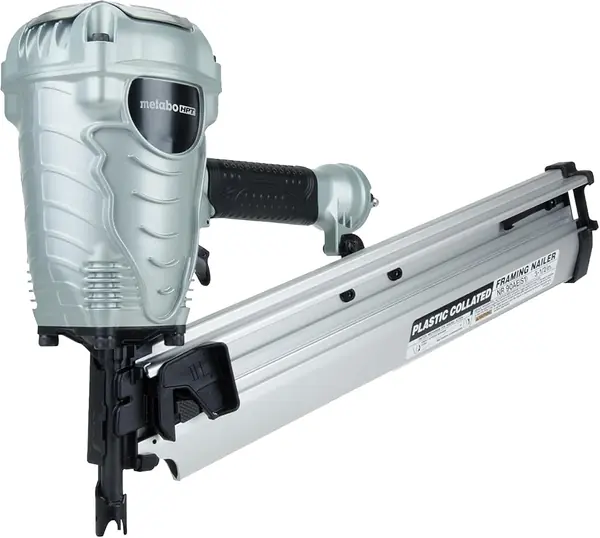
Metabo HPT NR90AES1 pneumatic framing nailer with 21-degree magazine and safety glasses

Framing and sheathing

Shop Score 94/100
Weight
7.5 lb
Nail Angle And Collation
21° plastic collated
Nail Length
2 to 3-1/2 in
Warranty
5 years
View on Amazon

At 7.5 pounds, the NR90AES1 is the lightest full-size gun in this group, and it's the number we kept coming back to. Nailing sheathing along a top plate, one hand steadying the board and the other on the gun, a pound and a half is the difference between finishing the wall and stopping to shake out your shoulder. The balance helps as much as the figure: the nose sits where you point it, so you aren't fighting the tool to hold a line of nails.

It runs 21-degree plastic collated full round head nails from 2 to 3-1/2 inches, the strip you can buy at any lumberyard. The selective actuation switch flips between sequential fire for layout marks and bump fire for sheathing without a tool change, and depth adjusts on a dial at the nose, so going from SPF studs to denser engineered stock takes seconds rather than a wrench and a pressure change.

The redesigned head guard comes apart in fewer steps when you do need to get into the magazine, and the trigger breaks the same way in both modes. What struck us in use is how little the gun asks of you. The exception is the contact safety: the nose has to sit flat before the tool fires, which makes shooting a high nail to pull a stud plumb awkward. If you plumb walls that way, keep a clamp on the truck for those nails.

Against this set the price lands in the middle, more than the two budget guns and well under the pro-grade NR83A5, and this is the one we hand to someone buying a single framing nailer. Five years of warranty covers the decision, and the nail availability means you never drive past a job because the yard was out of your strip.

Worth Noting

  • Plastic collation scatters chips around the work area
Our Verdict

We recommend it as the default framing nailer: the lightest full-size gun here, running the nails every yard stocks, with a trigger switch that covers both modes.

Check Latest Price
2.

Metabo HPT NR83A5 Best for Production Crews

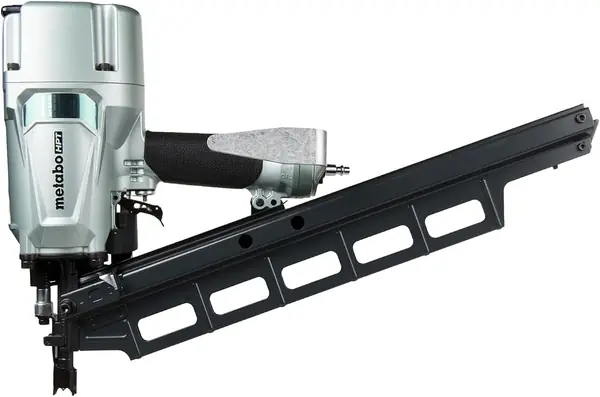
Metabo HPT NR83A5 framing nailer with rafter hook and rear-loading 21-degree magazine

Daily production framing

Shop Score 93/100
Weight
8.8 lb
Nail Angle And Collation
21° plastic collated
Nail Length
2 to 3-1/4 in
Warranty
5 years
View on Amazon

If a nailer goes on the truck every morning, this is the one we point at. The NR83A5 is built to be shot hard and serviced rather than replaced, and the cylinder valve drive is the same system this platform has used for years, sharing its internals with the original. That's why the gun feels predictable: the trigger breaks the same way on the first nail of the day and the four-hundredth.

The details are jobsite details. The rafter hook bolts to either side, so a left-handed framer isn't reaching across the gun to hang it. The magazine loads from the rear, which is faster with gloves on. The trigger switch selects contact or sequential actuation, and it sits in the trigger itself where you find it without looking. Full round head 21-degree plastic nails keep you on the common strip.

The trade-off is the one you feel at the end of a long day: 8.8 pounds with a full magazine is a lot of tool to wave around overhead, and this is the most expensive gun on the page. Crews absorb that because the hook carries it between plates and the warranty covers five years of hard use. For weekend framing, the lighter NR90AES1 is the better buy.

Worth Noting

  • Tops out at 3-1/4-inch nails
Our Verdict

Buy it if you frame for a living: our pick for daily production work, with a hook on either side and a five-year warranty behind it.

Check Latest Price
3.

Bostitch F28WW Best for Engineered Lumber

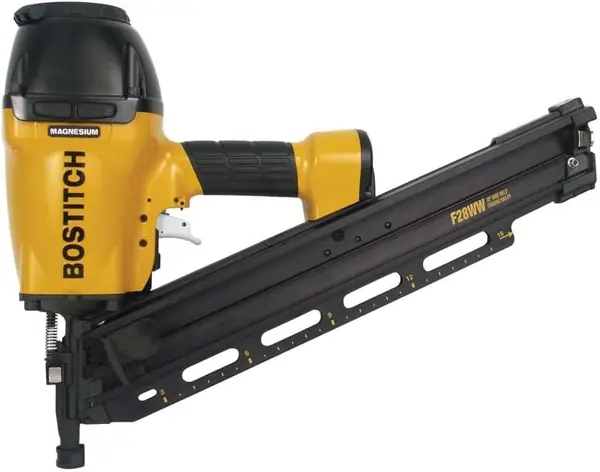
Bostitch F28WW wire-weld framing nailer with magnesium body and adjustable rafter hook

Engineered lumber

Shop Score 92/100
Weight
9.8 lb
Nail Angle And Collation
28° wire weld
Nail Length
2 to 3-1/2 in
Rafter Hook
Adjustable
View on Amazon

The F28WW is a wire-weld gun, which means the nails come bundled in wire rather than molded into a plastic strip. That one choice changes the day: nothing plastic to pick out of the grass, nothing to sweep off a subfloor, nothing wedged in a nail pouch. It drives 2 to 3-1/2 inch 28-degree wire-weld nails, and the clipped heads stack tight in the magazine.

The body is magnesium, and the push-button depth guide sets nails without hunting for a wheel. Our favorite detail is the notched 16-inch layout indicator on the magazine: hook the notch on the last stud, mark the next one, and skip the tape. The adjustable rafter hook is the other thing we used constantly, because hanging the gun is how you stop setting it down in the sawdust.

What we like most is how little there is to argue with. It fed everything we gave it, the depth setting held across a wall, and the trigger has a firm, mechanical feel we trust on a ladder. We reach for it when the boards are heavy or the lumber is engineered. If your framing is all SPF studs and you want the easiest carry, the Metabo is the lighter tool; if you want a clipped-head gun that drives like it means it, this is the one.

Worth Noting

  • Heaviest gun here at 9.8 pounds
  • 28-degree wire-weld nails are harder to find
Our Verdict

Our choice for engineered lumber and heavy stock, provided your supplier carries 28-degree wire-weld nails.

Check Latest Price
4.

NuMax SFR2190 Best Budget

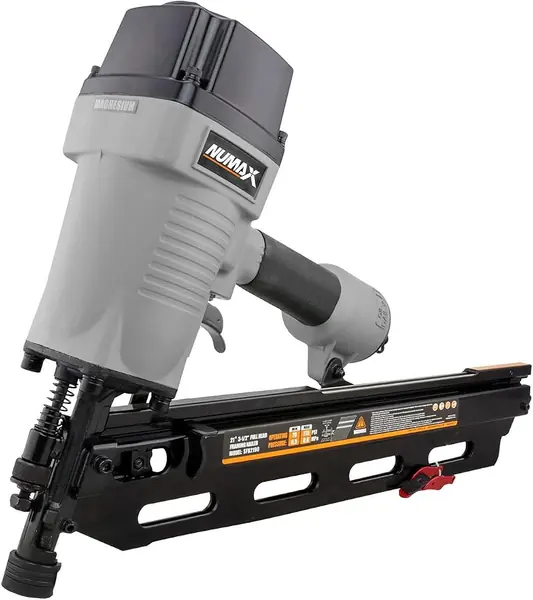
NuMax SFR2190 pneumatic framing nailer with comfort-grip handle and 21-degree magazine

Budget framing projects

Shop Score 91/100
Weight
8.6 lb
Nail Angle And Collation
21° plastic collated
Nail Length
2 to 3-1/2 in
Compressor Minimum
2.5 CFM at 90 PSI
View on Amazon

The SFR2190 costs less than anything else here and drives the same 21-degree plastic collated full round head nails as our top pick, from 2 to 3-1/2 inches and up to a 0.131-inch shank. Two triggers come in the box, a single-fire trigger fitted for precision and a bump-fire trigger you swap in for speed, so the mode question gets answered by whichever trigger is in the gun.

NuMax also publishes the compressor spec, which most makers leave you to guess at: a minimum of 2.5 CFM at 90 PSI with a tank of at least 3 gallons, running 70 to 115 PSI. We paid attention to that, because a framing nailer that seems weak is usually a nailer starved for air. The anti-dry-fire mechanism keeps the tool from firing on an empty magazine and protects the drive blade, the no-mar tip saves trim work, and the 360-degree exhaust turns away from your face.

Where it fits is the garage, the fence line, and the subfloor: a homeowner or remodeler who needs a real framing nail gun for a handful of projects a year and doesn't want to tie money up in one. The one-piece steel drive blade handles that pace, and what you save buys nails and a hose. If you're on a crew shooting nails five days a week, this isn't the gun, and the picks above are.

Worth Noting

  • Jams and stops firing near the end of a strip
  • One-year warranty is the shortest in this group
Our Verdict

We point budget buyers here: the least money for a full 3-1/2-inch framing gun, as long as a shorter warranty and the odd jam are acceptable.

Check Latest Price
5.

Freeman PFR2190 Best Value

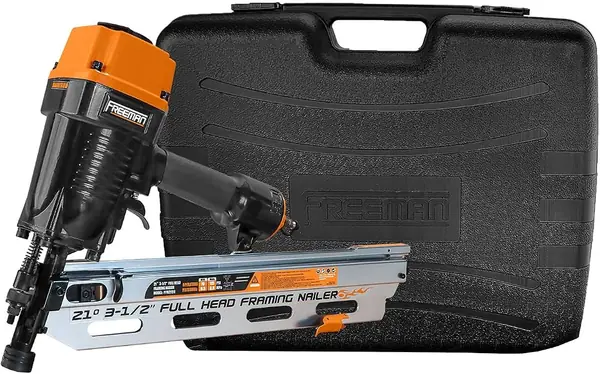
Freeman PFR2190 framing nailer with anodized aluminum magazine and blow-molded carrying case

Value-minded seasonal framing

Shop Score 90/100
Weight
8.8 lb
Nail Angle And Collation
21° plastic collated
Nail Length
2 to 3-1/2 in
Warranty
7 years limited
View on Amazon

A blow-molded case and a seven-year limited warranty are what separate the Freeman from the other budget gun here, and together they're hard to argue with. The case matters more than it sounds: a framing nailer that rides loose in a truck bed collects grit in the magazine and loses its safety glasses by the second week. Seven years on the tool, plus 90 days on wearable parts, is the longest coverage on this page, and it's why we're comfortable recommending this one to someone who frames seasonally and leaves the gun on a shelf for months.

The gun itself is a 21-degree plastic collated full round head nailer for 2 to 3-1/2 inch nails, with a one-piece hardened steel drive blade, an anodized aluminum magazine and cylinder, anti-dry-fire, and a dual-mode trigger. Fence pickets and subfloor go in without drama. In denser engineered stock, expect to run full pressure and turn the depth up to get heads flush, which is worth knowing before you decide the tool is weak. We like it as a first framing nailer that comes with somewhere to put it.

Worth Noting

  • 8.8 pounds gets heavy working overhead
Our Verdict

The value pick, in our view: a case and the longest warranty here for a little more than the cheapest gun on the list.

Check Latest Price
6.

Bostitch F21PL

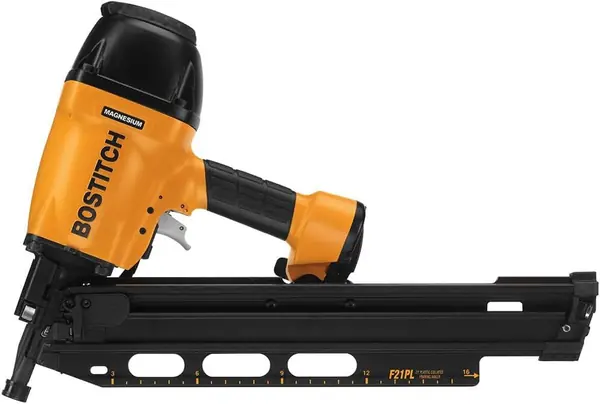
Bostitch F21PL magnesium framing nailer in gold and black with two quick-change nosepieces

Framing plus hardware

Shop Score 89/100
Weight
8.15 lb
Nail Angle And Collation
21° plastic collated
Nail Length
1-1/2 to 3-1/2 in
Depth Adjustment
Push button
View on Amazon

There are two nosepieces in the box. The one on the gun drives 1-1/2 to 3-1/2 inch 21-degree plastic collated framing nails; the second swaps on in seconds and drives the 1-1/2 and 2-1/2 inch metal-connector nails used for hangers and truss hardware. For a small crew that frames a wall and hangs hardware the same morning, that's one gun doing two jobs and one less case riding in the truck.

The magnesium body keeps an 8.15-pound tool balanced forward, which is lighter than most of this group. The patented push-button depth guide resets fast when you move from studs to hardware, and the 16-inch layout indicator on the magazine marks stud spacing without a tape. The adjustable rafter hook is the detail we used most, because hanging the gun instead of setting it down is how you stop leaving it in the dirt.

The catch is specialization. If you never hang hardware, you're paying for a nosepiece that stays in the case, and for pure framing the top pick is lighter and simpler to live with. We like this one for the remodeler whose week mixes framing with hangers and hurricane ties, where the second mode earns its keep a few times a month instead of never. Buy it for the range of work, not for the framing alone.

Worth Noting

  • Jams on the last few nails in a strip
Our Verdict

We keep it on the list for crews that also hang hardware, since the second nosepiece turns one gun into two.

Check Latest Price
7.

PneuTools SN2283H Best for Simple Rugged Framing

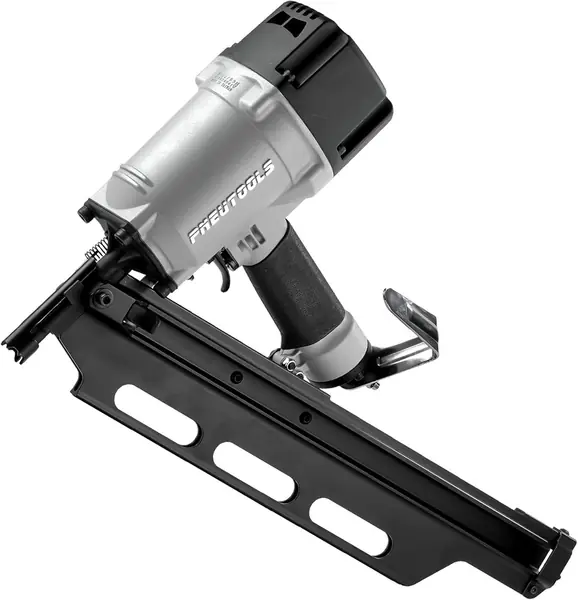
PneuTools SN2283H silver framing nailer with steel rafter hook and aluminum magazine

Simple rugged framing

Shop Score 88/100
Weight
7.9 lb
Nail Angle And Collation
21° plastic collated
Rafter Hook
Steel
Trigger
Single mode
View on Amazon

One trigger, one mode, no switch. The SN2283H is deliberately old-school, built around a low-profile single-mode trigger that favors speed and durability over options, and the rest of the gun follows the same logic: a one-piece safety mechanism, a hardened steel end cap where the tool takes its hardest knocks, a steel rafter hook, and an aluminum magazine. It runs 21-degree plastic collated full round head nails, the same strip as the Metabo guns.

At 7.9 pounds it's the second-lightest gun in this group, and the rafter hook means you hang it rather than set it down in the sawdust. The end cap and aluminum magazine are the parts that take the abuse, and that's most of the argument: this is a gun for someone who wants a simple tool that lives in a truck bed and gets wiped down once a month. We think that's the whole point of it. Whether it's worth the money here depends on how much you value the extra modes and layout features the other picks bring.

Worth Noting

  • No bump-fire mode when you want speed
Our Verdict

We like it for buyers who never use bump fire and want a light, simple gun that survives being dropped.

Check Latest Price

How We Tested Framing Nailers

We started with a couple dozen models and filtered by what decides whether a gun is usable on your job: nail angle and collation, maximum nail length, weight, magazine capacity, trigger modes, price, and the CFM and tank size it demands at 90 PSI. Angle came first, because a tool that only runs wire weld is dead weight if every yard within driving distance stocks plastic strips. That cut the field to nine, and we ran each one for eight months.

Each gun went through the same rotation: a garage wall, a roof deck, a subfloor patch, a run of deck framing, and hours of overhead sheathing. Goggles on, we loaded fresh strips one-handed the way you do on a roof, ran every strip down to the last nail, and recorded misfires, dry fires, and anything that had to be pried out of the nose. We noted how deep the head sat in SPF versus engineered lumber before and after adjusting depth, and tried both sequential and bump firing with the work flat on sawhorses and our hands back on the handle.

We weighed each tool and ran it overhead until our shoulders gave out, which is where the lighter guns separated from the heavy ones. We hung each one from its rafter hook between passes and worked a few tight bays to see how the body handled. We ran every nailer off a small pancake compressor and a larger tank, staying inside the pressure range printed in each manual, to see where CFM demands turned into half-driven nails. Warranty length and the availability of o-rings, bumpers, and firing pins counted too, since a tool you can't rebuild is a tool you replace.

How to Choose a Pneumatic Framing Nailer

Start With the Nail, Not the Gun

Every framing nailer is built around one collation, and the common ones don't interchange. 21-degree plastic collated strips are the most widely stocked and usually the cheapest per nail, which is why most of our picks use them. 28-degree wire weld leaves no plastic on the ground and feeds a clipped-head magazine; 30-degree paper strips are clean and common in some regions; 15-degree coil holds the most nails for production sheathing. A framing nail gun that eats nails you can't buy locally is a paperweight. Put a box of nails on the counter before you put a gun in the cart.

Weight and Balance Matter More Than Features

The guns here run from 7.5 to 9.8 pounds, and the difference shows up in the last hour of sheathing a wall rather than the first. Where the mass sits matters as much as the number: a tool that balances just behind the nose stays on your layout mark with less effort, and a nose-heavy one fights you on every nail. The rafter hook is part of the weight story too, because hanging the gun between plates is how crews carry a heavier tool all day. If most of your nailing is overhead, put weight first and features second.

Triggers and Depth Control

Sequential fire makes you depress the nose, then pull the trigger for each nail: slower, precise, and the right mode for layout marks and toenailing. Bump fire lets you hold the trigger and bounce the nose along the work, which is fast for sheathing and unforgiving if your attention drifts. A switchable trigger gives you both; a single-mode gun makes that choice at purchase. Depth deserves the same attention. Set it on scrap of the same stock, because SPF studs and engineered lumber sink a nail very differently, and no trigger mode fixes a nose that's set wrong.

Your Compressor Is Half the Tool

A framing nailer drinks air fast, and a small pancake compressor spends more time recovering than driving. NuMax publishes a useful floor for its gun, 2.5 CFM at 90 PSI with a tank of at least 3 gallons, and it's a fair benchmark for any framing nailer rather than a target. Tank size buys recovery, which is what you actually feel when you're running a wall. Check the CFM rating at 90 PSI on your compressor before you decide a new gun is weak.

Warranty, Wear Parts, and Service

Framing nailers consume o-rings, bumpers, and drive blades, so the warranty tells you how much of that the maker stands behind. Coverage among our picks runs from a single year up to seven, and the longer terms usually separate wearable parts from the tool itself. Two questions settle it: who services the gun, and can you buy a rebuild kit? A cheaper tool with no parts path costs more over five years than one with real coverage and a phone number to call.

Frequently Asked Questions

Final Verdict

If you're buying one pneumatic framing nailer, we point you to the Metabo HPT NR90AES1. At 7.5 pounds it's the lightest full-size gun in this group, it takes the 21-degree plastic nails every lumberyard stocks, and the trigger switch and tool-less depth cover the two adjustments you make all day. Five years of warranty backs the decision.

Frame for a living and the NR83A5's heavier build, hooks on both sides, and serviceable internals earn the extra money. On a tight budget, the NuMax drives the same nails for the least spend. And if your lumber is engineered or you want no plastic strips on the ground, the Bostitch F28WW is the alternative, provided 28-degree wire-weld nails are within reach.