↑↓ navigate ↵ open Esc close All results →

Best Pin Nailers of 2026

Thinner than a toothpick, a 23-gauge pin leaves a hole small enough to skip putty on a cabinet face or run of shoe molding. Because headless pins lack structural holding power on their own, the tool's real job is clamping trim immobile against hardwood or softwood until the glue cures.

Cabinet assembly on the bench, hallway baseboard, and overhead crown across seven months with 11 pneumatic and cordless nailers proved that sticker price rarely predicts a clean set. A responsive depth dial does more to keep pins flush than a larger motor, and a slender nosepiece decides whether the tool reaches an inside corner cleanly or bruises the adjacent stile.

Pneumatic models suit shops already plumbed to a compressor, while cordless units eliminate dragging a hose across finished floors—and every model that survived testing sinks pins flush in white oak without marring the face.

Our Top Picks

The Best Pin Nailers

1.

Metabo HPT NP35A Pin Nailer Best Overall
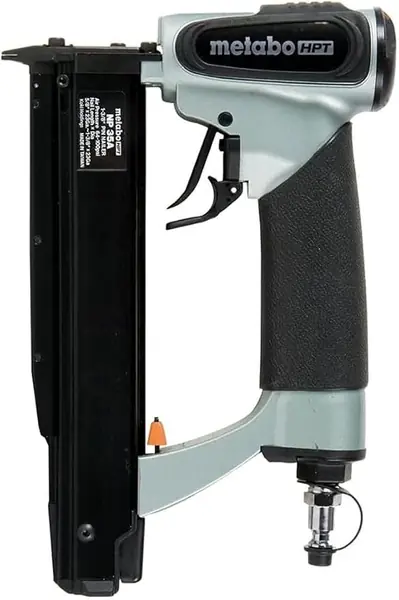
Metabo HPT NP35A 23-gauge pneumatic pin nailer with no-mar tips and carrying case

General trim work

Shop Score 92/100
Power Source
Pneumatic
Fastener Range
5/8 to 1-3/8 inches
Tool Weight
2 lb
Warranty
5 years
View on Amazon

Glazing bead above a door is where a pin nailer's weight stops being a number on a spec sheet. At 2 pounds, the NP35A is the tool we can keep up there through a full run without switching arms, and that comfort is a big part of why it's our top pick for fine trim and finishing work.

The magazine takes 23-gauge headless pins from 5/8 inch to 1-3/8 inch, which covers small moldings, paneling, cabinet trim, glazing bead, and picture frames. A visual reload indicator warns you before a stick runs dry, the no-mar tips and rear exhaust keep a finished face clean, and the drive was consistent enough that we stopped checking every pin after the first few feet.

The top of the range is where it can disappoint. On dense stock with the no-mar tip fitted, pins sometimes sit proud of the surface, so turn the pressure up and test on a scrap of the same species before you commit to a run of molding. Pine casing and plywood paneling set flush; a hard maple picture frame is where you'll be checking every pin.

The kit is generous for the money: a hard case, two no-mar tips, safety glasses, a 1/4-inch air fitting, and a hex wrench, all backed by a five-year warranty. Buy 3/4-inch pins for molding and 1-inch pins for cabinet face frames and you won't need to swap lengths mid-project.

Worth Noting

  • Depth changes need a hex wrench
Our Verdict

We recommend it for anyone trimming out a room: 2 pounds is easy to hold overhead, the pin range covers molding and glazing bead, and the five-year warranty backs it.

Check Latest Price
2.

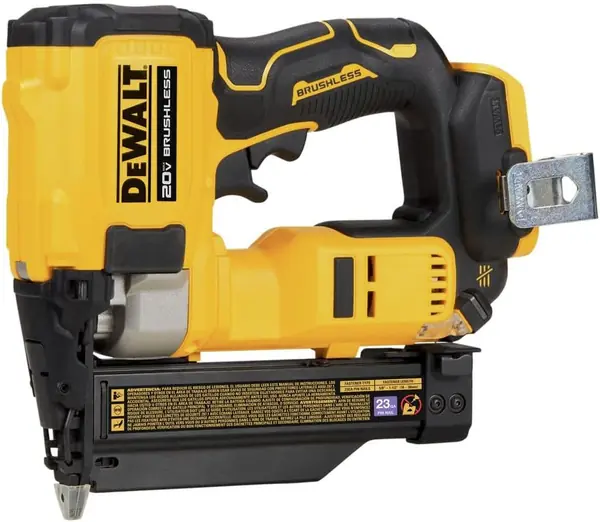
DEWALT ATOMIC DCN623B Cordless Pin Nailer Best Cordless

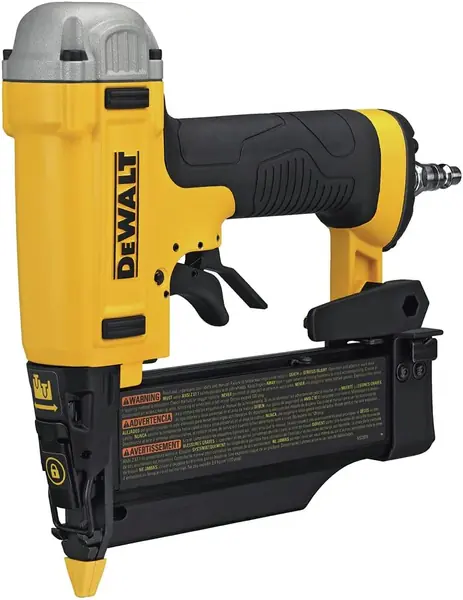
DEWALT ATOMIC 20V MAX cordless 23-gauge pin nailer body without battery

Finished rooms

Shop Score 91/100
Power Source
20V MAX battery (tool only)
Fastener Range
5/8 to 1-1/2 inches
Tool Weight
4.45 lb
Shots Per Charge
2,000
View on Amazon

A hose dragging across a finished floor is the reason a lot of pin nailers stay in the truck. The ATOMIC 20V removes that entirely — no compressor, no tank to pressurize, no line to step over — and it's the pin nailer we reach for once the floors are done.

It fires 23-gauge pins from 5/8 inch to 1-1/2 inch and manages 2,000 shots per charge, with tool-free jam release and depth adjustment plus a low-nail lockout and LED that tell you when to reload. The 1-1/2-inch ceiling is shorter than the 2-inch pneumatics here, though it clears cabinet trim, door casing, and paneling easily. At 4.45 pounds it's the heaviest tool in this group, more than double the compact Metabo, and overhead runs are where you feel it; the trade is a hose you never have to drag.

Pins are where the fussiness lives. The magazine feeds some brands more happily than others, especially at the top of its range, so buy a single stick and run a dozen before committing to a box. What you get in return is speed: no setup, no hose routing, and enough capacity in one charge to case a room.

Worth Noting

  • Sold as a bare tool, no battery
  • Fussy about some pin brands
Our Verdict

We keep this one for finished rooms: no hose to drag across a floor and up to 2,000 pins per charge, as long as you already own 20V MAX batteries.

Check Latest Price
3.

BOSTITCH HP118K Pin Nailer Kit Best Kit

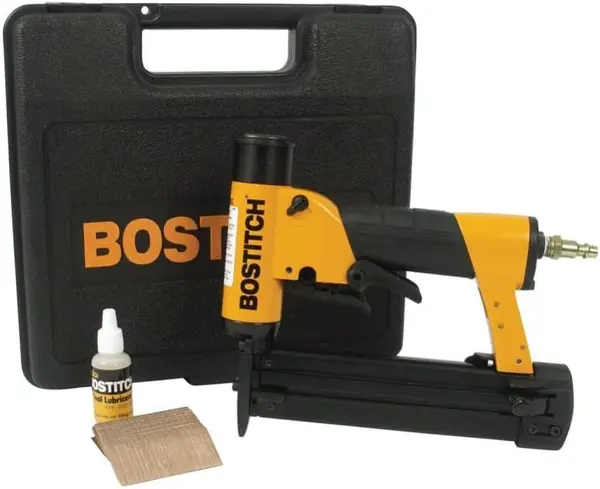
BOSTITCH HP118K 23-gauge pneumatic pin nailer kit with pins and black carrying case

First pin nailer

Shop Score 90/100
Fastener Range
1/2 to 1-3/16 inches
Tool Weight
2.5 lb
Included
1,500 pins and a case
Magazine Capacity
200 pins
View on Amazon

Open the case and you can start working: 500 pins each in 1/2, 3/4, and 1 inch, a 1/4-inch air fitting, lubricant, a belt hook, and a molded case to hold it all. For a first pin nailer that's a real advantage — you're not guessing at pin lengths before you've made a test cut.

The tool is a 2.5-pound aluminum-bodied pneumatic with a 200-pin magazine and a range of 1/2 inch to 1-3/16 inch. The low-profile nosepiece tapers to a fine point for clear sight lines into corners, and a high/low power switch changes depth without a trip to the regulator — useful when you move from pine casing to oak on the same run.

What keeps us coming back is how little fuss sits between the trigger and the result: pins feed smoothly and the holes disappear under a coat of paint. Plan around depth on hard material, though. At 1-3/16 inch in dense hardwood, pins can refuse to sink below the surface even at full pressure, so save the longest pins for softwood and let glue carry the hold where the set has to be flush.

Worth Noting

  • Tops out at 1-3/16-inch pins
Our Verdict

A first pin nailer that arrives ready to work, with 1,500 pins, a case, and a belt hook; its 1/2- to 1-3/16-inch range handles molding and picture frames.

Check Latest Price
4.

DEWALT DWFP2350K 2-Inch Pin Nailer Best for 2-Inch Pins

DEWALT DWFP2350K 23-gauge pneumatic pin nailer with no-mar tips and hard case

Cabinet assembly

Shop Score 89/100
Power Source
Pneumatic
Jam Release
Tool-free
Fastener Length
Up to 2 inches
Depth Adjustment
Tool-free
View on Amazon

Two inches is the pin length that takes a 23-gauge tool out of trim work and into cabinet assembly, and it's where most of these nailers stop short. The DWFP2350K is built around that ceiling: it drives pins up to 2 inches, and the maker's claim is that it sets them recessed into oak rather than merely flush.

Two features sold us on it over the other long-pin nailer here. The jam release is tool-free — a latch instead of a wrench and a prayer — and depth adjusts the same way, so moving between pine casing and white oak doesn't cost you five minutes in a dark corner. Oil-free operation matters too when you're pinning prefinished cabinet parts, where one oil stain means a refinish.

It ships with a hard case, two no-mar tips, and a 1/4-inch fitting. It's a specialist, though: if your work never runs past 1-3/8 inches, the compact Metabo is lighter in hand and less expensive, and extra reach is what you'd be paying for here. Feed it full pressure and let the pin do the work; long pins set best in solid stock, not in thin plywood.

Worth Noting

  • Heavier and pricier than compact 1-3/8-inch pin nailers
  • Long pins set best in solid stock, not thin plywood
Our Verdict

For cabinet work and thicker assemblies, this is the pneumatic that sets 2-inch pins recessed into oak, with the tool-free depth and jam release we appreciate.

Check Latest Price
5.

Metabo HPT NP50A Pin Nailer Best for Two-Inch Pinning

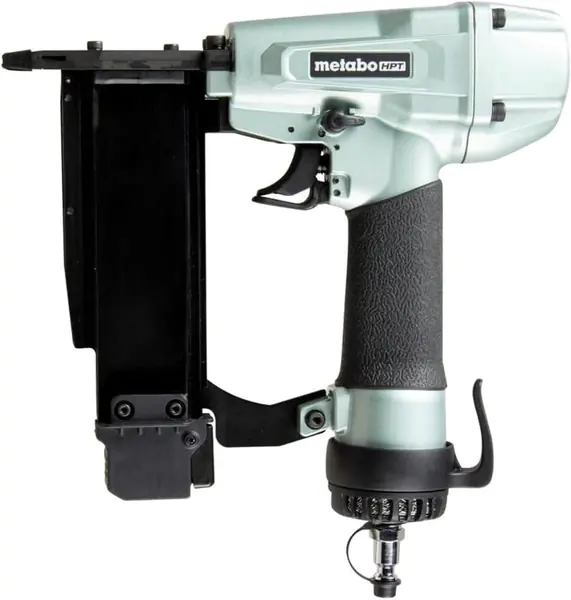
Metabo HPT NP50A 23-gauge pro pin nailer with aluminum magazine and storage case

Two-inch pinning

Shop Score 88/100
Power Source
Pneumatic
Fastener Range
1/2 to 2 inches
Tool Weight
3.3 lb
Warranty
5 years
View on Amazon

Where the NP35A stops at 1-3/8 inches, the NP50A keeps going to 2, and it does it with a 3.3-pound body and an aluminum magazine built to resist the fastener overlap that causes a lot of jams. The detail we value most is the dry-fire lockout: with six pins or fewer left, the tool won't fire, which is exactly the moment a dry shot would scar a finished face. A 360-degree silenced exhaust keeps air off your work, and the belt hook keeps the tool within reach.

It's a professional-grade pneumatic with a five-year warranty, a case, two no-mar tips, and enough range to handle 1/2-inch pins in a picture frame and 2-inch pins in a face frame. The DEWALT DWFP2350K matches its 2-inch reach and adds tool-free depth and jam release; the Metabo answers with the lockout and the longer warranty.

Worth Noting

  • Heavier at 3.3 lb for overhead work
Our Verdict

A well-built 2-inch pinner whose dry-fire lockout protects finished work, for woodworkers who want one air tool that covers long pins too.

Check Latest Price
6.

Arrow PT23G Pin Nailer Best for Crafts and Repairs

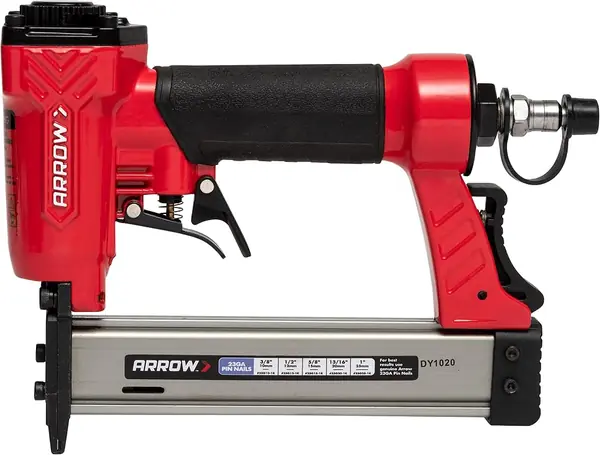
Arrow PT23G compact pneumatic 23-gauge pin nailer with side-load magazine and rubber grip

Crafts and repairs

Shop Score 87/100
Power Source
Pneumatic
Fastener Range
3/8 to 1 inch
Safety
Two-step trigger
Lubrication
Oil-free
View on Amazon

There's a much less expensive way into this: a compact pneumatic that shoots 3/8- to 1-inch pins, runs oil-free, and works off the same small compressor you'd use for a brad gun. The PT23G is the lowest-priced tool here, and for a lot of small work it does the job of guns costing several times more.

The body is die-cast aluminum with an overmold rubber grip, and the magazine side-loads so you can clear it without tools. A two-step safety trigger has to be disengaged before the tool fires, and it runs on home compressors up to 100 psi with no oil to add — two things you'll appreciate the first time you use it indoors on prefinished material.

Consistency is where the savings show. Pin feed on this one is the variable: it can run hundreds of pins without a hitch and then need clearing twice in a row, depending on the pins and the material, so keep a short stick of good pins on hand and don't push it past what 23-gauge is meant for. Think of it as a second gun, or a first gun for crafts, thin molding, and shop jigs.

Worth Noting

  • Feed can be inconsistent under heavy use
  • Some units fail early in their life
Our Verdict

The lowest-cost way into 23-gauge pinning, and enough gun for crafts and small moldings if you accept a little more clearing than the pricier tools.

Check Latest Price

How We Tested Pin Nailers

We started by pulling specs on every 23-gauge pin nailer we could find and sorting them by fastener range, power source, nose shape, and what comes in the box. Pneumatic and cordless tools are separate purchases, one leaning on a compressor you may already own and the other on a battery platform, so both stayed in the running. That filter left us with 11 tools, together covering the 3/8-inch to 2-inch pin range.

Testing ran seven months, mostly in a garage shop with the compressor by the door and in a finished hallway where mess mattered. Wearing the eye protection that came with each tool, we built cabinet boxes, ran baseboard, and hung crown overhead until our shoulders quit, driving pins into white oak, pine, and MDF. We kept every pin shorter than the stock it went into, and ran each tool through several hundred pins, watching for misfires, worn drivers, and slow leaks that showed up after a few weeks.

We weighed each tool on a kitchen scale, then noted how it balanced with an arm raised, because a light pinner and a heavy one feel very different in the middle of a crown run. We timed the depth adjustment to see whether it was a dial turn or a hunt for a hex wrench, and we counted every jam and clocked how long it took to clear.

To judge reach, we pushed each nose into a corner joint and against a finished face to see where it would and wouldn't sit. For the trigger, we pressed the nose against a scrap block and noted whether the tool fired on contact alone or waited for a deliberate pull. Then we added up what it costs to get started: compressor or batteries, pins, and a case.

How to Choose a 23-Gauge Pin Nailer

Pneumatic or Cordless: Start With What You Already Own

Every pin nailer here is air-powered except one, and that one costs more because it carries its own power. If a compressor already lives in your shop, a pneumatic gives you the lightest tool for the money — the compact Metabo HPT weighs 2 pounds where the cordless DEWALT is 4.45. If your pinning happens in finished rooms where a hose would drag across floors and knock lamps, that cordless premium buys you something real.

One trap: cordless pin nailers are usually sold as bare tools. Add a battery and charger to the total unless you're already on that platform, or the cordless option quietly becomes the most expensive one on your bench.

Match the Pin Range to the Work

Twenty-three-gauge pins run from about 3/8 inch to 2 inches, and the top of that range is what separates one tool from another. A 1-inch ceiling covers crafts, thin molding, and shop jigs; 1-3/8 inches handles glazing bead, paneling, and most cabinet trim; 2 inches reaches into face-frame assembly and thicker stock.

Buy for the length you'll shoot most weeks, not the longest pin in the description. A tool rated to 2 inches spends most of its life at 1 inch anyway, and the extra reach usually arrives with more weight in your hand.

Depth Adjustment and Clean Sets

Flush is the whole point, and getting there depends on two things: how the tool sets depth and what the nose does to the surface. Tool-free depth dials let you move between pine and oak without hunting for a wrench; the Metabo HPT NP35A asks for a hex key, a small annoyance you notice every time you change material.

No-mar tips protect finished faces but can hold a pin slightly proud on dense stock. Test on a scrap of the same species and turn the pressure up before you commit a run of molding to it.

Jams, Clearing, and Trigger Safety

Every pin nailer jams eventually; the question is how long it takes to get running again. Tool-free jam releases and side-load magazines are worth paying for on a tool you'll own for years.

Take the trigger seriously as well. A two-step safety trigger has to be disengaged before the tool fires, and a dry-fire lockout stops the gun when the magazine is nearly empty — the moment a dry shot would scar a face you just finished. Those two features are worth more than an extra half-inch of pin range.

Weight, Nose Access, and Overhead Work

Trim work spends a lot of time above shoulder height, and 2 pounds versus 3.3 versus 4.45 is the difference between finishing a run of crown and taking a break in the middle of it. Balance matters as much as the number: a light tool that sits forward in your hand tires you faster than a slightly heavier one that doesn't.

A slim, tapered nosepiece matters just as much in tight corners — inside a cabinet frame, against a glass stop. Handle the tool before you buy if you can rather than judging the nose from a photo.

Frequently Asked Questions

Final Verdict

The Metabo HPT NP35A is the pin nailer we hand to anyone trimming out a room: 2 pounds, a 5/8- to 1-3/8-inch range that covers bead and molding, and a five-year warranty nothing else here matches.

If your work happens in finished spaces and a hose is the obstacle, the cordless DEWALT DCN623B is the alternative and worth the outlay once you account for a battery. For a first kit that arrives with pins and a case, the BOSTITCH HP118K is the easiest place to start.