↑↓ navigate ↵ open Esc close All results →

Best Palm Nailers for Tight Spaces and Hangers of 2026

Anybody who has hung a joist hanger knows the problem: no room to swing, a nail that wants to wander, and an arm wedged between joists. A palm nailer puts a small air hammer in your palm — you press down, the tool strikes, and your other hand stays free to hold the hanger square. They all look like the same stubby aluminum block in a listing photo, though, and they are not remotely the same tool.

We tested 11 palm nailers over eight months, driving hanger nails, deck boards, and fence pickets in crawlspaces and overhead, and the differences came down to details rather than raw power: whether the magnetic nose held a nail while you lined it up, whether the air fitting swiveled enough to keep the hose off your wrist, and which way the exhaust aimed. (I stopped noticing the hose entirely on the ones that swiveled.) Check the nose against your nails first; a palm nailer that won't take your fasteners is useless no matter how hard it hits. These six earned a spot in the truck box, for framers and weekend deck builders alike.

Our Top Picks

The Best Palm Nailers for Tight Spaces and Hangers

1.

Metabo HPT NH90AB Palm Nailer Best Overall
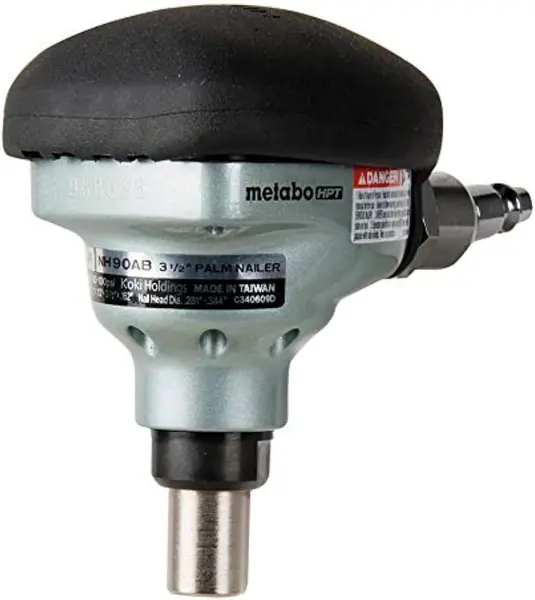
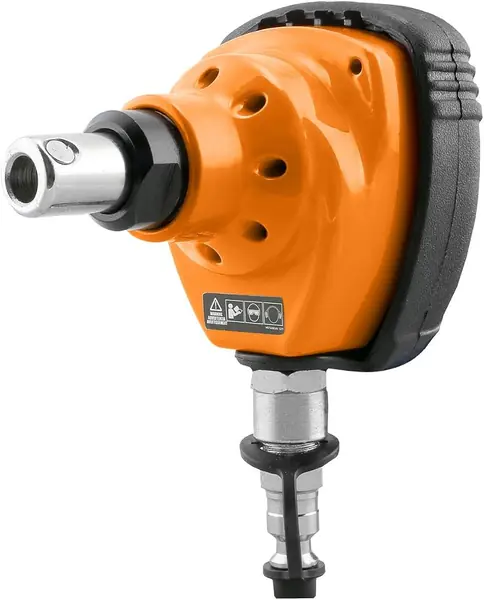
Metabo HPT NH90AB palm nailer with rubber grip and magnetic nose

Joist hangers

Shop Score 92/100
Weight
1.3 lb
Nose
Magnetic
Fastener Range
2-1/2" - 3-1/2" bulk fasteners
Air Fitting
360-degree swivel
View on Amazon

The value case here is simple: this is the least expensive way in our group to get a 3-1/2-inch-capable palm nailer, and it still arrives with the features that matter for hanger work. The body weighs 1.3 pounds, the over-molded rubber grip gives you something to hold onto, and the magnetic nose keeps a nail upright while you position the tool with one hand.

The 360-degree swivel air fitting is the detail we appreciate most. A hose that hangs straight down instead of fighting you sideways makes a real difference between joists, and the compact nose gets into the corner of a hanger where a hammer swing has no room. The five-year warranty gives the tool a useful safety net if it will live on a deck build.

For the buyer doing a run of joist hangers, deck boards, or fence rails, this is the palm nailer we point to first. It has enough power for the common 16D and hanger nails that drive these jobs, and the price leaves room for a good hose and fittings. We do not treat it as a framing nailer replacement; it is the tight-space tool you reach for when the framing gun will not fit.

Worth Noting

  • Air fitting can leak on some units
Our Verdict

We recommend the Metabo HPT NH90AB as the default palm nailer for hanger and deck work because it drives full-size bulk nails in tight spots without the premium price of the alternatives.

Check Latest Price
2.

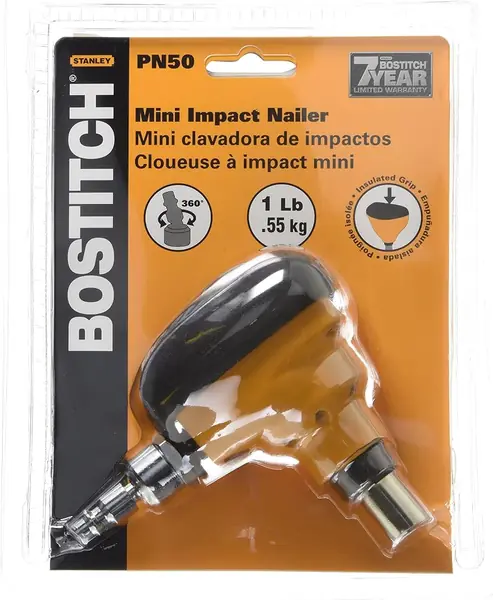
Bostitch PN50 Mini Impact Nailer Best for One-Handed Work

Bostitch PN50 mini impact nailer with rubber grip and swivel air fitting

One-handed tight work

Shop Score 90/100
Weight
1 lb
Exhaust
Front exhaust
Air Fitting
360-degree swivel
Fastener Type
Common bulk finish, framing, and timber nails
View on Amazon

At one pound, the PN50 is the lightest tool in this group, and that is not a spec-sheet nicety. We noticed the difference when holding a nailer above our shoulders or working one-handed between joists; the front exhaust also sends spent air away from your palm instead of into it. The 360-degree swivel fitting lets the hose fall out of the way, which matters more in a cramped rim joist than it does on a bench.

The PN50 mini impact nailer is built around common bulk finish, framing, and timber nails, and it handled the 16D hanger work that defines this category. The rubber grip insulates vibration, and the compact nose reaches into metal connectors where a hammer cannot swing. We like it as the control-first choice: you place the nail, set the nose, and let the tool do the hammering.

That combination of low weight and front exhaust is why we keep it near the top for overhead connector work. It is the palm nailer we hand someone who has to hold the tool in place with one hand and wants the hose to stay out of the way. For a deck framed with hanger nails and 16D fasteners, it is an easy tool to live with.

Worth Noting

  • Small-head nails sit loosely in the nose
  • Loud exhaust in enclosed spaces
Our Verdict

Choose the Bostitch PN50 when you want the lightest one-handed palm nailer here, with front exhaust and a swivel fitting that keep it controllable overhead.

Check Latest Price
3.

Freeman PMPN Pneumatic Mini Palm Nailer Best for Decking and Fencing

Freeman PMPN pneumatic mini palm nailer with magnetic tip and rubber grip

Deck and fence

Shop Score 89/100
Weight
1.4 lb
Nose
Magnetic tip
Fastener Range
Single 6D – 16D nails from 2" – 3-1/2" L
Warranty
7-year limited
View on Amazon

The Freeman PMPN covers the widest nail range in the compact group, taking 6D through 16D fasteners from 2 to 3-1/2 inches. The magnetic tip is the feature that makes that range practical: it holds the nail while you bring the tool into a hanger or fence rail, so you are not trying to balance a nail and a palm nailer at the same time.

We reach for this one on decking and fencing because the rapid hammering action keeps a run of nails moving without the wrist work of a hammer. The 1.4-pound body is still light enough to hold one-handed, and the rubber grip takes some of the sting out of repeated driving. The seven-year limited warranty is a meaningful vote of confidence for a tool that will sit in a drawer between projects.

The 6D-to-16D range is what earns it a place on a fence or deck job, where you may be switching between hanger nails and larger framing nails. It is a simpler tool than the Bostitch PN100K, and it gives up the big-spike capability in exchange for a handier body. For a homeowner building a fence or redecking a porch, that is the right trade.

Worth Noting

  • Magnet grip is inconsistent on some nails
  • Nose opening rejects some large nail heads
Our Verdict

For deck and fence work, the Freeman PMPN pairs a 6D-to-16D nail range with a magnetic tip that makes repeated one-handed nailing easier.

Check Latest Price
4.

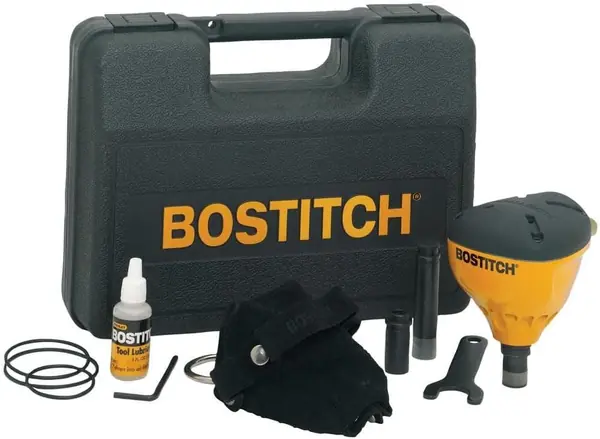
Bostitch PN100K Impact Nailer Kit Best for Large Fasteners

Bostitch PN100K impact nailer kit with magnetic recessed nose

Large spikes

Shop Score 88/100
Weight
2.9 lb
Nose
Magnetic recessed slot
Warranty
7-year limited
Max Nail Length
Up to 5 in.
View on Amazon

The PN100K impact nailer kit is the outlier here: it is a palm nailer built for large fasteners, with enough force to drive nails up to 5 inches and a 2.9-pound body that absorbs the recoil those nails produce. We do not treat it as a replacement for a framing nailer, but it is the tool we reach for when a large spike has to go where a framing gun will not fit.

The magnetic nose has a recessed slot that holds a nail head while you set the tool, and the impact action lets you keep both hands on the work instead of on a hammer. The seven-year limited warranty is a long safety net for a tool that takes a beating, and the steel build feels like it can handle jobsite abuse. This is the one to pick for pole-barn repairs, dock work, and heavy connectors that call for a bigger nail than a mini palm nailer handles. For a remodeler who already owns a framing gun but keeps meeting spots it cannot reach, this is the kit that fills the gap.

Worth Noting

  • Heavy for overhead one-handed work
  • Bulky compared with mini palm nailers
Our Verdict

We recommend the Bostitch PN100K for large spikes and heavy connectors when a standard framing nailer cannot fit into the work.

Check Latest Price
5.

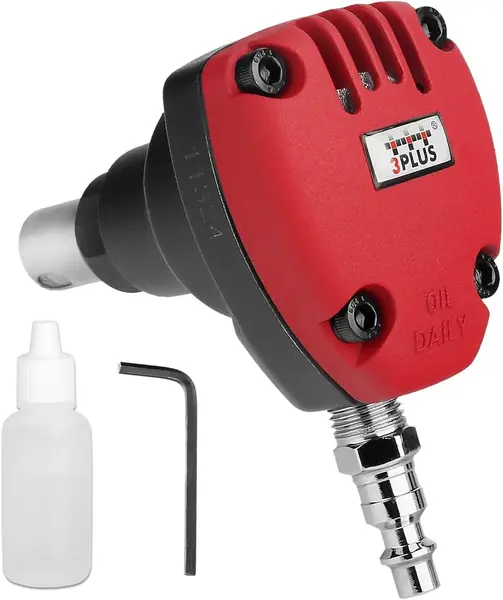
3PLUS HMPN50SP Mini Palm Nailer Best for Occasional Deck Work

3PLUS HMPN50SP mini palm nailer with black and red aluminum body

Occasional deck work

Shop Score 86/100
Weight
1 lb
Nose
Magnetic nose
Fastener Range
Up to 3-1/2'' long
Exhaust
Front exhaust
View on Amazon

The 3PLUS HMPN50SP is the low-cost entry point in this group, and it gets the basics right: a one-pound aluminum body, a magnetic nose, and a front exhaust that keeps spent air away from your hand. We like the narrow body for getting between joists, and the magnetic nose makes it possible to start a nail without a second hand. It drives common nails up to 3-1/2 inches, so it covers the hanger and decking sizes that send most people looking for a palm nailer. The simple aluminum housing also wipes down easily after a day in the dust.

For occasional deck repairs and fence projects, the low price and light body make it a sensible second tool. We keep it in the category as a budget option, not as the first pick for a production job. If you are building one deck and do not want to spend much on a tool you will rarely use, it covers the core job. The light body is easy to control one-handed, which is the whole point of this category.

Worth Noting

  • Driver can stick after repeated use
Our Verdict

As a light budget palm nailer, the 3PLUS HMPN50SP suits occasional hanger and deck work better than daily production.

Check Latest Price
6.

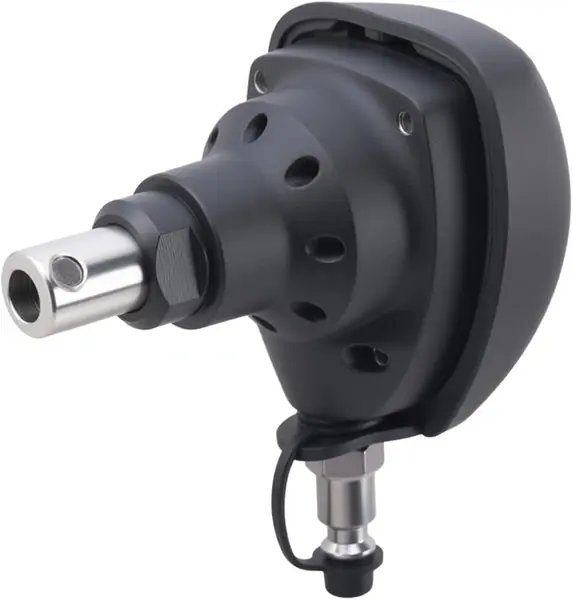
AEROPRO CPN90 Palm Nailer Best for Small Hands

AEROPRO CPN90 palm nailer with black heat-treated aluminum body and magnetic tip

Small hands

Shop Score 85/100
Weight
1.06 lb
Nose
Magnetic tip
Fastener Range
2-1/2" - 3-1/2" bulk nails
Body Width
2.8 in.
View on Amazon

The AEROPRO CPN90 is the narrowest body in this group, and that is its reason to exist. At 2.8 inches wide it fits a smaller hand and slips into framing gaps where the fatter palm nailers feel clumsy. The 1.06-pound body is light enough to hold one-handed, and the magnetic nose keeps a nail in place while you line up the shot.

We found it most useful for hanger nails and connectors in tight framing, where the tool's short body lets you keep your wrist straight. It takes 2-1/2 to 3-1/2 inch bulk nails, and the front exhaust directs air away from your palm. The included white oil and hex key are a small convenience that saves a trip to the toolbox before the first use.

This is not the tool for the biggest spikes in the group; the 3-1/2-inch ceiling puts it in the same class as the Metabo and Freeman. What it offers instead is a compact grip for smaller hands and a low-cost way to try palm nailing. For cabinet installers, trim carpenters, and anyone whose hands disappear inside a framing bay, it is an easy one to keep in the bag.

Worth Noting

  • Caps out at 3-1/2-inch nails rather than the largest spikes
Our Verdict

Smaller hands and narrow framing bays suit the AEROPRO CPN90, where a compact 2.8-inch body matters more than maximum spike size.

Check Latest Price

How We Tested the Best Palm Nailers

We built the shortlist by pulling every palm nailer we could find from the major pneumatic brands, then filtering for the things that decide whether a tool is usable: a nose that accepts the bulk hanger and decking nails these are built around, a magnetic tip, and a body small enough to work inside a joist bay. That left 11 tools, which we bought at retail and ran for eight months; warranty terms went into the scoring later rather than into the first cut.

Most of that time went into a deck: joist hangers, ledger boards, blocking, and a run of fence pickets. We also took the nailers into a crawlspace to sister joists, up a ladder for overhead framing, and into bays where a hammer won't swing. At each step we noted whether a nail started straight or had to be reseated, and how many it took before the hand and forearm wanted a break.

Between jobs we weighed each tool on a kitchen scale and passed it around to judge palm balance, since a light nailer that sits top-heavy still fights you overhead. We held each one nose-down and shook it to see whether the magnet kept hold of a nail, routed the hose over a shoulder and around a ladder to judge the swivel, and marked every time exhaust blew grit at a face. We also fired into pressure-treated lumber and across galvanized hanger metal to find where power fell off.

Fittings got a soapy-water check at the start and again at the end to see what had begun leaking, and we read every warranty in full — length, exclusions, who honors it. Throughout, we wore eye and hearing protection and disconnected the air hose before loading nails, clearing a jam, or changing a fitting; a tool that made us want to skip one of those steps got marked down.

How to Choose a Palm Nailer for Tight Spaces

Match the Nose to the Nails You Drive

Start with the fastener, not the tool. Most palm nailers here are built for 2-1/2- to 3-1/2-inch bulk nails, which covers joist hanger and decking work, while the Bostitch PN100K reaches up to 5 inches for larger spikes. A rated length is only half the fit: the nose opening has to accept the nail head without letting it wobble. Test the actual nails you plan to use, especially small finish heads or oversized connectors. If a head drops through or will not enter the collar, the tool will bend nails no matter how carefully you hold it.

Weight and Reach Matter More Than Raw Power

A palm nailer is a one-handed tool, so a pound of extra weight shows up quickly when you are reaching above your head or working between joists. We prioritize a body around one pound for overhead work and accept a heavier tool only when it buys real driving force for large fasteners. Look at the nose profile and the air fitting too. A 360-degree swivel keeps the hose from pulling the tool off line, and a front exhaust keeps spent air away from your palm. Compact in the listing can mean a short body with a fat nose, so check both dimensions against the opening you need to reach.

Plan for Air Supply and Maintenance

Every tool in this group runs on compressed air, and a palm nailer can drain a small tank quickly during a fast run of hanger nails. A pancake compressor can keep up for short bursts if you let it recover, but a larger tank makes repeated work less stop-and-go. Set the regulator to the pressure listed for the tool and test on scrap before you climb a ladder. Listen for a constant hiss at the inlet or exhaust; a leaking fitting will keep the tool from building enough force to seat a nail.

Grip, Magnet, and Warranty

The magnet is a positioning aid, not a clamp. It should hold the nail upright while you set the nose, but you still need to square the tool before you fire. A stronger magnet helps with one-handed starts; a weak one shows up as nails that slip or drive at an angle. Grip matters just as much. Rubber overmolds reduce vibration, and a body that fills your palm without forcing your wrist to cock sideways is easier to control. We also check the warranty, because a palm nailer lives in dust and vibration: five to seven years is a meaningful signal of how long the maker expects the tool to last.

Frequently Asked Questions

Final Verdict

For most shoppers, the Metabo HPT NH90AB is the palm nailer we recommend first. It drives the 2-1/2- to 3-1/2-inch bulk nails that hanger and deck work calls for, and its swivel fitting and magnetic nose make cramped spots less frustrating. If you want the lightest one-handed tool here, choose the Bostitch PN50; if your work is dominated by large spikes, the Bostitch PN100K is the better fit.