↑↓ navigate ↵ open Esc close All results →

Best Siding Nailers of 2026

A fraction of a turn on a depth dial separates clean siding installation from costly waste: sink a nail too deep into fiber cement and the panel cracks, or leave the head proud and the next lap course rocks across it. Siding work asks for repeatable depth adjustment over thousands of shots, jam-free coil feeding, and balanced weight when holding the gun at shoulder height.

Depth consistency was the first variable checked across 11 coil nailers over 10 months of driving fasteners. Just as important for anyone buying a first gun is matching collation to local supply: 15-degree plastic-collated coils and 16-degree wire-collated coils are not interchangeable, so checking which nails the lumberyard keeps in stock often narrows the field immediately.

Whether tackling full-house clapboard, fencing and sheathing, or occasional gable repairs, steady drive depth across long runs matters more than raw firing speed.

Our Top Picks

The Best Siding Nailers

1.

Bostitch N66C-1 Coil Siding Nailer Best Overall
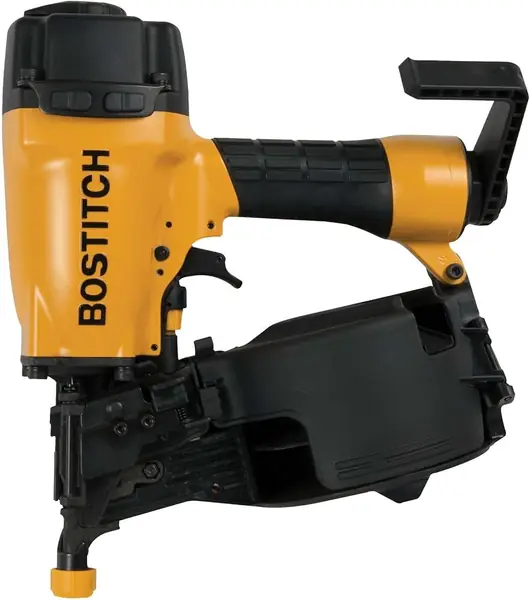
Bostitch N66C-1 pneumatic coil siding nailer with aluminum housing and soft rubber nose foot

Whole-house siding jobs

Shop Score 92/100
Fastener Range
15-degree coil, 1-1/4 to 2-1/2 inches
Weight
4.1 lb
Collation
Wire weld or plastic inserted coil
Included Components
Sequential trip trigger and case
View on Amazon

At 4.1 pounds, the N66C-1 is the lightest siding nailer in this group, and that number stops being a spec line about an hour into hanging a wall with a hose and a coil of nails hanging off the tool. We kept reaching for it over the heavier guns because a light nailer lets you hold the board, the gun, and your balance at the same time from a ladder. It also sits in the middle of the pack on price, which is not where we expected the top pick to land.

The fastener range — 15-degree coil, 1-1/4 to 2-1/2 inches — covers lap siding, cedar shingles, and fence pickets, and the tool runs wire weld or plastic inserted coil, so you are not married to one supplier. The depth guide adjusts without tools and holds its setting, and the soft rubber foot is the detail we ended up appreciating most on cedar: the nose is what dents a soft board when you lean into the tool to fire, and the rubber takes that pressure instead of the wood. A tool-free exhaust port turns the air away from your face, which matters more than it sounds in a corner.

Feeding is the less certain half. Long runs go clean, then a nail hangs and you open the nose to clear it — nothing dramatic, and the jam costs a minute rather than a course, but do not plan the day around perfect cycling. Matched coil nails and a clean magazine prevent most of it. Oil it before each session and keep it in the included case, and this is a gun that pays for itself on a whole-house job.

Worth Noting

  • Housing has cracked on hard-used units
Our Verdict

Our default siding nailer: the lightest tool here, it runs wire or plastic coil and handles a whole house without wearing you out.

Check Latest Price
2.

Metabo HPT NV65AH2 Coil Siding Nailer Best for Production Work

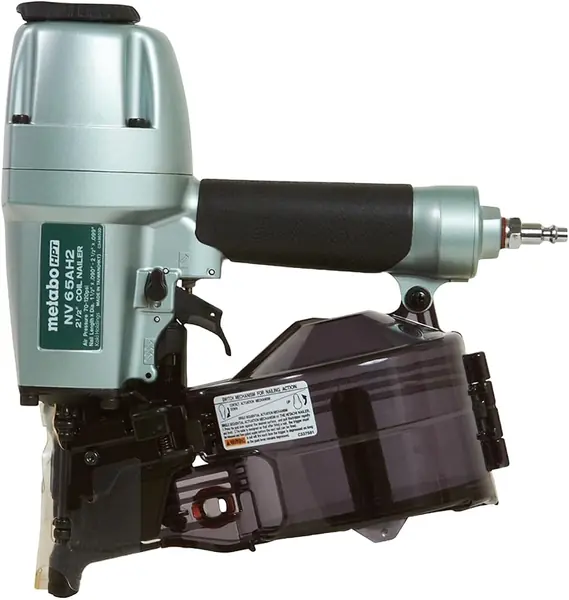
Metabo HPT NV65AH2 pneumatic coil siding nailer with side-load tilt-bottom magazine and no-mar nose cap

High-volume pro work

Shop Score 89/100
Fastener Range
16-degree wire 1-1/2 to 2-1/2 in; 15-degree plastic 1-1/2 to 2-1/4 in
Weight
4.8 lb
Warranty
5 years
Magazine
Side-load, tilt bottom
View on Amazon

The magazine tilts open from the side, so a fresh coil drops in and the lid closes over it instead of you threading a leader through a fixed canister. At production pace that is the difference between a rhythm and a stall, and we noticed it most on long runs where you reload every few minutes. Metabo also moved the depth dial down onto the body where your thumb finds it without leaving the handle.

On fasteners it is the most flexible gun here: 16-degree wire coil from 1-1/2 to 2-1/2 inches and 15-degree plastic coil from 1-1/2 to 2-1/4 inches, so you can run whatever your yard stocks. The selective actuation switch flips between sequential and contact firing, the no-mar nose cap protects prefinished trim, and the adjustable deflector keeps exhaust off your face. At 4.8 pounds it carries a little more than the Bostitch without becoming a burden on a ladder.

What the premium buys is the magazine and a five-year warranty, and for anyone nailing weekly rather than once a season we think that is the right trade. The feed is not flawless — a coil can misfire and shoot a blank — so break a new gun in on scrap before you trust it on a visible wall. Otherwise the honest note is that this is a siding gun and only a siding gun; the NV75A5 is the one to look at when the job runs into sheathing.

Worth Noting

  • No belt hook on the tool body
Our Verdict

For crews nailing weekly, we think the fast side-load magazine and five-year warranty justify the premium over our top pick.

Check Latest Price
3.

Makita AN613 Siding Coil Nailer Best Depth Control

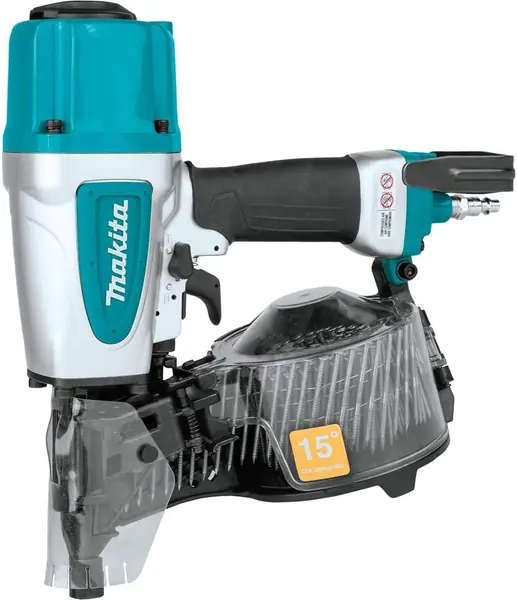
Makita AN613 teal pneumatic siding coil nailer with clear loading canister and reversible belt hook

Fiber cement siding

Shop Score 88/100
Fastener Range
15-degree wire or plastic coil, to 2-1/2 inches
Weight
7.48 lb
Belt Hook
Reversible
Depth Adjustment
Tool-less, nine detents
View on Amazon

Fiber cement is unforgiving: a nail set a hair deep crushes the board and leaves a dimple that shows through paint, and one left proud holds the next course off the wall. The AN613's tool-less depth dial has nine detents, and that granularity is why it gets the call on cement board. You can step the setting down one click at a time on an offcut until the head sits flush, then stop thinking about it.

It is also the most thoughtfully finished gun in this group. Rubber bumpers and a smooth nose tip protect a prefinished board, the exhaust turns where you want it, and the reversible belt hook is the feature we missed on the NV65AH2. A clear canister lets you watch the coil run down so you reload before you dry-fire. At 7.48 pounds it is the heaviest tool here by a wide margin, and that is the price of the control — you notice it on overhead shingle work, not on a fence line.

One caution: not every AN613 behaves out of the box. Bent nails that will not seat and a hammer rod that fails to retract have turned up on individual guns, so shoot a coil through it on scrap before you commit it to a wall. Past that, the Makita does the one thing that matters most in fiber cement, which is put the head exactly where you aimed it.

Worth Noting

  • Shortest warranty here at three years
Our Verdict

If you are nailing fiber cement, we pick the AN613 for its nine-step depth dial; nothing else here sets a nail as precisely.

Check Latest Price
4.

Metabo HPT NV75A5 Siding and Framing Nailer Best for Thick Siding

Metabo HPT NV75A5 pneumatic coil nailer with aluminum rafter hook and side-load magazine

Siding and sheathing

Shop Score 85/100
Fastener Range
16-degree wire 1-3/4 to 3 in; 15-degree plastic 1-3/4 to 2-1/4 in
Weight
5.7 lb
Warranty
5 years
Rafter Hook
Aluminum
View on Amazon

Every other gun on this list runs out of reach at 2-1/2 inches. The NV75A5 keeps going to 3 inches in 16-degree wire coil, which is what you want the moment a siding job turns into sheathing, a thick trim board, or a quick framing repair. That extra half inch makes it a different tool, not a spec-sheet boast.

It stays manageable at 5.7 pounds, and the aluminum rafter hook is the best hanging hardware here — wide enough to drop over a rail or a ladder rung without a fight. The side-load magazine, selective actuation, and no-mar nose cap carry over from the NV65AH2, and the five-year warranty matches it.

We do not think of it as a first siding nailer. Plastic-coil capability stops at 2-1/4 inches, so if your supplier stocks 15-degree plastic siding nails at 2-1/2 you are stuck, and the longer body is more to swing overhead than the NV65AH2. Feeding is decent rather than perfect — a coil can jam and a nail can shoot wide, usually early in a session — but nothing that has kept us from using it on sheathing. For a remodeler who wants one coil gun for siding and light framing, the compromises are fair.

Worth Noting

  • Plastic coil nails stop at 2-1/4 inches
Our Verdict

We reach for the NV75A5 when siding turns into sheathing or light framing: it drives three-inch wire coil where the others stop.

Check Latest Price
5.

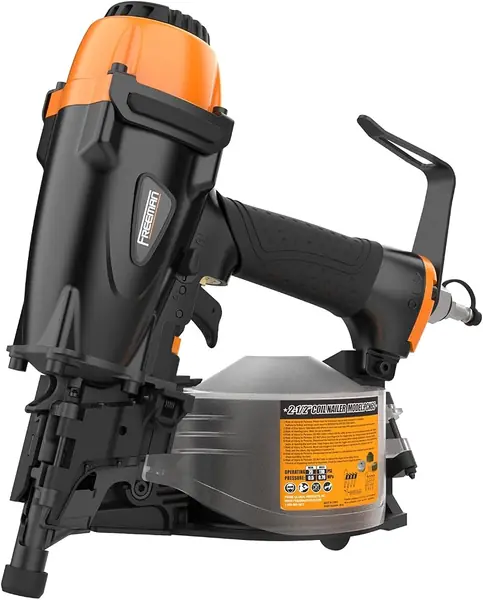
Freeman PCN65 Coil Siding Nailer Best for Budget Fence Projects

Freeman PCN65 pneumatic 15-degree coil siding nailer with black body and metal belt hook

Budget fence projects

Shop Score 84/100
Fastener Range
15-degree plastic 1-1/4 to 2-1/2 in; wire 1-3/4 to 2-1/2 in
Weight
6 lb
Warranty
7-year limited
Magazine Capacity
350 nails
View on Amazon

Freeman costs less than the three guns above it on this list and still carries the longest warranty here — seven years, limited. It takes 15-degree plastic coil from 1-1/4 to 2-1/2 inches or wire coil from 1-3/4 to 2-1/2, holds 350 nails, and ships with a metal belt hook that the NV65AH2 does not include. On paper that is a lot of nailer.

In use it is a two-speed experience. When the feed behaves, it drives fence pickets or cedar shingles as quickly as anything here, and the fire lock and bump-fire switch are laid out sensibly. The feed is the weak point: double fires and jams arrive and break the rhythm, and clearing one means opening the magazine. Matched nails and a clean magazine cut most of it, but we plan around a few stoppages on a long run.

The warranty is why it stays on the list, with one piece of fine print worth knowing: the seven years covers the tool body while wearable parts get 90 days, which is exactly the window where a bad feed shows up. Run a couple of coils through it as soon as it arrives. If it cycles cleanly, it will handle a fence, a shed, or a single wall for a fraction of a production gun.

Worth Noting

  • Durability of the drive parts is inconsistent
Our Verdict

For a fence or one outbuilding, this is the lower-cost coil gun, and the seven-year warranty softens the gamble.

Check Latest Price
6.

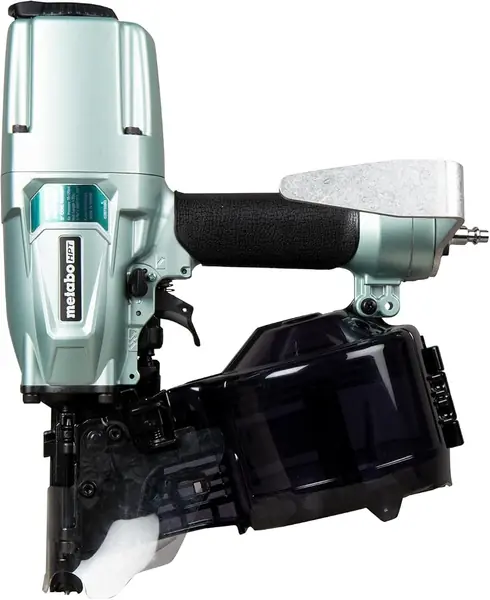
3PLUS HBCN65P Coil Siding Nailer Best for Occasional DIY Siding

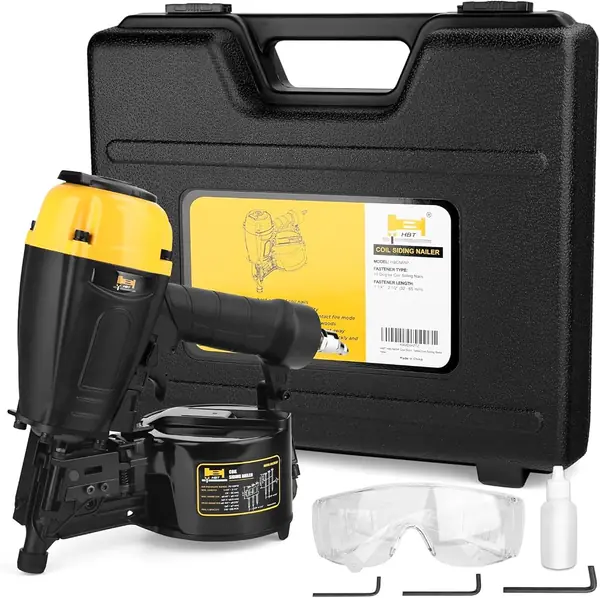
3PLUS HBCN65P pneumatic 15-degree coil siding nailer with magnesium housing and swivel air plug

Occasional DIY siding

Shop Score 83/100
Fastener Range
15-degree, 1-1/4 to 2-1/2 inches
Housing
Magnesium
Firing Modes
Sequential or contact
Operating Pressure
70 to 120 PSI
View on Amazon

The lowest-priced siding nail gun in this group is built to the same 15-degree, 1-1/4 to 2-1/2 inch coil specification as the name brands, with a magnesium housing and a 360-degree swivel air plug that keeps the hose from twisting at the connector. It runs on regulated air from 70 to 120 PSI and flips between sequential and contact firing. On paper, nothing obvious explains the gap in price.

In practice the savings land in the feed rather than the housing. When it cycles, nails go in straight and the exposed nose guide makes a jam easy to reach once the magazine is open. Feed is the gamble: some guns stop pulling nails partway through a coil and jam every few nails. We treat it as a one-project tool rather than something you hand down.

That is not a bad thing to be. A homeowner facing a hundred feet of fence or a small shed wall does not need a production gun, and this one leaves budget for nails, a hose, and a compressor. Buy matched 15-degree coil nails, oil it before each session, and keep the receipt close while you work through the first coils.

Worth Noting

  • Depth adjustment needs frequent re-setting
Our Verdict

The least expensive way into coil siding nailing, and a fair one for a single fence or shed, with a feed that needs watching.

Check Latest Price

How We Tested Siding Nailers

We started with spec sheets, sorting every coil siding nailer we could find by fastener angle and collation — 15-degree plastic against 16-degree wire — and cut anything that wouldn't run a 2-1/2-inch nail in the format it claimed. Operating pressure narrowed it further, since a gun that asks for more than a standard jobsite compressor can deliver is no use mid-remodel. Eleven nailers survived and went into 10 months of testing.

They sided a detached garage in fiber cement lap, shingled a gable in cedar, rebuilt a fence, sheathed a shed, and ran fascia from a ladder and a short scaffold — the places these tools actually live. At each gun's stated pressure we drove 50 nails into fiber cement with the depth setting untouched, counting proud heads and crushed faces, then checked between sessions whether that setting had drifted. We also logged the lowest pressure at which a nail still sank flush.

Weight went on a kitchen scale, and then we hung each gun by its hook from a ladder rung to see where it sat against the balance point. Every feed stall was timed — air line disconnected first — along with the steps to clear it: tool or no tool, nail pried out or dropped free. With safety glasses on, we tried both trigger modes on scrap sheathing at the bench and kept contact activation off the ladder, and we timed reloads to see whether a side-load magazine spilled nails.

Nail accuracy came down to a chalk line: 20 nails per gun per run, and we measured how far the heads wandered off it. Then the guns stayed in rotation through cold mornings, where sluggish drives and misfires announce themselves. Warranty coverage and what came in the box — case, spare trigger, hook — fed the value call.

How to Choose a Siding Nailer

Fasteners Come First: Angle, Collation, and Length

Siding nailers are coil guns, and the coil has to match the tool: 15-degree plastic collated and 16-degree wire collated are different feeds, and you do not swap one for the other. Length is the second lock — 1-1/4 to 2-1/2 inches covers lap siding, cedar shingles, and fence pickets, while longer fasteners mean a gun built for sheathing. Check what your supplier actually stocks before you fall for a gun that claims both.

The trap sits inside the two-collation claim. A tool listed as accepting wire and plastic often caps the plastic coil shorter than the wire: the Metabo NV75A5 runs wire to 3 inches but stops at 2-1/4 for plastic. Read the two ranges separately. If the longest nails you need are 2-1/2-inch plastic siding nails, that single number decides the purchase.

Depth of Drive Is the Setting You Will Touch Most

Fiber cement wants the head flush. Over-drive it and you crush the board and crack the finish; leave it proud and the next course sits off the wall. Look for a tool-free depth dial with real detents — the Makita AN613 has nine — so you can step down one click at a time on an offcut instead of hunting between two vague positions.

Cedar and other soft woods want the opposite: less pressure at the nose so the head does not sink. That is why the rubber and no-mar nose caps here matter more than they look. Set depth on a piece of the actual siding before the first course; the same setting does not carry between fiber cement and cedar.

Weight, Balance, and Somewhere to Hang It

The tools in this group run from 4.1 to 7.48 pounds, and the spread stops being abstract when you are holding a board with one hand and the gun with the other. A full coil and a hose add to it. We lean light for anything overhead or high on a wall, and accept the extra weight only when it buys depth control or fastener reach.

Hanging hardware is the most overlooked line on a spec sheet. A belt hook or rafter hook means the tool leaves your hand between courses instead of landing in the dirt, and the Makita, the Freeman, and the NV75A5 have one while the NV65AH2 does not. If yours has no hook, add a holster or a hook — the ladder is not a shelf.

Jams and Feed: Where the Cheap Guns Show

Every coil gun jams eventually; the question is how often and how fast you get back to work. A side-load tilt-bottom magazine clears quickly, and an exposed nose guide lets you see the nail path. Matched nails matter as much as the tool — a coil that does not sit right in the canister is the usual cause of the jam that repeats.

Run the coil down instead of dry-firing the last nails, and oil the tool before each session; those small habits are most of what separates a gun that cycles for years from one that goes back in its box. Between two guns at similar money, we take the one whose magazine opens wide and shows the feed path over one with an extra feature we will never switch.

Frequently Asked Questions

Final Verdict

The Bostitch N66C-1 is the siding nailer we point most people toward. At 4.1 pounds it is the lightest tool here, it runs whichever coil your supplier stocks, and it handles lap siding, cedar, and fence pickets without a second gun.

If you nail most days, the Metabo HPT NV65AH2 buys a faster magazine and a five-year warranty; if the work runs into sheathing and three-inch fasteners, the NV75A5 is the one that reaches.