↑↓ navigate ↵ open Esc close All results →

Best Cordless Nail Guns of 2026

Trading a compressor for a cordless trim nailer removes air-hose drag and tank noise from finished rooms, making quick twenty-minute punch-list sessions practical. That convenience comes with higher tool weight and battery pricing that shift the math compared to pneumatic guns.

Running 12 cordless nailers for nine months across baseboard, window casing, shoe molding, and long stretches of overhead crown exposed where fatigue sets in first. Tracking shots per charge, battery-loaded weight, and trigger response showed which guns fire predictably at awkward ceiling angles.

First-time buyers often stumble on kit math: a bare tool saves money only when matching packs already sit on the shelf, whereas a full kit usually undercuts buying batteries separately across these 18- and 16-gauge trim nailers.

Our Top Picks

The Best Cordless Nail Guns

1.

Metabo HPT NT1850DG 18-Gauge Brad Nailer Kit Best Overall
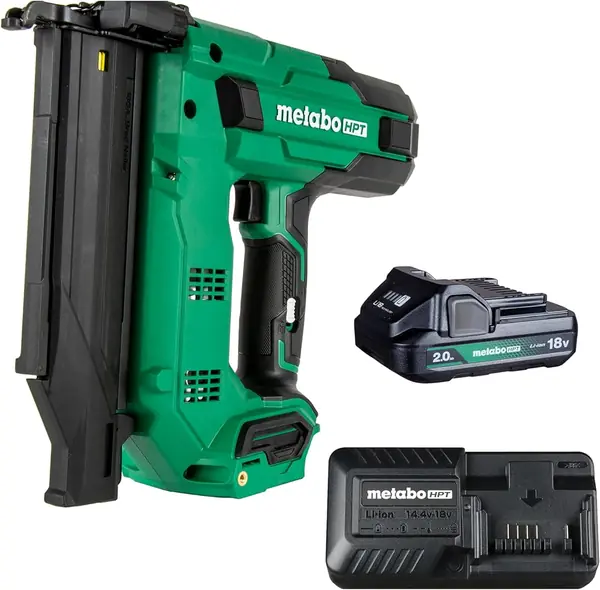
Metabo HPT green and black 18-gauge cordless brad nailer kit with battery and charger

Trim and molding

Shop Score 95/100
Weight
5.5 lb
Nail Range
5/8 to 2 in, 18 gauge
Battery
2.0Ah 18V with fuel gauge
Shots Per Charge
Up to 700
View on Amazon

Five and a half pounds on the spec sheet, and 700 brads on a single charge. Those two numbers describe this kit better than any feature list: an 18V 2.0Ah pack with a fuel gauge, a mechanical spring drive instead of an air cylinder, and a magazine that takes 5/8- to 2-inch 18-gauge brads — the range that covers casing, crown, shoe molding, and cabinet face frames.

What won us over is how little there is to manage. There's no ramp-up between shots, so the brad lands where the nose is pointed rather than where your hand has drifted to, and the low center height gets the nose into an inside cabinet corner or the meeting point of two crown pieces. The LED washes the work area, which matters more than it sounds when you're nailing the underside of an upper cabinet.

The kit is genuinely complete: battery, charger, no-mar nose caps, and a belt hook, which is why it works as a first nailer rather than an addition to a shelf of tools. Depth is quick to set, and 2-inch brads run through 3/4-inch trim and drywall into a stud without complaint. You'll pull the trigger a lot on a trim package this size, and the drive keeps its rhythm shot after shot instead of softening as the spring cycles.

Worth knowing: the pack is Metabo HPT's own 18V, shared across the MultiVolt line, so this is a starting point for a system rather than a dead end. If your garage is already stocked with another brand's batteries, though, a bare tool from that line stretches your money further — that's the one case where another pick here serves you better.

Worth Noting

  • 5.5 pounds still tells on a long overhead run
Our Verdict

For most people this is the cordless nailer to buy: a light 18-gauge kit with the battery and charger in the box and enough runtime to finish a room of trim.

Check Latest Price
2.

DEWALT DCN680B 20V MAX 18-Gauge Brad Nailer Best for Visible Trim

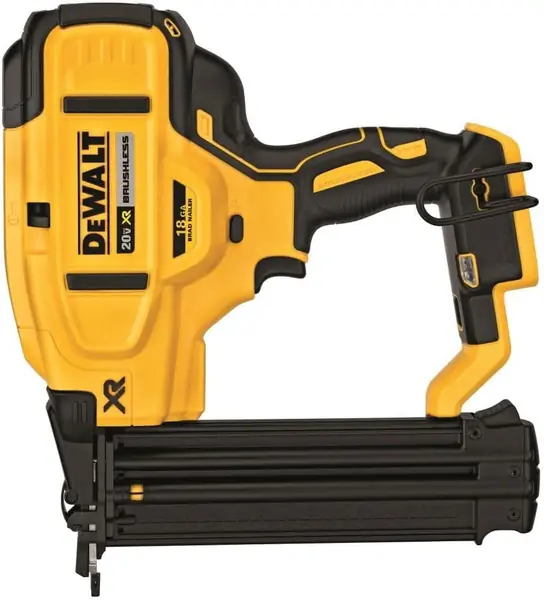
DEWALT yellow and black 20V MAX cordless 18-gauge brad nailer, bare tool

20V MAX users

Shop Score 94/100
Weight
3.97 lb bare tool
Nail Range
5/8 to 2-1/8 in, 18 gauge
Voltage
20V MAX
Depth Adjustment
Tool-free
View on Amazon

The nose is the part that decides whether a brad lands on your pencil line or a sixteenth off it, and this one is the reason we reach for the DEWALT on visible work. The micro nose narrows the tip so you can see the entry point past the magazine, and on casing and face frames that line of sight is worth more than any feature on the box.

The rest of the tool follows the same idea. Depth adjustment and jam release both work without a tool, so a brad that stops proud or a strip that hangs up costs you seconds instead of a walk back to the toolbox. The brushless motor handles 5/8- to 2-1/8-inch brads — a slightly longer reach than most 18-gauge guns here — and on a 20V MAX pack it runs cool through a long trim session.

The 3.97-pound figure is a bare-tool weight, and weight is where this nailer divides people most: light in the hand for some, bulky once a pack is aboard and the work is overhead. If your trim runs along a ceiling, run it that way before you commit. For baseboard and cabinet work at chest height, the balance never became an issue for us.

Worth Noting

  • Sold bare, without battery or charger
Our Verdict

If 20V MAX packs are already in your shop, we think this is the brad nailer to get: the micro nose puts brads exactly where you aim on visible trim.

Check Latest Price
3.

Milwaukee M18 FUEL 18-Gauge Brad Nailer (2746-20) Best for M18 Users

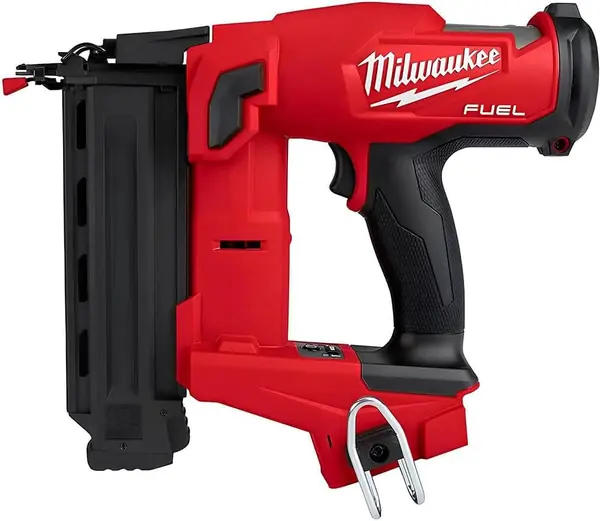
Milwaukee M18 FUEL red and black cordless 18-gauge brad nailer, bare tool

M18 users

Shop Score 93/100
Weight
6.5 lb
Gauge
18 gauge
Voltage
M18 18V
Motor
Brushless
View on Amazon

Cordless nailers used to announce themselves with a half-second of wind-up before the fastener moved. The M18 FUEL doesn't. The trigger trips a brushless driver that fires the brad on the pull, with no ramp-up to account for as your hand travels down a run of casing, and there's nothing to anticipate before the nail sets.

That immediacy is what we like most about it, and it's why this is the nailer we hand someone coming off a pneumatic. The rhythm stays even when you speed up: set the nose, squeeze, move. It's the most responsive trigger of the picks here, which sounds like a small thing until you've spent an afternoon waiting on a tool that thinks before it fires.

Buying it bare is the point — the M18 packs already on your shelf are the reason, and the pack that runs your drill runs this. That also frames the math honestly: if you're starting with no batteries at all, a complete kit costs less than this nailer plus a pair of packs, and it nails trim just as well. The M18 argument only works when the platform is already yours.

Worth Noting

  • 6.5 pounds gets heavy in overhead work
Our Verdict

We recommend it to anyone already on M18: no ramp-up, a brushless driver, and the same packs that run the rest of your Milwaukee tools.

Check Latest Price
4.

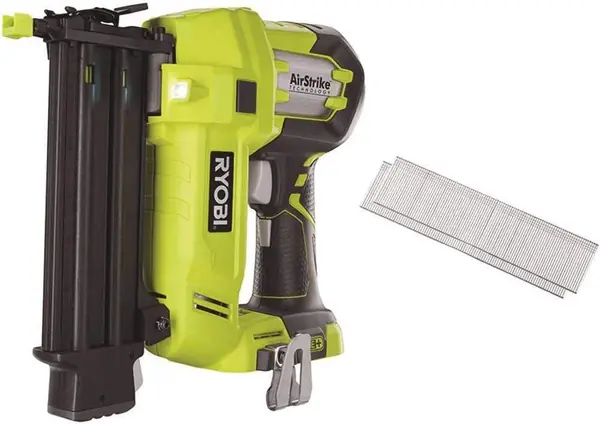
Ryobi ONE+ 18V AirStrike 18-Gauge Brad Nailer (P320) Best Budget Bare Tool

Ryobi ONE+ green 18-volt AirStrike cordless 18-gauge brad nailer, bare tool

ONE+ users

Shop Score 92/100
Weight
6 lb
Nail Range
5/8 to 2 in, 18 gauge
Firing Rate
Up to 60 per minute
Platform
Ryobi ONE+ 18V
View on Amazon

This is the least expensive way into cordless brad nailing in this group, and we don't think you give up much to take it. The P320 fires 5/8- to 2-inch 18-gauge brads at up to 60 nails a minute on any ONE+ 18V pack, which turns a loose piece of quarter round from a compressor-and-hose production into a two-minute errand.

Where it earns its keep is repeat household work: door casing, baseboard, a closet of shelving, the trim around a new floor. It's a little slower to cycle than a pneumatic, so a long baseboard run takes a bit more patience, but for a dozen brads in a doorway the difference disappears. Loading is straightforward and the nose is easy to place.

ONE+ is what makes the arithmetic work. The packs are inexpensive, they're shared across the whole line — drill, trim router, work light — and a spare doesn't sting. For a garage already running Ryobi, this is the least painful way to stop dragging a compressor out for a Saturday of trim, and the tool keeps earning its shelf space long after the first project.

Worth Noting

  • Bare tool; battery and charger sold separately
  • Noticeably slower cycling than a pneumatic
Our Verdict

We think it's the best value here: a 6-pound brad nailer that drives 2-inch brads into molding and runs on the ONE+ packs you already have.

Check Latest Price
5.

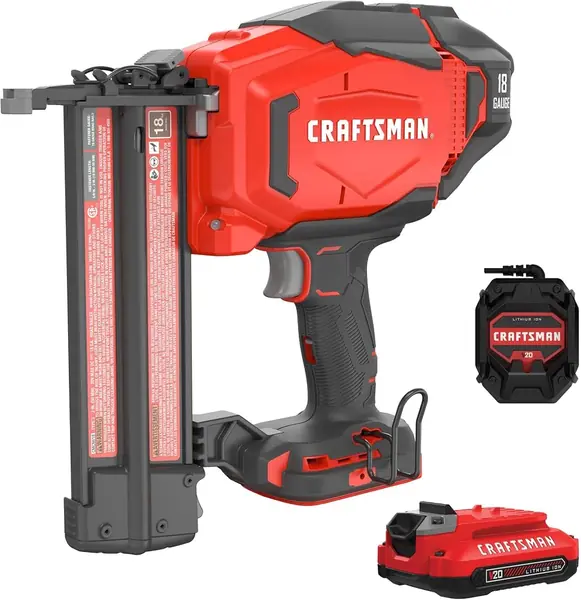
CRAFTSMAN V20 18-Gauge Brad Nailer Kit (CMCN618C1) Best Kit for Homeowners

CRAFTSMAN red and black V20 cordless 18-gauge brad nailer kit with battery and charger

Home punch lists

Shop Score 91/100
Weight
7.6 lb
Gauge
18 gauge
Battery
20V V20, one included
Jam Release
Tool-free
View on Amazon

If the nailer's job is a punch list — a laundry room's worth of wainscoting, quarter round around a new floor, a loose run of door casing — a complete kit makes more sense than a bare tool you then have to power. This one arrives with the 18-gauge brad nailer, a V20 battery, and a charger, so the first project isn't also a shopping trip.

The tool itself is straightforward: a brushless motor, tool-free depth, tool-free jam and stall release, and a magazine for adhesive-collated 18-gauge brads. The motor is built to hold its firing power across changing weather and materials, which counts for something in a garage that runs cold in January, and the handle has enough contour to keep your grip from cramping through a room's worth of nailing.

What we like about it is how little ceremony there is: battery in, brads in, set the depth, go. That's the whole case for a kit — no platform decision, no second order for a charger, no hunting for the right pack when you have twenty minutes before dinner. If you already own V20 tools, it's an even easier call, because the batteries you add here run everything else in the line.

Worth Noting

  • Jams during long runs of brads
Our Verdict

We recommend it to homeowners who want one box: the nailer, a V20 battery, and a charger, with enough control for wainscoting and quarter round.

Check Latest Price
6.

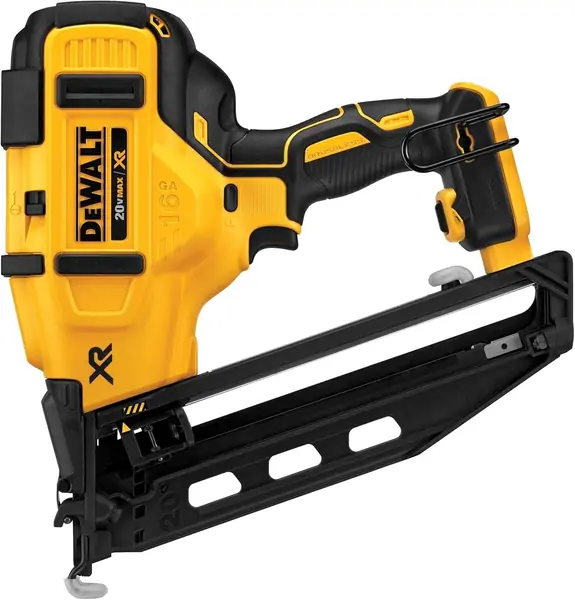
DEWALT DCN660B 20V MAX 16-Gauge Angled Finish Nailer Best for Casing and Baseboard

DEWALT yellow and black 20V MAX 16-gauge angled finish nailer, bare tool

Casing and baseboard

Shop Score 90/100
Gauge
16 gauge angled
Depth Adjustment
Tool-free
Power
20V MAX
Trigger
Tool-free sequential or contact
View on Amazon

Eighteen-gauge brads have a ceiling, and casing and baseboard are where you hit it. A 16-gauge angled nailer drives a heavier, headed fastener with real holding power, and this is the tool we pick when the trim package is thicker than cabinet crown and has to stay tight against the wall through a heating season.

The magazine is angled, which is what lets the nose reach into a corner where a straight magazine fouls on the adjoining wall, and the trigger selects between sequential fire for placing a nail by eye and contact actuation when you're running baseboard and want to keep moving. Depth and jam clearing are both tool-free, and the motor is brushless, so the maintenance list is short.

What you're paying for is the fastener, not the features. A 16-gauge nail holds casing to a stud in a way an 18-gauge brad simply can't, and that's the whole argument for keeping a second nailer in the van. On face frames, small crown, and anything that only needs pinning, the brad nailer is the better tool — this one is for the trim that has to stay put.

Worth Noting

  • Bare tool with no battery or charger
  • 16-gauge fasteners cost more than brads
Our Verdict

When brads won't hold the trim, we reach for this: a 16-gauge angled nailer built for casing, baseboard, and stair work.

Check Latest Price
7.

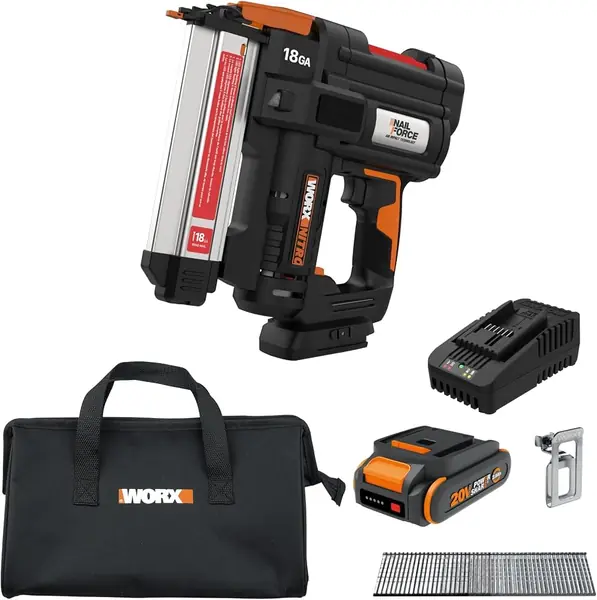
Worx NITRO 20V 18-Gauge Brad Nailer (WX842L) Best for PowerShare Households

Worx NITRO green and black 20V cordless 18-gauge brad nailer kit with battery

PowerShare households

Shop Score 89/100
Nail Range
Up to 2 in, 18 gauge
Firing Rate
Up to 80 nails per minute
Shots Per Charge
Up to 500
Kit Contents
20V 2.0Ah battery and charger
View on Amazon

Eighty nails a minute is the figure Worx rates this nailer at, and it's enough to change how a run of baseboard feels: the next brad is ready before you've moved the tool. NailForce air-impact drive, a 2.0Ah pack rated for 500 brads per charge, and the ability to sink 2-inch brads in hardwood are the other numbers worth knowing.

It's a kit rather than a bare tool — battery and charger are in the box — and the PowerShare pack is the quiet advantage, because it runs 140-plus other Worx tools if there's already a trimmer or blower in your shed. Jam release is tool-free, so a hung strip costs a few seconds, and the nose has enough clearance to see the entry point on casing.

The spec sheet says just over 7 pounds, and overhead work is where that registers: crown and upper casing ask more of your shoulder than baseboard ever will. For cabinet work, shoe molding, and anything at bench or waist height, the weight is a fair trade for a tool that doesn't need a hose trailing behind it.

Where it lands for us is a strong second-tier kit. It fires fast, clears jams without a tool, and spreads the battery cost across the rest of the Worx line. The Metabo HPT above is lighter, quotes a longer run per charge, and costs less — so the reason to choose this one is the ecosystem you're already in, not the tool on its own.

Worth Noting

  • 500 brads per charge, the shortest run quoted here
Our Verdict

For a garage already on PowerShare, we like this kit: 80 nails a minute, 2-inch capacity, and a jam release you work without a tool.

Check Latest Price
8.

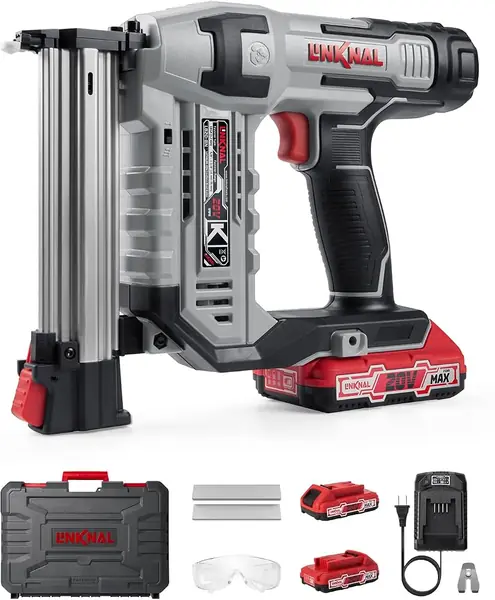
LINKNAL L820-BN 18-Gauge Brad Nailer Kit

LINKNAL black 18-gauge cordless brad nailer kit with two batteries, charger, nails, and case

First nailer

Shop Score 88/100
Nail Range
3/4 to 2 in, 18 gauge
Included
1,000 brads and case
Batteries
Two 20V 2.0Ah
Firing Modes
Sequential and contact
View on Amazon

Two batteries, a charger, a thousand 18-gauge brads, and a molded case. Few cordless nailer kits hand over a complete starting package like that, and it's the reason this one earns a place on the list even though it doesn't come from a tool brand you'd find on a job site.

The tool covers the usual trim ground: 18-gauge brads from 3/4 inch to 2 inches, sequential fire when you're placing a brad by eye and contact fire when you're moving fast down a run, and a depth knob on the side of the body. A dry-fire lockout stops the driver when the magazine runs empty, which is exactly the kind of detail that saves a mark on finished wood.

Having two 2.0Ah packs in the case is the practical part: you alternate them, and a charge cycle never stops the job. The contact trip has to be flat against the work before anything fires, which is the behavior you want from a tool that lives in a garage, and the whole kit packs back into the case between projects instead of sprawling across a shelf.

What it's for, then, is the person who wants the whole thing on one order without committing to a tool brand's battery platform. As a first nailer for cabinets, casing, and a season of trim, it does what it's asked and shows up with everything needed to start — including the brads, which is more than most kits here provide.

Worth Noting

  • Batteries fit only LINKNAL tools
Our Verdict

We think it's a smart first nailer: two batteries, a charger, and a thousand brads in one case, with sequential and contact firing.

Check Latest Price

How We Tested Cordless Nail Guns

We started with every current 18- and 16-gauge cordless nailer sold by the major tool platforms, then filtered the list by nail length range, whether the box holds a battery and charger or just the tool, and what the total cost of entry looked like against the bare-tool price. That narrowed the field to 12 models, which we used for nine months.

The work happened where trim actually gets hung: a hallway of baseboard and shoe molding, window casing and a small built-in in a garage workshop, and crown run overhead. We drove brads into pine, oak, and MDF and recorded how deep each tool sank a fastener, where it needed a second pass, and whether the heads sat proud or flush. Overhead, we noted how each tool balanced after twenty brads one-handed, and how much of the pencil line the nose hid.

Battery life was measured, not quoted: each nailer started with a full pack and fired into scrap until it stopped, and we logged the count plus any ramp-down in power near the end. We timed jam clearances with a stopwatch and recorded whether it took a tool-free latch or a hex key, set depth with work gloves on, and compared trigger travel before the first shot along with how easily each tool switched between sequential and contact firing.

Across those nine months of intermittent use, we tracked misfires and double-fires as a read on reliability, and weighed the total kit against the bare tool to see which purchase made sense for someone starting from nothing versus someone already invested in a platform.

How to Choose a Cordless Nail Gun

Match the Gauge to the Trim You Actually Hang

An 18-gauge brad has a head small enough to disappear into casing and face frames, and it's the fastener most trim work wants: shoe molding, cabinet trim, paneling, small crown. Step up to 16- or 15-gauge and you get a headed nail with real holding power for baseboard, door casing, and stair work.

We see the mistake in both directions — a brad nailer bought for casing that keeps pulling loose, and a 16-gauge gun bought for cabinet trim that leaves holes to fill. Buy for the majority of your work. Every pick here drives 18-gauge brads up to 2 inches, and the DEWALT DCN660B is the one to add when the trim needs more bite than a brad can give.

Bare Tool or Kit: Do the Battery Math First

If you already own a stack of one brand's batteries, a bare tool is the cheapest way in — the DEWALT DCN680B, the Milwaukee, and the Ryobi all ship without a pack. The trap is that a bare tool's sticker isn't its entry price: add a pack and a charger and the total usually climbs past what a complete kit costs.

Starting from nothing, buy the kit — the Metabo HPT, the CRAFTSMAN, or the Worx all arrive ready to fire. One caution about a standalone kit: LINKNAL's packs run LINKNAL tools and nothing else, so those batteries aren't an investment in a system the way a major brand's are.

Weight and Balance Decide How Long You Can Work

The tools here run from 5.5 to 7.6 pounds, and the difference only shows up in one place: overhead. Twelve feet of crown above your head tells you things a spec sheet can't, so if your projects run to ceiling work, buy the lighter tool and accept a smaller battery.

A pack also shifts the balance forward of the grip, which is why a 3.97-pound bare tool can feel heavier in the hand than its number suggests. Where you nail matters as much as what you buy: bench and baseboard work forgives heft, and a ceiling does not.

Trigger Response, Firing Modes, and Jam Clearance

Ramp-up is the pause between pulling the trigger and the fastener moving, and it's the difference between a nailer that feels like a tool and one that feels like a machine thinking it over. The Metabo HPT and the Milwaukee both fire with no wind-up, which is what keeps a run of casing even.

Trigger mode matters too: sequential fire puts one nail exactly where you place the nose, while contact actuation fires as fast as you bump the tool along a run of baseboard — the DEWALT 16-gauge and the LINKNAL both switch between the two. Look for tool-free depth and jam release, and for dry-fire lockout on a first nailer, so an empty magazine doesn't scar the wood.

Frequently Asked Questions

Final Verdict

For most woodworkers, the Metabo HPT kit is the answer: 5.5 pounds, 700 brads per charge, a battery and charger in the box, and the lowest price of any complete kit here. It's the one we'd hand someone who wants a nailer, not a project — except we're not handing it to everyone. If your shop already runs 20V MAX or M18 packs, buy the bare tool for your platform instead, the DEWALT for its micro nose and tool-free controls or the Milwaukee for the most responsive trigger here.

And when the trim needs more bite than a brad can give, the 16-gauge DEWALT is the second nailer worth adding. Casing and baseboard are a different job from cabinet crown, and buying one tool for both is how trim ends up pulling loose.