↑↓ navigate ↵ open Esc close All results →

Best Cordless Brad Nailers of 2026

Dragging a compressor hose across sawhorses breaks the cadence of finish carpentry, yet cutting the cord introduces its own constraints: whether an 18-gauge battery nailer can sink a two-inch brad flush in oak, balance overhead along crown molding, and cycle without frequent jams.

Over nine months, we drove 12 cordless brad nailers into pine, poplar, MDF, and oak across hallway baseboards, window casing, cabinet face frames, and overhead crown runs. Scale weight on a spec sheet hides nose-heavy balance that fatigues a wrist quickly, and battery platform matters just as much—buyers who already own compatible packs pay far less for a bare tool than a full kit.

Overhead crown, fast trim runs, and cabinet assembly each favor slightly different proportions, so matching balance and battery platform to your trim workload is what settles the choice across these eight nailers.

Our Top Picks

The Best Cordless Brad Nailers

1.

DEWALT DCN680B Brad Nailer Best Overall
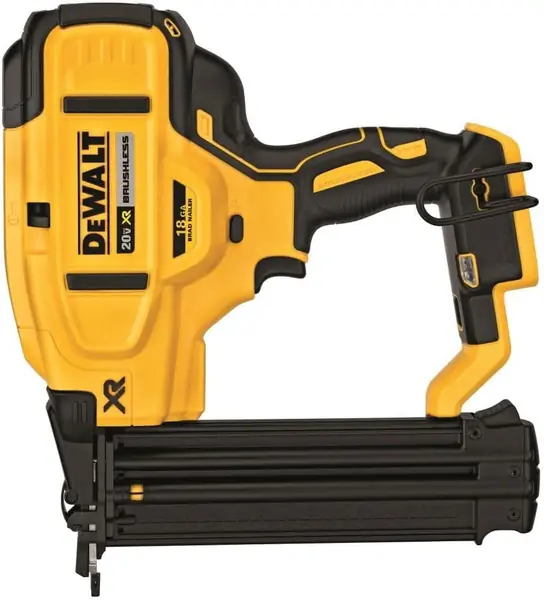
DEWALT DCN680B 20V MAX cordless 18-gauge brad nailer with micro nose and tool-free depth dial

Overhead trim work

Shop Score 95/100
Weight
3.97 lb
Nail Length
5/8 to 2-1/8 in
Motor
Brushless
Battery
20V MAX, tool only
View on Amazon

At 3.97 pounds without a battery, the DCN680B is the lightest nailer in this group, and that figure stops being abstract the moment you're on a step stool holding crown in place with one hand. We noticed it most on the second and third passes along a ceiling line, where a heavier gun starts to droop at the nose. The micro nose earns its keep for the same reason: you can watch the tip land on a pencil mark instead of guessing past a wide housing.

Capacity is the other place it pulls ahead. It drives 18-gauge brads from 5/8 inch to 2-1/8 inch, a quarter inch more than most of the group, which matters for built-up casing and thicker trim stock. Depth adjusts at the nose without a tool, so moving from pine casing to oak shoe molding takes a twist instead of a hunt for a hex key, and the brushless motor is there to stretch runtime and keep heat down over a long afternoon.

The 20V MAX platform is the quiet advantage: the packs we already keep for a drill or a circular saw run this gun, and swapping to a compact 2.0Ah pack moves the balance back over your palm for overhead work. Save the big packs for a bench full of casing, where the extra runtime pays you back.

Worth Noting

  • Sold as a bare tool, battery extra
  • Jams on dense stock need clearing
Our Verdict

We recommend the DCN680B for anyone already on the 20V MAX platform: it's the lightest nailer here, drives the longest brads, and puts the tip where you can see it.

Check Latest Price
2.

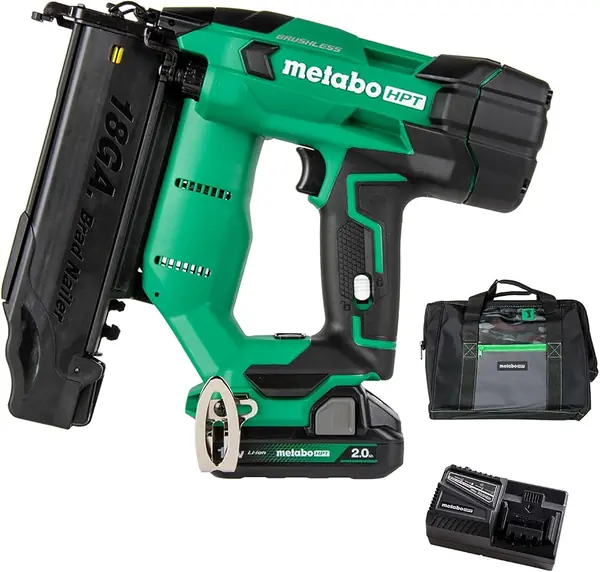
Metabo HPT NT1850DG Kit Best Value Kit

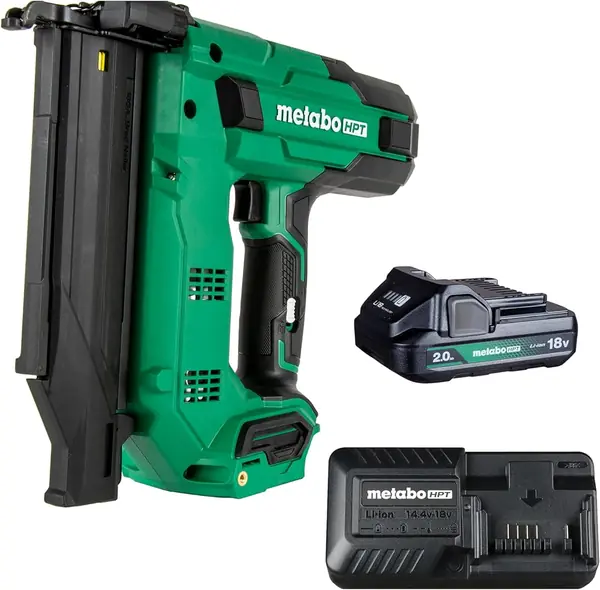
Metabo HPT NT1850DG 18V cordless 18-gauge brad nailer in green with battery and charger

Budget trim kit

Shop Score 94/100
Weight
5.5 lb
Nail Length
5/8 to 2 in
Shots Per Charge
700
In The Box
Battery, charger, no-mar caps, hook, glasses
View on Amazon

The box is the argument here. The NT1850DG arrives as a complete kit — a 2.0Ah 18V battery with a fuel gauge, a charger, no-mar nose caps, a hook, and safety glasses — for less than several bare tools in this guide. If you're starting from nothing, that's the difference between nailing trim this weekend and placing three orders and waiting.

In hand it's a well-mannered tool. The mechanical spring drive fires without the wind-up pause you feel on some cordless nailers, so the brad lands when you expect it, and the low center height lets the nose drop under a piece of crown where a taller housing fouls. We also liked the LED at the tip; on a dim stairwell it's the difference between seeing the mark and feeling for it. At 5.5 pounds it sits mid-pack here, heavier than the compact kits and lighter than the full-size ones.

Capacity runs 5/8 to 2 inches, which covers shoe molding, casing, and cabinet face frames, and the fuel gauge on the pack means you aren't guessing before you climb a ladder. Metabo rates it at 700 brads per charge, so a room's worth of baseboard doesn't come close to emptying it.

Worth Noting

  • Sequential trigger only, no bump fire
Our Verdict

Our pick for a first nailer: the NT1850DG arrives with battery, charger, and no-mar caps for less than most bare tools here, and runs 700 brads a charge.

Check Latest Price
3.

Milwaukee 2746-20 M18 FUEL Best for M18 Owners

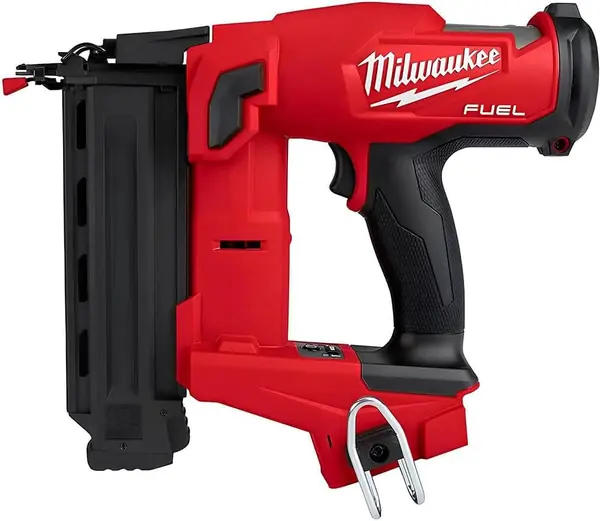
Milwaukee M18 FUEL Gen II 18-gauge cordless brad nailer, sold as a bare tool

M18 finish work

Shop Score 93/100
Weight
6.5 lb
Motor
Brushless
Firing Modes
Single and contact
Battery Platform
M18
View on Amazon

Pull the trigger and the brad is already set — no wind-up, no half second of waiting for the mechanism to build. That immediacy is what separates the M18 FUEL from cordless nailers that make you learn a rhythm. On a run of door casing, where each shot follows the last by a couple of inches, it feels like a pneumatic.

The two firing modes cover the two jobs: single sequential for setting a piece where placement matters, contact actuation for a long run of baseboard when you're moving fast. Depth adjusts without tools, and clearing a jam doesn't mean dismantling the magazine — the nose opens, you pull the offender, and you're back to work. Because it's a bare tool, the pack you fit decides how it carries; a compact pack keeps the weight closer to your hand than a big brick does.

Consistency is what we keep coming back to — the same depth from the first brad to the last, shot after shot, which is the whole reason to pay Milwaukee money. This is the nailer we hand someone fitting out a room they can't afford to revisit.

Worth Noting

  • 6.5 pounds is a load overhead
Our Verdict

If your shop already runs on M18 packs, this is the nailer we point you to — no ramp-up, two firing modes, and speed that suits cabinet and trim work.

Check Latest Price
4.

Metabo HPT NT1850DFT Kit Best Compact Kit

Metabo HPT NT1850DFT 18V brushless cordless brad nailer kit with 2.0Ah battery and magazine

Cabinet work

Shop Score 92/100
Weight
4.4 lb
Nail Length
5/8 to 2 in
Shots Per Charge
1,300
Firing Modes
Sequential and bump fire
View on Amazon

1,300 brads on a single 2.0Ah charge is the number that sets this kit apart — roughly double what some kits here manage, and enough that a day of cabinet work rarely involves a battery swap. We noticed it as an absence: no hunting for a fresh pack mid-run, no half-charged spare sitting on the bench. For anyone billing hours, that's the argument for the step up in price.

The tool is compact where compact matters. At 4.4 pounds and about 30 percent smaller than the model it replaces, it fits between a face frame and a shelf, and the nose is short enough to see the tip on a narrow stile. The selective actuation switch flips between sequential and bump fire without a tool, and depth adjusts the same way.

It's the newer of the two Metabo kits here, so there's less history behind it than the cheaper one carries. What it does carry is a lifetime warranty and a 5/8-to-2-inch capacity that runs from shoe molding up through casing.

Worth Noting

  • Premium price without extra brad length
Our Verdict

For cabinet and tight trim, we reach for this compact Metabo: 4.4 pounds, 1,300 brads per charge, and a switch that gives you bump fire when you want it.

Check Latest Price
5.

Ryobi P320 AirStrike Best for ONE+ Households

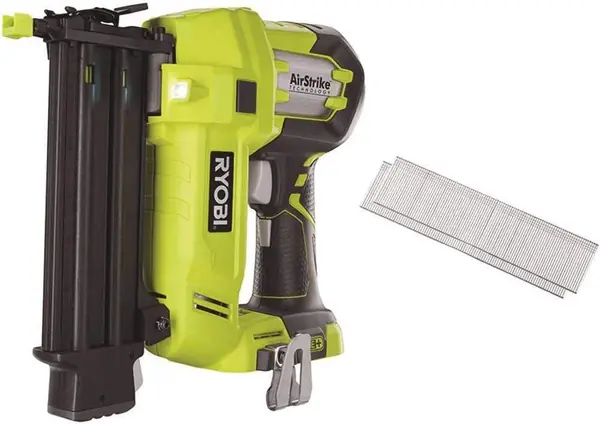
Ryobi ONE+ P320 18-volt cordless 18-gauge AirStrike brad nailer, tool only, with magazine

ONE+ households

Shop Score 91/100
Weight
6 lb
Nail Length
5/8 to 2 in
Firing Rate
Up to 60 nails per minute
Battery Platform
18V ONE+, tool only
View on Amazon

If your garage already runs on ONE+ batteries, this is the least complicated way into cordless nailing: the P320 is a bare tool, so the only thing you're adding is the gun itself. The same packs that run the drill and the trim router drop into the back of it.

What we like is how little fuss there is. The magazine loads from the front, the depth dial is a thumb turn, and the AirStrike mechanism fires up to 60 nails a minute — a homeowner's cadence rather than a production rate, which is exactly right for running baseboard in one room and then shelving the tool for a month. It drives 5/8 to 2 inch brads, so one box of nails covers shoe molding and casing.

Ryobi's real advantage is the platform: one battery family across a garage full of tools, and a nailer that doesn't ask you to learn anything new. It's the tool you grab for a loose piece of quarter round and put back before a compressor would have been plugged in.

Worth Noting

  • Six pounds is heavy for overhead trim
Our Verdict

We point ONE+ households to the P320: it drives the full 5/8-to-2-inch range at a homeowner's pace and loads in seconds.

Check Latest Price
6.

Worx WX842L Best for Fast Firing

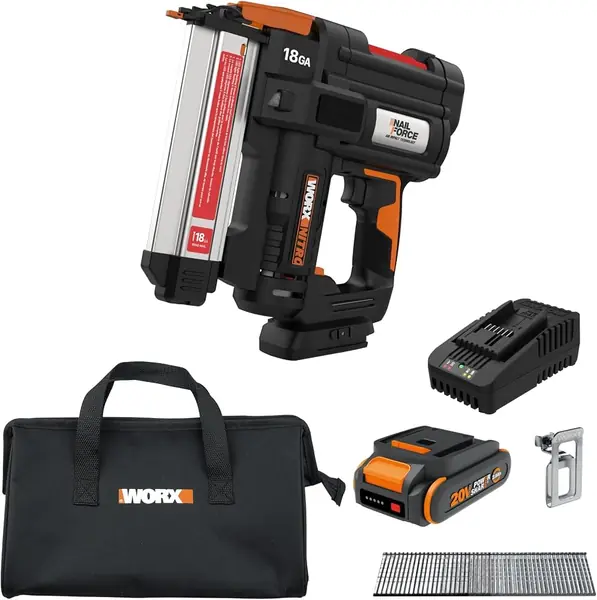
Worx WX842L 20V Power Share cordless 18-gauge brad nailer with battery and charger

Fast trim runs

Shop Score 90/100
Weight
7.06 lb
Nail Length
Up to 2 in
Shots Per Charge
Up to 500
Firing Rate
Up to 80 nails per minute
View on Amazon

Eighty nails a minute is the fastest firing rate in this group, and it's not a number you'll never use — the WX842L keeps up while you're tacking a long piece of baseboard every few inches before the glue grabs. Where the slower tools make you wait on the mechanism, this one is ready when you are.

The kit is genuinely complete: a 20V Power Share battery, a charger, and up to 500 brads on that 2.0Ah pack. We liked that there was no second order standing between the box and the first cut. The jam release is a lever at the nose rather than a disassembly job, and the magazine takes a full stick without fiddling.

Worx rates it for 2-inch brads into hardwood, and in pine and poplar trim it does that without complaint. In denser stock, slow down and let the mechanism work rather than leaning on the nose.

The case for it is a remodel in stages: one battery covers a room's worth of baseboard, the charger lives on the bench, and the tool doesn't demand a compressor's worth of setup for twenty nails. It isn't the nailer a production trim crew would carry, but it turns a Saturday's punch list into an hour.

Worth Noting

  • 7.06 pounds plus battery, heavy overhead
Our Verdict

We hand the WX842L to anyone who wants speed without a compressor: 80 nails a minute, and the battery comes in the box.

Check Latest Price
7.

Craftsman CMCN618C1 Best for Home Trim Projects

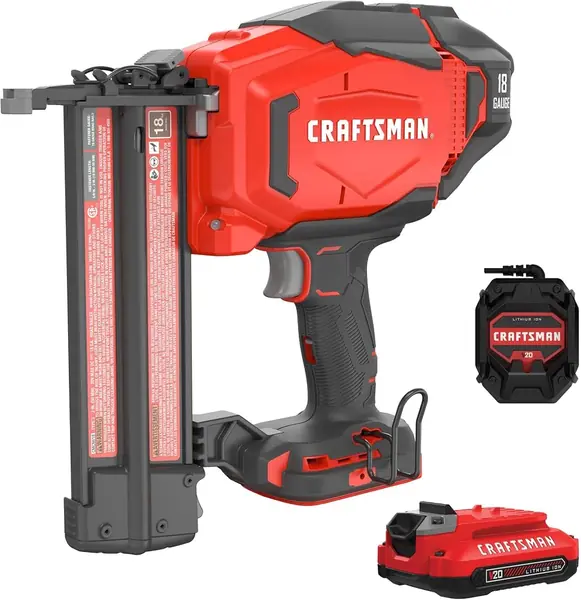
Craftsman CMCN618C1 V20 cordless 18-gauge brad nailer kit in red and black with battery

Home trim projects

Shop Score 89/100
Weight
7.6 lb
Motor
Brushless
Battery
V20, one battery included
Depth Adjustment
Tool-free
View on Amazon

Jamming is the thing to know about before you buy. This is the weakest jam record in our group — mid-run stoppages come up more here than on the picks above, and clearing one costs you whatever rhythm you'd found. The tool-free release does its job, with the nose opening without a hex key, but a nailer that stops every few dozen shots is one you learn to feed carefully.

Everything else is easy. Depth adjusts with a thumb dial, the magazine loads from the front, and the brushless motor is built to hold firing power as the temperature drops, which is a useful trait in a garage shop in February. The kit includes a V20 battery and charger, so it's a one-box start for someone who doesn't want to think about platforms.

For a homeowner already on V20 packs who wants a single purchase and no decisions, that's a sensible package. It's happiest on trim, wainscoting, and furniture repairs — the kind of work measured in dozens of brads rather than hundreds.

Worth Noting

  • 7.6 pounds before the battery goes on
  • Packs have failed to hold a charge
Our Verdict

We see the CMCN618C1 as a starter kit for V20 households: brushless, complete in the box, and simple to set up.

Check Latest Price
8.

Porter-Cable PCC790B Best for Softwood Casing

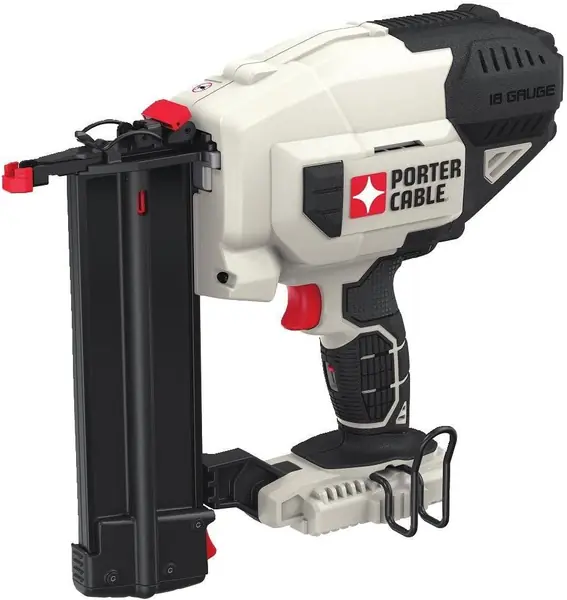
Porter-Cable PCC790B 20V MAX 18-gauge brad nailer, bare tool, with magazine

Softwood casing

Shop Score 88/100
Weight
6.4 lb
Battery
20V MAX, bare tool
Depth Adjustment
Tool-free
Warranty
3-year limited
View on Amazon

Ask this one for two inches of brad in oak and it will disappoint you. The published ceiling is 2 inches, but hardwood is where that number stops being true — 1-1/2 inches is the practical limit in dense stock. In pine casing and poplar base it's a different tool altogether, sinking brads flush with almost no adjustment.

The rest of the package is straightforward: tool-free depth, a jam release at the nose, a contoured handle that sits well in the hand, and a three-year limited warranty that's longer than most here. It's a bare tool, so it makes sense if Porter-Cable's 20V MAX packs are already in your shop.

Sight lines are decent for a gun this size, and at 6.4 pounds it's manageable on a ladder, though it isn't the tool we reach for on a ceiling line.

We see it as a second nailer, or a first one for softwood work: casing, baseboard, cabinet backs, and shop jigs, where brads in the 1-1/4 to 1-1/2 inch range do everything the job needs. For a shop that already owns the packs, that's a narrow but real role.

Worth Noting

  • Short delay between trigger and shot
Our Verdict

We rate the PCC790B as a softwood trim nailer: casing and baseboard, yes; two-inch brads in oak, no.

Check Latest Price

How We Tested Cordless Brad Nailers

We started by rounding up every 18-gauge cordless brad nailer we could find in the U.S., then cut the field on the things that decide a purchase: whether a tool drives the full range of brad lengths trim calls for, whether it runs on a battery platform you can share across tools, whether a pack and charger come in the box, and what the bare tool costs next to the kit. From that shortlist we bought twelve nailers and spent nine months with them.

Each one got weighed with its battery in, then run through baseboard and casing in pine, poplar, MDF, and white oak so we could feel where it balanced at the grip rather than trusting the number on the box. We fired single shots and bump-fire runs down long pieces, timing how fast each tool kept up and whether the trigger felt crisp or mushy. Flush mattered more than fast: we checked every head by feel, moved from soft pine to hard oak and back, and adjusted depth without a wrench to see whether the setting drifted.

Jams went into a log — what the nail was doing, whether clearing took a tool, and how long the nailer sat out. The battery came out before every load and every clear, and safety glasses stayed on for the whole run, especially over knots and dense grain. To judge nose access, we set baseboard into an inside corner and watched how much of the tip we could see past the workpiece.

Battery life got tested the boring way: fresh pack, full magazine, fire until it quits, and note whether it slowed before it stopped. The tools that kept coming back out of the case for cabinet work and closet shelves months later were the ones that earned their place.

How to Choose a Cordless Brad Nailer

Start With the Batteries Already in Your Shop

Every nailer here is a battery decision first. A bare tool looks like the cheaper buy until you price a pack and charger, which is why the kits in this guide matter: the Metabo HPT NT1850DG arrives complete for less than several bare tools, while the DEWALT DCN680B assumes 20V MAX packs are already on your shelf.

Count your packs and note their capacity before you compare anything else. A kit with a small 2.0Ah pack is a fine start for trim, but check that the platform offers a bigger pack for the day you're nailing a whole house.

Weight and Balance Beat the Number on the Box

The nailers here run from just under four pounds to seven and a half, and that gap matters most above your shoulders. A 7.6-pound tool with a big pack on it is a different animal at the end of your arm than a four-pound one with a compact pack.

Balance counts as much as total weight: a gun that sits over your palm handles better than one that hangs out at the nose. If most of your work is crown, casing, and ceiling trim, stay near the light end and fit the smallest pack that will finish the run.

Nail Length, Firing Speed, and the Trim You Run

Most 18-gauge nail guns here drive brads from 5/8 inch to 2 inches, with one reaching 2-1/8. Treat the top figure as a ceiling, not a target: 1-1/4 to 1-3/4 inch brads handle most casing and base, and the long ones are for thicker or built-up stock.

Firing speed runs from about 60 to 80 nails a minute. Faster pays off on long baseboard runs; slower is fine when you're placing one brad in a cabinet face frame. Match the cadence to the way you work rather than to the biggest number.

Jams, Depth, and Getting the Nose Into a Corner

Two features decide how a nailer behaves on a bad day: a tool-free jam release and tool-free depth adjustment. Both let you fix a problem without walking to the bench for a hex key, and both show up on every pick worth buying here.

Nose shape matters just as much. A micro nose lets you see the tip land on a narrow casing, and a low housing slides under crown where a tall one fouls. Before you commit, ask whether you can reach the release with the tool at arm's length above your head.

Frequently Asked Questions

Final Verdict

The DEWALT DCN680B is the nailer we point most people to, and the reason is simple: it's the lightest tool here, it drives the longest brad in the group, and the nose is short enough to see around. If you don't already own 20V MAX packs, though, that advantage disappears into the cost of a battery and charger.

Start with the Metabo HPT NT1850DG instead — a complete kit for less than most bare tools here, with 700 brads per charge and no platform commitment. Buy the DEWALT when the batteries are already on the shelf; buy the Metabo when they aren't.