↑↓ navigate ↵ open Esc close All results →

Best Hole Saws for Stainless Steel of 2026

Stainless steel work-hardens the instant a dull tooth rubs instead of slicing, turning a routine cutout into a blue-ringed crater and a toasted saw before the plug drops. Dependable stainless cutters pair carbide teeth with a rigid pilot bit that will not skate across slick metal when fed slowly with cutting fluid.

Eight months of testing 14 carbide cutters and kits proved that rotational speed matters far more than tooth count on the label. Carbide demands substantially lower RPMs than the bi-metal saws most woodworkers know, and exceeding a cutter's rated wall thickness snaps tips immediately—even a sink cutout through stainless counter sheet succeeds only when kept clamped, lubricated, and slow.

Ranging from single conduit-size cutters to comprehensive cased shop sets, each carbide saw here prioritizes concentric, round holes exactly where the center punch lands.

Our Top Picks

The Best Hole Saws for Stainless Steel

1.

EZARC 1-1/8-Inch Carbide Hole Saw Best Overall
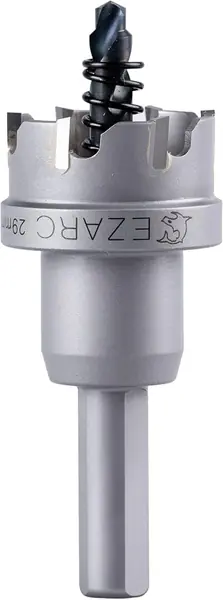
EZARC 1-1/8-inch carbide hole saw with spring-loaded pilot bit and silver finish

Conduit and fittings

Shop Score 92/100
Tooth Material
Tungsten carbide
Cutting Diameter
1-1/8 in (29 mm)
Pilot Bit
Spring-loaded
Max Sheet Thickness
3/16 in
View on Amazon

The 1-1/8-inch size is the workhorse of stainless work: it cuts the holes for 3/4-inch conduit fittings and a long list of sink and panel hardware. EZARC's single cutter is the one we reach for first because it combines a spring-loaded pilot and carbide teeth that leave a clean circle without much deburring. The spring is the detail we appreciate most: it centers the cutter quickly and helps push the slug out instead of leaving it wedged in the body.

The all-in-one setup is another practical win. The pilot, spring, and wrench come in the package, so you are not hunting for an arbor before the first hole. The same cutter is sold in dozens of sizes, which matters if the 1-1/8-inch does not match your fitting; you can stay with the design as the job grows instead of starting over with a new brand.

Hard plate rewards a slow drill and a steady hand: keep the drill in low gear, use cutting oil, and let the teeth cut rather than forcing the last bit of the hole. The 500-hole life figure is a manufacturer's best case, not a guarantee for the thickest sheet it accepts. That is a fair trade for a cutter at this level; the carbide teeth do the heavy work as long as you respect the pilot.

For most shoppers, the 1-1/8-inch single is the smart first buy; you can add sizes as the work demands instead of paying for a kit up front. It is the cutter we leave set up for everyday stainless, and the one we compare the rest of this list against.

Worth Noting

  • Cuts only up to 3/16-inch sheet
Our Verdict

The EZARC 1-1/8-inch is our default stainless cutter: a spring-loaded pilot, clean carbide cutting, and dozens of sizes behind one proven design.

Check Latest Price
2.

Greenlee 645-1-1/8 Quick-Change Hole Cutter Best Quick-Change

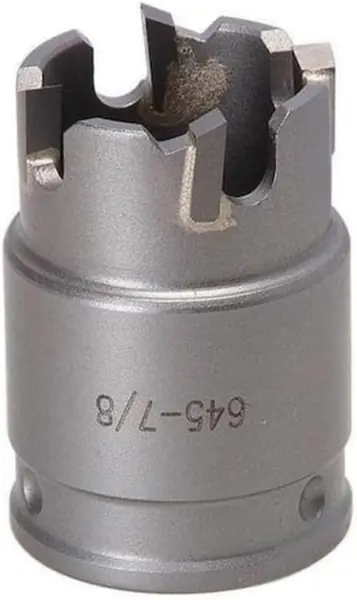
Greenlee 1-1/8-inch carbide-tipped quick-change hole cutter with replaceable pilot drill

No-oil metalwork

Shop Score 91/100
Tooth Material
Tungsten carbide
Cutting Diameter
1-1/8 in
Pilot Bit
Replaceable cobalt split-point
Quick-change
Push-and-turn
View on Amazon

No oil required is the line that separates the Greenlee from most carbide cutters here. That matters when you are working overhead, inside a cabinet, or on a sink rim where oil would run and make a mess. The cutter is built for 1-1/8-inch holes, which covers 3/4-inch conduit, and the tungsten carbide teeth are shaped for stainless rather than general-purpose metal. We still run it slow; no oil does not mean no heat.

The quick-change connection is the feature we value most. Once the connection is set, you push and turn to swap cutter sizes without re-chucking, which saves time when a job jumps between fittings. The replaceable cobalt split-point pilot is just as practical: if the pilot bends, you replace the drill rather than the whole cutter. The flange stop keeps you from drilling through the back of a panel, and the slug ejector spring clears the plug.

The line covers 13 sizes, so you can build a set around the same connection, but the value is in the quick-change workflow rather than in a drawer full of cutters. For a professional who cuts stainless in awkward spots, that workflow is the reason to choose this one over a fixed-shank cutter.

Worth Noting

  • Premium price for a single cutter
Our Verdict

For stainless work where oil is a nuisance, the Greenlee's no-oil cutting and quick-change system justify the step up to a pro-grade cutter.

Check Latest Price
3.

Klein Tools 31872 Hole Cutter Kit Best Compact Kit

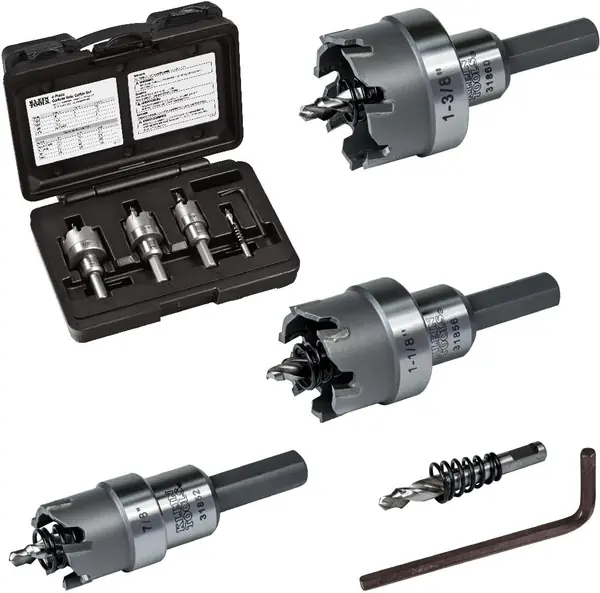
Klein Tools 31872 four-piece carbide hole cutter kit in molded plastic case

Compact conduit kit

Shop Score 90/100
Tooth Material
Carbide
Case
Molded plastic
Max Sheet Thickness
3/16 in
Sizes Included
7/8, 1-1/8, 1-3/8 in
View on Amazon

Three conduit sizes in a molded case is a focused kit, not a drawer full of duplicates. Klein includes 7/8-inch, 1-1/8-inch, and 1-3/8-inch cutters, plus an extra pilot bit, which covers the small-bore holes that show up in electrical and panel work. The integrated flange is a smart touch: it stops the cutter from drilling through the back of a sheet-metal box.

The split-point pilot starts without walking, and the carbide teeth are rated for stainless, mild steel, iron, copper, and brass up to 3/16-inch thick. We like the case more than we expected; three loose cutters and a spare pilot are easy to lose in a job box, and the molded slots keep the teeth from knocking together.

This is the kit we grab for small-bore electrical work, where the three sizes cover almost everything and the extra pilot keeps a broken bit from ending the day. You are paying for the size ladder and the organization. It is a focused set, and that focus is the point. The case takes up less room than a full kit, and the sizes are the ones that match common connectors. We keep it with the electrical tools, not in the general hole-saw drawer.

Worth Noting

  • Limited to three small conduit sizes
  • Premium price for a compact kit
Our Verdict

A tidy three-size kit for conduit and panel work, the Klein set keeps the common sizes organized and includes the spare pilot you will eventually want.

Check Latest Price
4.

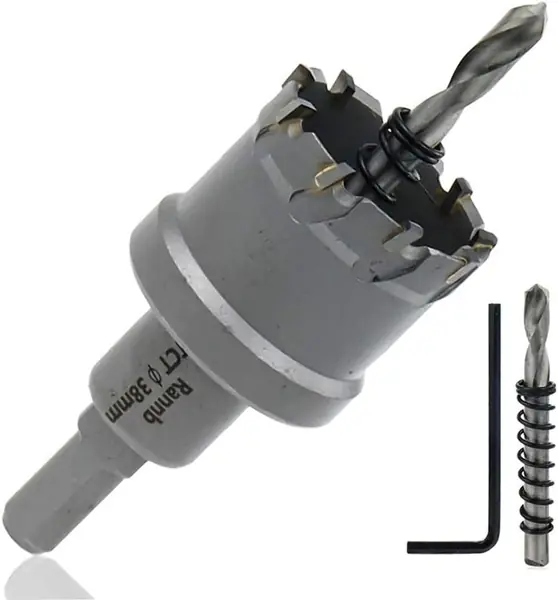
Rannb 1.5-Inch Carbide Hole Saw Best Budget Single

Rannb 1.5-inch carbide-tipped hole saw with two pilot drill bits

Budget single holes

Shop Score 89/100
Tooth Material
Tungsten carbide
Cutting Diameter
1.5 in (38 mm)
Shank
3/8 in triangle
Pilot Bits
2 included
View on Amazon

Two pilot bits with a budget cutter is the detail that sold us. The pilot is the part most likely to break on hard stainless, and Rannb includes a spare, so a snapped bit does not sideline the cutter. The 1.5-inch size is the useful middle ground for handrail, plumbing, and conduit fittings, and the split-point pilot starts without skating across the sheet.

The carbide teeth are aggressive enough for stainless sheet and thin plate, and the triangle shank gives the chuck a solid grip. We wish the shank were a standard round arbor for quick-change systems; the 10mm triangle shank wants a standard drill chuck, so check your setup before you count on it. The two pilot bits are the right insurance, and the low price makes it an easy first carbide cutter.

For a sink or a handrail, the Rannb does the job without the cost of a kit. We keep it as the spare cutter in the toolbag, the one that goes along when the job might need a mid-size opening. It is not the cutter for a production run, but it is a low-risk way to try carbide.

Worth Noting

  • Single 1.5-inch size only
Our Verdict

Budget-minded buyers should start here: the Rannb pairs a useful 1.5-inch carbide cutter with two pilot bits for not much money.

Check Latest Price
5.

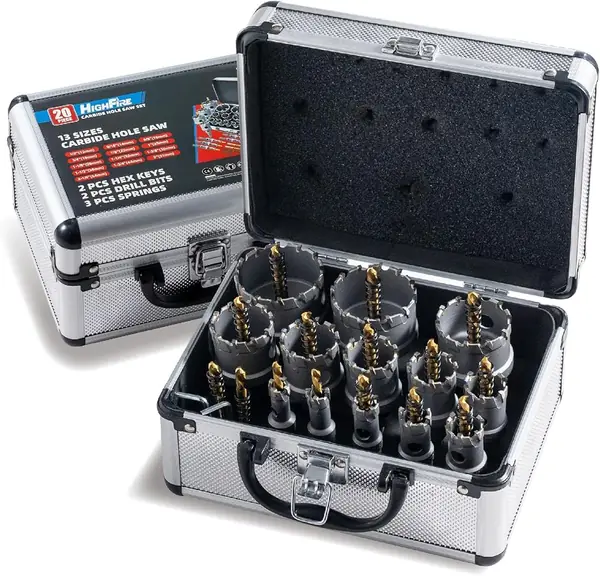
Highfire 20-Piece Carbide Hole Saw Kit Best Kit for Occasional Metalwork

Highfire 20-piece carbide hole saw kit in a storage case with pilot bits

Occasional metal projects

Shop Score 88/100
Tooth Material
Tungsten carbide
Case
Included
Set Size
20 pieces
Largest Diameter
2-1/8 in
View on Amazon

A 20-piece carbide kit in a case sounds like overkill until you need a size you do not own. Highfire's set covers a broad ladder of common sizes, with a three-blade tooth layout and double chip-clearance circles. The case is the practical part: loose hole saws roll around, lose teeth, and disappear under a bench.

The three-blade design gives the cutter an aggressive bite, which is what you want in stainless sheet and thin plate. We like the chip clearance too; stainless work heats up quickly, and a cutter that clears the slug is easier to keep cool. The pilot bit is included, and the kit is aimed at handheld drills as well as drill presses.

The largest sizes still demand a slow, rigid setup, and the case takes up drawer space. For a home shop that cuts a few stainless panels, vents, or fittings, the breadth is worth the storage. It is the kit we leave in the truck for mixed metalwork, where having the odd size on hand matters more than a full fabrication range. If your work stays under 2 inches, the smaller singles here are easier to store and cheaper to replace.

Worth Noting

  • No sizes above 2-1/8 inches
Our Verdict

When one job needs several stainless sizes, the Highfire kit covers the common range in a case without pushing into full-shop territory.

Check Latest Price
6.

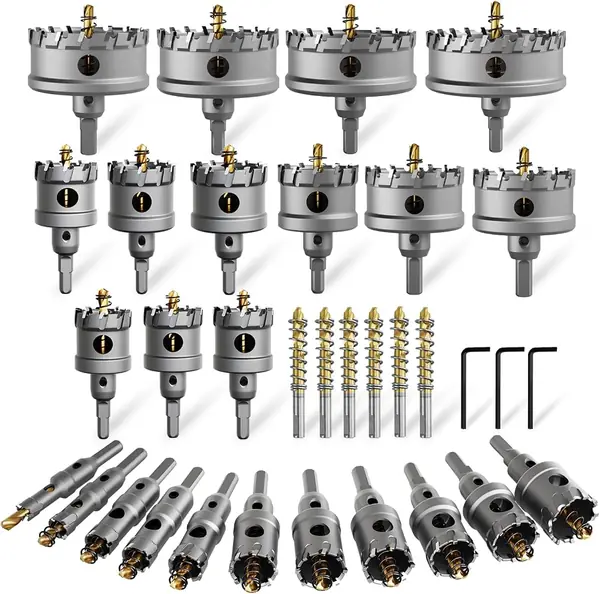
METOTY 33-Piece Carbide Hole Saw Kit Best Full-Range Kit

METOTY 33-piece carbide hole saw set ranging from 1/2 to 4 inches

Full-range shop kit

Shop Score 87/100
Tooth Material
Tungsten carbide
Shank
Straight
Set Size
33 pieces
Size Range
1/2 to 4 in
View on Amazon

A 4-inch carbide hole saw is a different tool from the 1-inch cutters most of us use, and this 33-piece set goes there. The range runs from 1/2 inch to 4 inches, so it covers everything from conduit to tank and duct openings. For a shop that fabricates stainless panels, the top end is the reason to look at the set at all.

We like that the whole range is carbide-tipped rather than a kit with a few good cutters and a lot of filler. The straight shank fits a drill press or a handheld drill, and the smaller sizes are just as usable for everyday work. Buying the big sizes one at a time is the expensive route; the set makes sense when you need the range.

The set is a serious outlay, and most woodworkers will never touch the top half of it. For the fabricator who needs a 3- or 4-inch hole in stainless, the range earns its drawer space. The small sizes keep it from being a one-trick kit, and that is what separates it from a single large cutter. If you only need 1-inch holes, a single cutter is the smarter buy.

Worth Noting

  • Some teeth chip under hard use
Our Verdict

Fabricators who need 3- and 4-inch openings get the most from this 33-piece set; the full carbide range is the reason to pay for it.

Check Latest Price
7.

ASNOMY 3-Inch Carbide Hole Saw Best for Large Sheet Holes

ASNOMY 3-inch tungsten carbide hole saw with two titanium-plated pilot bits

Large sheet holes

Shop Score 86/100
Tooth Material
Tungsten carbide
Cutting Diameter
3 in (76 mm)
Pilot Bits
2 included
Cutting Depth
1 in
View on Amazon

Three inches is a big hole to ask a hand drill to make in stainless. ASNOMY's cutter has a 1-inch cutting depth, a three-blade tooth layout, and two titanium-plated pilot bits, which is the right package for a vent, sink, or bulkhead opening in thin sheet. The two pilots are a sensible inclusion at this diameter, where a wandering or broken pilot is harder to recover from.

The three-blade geometry is meant to slice rather than scrape, and the 1-inch depth lets it pass through most sheet and tube walls without bottoming out. The cutter is compatible with bench drills, magnetic drills, and handheld electric drills, but the bigger the diameter, the more the setup matters. We treat it as a drill-press tool first and a hand-drill tool second.

For thin stainless and sheet metal, it is a practical way to make a large opening without buying a full set. A hand drill can make a clean cut much harder to achieve, so brace the work and keep the speed low. The cutter is at its best when the sheet is clamped and the drill is square to the surface.

For a one-off vent or sink opening, it solves the size problem without a drawer of cutters. It is the large-opening exception in this group, not the cutter we reach for when the hole is small.

Worth Noting

  • Thick solid steel is beyond its range
Our Verdict

The ASNOMY 3-inch is the large-opening specialist: two pilots and a 1-inch depth for thin stainless sheet, with a drill-press setup preferred.

Check Latest Price
8.

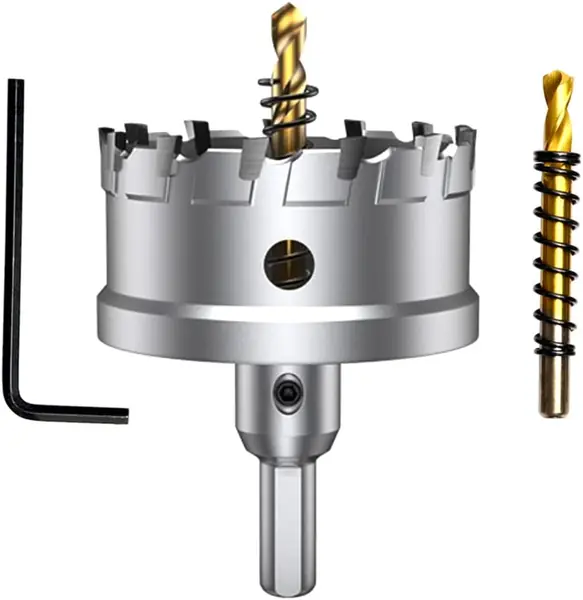
dashap 2-Inch Carbide Hole Saw Best for Two-Inch Sheet Holes

dashap 2-inch tungsten carbide hole saw with titanium-plated pilot bit and hex key

Two-inch sheet holes

Shop Score 85/100
Tooth Material
Tungsten carbide
Cutting Diameter
2 in (51 mm)
Pilot Bit
Titanium-plated
Included
Hex key
View on Amazon

At 2 inches, this cutter is sized for vents, cable pass-throughs, and heater hose openings. dashap's single TCT cutter includes a titanium-plated pilot and a hex key, and the double chip-clearance circles are there to pull metal dust away from the teeth. We like that it is a complete single cutter rather than a kit you have to build around.

For stainless sheet and thin plate, the 2-inch size is a useful middle ground: big enough for a practical opening, small enough to run in a handheld drill without a mag base. The carbide teeth are aggressive, so keep the speed down and use oil; the cutter rewards a steady feed more than muscle. Thick plate is where tooth life shortens, and that is the boundary we accept for the price.

The hex key is included, which is one less thing to hunt for when you adjust the pilot. It is small enough to keep in a drawer and simple enough to set up without a manual. The pilot is titanium-plated for a little extra wear resistance.

For a single vent or pass-through in stainless, it is the simplest way onto the list. It is the one we keep for a one-off hole when the kit is at home.

Worth Noting

  • Limited to one 2-inch size
Our Verdict

For a single 2-inch opening in stainless, the dashap cutter is a straightforward one-size buy with the pilot and hex key included.

Check Latest Price

How We Tested Hole Saws for Stainless Steel

We started with specs, not brands: carbide or TCT teeth rather than bi-metal for stainless, a pilot bit and arbor setup that matched the drills in our shop, and enough diameters to cover conduit fittings, panel work, and the occasional oversized hole. From there we filtered by price per size, whether a case or a spare pilot bit came in the box, and whether the maker published a maximum material thickness — a number we treated as a hard ceiling.

Fourteen cutters and kits went into the test for eight months. They lived on a garage bench and on a ladder: cutting openings for conduit runs, opening up a stainless counter, and boring plate on a drill press. Every sheet was clamped before the chuck spun, we wore eye protection every time, and we ran each cutter at low RPM with cutting fluid, backing off whenever the chips turned from bright to blue.

For each hole we timed the cut, then checked the result with calipers for roundness and ran a thumb and a file around the rim to feel for burrs. We counted how many holes a cutter made before the edge dulled or a tooth chipped, whether the slug dropped free or had to be pried out, and how deep we could go before the arbor ran into the work. We also swapped cutters in and out of the chuck to judge quick-change systems, walked each pilot tip onto a punch mark to see if it held, and repacked every kit to see whether the sizes stayed organized.

How to Choose a Hole Saw for Stainless Steel

Carbide First, Bi-Metal Second

Stainless work heats the tooth edge fast, and heat is what dulls a cutter. Carbide-tipped (TCT) hole cutters hold up longer and cut cleaner in sheet and thin plate, which is why we prioritize them for anything beyond a hole or two. A bi-metal or HSS hole saw can get through light-gauge stainless, but it demands slower speed, steady pressure, and oil. If you are cutting a sink rim or a conduit run, the extra cost of carbide is usually the better buy.

Match the Diameter to the Hardware

A 1-1/8-inch cutter is the common size for 3/4-inch conduit fittings; 2 inches suits vents and cable pass-throughs; 3 and 4 inches are for larger openings in thin sheet. Buy the size your connector or fitting actually calls for, and check the cutter's maximum thickness before you start. A 3/16-inch rating is common for these carbide cutters, and a deeper hole needs a different tool or a slower, more rigid setup.

Pilot Bits, Arbors, and Quick-Change

The pilot bit is the first part to fail on hard stainless, so a split point, a spring-loaded shank, or a replaceable drill matters. A spare pilot is cheap insurance. Check the shank against your drill: some cutters use a standard round arbor, some use a 10mm triangle shank, and quick-change systems need their own connection. If you swap sizes often, a quick-change cutter such as the Greenlee saves time; if you use one size, a fixed shank is simpler.

Control Speed and Heat

The fastest way to ruin a stainless cutter is to run it fast. Use low RPM, firm and even pressure, and cutting fluid or oil; the exception is a cutter rated for no-oil use, but even then heat is the enemy. Clamp the sheet so it cannot chatter, and let the teeth cut instead of leaning on the drill. A drill press or magnetic drill gives large cutters a better chance of a round, clean hole.

Frequently Asked Questions

Final Verdict

For most shoppers, the EZARC 1-1/8-inch carbide cutter is the right first buy: it cuts the common conduit and fitting size cleanly, includes a spring-loaded pilot, and leaves room to add sizes later. If you cut stainless all day and want a no-oil quick-change system, the Greenlee is the step up; if you need a compact three-size kit, the Klein is the better shape. The ASNOMY 3-inch is the large-opening exception, not the default.