↑↓ navigate ↵ open Esc close All results →

Best Hole Saws for Recessed Lights of 2026

Working off a ladder with a recessed light waiting in its box leaves almost no margin for error: a hole slightly off size misses the trim flange, dull teeth bind in old plaster, and an unshielded arbor dumps half a pound of drywall dust straight onto the furniture below. Clean overhead installation depends equally on exact hole diameter, edge material, and dust capture.

Overhead cuts through paper-faced drywall, old plaster-and-lath, wood framing, PVC, and thin metal across six months with a dozen hole saws underscored two practical rules. First, the light fixture's spec sheet—not the nominal 4-inch or 6-inch label on the saw—dictates the exact cutout size, and second, a debris bowl that seals flush and empties without spilling saves almost as much time as sharp teeth.

Bi-metal cutters handle fast drywall retrofits cleanly, while carbide-grit edges power through abrasive plaster ceilings across both common recessed-can sizes.

Our Top Picks

The Best Hole Saws for Recessed Lights

1.

VIKITON 4-1/4-Inch Hole Saw with Dust Bowl Best Overall
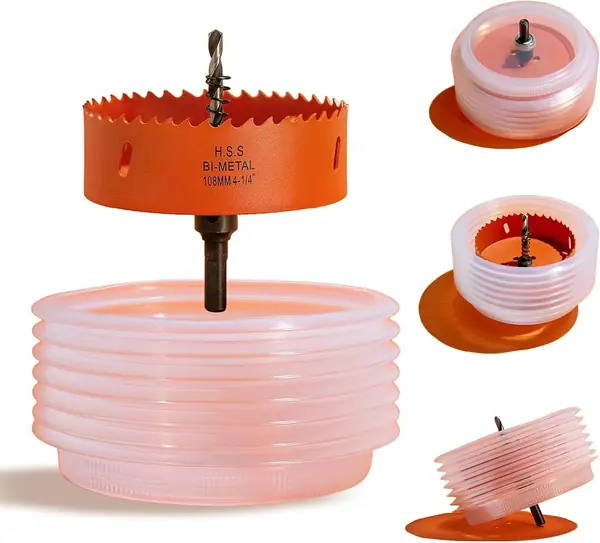
VIKITON 4-1/4-inch bi-metal hole saw with orange dust bowl and arbor

4-inch can retrofits

Shop Score 91/100
Saw Edge
Bi-metal, high-speed steel teeth
Cutout Diameter
4-1/4 in.
Dust Bowl
Included, rigid plastic
In The Kit
Arbor, replacement pilot bit, hex key
View on Amazon

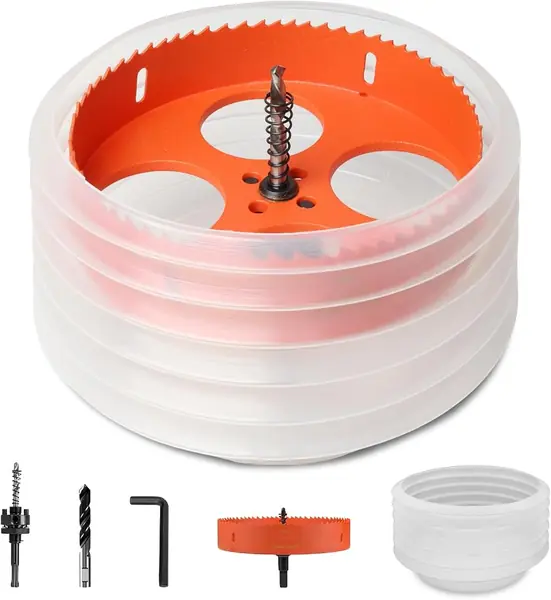
Cutting overhead is the part of a can light retrofit people dread: you're up a ladder with your arms over your head and drywall dust falling into your face. The orange bowl on this VIKITON saw changes that. It presses against the ceiling, the arbor runs through its center, and the debris collects inside it instead of raining down on you and the floor. In a finished room, that one design choice is worth more than any other difference between these saws.

The 4-1/4-inch size is the number to notice. It cuts the opening for standard 4-inch cans with just enough clearance that the housing drops in without a fight, which is what you want when the ceiling is already painted. The saw is bi-metal with high-speed steel teeth, so it handles drywall, wood, plastic and thin sheet metal. In the box: the saw, the bowl, the arbor, a replacement pilot bit and a hex key.

Where it gives ground is longevity. The teeth are the wear item on any bi-metal saw, and this one is built for a weekend's worth of holes rather than a whole house, which is the right trade for most of us cutting four or eight openings in a bedroom ceiling. If your ceiling is 1950s plaster with wire mesh buried in it, skip to the carbide saws below.

Nothing else here combines the 4-inch cut, a bowl that actually holds the dust, and a complete kit for so little. The replacement pilot bit is the detail we appreciate most: catch a hidden joist, snap the bit, and the job doesn't stop while you drive to the hardware store. If your lights are 6-inch, the Storystore kit is the equivalent starting point.

Worth Noting

  • Bowl fits only VIKITON saws
  • Sized for 4-inch cans only
Our Verdict

We recommend this for most 4-inch retrofits: the bowl keeps the dust off you and the floor, and the 4-1/4-inch cut leaves the clearance a can light needs.

Check Latest Price
2.

HLOFIZI 6-3/8-Inch Carbide Grit Hole Saw Best for Plaster and Lath

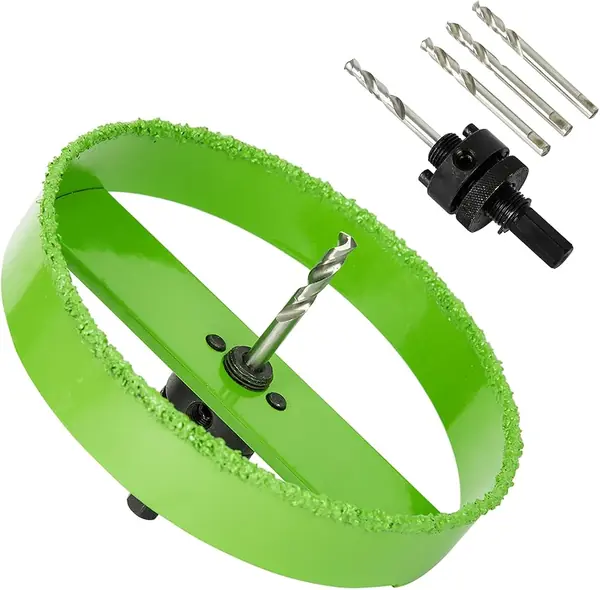
Green HLOFIZI 6-3/8-inch carbide grit hole saw with arbor and pilot bits

Old plaster ceilings

Shop Score 90/100
Saw Edge
Tungsten carbide grit
Cutout Diameter
6-3/8 in.
Arbor
Fits 1/2-inch chuck, three pilot bits
Cutting Depth
1-1/8 in.
View on Amazon

Plaster is where toothed saws go to die. An old ceiling is gypsum plaster over wood lath, often with wire mesh buried in it, and bi-metal teeth that skate through drywall round over in that stuff within a couple of holes. This HLOFIZI saw uses a tungsten carbide grit rim instead of teeth, grinding rather than slicing, and it's the one we pick up when the ceiling isn't drywall. It keeps cutting as the holes add up instead of fading halfway across the room.

The 6-3/8-inch diameter is the standard opening for 6-inch recessed cans, leaving room for the housing and its trim. Cutting depth runs 1-1/8 inches, enough for the plaster, the lath behind it and a little of the wood; the arbor fits a 1/2-inch chuck and three high-speed pilot bits come along. Dust collection is the gap, since there's no bowl in the box, so line up a helper with a vacuum hose or add a dust dome if you're working in a furnished room.

We also like the open back: the plug of plaster and lath pushes out instead of wedging in the barrel, which matters once you're past the third opening. It sits in the middle of the range here, more than the bi-metal saws and well under the Milwaukee. On plain paper-faced drywall the cheaper toothed saws cut faster and leave a smoother edge, so save this one for ceilings that fight back.

Worth Noting

  • Requires a 1/2-inch chuck drill
Our Verdict

For old plaster and lath, this is the saw we reach for: the carbide grit rim grinds through the plaster and the wood behind it and keeps cutting as the holes add up.

Check Latest Price
3.

Storystore 6-Inch Hole Saw with Dust Bowl Best Budget 6-Inch

Storystore 6-inch bi-metal hole saw with orange dust bowl and arbor kit

Budget 6-inch jobs

Shop Score 89/100
Saw Edge
Bi-metal, high-speed steel teeth
Cutout Diameter
6 in.
Dust Bowl
Included
In The Kit
Arbor, replacement drill bit, hex key
View on Amazon

Six-inch cans call for a 6-inch saw, and a kit that pairs one with a dust bowl usually carries a brand-name price. Storystore's version is one of the least expensive routes here to both, and it does what it's sold for: a clean circle through ceiling drywall with most of the debris landing in the bowl instead of on your floor. The bowl holds a full room's worth of dust, so you're not stopping to empty it every other hole.

What you're buying is a drywall and softwood tool. The bi-metal teeth are sharp out of the box and cut fast, and they're unlikely to stay that way through a whole house, so we think of it as a one-project saw, and it's priced like one. Diameter matters as much as condition: it cuts a true 6 inches, which suits fixtures that want a snug opening, while a can calling for 6-3/8 needs one of the carbide saws here. Check your fixture's cutout spec before you cut. It earns its place on a bedroom, a basement rec room, or a garage with a handful of cans and a weekend to spare.

Worth Noting

  • Not for plaster or lath ceilings
Our Verdict

If your cans are 6-inch and the budget is tight, this kit gets you a clean hole with the dust caught, and we think it's the value pick for a single room.

Check Latest Price
4.

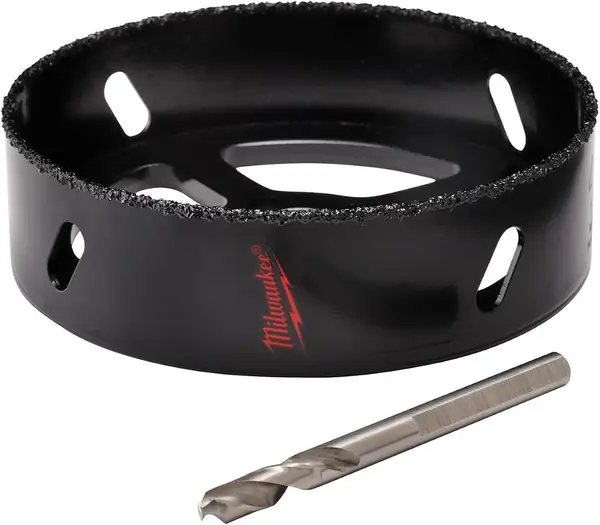
Milwaukee 49-56-0305 6-3/8-Inch Hole Saw Best for Whole-House Jobs

Milwaukee 6-3/8-inch carbide grit recessed light hole saw in black

Whole-house plaster work

Shop Score 88/100
Saw Edge
Carbide grit
Cutout Diameter
6-3/8 in.
Arbor
Sold separately, 5/8-18 thread
Cutting Depth
1-3/4 in.
View on Amazon

Depth is the spec that separates this saw from the rest of the group. Milwaukee cuts 1-3/4 inches deep against 1-1/8 inch on the HLOFIZI, and that matters on an old ceiling where the plaster is an inch thick with lath and wire behind it. The saw reaches through the whole assembly in one pass instead of bottoming out halfway and burning.

The rim is carbide grit, so it grinds through plaster, drywall, stucco, acoustical tile and cement board with no teeth to dull. Two things aren't in the package: the arbor, which needs a 5/8-18 thread and a hole shooter with 1/2-inch capacity, and any kind of dust bowl. Order the arbor with the saw, and plan on a vacuum or a dome for containment, because with this one dust control is your problem, not the box's.

Is the premium worth it? For one ceiling of modern drywall, no, since the toothed saws here cut it faster for far less. For a floor of a 1950s house, or a job with stucco and wire mesh, yes: this is the saw we trust to still be cutting at the end of a long day, and a saw that quits costs you a trip and a day. It's the deepest-cutting and the most expensive one here, and on abrasive ceilings that's the whole argument.

Worth Noting

  • Arbor sold separately, 5/8-18 thread
  • No dust bowl in the box
Our Verdict

The one we choose for a whole house of old plaster: nothing else here cuts as deep or holds up as long in abrasive ceilings, and we trust it to finish the job.

Check Latest Price
5.

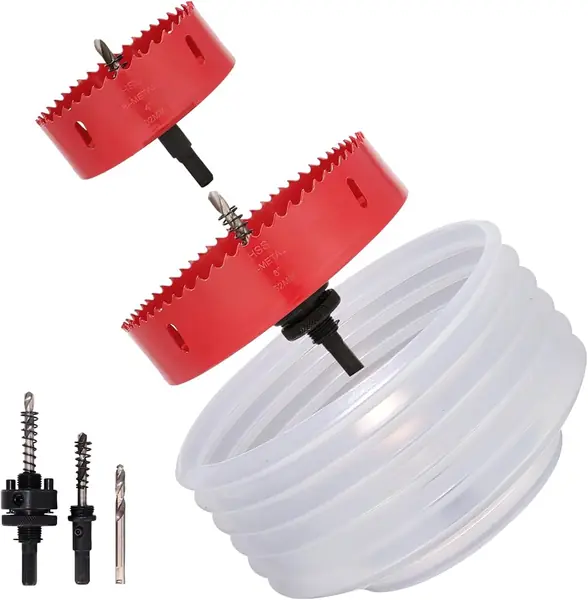
Nexigins 4-Inch and 6-Inch Hole Saw Kit Best Two-Size Kit

Nexigins red two-piece hole saw kit with 4-inch and 6-inch saws and dust bowl

Mixed fixture sizes

Shop Score 85/100
Saw Edge
Bi-metal, high-speed steel teeth
Dust Bowl
Included, one for both saws
In The Kit
Arbor, drill bit, hex key
Cutout Diameters
4 in. and 6 in.
View on Amazon

Fixture sizes are what trip people up: you buy a 6-inch saw, then find the second bedroom takes 4-inch wafers, or the reverse. This kit sidesteps that. A 4-inch and a 6-inch bi-metal saw, one dust bowl, an arbor, a drill bit and a hex key, and you're covered whichever box the lights came in. You can sort sizes out on the ladder instead of in the aisle.

Both saws are bi-metal with high-speed steel teeth and deep gullets for chip clearing, and the same bowl serves either one. We like that: fewer parts to lose, one thing to rinse at the end of the day. Bought as a pair it costs less than two separate saws, and it's what we suggest for a whole-house lighting swap where the fixture schedule isn't final yet.

The honest limit is what the blades are made for. These are drywall, wood and plastic saws; run the 4-inch through metal ceiling trim or old plaster and you'll chip teeth and leave ragged openings, and the carbide saws here are the ones for a plaster ceiling. For a house full of drywall in mixed fixture sizes, though, this is the kit that keeps you from placing a second order on a Saturday morning.

Worth Noting

  • Both saws share a single arbor
  • Sizes are 4 and 6 inches exactly
Our Verdict

The kit we suggest when you don't know your fixture sizes yet: both saws and one dust bowl, so a mixed batch of cans doesn't stall the job.

Check Latest Price
6.

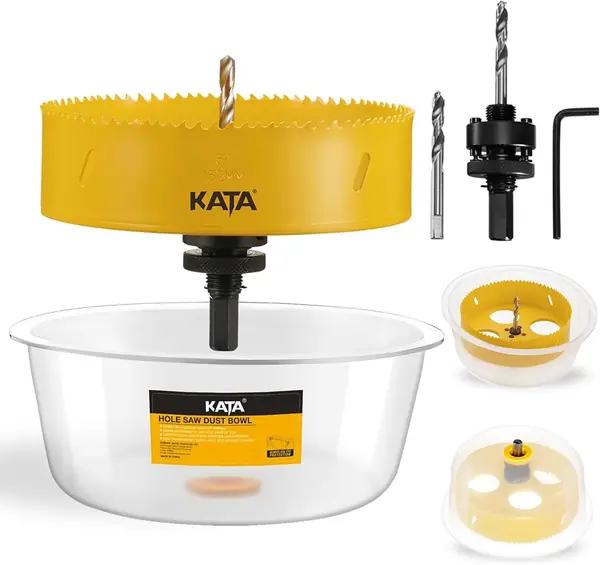
KATA 6-Inch Hole Saw with Silicone Dust Bowl Best for Visible Cut Lines

KATA 6-inch hole saw with clear silicone dust bowl and arbor

Visible cut lines

Shop Score 84/100
Saw Edge
High-carbon steel teeth
Cutout Diameter
6 in.
Dust Bowl
Translucent silicone, one piece
In The Kit
Arbor, drill bit, hex key
View on Amazon

Most dust bowls are opaque, which leaves you guessing where the rim of the hole is. KATA's is soft translucent silicone, and you can watch the cut line through it while the drill is running. We prefer to see the line rather than guess at it, and that preference gets stronger once you're overhead on a ladder trying to keep a 6-inch circle centered between two joists.

The bowl is the design story: a single smooth wall with no pleats, so drywall dust rinses out instead of packing into folds, and it stays clear enough to read the next cut. Soft silicone also presses flat where a rigid plastic shell rocks on an uneven ceiling. The high-carbon blade takes a fine edge and moves through ceiling drywall and soft wood quickly. Setup is like the rest of these: arbor through the bowl, saw threaded on, snugged with the hex key in the kit. At this price it makes a sensible second saw, the one you keep for punch-outs and small jobs once the good saw goes back in the box.

Worth Noting

  • Not for metal, tile or ceramic
  • 7/16-inch shank may not fit 3/8-inch drills
Our Verdict

We like this one for the bowl: soft translucent silicone shows the cut line and rinses clean, and it's an inexpensive way to add a second saw.

Check Latest Price
7.

METOTY 6-Inch Hole Saw with Dust Bowl Best for Occasional 6-Inch Holes

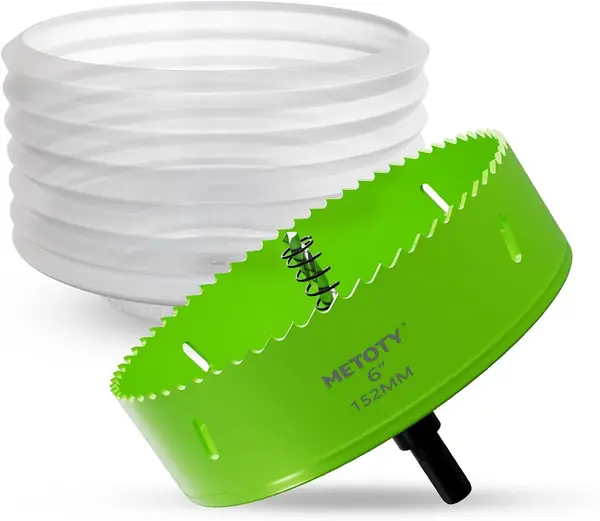
METOTY 6-inch bi-metal hole saw with green dust bowl and arbor

Occasional 6-inch holes

Shop Score 83/100
Saw Edge
Bi-metal, 4-6 TPI variable pitch
Cutout Diameter
6 in.
Dust Bowl
Included, rigid plastic
In The Kit
Hole saw, dust bowl, arbor
View on Amazon

Six inches of bi-metal with a coarse 4-6 tooth pitch is a fast combination in drywall: the big gullets clear chips instead of packing, and the bowl catches what falls. What you're buying here is the low end of that idea, a 6-inch saw, a rigid plastic bowl that lifts off for emptying, and an arbor to mount it on. Nothing fancy, and at this price nothing should be.

Fit and finish sit where you'd expect near the bottom of the range. The bowl is a rigid shell that presses against the ceiling and pulls off to empty; on a flat ceiling it catches the bulk of the dust, but over heavy texture or a wavy patch it leaves gaps that the soft silicone bowl on the KATA closes. The teeth are coarse, quick through drywall and rougher in plywood, and we think that's the trade for the price.

The thing to watch is diameter. This saw can cut a hair under its nominal 6 inches, and a can light needs the full opening, so test the first hole in a scrap of drywall and keep a rasp handy in case a housing won't seat. It's the least expensive route here to a 6-inch cut with dust collection, and for a handful of holes in a flat ceiling, we think that's enough.

Worth Noting

  • No spare pilot bit or hex key
Our Verdict

A low-cost way into a 6-inch cut with dust collection, though we'd test the first hole in scrap before committing your ceiling.

Check Latest Price

How We Tested Recessed-Light Hole Saws

We started with saws sold specifically for can lights, in both the 4-inch and 6-inch families, then filtered the field by cut depth, edge type, and what came in the box — arbor, pilot bit, hex key, dust bowl. That left a dozen saws, which we ran for six months.

All of it happened overhead, where these saws actually work. We cut openings for can lights in paper-faced drywall in a finished kitchen, worked through old plaster-and-lath, and pushed the same saws into pine, PVC, and thin metal to see how the teeth held. Before every cut we confirmed nothing sat in the path — no wiring, ceiling box, ductwork, or joist — and on the 6-inch saws we used a drill with a side handle, both hands on the tool, because a saw that size can bind and kick in drywall.

We measured each opening against its trim and noted whether the fixture dropped in or needed filing, and we watched how deep the saw cut before the arbor bottomed out in a thick ceiling assembly. To judge dust, we swept the drop cloth after every hole, checked how the bowl sealed against the ceiling, and emptied it the way a homeowner would. We examined the cut edge for torn paper facing, counted how many holes each saw cut before the teeth dulled, and chucked every one into a 1/2-inch drill to see how the arbor fit and whether it was in the box or sold separately.

Value came last: what the kit included against what it cost, and whether the money bought a saw that would finish a room rather than two holes.

How to Choose a Hole Saw for Recessed Lights

Start with the fixture, not the label

The opening is decided by the light, not by whatever saw is on sale. Four-inch fixtures generally want a 4-1/8 to 4-1/4 inch cut; 6-inch fixtures take a 6-3/8 inch opening in most cases, though some trims call for a tighter 6-inch hole. Sellers round these to the nearest inch, so a hole cutter sold as 6-inch may measure 6 or 6-3/8 across the rim. Check the actual diameter, not the name on the package.

Then read the fixture's own instructions. An undersized hole won't let the housing in, and an oversized one leaves the can sitting loose with a gap the trim may not cover. When you're stuck between two sizes, take the smaller saw and open the hole up with a rasp, which is far easier than shrinking it.

Match the edge and the depth to your ceiling

Bi-metal saws have teeth. They cut fast and clean in paper-faced drywall, wood, plastic and thin metal, which covers most modern ceilings. Carbide grit saws have no teeth at all; they grind, which is slower in drywall but the only thing that survives plaster, lath, stucco and cement board. Put a toothed saw into a 1950s ceiling with wire mesh in the plaster and you'll be buying another one before the room is finished.

Depth matters for the same reason. A 1-1/8 inch saw gets through drywall and ordinary lath; a 1-3/4 inch saw gets through an inch of plaster plus the wood behind it in one pass. We weigh both against the size of the job: for two or three holes, the inexpensive toothed saw wins, and for a floor of ceilings the carbide saw pays for itself in blades you don't buy.

Check the arbor against your drill

Some saws come with an arbor and some don't, and nothing is more irritating than a saw you can't mount. Confirm the shank size against your drill's chuck as well: the large carbide saws want a 1/2-inch chuck, and one saw here uses a 7/16 inch shank that won't seat in every 3/8-inch drill. If the arbor is sold separately, buy it in the same order.

A 6-inch saw in drywall also wants a drill with some muscle and a side handle. Use low gear and steady pressure and let the rim do the cutting, because forcing a big saw is how you burn an edge, tear the ceiling paper, or get the drill twisted out of your hands.

Decide how much dust you'll tolerate

A dust bowl is a plastic or silicone cup that sits against the ceiling with the arbor through its middle, and a good one turns an overhead cut from a mess into a shrug. Rigid plastic bowls, which come with most of the kits here, work on a flat ceiling and lift off to empty. Soft silicone, as on the KATA, seals better over texture and lets you watch the cut.

Two caveats. Bowls are usually made for one brand's saw and won't transfer, so treat saw and bowl as a set. And for a single hole, a second person holding a shop vac hose at the cut edge does nearly as well without another purchase.

Frequently Asked Questions

Final Verdict

For a typical retrofit of 4-inch wafer lights in a drywall ceiling in a room you'd rather not dust, the VIKITON 4-1/4-inch kit is the one we hand people. The diameter is right, the bowl does the work while you're on the ladder, and the box has everything needed to start cutting.

Two situations change that. If your lights are 6-inch, the Storystore kit covers the same ground for less than the carbide saws. If the ceiling is old plaster and lath, skip straight to carbide: the HLOFIZI for a room, and the Milwaukee with its deeper cut and separate arbor for a whole floor of them.