↑↓ navigate ↵ open Esc close All results →

Best Door Hole Saw Kits of 2026

Boring a 2-1/8-inch lockset hole through a hung door leaves zero margin for a wandering jig—if the clamp creeps a quarter inch or the saw binds mid-cut, you are patching a slab you cannot easily flip over. Dependable door lock kits remove that risk with clamps that grip without denting painted faces, guides built for both standard door thicknesses, and teeth that leave crisp edges on entry and exit.

Drilling hollow-core interior slabs, heavy exterior doors, and paint-thickened old doors across six months with 12 kits turned up two details first-time installers rarely notice before checkout. Strike-plate and latch mortisers seldom ship in the box, and the smaller 1-inch bore saw matters just as much as the main bore because ragged latch holes still show after the trim plate goes on.

Whether you are swapping a single deadbolt or hanging doors throughout a full remodel, these five kits deliver clean alignment without chewing up the door skin.

Our Top Picks

The Best Door Hole Saw Kits

1.

DEWALT D180004 Door Lock Installation Kit Best Overall
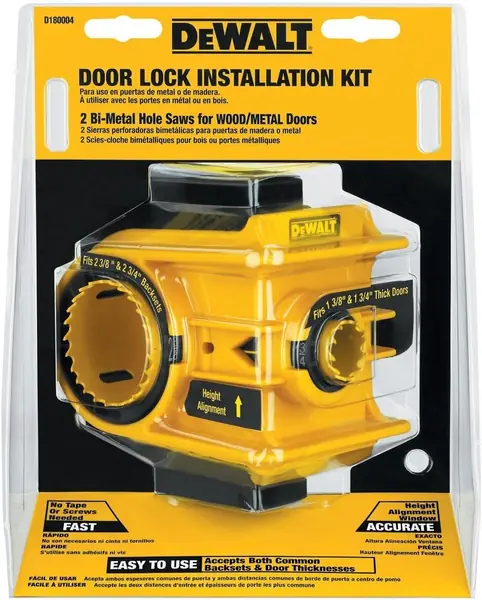
DEWALT door lock installation kit in a yellow and black case

Most door installs

Shop Score 93/100
Hole Saw Sizes
1 in. and 2-1/8 in.
Jig Mounting
Tool-free C-clamp, no surface damage
Included Extras
Mandrel, adapter, drill guide, two spare pilot bits
Door And Backset Fit
Two bushings cover both common thicknesses and backsets
View on Amazon

The clamp is what sold us. Instead of a template you line up by eye or screw into the door face, this one grips the slab and tightens by hand, so the jig holds its position while a 2-1/8 in. saw works through a solid-core exterior door. There is nothing to fill and repaint afterward, which matters on a door that is already finished. An alignment window gives a straight sightline for height, and the bushings stand tall enough to keep the saw running square rather than wandering off angle.

Coverage is the other reason it takes the top spot. Two adjustable bushings accept both standard backsets and both common door thicknesses, so one kit handles a 1-3/8 in. interior hollow-core and a 1-3/4 in. exterior slab without a second template. You get the 1 in. and 2-1/8 in. saws, a mandrel, an adapter, a drill guide and two spare pilot bits in a molded case with a carry handle — and the spares matter, because the pilot is the thing that snaps first.

Feed the big saw steadily and back it out to clear the chips, since it will grab if you rush the last half inch of a thick door. Otherwise there is little to learn: the bushings set the backset, the window sets the height, and the holes land where the lockset needs them. That short learning curve is the whole argument for spending more than the price of two saws.

Worth Noting

  • Plastic bushings wear where the large saw passes
Our Verdict

We recommend the DEWALT kit for most door projects: the clamp holds without screws and the two bushings cover the doors and backsets you'll actually meet.

Check Latest Price
2.

Milwaukee 49-22-4073 Door Lock and Deadbolt Kit Best Self-Centering Jig

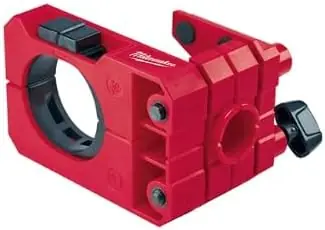
Milwaukee polycarbonate door jig with non-slip clamp and hole saw

Quick hollow-core swaps

Shop Score 89/100
Hole Saw Sizes
1 in. and 2-1/8 in.
Door Thickness
Fits 1-3/8 in. and 1-3/4 in. doors
Centering
Auto-centering guide with non-slip clamp
Jig Material
Polycarbonate
View on Amazon

Milwaukee's jig is one piece of polycarbonate with a clamp on one side and an auto-centering guide on the other, so setup is a single motion: clamp it over the door edge and the guide finds the center of the slab itself. That is a different ritual from the templates with separate bushings you drop in and swap, and it is why this one suits a door that is already hung, painted, and not coming off its hinges.

The clamp is the part we trust. It wraps the slab instead of screwing into it, and it holds the guide square while the saw goes through, so the 2-1/8 in. bore comes out centered on both faces rather than a sixteenth high on the back. On a hollow-core door there is very little to it: clamp, drill, flip the jig, drill again.

It covers 1-3/8 in. and 1-3/4 in. doors and includes both saw sizes, so nothing else needs buying. The polycarbonate is light and precise, though it is not the kit to hand a crew that hangs doors all week; a homeowner doing two or three will never notice the difference. For a weekend of swapping builders-grade knobs for real hardware, the setup time is the reason to pick it.

Worth Noting

  • Single arbor makes saw swaps slow and grabby
  • Backset setting can creep during the cut
Our Verdict

We point you to the Milwaukee when you want the jig to center itself and clamp on in one motion, especially on doors already hung.

Check Latest Price
3.

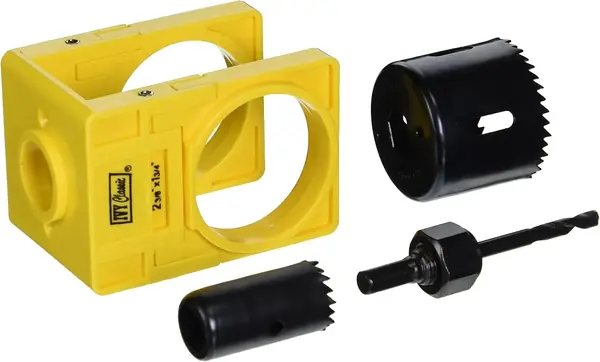
IVY Classic 27003 Lock Installation Kit Best Budget

IVY Classic carbon-steel hole saw kit with plastic guide template and arbor

Budget interior doors

Shop Score 88/100
Hole Saw Sizes
1 in. and 2-1/8 in., carbon steel
Door Thickness
Fits 1-3/8 in. and 1-3/4 in. doors
Backsets
Fits 2-3/8 in. and 2-3/4 in. backsets
Template
Snap-lock adjustable plastic guide
View on Amazon

This is the kit we hand someone with three interior doors to do and no interest in starting a jig collection. The plastic template snaps to 1-3/8 in. or 1-3/4 in. doors and to 2-3/8 in. or 2-3/4 in. backsets, and the card includes 1 in. and 2-1/8 in. carbon-steel saws on a D-type arbor with a pilot drill. You give up the clamp, not the coverage, for less than half the price of our top pick.

Setting the arms takes a second and there is nothing to screw into the door. The flip side is that nothing clamps it either: the template rests on the edge and stays put under hand pressure, which is fine on a raw or primed slab and less fine on a slick factory finish. A strip of painter's tape along the hinge edge gives it something to bite and keeps it from walking while the saw starts.

In wood the saws cut cleanly and the holes land where the template says. Keep it on wood, though — the teeth are carbon steel, the kit is built for wood doors, and a metal-clad exterior slab will dull them quickly. For a rental turnover or a first house with a handful of hollow-core doors, that is the right trade.

Worth Noting

  • Pilot bit is the first part to break
Our Verdict

Our budget pick, and the one we recommend for a few interior doors: both thicknesses, both backsets, and no clamp to fiddle with.

Check Latest Price
4.

RKK Door Lock Installation Kit Best for Single-Door Projects

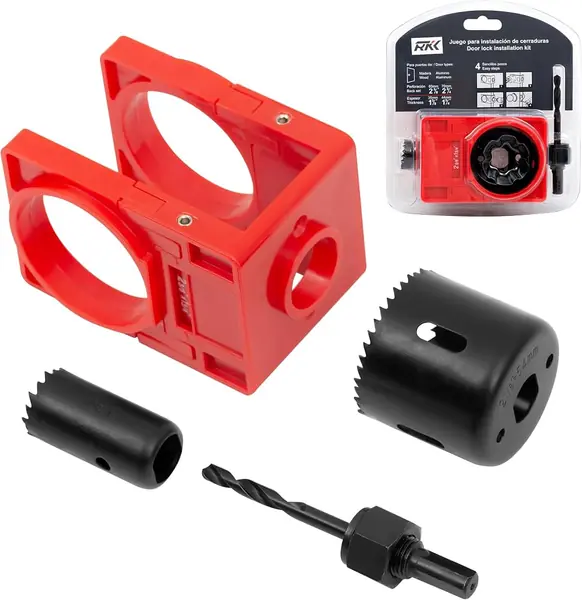
RKK kit with yellow adjustable guide template, two hole saws, and arbor

Single-door projects

Shop Score 87/100
Hole Saw Sizes
1 in. and 2-1/8 in., carbon steel
Guide Template
Adjustable plastic with snap-lock arm
Pilot Point
Brad point on a straight-shank arbor
View on Amazon

Four pieces arrive from RKK: an adjustable plastic guide with a snap-lock arm for door width and backset, a 1 in. hole saw, a 2-1/8 in. hole saw, and an arbor with a brad-point pilot. There is no case, no spare pilot, and no clamp — the template rests on the door edge and depends on your hand to stay put through the first few seconds of the cut.

For a run of six doors that would be faint praise. For one wood door — a hollow-core closet, a bedroom lock swap, a rental that needs a handle before the next tenant — we think it is the sensible buy. The saws are carbon steel and cut cleanly in softwood, the template sets both door width and backset, and the saving goes toward the lockset instead of the tool. Clamp or tape the guide down before you start and the bores land where you want them. Nothing in the box feels like a lifetime tool, and for one door it does not need to.

Worth Noting

  • No case, so the pieces travel loose
Our Verdict

We think it suits one wood door and one afternoon, when four simple pieces are all the job actually needs.

Check Latest Price
5.

KATA KT20531 Door Lock Installation Kit Best for Interior Wood Doors

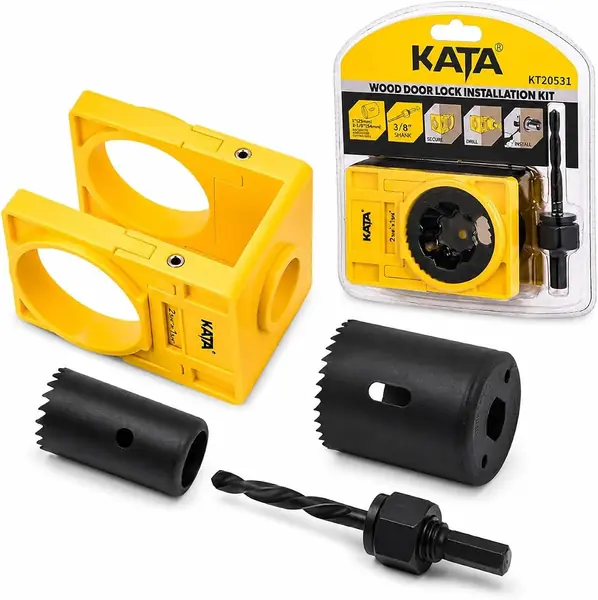
KATA yellow plastic U-shaped guide template with two hole saws and arbor

Interior wood doors

Shop Score 86/100
Hole Saw Sizes
1 in. and 2-1/8 in.
Door Thickness
1-3/8 in. to 1-3/4 in.
Guide Template
U-shaped adjustable with snap-lock arms
Materials
Carbon-steel saws, plastic template
View on Amazon

Two hole saws, an arbor with a pilot bit, and a U-shaped plastic template with snap-lock arms — that is the whole kit, and it fits in one hand. The arms click to the door width and backset, so setup is a matter of setting both notches and sliding the guide onto the door edge.

Where it makes sense is a standard 1-3/8 in. interior door, especially one where you are opening an old, undersized bore to take a modern lockset. The template sits flat on a slab that thickness, the saws cut quickly through hollow-core and softwood, and the job is over before the drill has cooled.

A 1-3/4 in. exterior slab is where this kit stops being the right answer. The template does not seat the same way on a thicker door, the fit gets sloppy, and that is the door where a wandering 2-1/8 in. saw ruins the slab. We like the KATA for interior doors and leave it in the box for the front door.

Worth Noting

  • Hole saws dull quickly on solid wood
  • Thin template flexes under drill pressure
Our Verdict

We recommend it for interior wood doors, and not for the front door, where the template stops seating properly.

Check Latest Price

How We Tested Door Lock Installation Kits

We started by pulling every door lock installation kit we could find that named both saw sizes, then narrowed the shortlist by what each listing said about door thickness and backset coverage. That left 12 kits, used over six months to hang new doors and swap locksets on existing ones. Before any clamp went on, we measured each door's thickness with calipers and noted which bushing or template setting it called for.

Each kit got the same run: set to a 2-3/8-inch backset, bore the face and edge holes, then reset to 2-3/4 inches and repeat, checking the result against a strike plate already in the frame. We marked the jig's starting position and looked again after the cut to see whether it had crept. We checked every door edge and face for nails, screws, and metal hardware before boring, wore eye protection, kept both hands clear of the saw, and ran the big 2-1/8-inch saw on a drill with a side handle, letting it spin down before pulling it out of the cut.

Then we kept going until things wore out, counting how many doors each saw survived before cut times stretched and the rims tore fibers instead of slicing them. A few kits went through a metal-clad exterior door to see which carbon-steel saws stalled or shed teeth. We also took stock of what came in the box, from spare pilot bits to a case to whether the plate template was genuinely usable, and judged ease of use on the third door rather than the first, since that's when a fussy clamp stops being charming.

How to Choose a Door Hole Saw Kit

Measure the door before you trust the listing

Nearly every kit here claims both common door thicknesses and both standard backsets, and most of them manage it on one. A standard interior slab is 1-3/8 in.; exterior and solid-core doors run 1-3/4 in. Backset is the distance from the door edge to the center of the bore, either 2-3/8 in. or 2-3/4 in., and you can read it with a tape in ten seconds.

Set the tape on the actual door. A template that only seats properly on one thickness shows up as a sloppy fit on the other, and if every door in your house is a 1-3/4 in. exterior slab, a kit that shines on hollow-core is the wrong purchase however cheap it is.

Decide how the jig attaches

A guide stays put one of three ways: a clamp that wraps the door, a template that rests on the edge under hand pressure, or screws driven into the face. We put a clamp at the top of that list — the DEWALT tightens by hand and leaves no mark on a finished door, and the Milwaukee clamps over the slab so the job needs one pair of hands.

Hand-held templates are quick and cheap, and on a raw or primed door they are steady enough; on a slick factory finish they walk, so a strip of tape or a spring clamp earns its keep. Screws hold hardest and leave two holes to fill, which is a bad trade on a door you have already painted.

Look at the saws and the spares

Every kit here ships a 1 in. saw for the latch and a 2-1/8 in. saw for the knob or deadbolt body, so the sizes are settled. What varies is the steel. Carbon cuts wood well and dulls on anything harder, including the thin steel skin of a metal-clad exterior door; bi-metal and carbide hold an edge longer and cost more.

The pilot bit in the arbor is the part that breaks first, so a kit with a spare pilot saves a mid-project trip to the hardware store. If you are fitting more than a handful of doors, plan on buying a better 2-1/8 in. saw no matter which jig you choose.

Budget for the strike plate

The two bores are the visible half of the job. The deadbolt still needs a mortise in the door edge and a recess in the jamb for the strike, and most kits here leave that to a chisel. A router bit and a bolt-plate template are the exception in this category, and they are worth having if you are fitting several locks.

Without them, hang the lock body first, mark the plate through its screw holes, and pare the recess with a sharp chisel before driving anything home. It is slower, but a plate that sits flush matters more than a plate that got cut fast.

Frequently Asked Questions

Final Verdict

The DEWALT kit is what we recommend for most doors. It clamps on without screws, its two bushings cover both common thicknesses and both backsets, and the spare pilot bits mean a snapped bit does not end the afternoon. That combination is worth the extra money over a hand-held template.

If your project is interior doors and the budget is tight, the IVY Classic cuts the same two holes for less than half the price. Accept the hand-held template, keep it on wood, and it will do everything a hollow-core door asks.