↑↓ navigate ↵ open Esc close All results →

Best Hole Saw Arbors of 2026

Buying a hole saw first and grabbing whatever arbor hangs nearest the register is a fast way to get a wobbly, scorched bore. Though the arbor is the least expensive piece in the setup, a cheap shaft can spin loose mid-cut in a door blank even when the saw teeth are sharp.

Testing 14 arbors over three months on both a corded drill and a compact cordless driver across plywood, drywall, PVC, and stainless panel showed that price matters far less than chuck fit and saw-change speed. Matching the shank directly to the drill without adapters and fitting existing shop saws saved far more frustration than extra packaging claims.

Two sizing realities apply across every brand: running an oversized saw on a small-rated arbor overloads the shank, and pilot bits are consumable wear parts rather than lifetime tools. Both universal threaded arbors and quick-change systems are covered below to match common shop saw collections.

Our Top Picks

The Best Hole Saw Arbors

1.

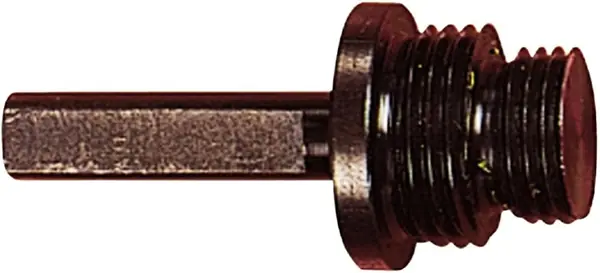
Milwaukee 49-56-7250 Quick-Change Arbor Best Overall
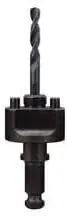
Milwaukee 49-56-7250 quick-change hole saw arbor with alloy steel body and 3/8-inch hex shank

All-around shop use

Shop Score 93/100
Shank
3/8 in. hex
Compatibility
All brands, no adapters required
Minimum Chuck
3/8 in.
Hole Saw Range
1-1/4 in. and larger
View on Amazon

A shop drawer usually holds hole saws from three or four different makers, and most arbors will only drive their own brand's blades. The Milwaukee 49-56-7250 does not care whose name is on the saw: it takes any cutter built around the standard threaded hub and two drive pins, with no adapters and no part-number matching. That universal fit is the reason it became the arbor we leave in the drill.

Quick change here means tool-free. Slide the retaining pins, spin the saw off, spin the next one on. Of everything we handled for this guide, the changeover on this one was the most repeatable — a 1-1/2-inch saw and a 4-inch saw swapped back and forth without the collar fighting us. The pins are the one fussy part, sliding stiffly when they are dry, and a drop of light oil sorts that out.

What the money buys is a solid piece of alloy steel with a 3/8-inch hex shank that seats in any chuck of that size or larger, plus 8 ounces of heft that feels like a machined part rather than the stamped shell that ships in a bargain kit. We kept reaching for it on anything above 2 inches, where the extra body makes the whole assembly feel settled in the chuck.

Worth Noting

  • Won't drive hole saws under 1-1/4 inches
  • Needs a 3/8-inch or larger chuck
Our Verdict

Our first choice for most shops: it drives every major brand's saws from 1-1/4 inches up, changes without tools, and never leaves us hunting for an adapter.

Check Latest Price
2.

Diablo Snap-Lock Plus Mandrel DHSAR375 Best for Diablo Saws

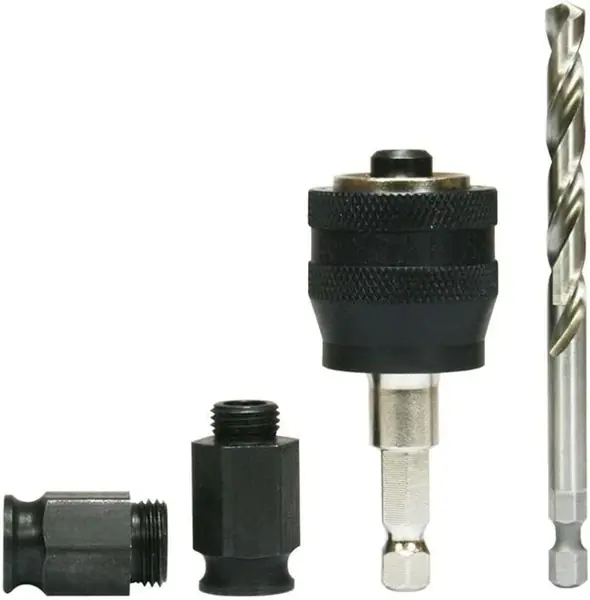
Diablo Snap-Lock Plus mandrel with black oxide finish, adapter nuts, and 3/8-inch hex shank

Diablo saw owners

Shop Score 91/100
Shank
3/8 in. hex
Fits Saws
Diablo Snap-Lock Plus saws
Plug Ejection
Tool-free
Pieces Included
3
View on Amazon

The worst part of drilling with a hole saw is usually not the cutting — it is getting the plug out. Diablo's Snap-Lock Plus mandrel handles that without a screwdriver or a pry bar, and the saw snaps onto the arbor instead of being threaded on and chased off. That combination is why this is the one we keep loaded when a job means a long run of holes.

The catch is the family it belongs to. Snap-Lock Plus is Diablo's own system: the mandrel drives Diablo Snap-Lock Plus saws, and the adapter nuts in the three-piece kit are what let a single mandrel hold different saw sizes. It will not seat a Milwaukee or a Lenox blade, so check the name printed on your saws before you order. This is not a universal arbor and does not pretend to be.

At 2.4 ounces it disappears into a cordless drill, and the 3/8-inch hex shank fits any chuck of that size or larger. For a Diablo user the arithmetic is simple: tool-free plug ejection and quick saw changes in a package small enough to keep in the case with the saws, without buying a second mandrel for every diameter.

Worth Noting

  • Only drives Diablo Snap-Lock Plus saws
Our Verdict

If your saws say Diablo on them, this is the fastest way to swap and clear them, and the cheaper of the two tool-free options here.

Check Latest Price
3.

Luckyway 3-Piece Hole Saw Arbor Set Best Budget Set

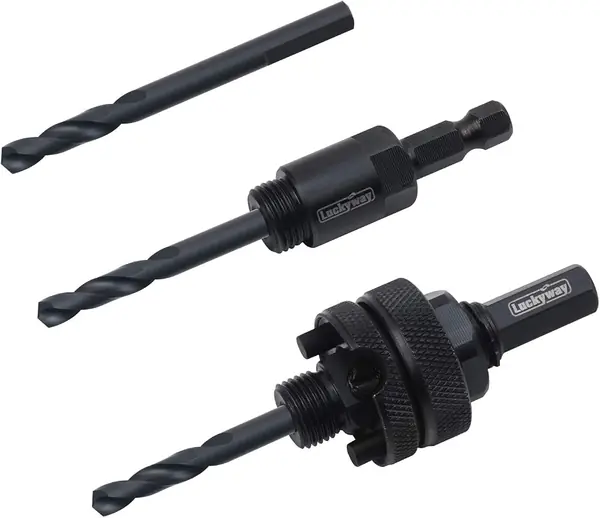
Luckyway three-piece hole saw arbor set with two hex-shank arbors and spare pilot drills

Budget backup set

Shop Score 90/100
Shank Sizes
3/8 in. and 7/16 in. hex
Hole Saw Fit
3/4 to 6 in.
Pilot Drills
1/4 in. HSS (M2)
Arbor Material
45 carbon steel
View on Amazon

The Luckyway set opens to a 3/8-inch hex arbor, a 7/16-inch hex arbor, two 1/4-inch M2 pilot drills, and locking pins that stop a saw from over-tightening on the thread. We think that is the most coverage per dollar in this group — the pair spans saws from 3/4 inch to 6 inches, and the two shank sizes mean the set works on a compact drill and on a half-inch monster without an adapter.

The arbors are 45 carbon steel and take any saw built around a 1/2-inch thread with two drive pins, which covers most of the bimetal blades sold under the usual brand names. Machining is clean and the pins seat squarely in the saw's holes rather than needing to be forced. A spare pilot drill in the box matters more than it sounds: the pilot is the part that breaks first, and having one on hand saves a trip to the store.

Where it gives ground is refinement. The thread and the pins are the wear points on any arbor, and this is a set built for occasional work rather than production. Buy it as a second set for the truck, as the arbors that live with the saws you cut with twice a year, or as the cheapest way to cover both shank sizes before you commit to a premium arbor.

Worth Noting

  • Only fits saws with a 1/2-inch thread and two pins
Our Verdict

For the money, nothing here covers more ground: two arbors, spare pilot bits, and fit for saws from 3/4 to 6 inches.

Check Latest Price
4.

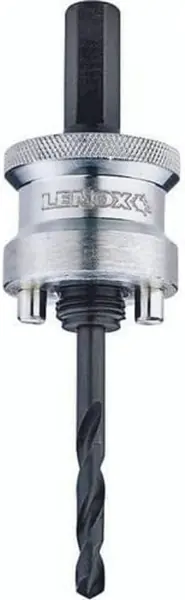
Lenox 2L Snap-Back Arbor Best for Quick Changes

Lenox 2L Snap-Back hole saw arbor in hardened carbon steel with a quick-change collar

High-volume saw changes

Shop Score 89/100
Pilot Bit
Replaceable with hex key and set screw
Release
Pull, twist, snap
Minimum Bore
1.25 inches
Fits Hole Saws
20L through 96L
View on Amazon

The Snap-Back's whole idea is where the force goes. Instead of spinning a saw off against the arbor's threads, you pull the collar and twist, and the arbor pushes the saw off its pins — the release drives off the pins rather than the thread, so the thread is not the part that wears out. Anyone who has retired an arbor because a saw seized onto it will recognize the problem Lenox is solving.

The rest of the tool is built to the same standard: hardened carbon steel, a split-point pilot drill that starts without walking, and a pilot that comes out with a hex key and a set screw instead of being pressed in for life. We were pleasantly surprised by that last detail. The pilot is the first thing to dull or snap, and dropping in a new one keeps the arbor in service instead of sending it to the back of a drawer.

Fit is Lenox's own: the 20L through 96L saws, with a 1-1/4-inch minimum bore, so it is the larger-saw arbor rather than a one-and-only. The release can also hang up. A saw that has been forced through a deep cut can take real effort to break off the collar, and it eases only as the mechanism wears in.

Whether it earns its place comes down to how often you change saws. For a plumber or an electrician swapping sizes a dozen times a day, we think the pin-driven release and the replaceable pilot pay for themselves quickly, and the limited lifetime warranty backs the bet. For a couple of 2-inch holes in a stud, a plain threaded arbor does the same work.

Worth Noting

  • Premium price for a single arbor
Our Verdict

Worth the premium if you change saws all day: the Snap-Back pushes the saw off its pins so the threads never take the wear.

Check Latest Price
5.

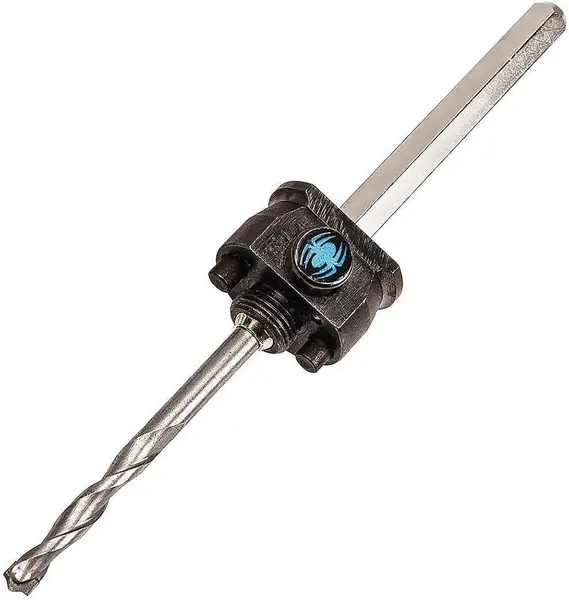
Spyder 600634 Hole Saw Arbor Best for Spyder Saw Owners

Spyder 600634 hole saw arbor with half-inch hex shank and high-speed steel pilot

Spyder saw owners

Shop Score 88/100
Shank
1/2 in. hex
Fits Saws
Spyder 1-3/8 in. and larger
Pilot Bit
High-speed steel
Cutting Materials
Wood, plastic, metal
View on Amazon

A half-inch hex shank is the first thing to notice here. It is a beefier drive than the 3/8-inch shanks most of these use, and the extra mass suits the larger saws the arbor is rated for. We paid close attention to that spec, because the shank is what decides whether this arbor goes in the drill bag or stays in the drawer.

The arbor is built for Spyder's Rapid Core Eject saws, 1-3/8 inches and up, and the core comes out at the push of a button — no screwdriver, no lever, no reaching into a hot cutter. It is the same idea as Diablo's tool-free ejection and just as welcome on a long run of holes. The pilot is high-speed steel and the arbor is rated for wood, plastic, and metal, so it follows you across materials.

Where it lands for us: this is a good arbor with a genuinely useful trick. If you cut a long run of holes in one session, the push-button eject earns its place in the box, and the half-inch shank keeps the assembly planted when a big saw grabs. It is the kind of tool you buy once the saws are already sorted, not the arbor you start with.

Worth Noting

  • Needs a 1/2-inch chuck or an adapter
Our Verdict

A fast, push-button arbor for anyone already running Spyder's Rapid Core Eject saws, and a second arbor rather than a first one.

Check Latest Price
6.

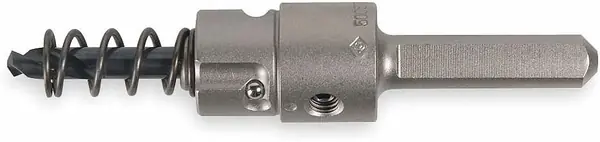
Greenlee 645-011 Kwik Change Arbor Best for Stainless Panel Work

Greenlee 645-011 Kwik Change arbor for carbide-tipped cutter heads in stainless steel

Stainless panel work

Shop Score 87/100
Change
Push and turn
Flange Stop
Prevents over-drilling
Pilot Drill
Replaceable cobalt steel, split point
Cutter Range
5/8 to 2-1/4 in.
View on Amazon

Kwik Change is the right name for it. Greenlee's 645-011 holds a carbide-tipped cutter head with a push and a twist, and the head comes off the same way — no thread to chase, no pins to line up. We noted how much of the design is aimed at stainless: a flange stop that keeps the cutter from running past its depth, and a replaceable cobalt-steel pilot with a split point that resists walking on a curved surface.

The cutter heads carry the range. This arbor runs heads from 5/8 inch to 2-1/4 inches, and the heads above 3/4 inch have an ejector spring that pushes the slug out rather than leaving you to dig at it. Inside its own system we think it is excellent — a quick, precise change on a body built for the material it targets. What it is not is flexible: 2-1/4 inches is as large as this arbor goes, which puts bigger stainless cutouts out of its reach.

Where that leaves most woodworkers is somewhere else. This is more arbor than a bimetal saw needs; a plain threaded arbor drives a saw through pine or plywood all day and the quick change buys you nothing there. For panel work, knockouts, and stainless, though, the push-and-turn change and the replaceable pilot are the whole reason the design exists, and the arbor will outlast the cutters it drives.

Worth Noting

  • Drives only Greenlee Kwik Change cutter heads
Our Verdict

Only worth it if you are already running Greenlee Kwik Change cutters — for those, the push-and-turn change is quick, precise, and built for stainless.

Check Latest Price
7.

Starrett KA19 Hole Enlargement Arbor Best for Enlarging Existing Holes

Starrett KA19 hole enlargement arbor with black oxide finish for enlarging cut holes

Enlarging existing holes

Shop Score 86/100
Replaces
The pilot drill
Fits Arbors
A1, A2, and A10
Saw Compatibility
Five Starrett saw types
View on Amazon

Enlarging a hole is the job nobody plans for: the panel was cut for a 2-inch fitting, the new one needs 2-1/2, and a hole saw has no pilot to bite into. The KA19 replaces the pilot drill in an existing Starrett arbor, and a saw the size of the old hole mounts on it as the guide while a larger saw cuts the new diameter — so the second cut follows the first instead of wandering across the panel.

It works with Starrett's A1, A2, and A10 arbors and with five saw types, including the carbide-tipped and diamond-grit cutters you reach for on tile or abrasive board. Fit and finish are what we expect from a Starrett accessory: black oxide, clean machining, made in the USA, and small enough to live in a drawer until the day you need it.

We like it best as insurance. It saves the panel it rescues, and it turns a hole that is the wrong size into a hole that is the right size in a few minutes. One thing to know before the cut: chips pack between the guide saw and the cutting saw, so back the pair off and clear them before you try to unscrew the stack, or you will be prying at a seized pair.

Worth Noting

  • Needs a Starrett A1, A2, or A10 arbor
Our Verdict

Not a replacement for your main arbor — it is the tool for opening an existing hole one size larger, using the old hole as the guide.

Check Latest Price

How We Chose and Tested Hole Saw Arbors

To build the shortlist, we started with the specs that decide whether an arbor is usable at all: the mount, meaning universal threads versus a brand's quick-change system; the shank size and hex profile; and the saw diameters it's rated to drive. We read the coverage charts, filtered out anything priced well above what its range covered, and bought 14 arbors to test in a home shop over three months.

Each arbor went into a corded drill and a compact cordless, and we seated the shank in a keyed chuck and a half-inch chuck to see how much play there was before the drill even turned. Then we put them to work: door blanks for deadbolts, drywall for recessed lights, PVC through a rim joist, plywood shelving, and a stainless panel. We pulled the battery out of the drill before every saw or pilot bit change, no exceptions, and timed each change with a stopwatch to note whether it needed a tool.

We also watched how the plug came out, whether it dropped free or needed a poke, and how the pilot drill was held and whether we could swap it with a hex key. Once a saw was mounted we checked runout by eye and by the hole's edge, and each arbor stayed paired with saws inside its rated range, so anything that labored at the top of its range got marked down. After every session we inspected the threads, drive pins, and pilot tips, tracking how many changes it took before something loosened, then weighed that wear against the arbor's cost and how locked-in its system left us.

How to Choose a Hole Saw Arbor

Start With the Saws You Already Own

Two mounting styles split this category. Universal arbors — often sold as mandrels — grip a bimetal saw on a threaded hub with two drive pins, and they will take any saw built to that pattern. The thread size differs between systems, with 1/2-inch and 5/8-inch-18 both in circulation, so confirm the one your blades use. Brand systems are the other half: Diablo's Snap-Lock Plus, Lenox's Snap-Back, Spyder's Rapid Core Eject, and Greenlee's Kwik Change each drive only their own cutters.

The trap is buying an arbor for its quick-change mechanism and then finding it will not hold your blades. Read the saw, not the listing: if it has two pin holes and a plain thread, a universal arbor like the Milwaukee 49-56-7250 will drive it. If it has a collar or a snap feature, you are shopping inside that brand and should check the fit before anything else.

Check the Shank Against Your Drill

Shank sizes run 3/8 inch, 7/16 inch, and 1/2 inch, all in hex. A 3/8-inch hex drops into the keyless chuck on nearly any drill and is the safest default. Step up to 1/2 inch and you need a 1/2-inch chuck or an adapter — that is the spec that quietly rules out a lot of compact cordless drills, including the Spyder 600634 if yours tops out at 3/8.

Hex beats a round shank for one practical reason: it seats in the jaws at a repeatable angle and holds there when a big saw grabs. If you regularly hang a 4-inch or 6-inch saw off your drill, the larger shank and the drill that can take it are worth the upgrade.

One Arbor Won't Cover Every Saw Size

Arbors are rated by the saws they will drive, and those ranges barely overlap. The Milwaukee is rated for 1-1/4 inches and up, the Lenox starts at a 1-1/4-inch bore, the Spyder at 1-3/8 inches, and the Greenlee tops out at 2-1/4 inches because it is built for cutter heads rather than saws. Only the Luckyway set spans 3/4 inch to 6 inches on its own.

So count the sizes you actually cut. If you own a 3/4-inch saw for pilot holes and a 4-inch saw for vent cutouts, plan on two arbors — a small one for the small saw and a big-thread arbor for everything above 1-1/4 inches. Buying one and hoping is how people end up with a saw that will not mount.

Decide What a Fast Change Is Worth

Every arbor here holds a saw securely; they differ in how much work it is to get one off. A plain threaded arbor means spinning the saw off by hand, which is fine twice a day and irritating twenty times an hour. Quick-change collars cut that to a pull and a twist, and Lenox's Snap-Back goes further by driving the saw off the pins rather than the threads, so a seized saw does not take the thread with it.

Plug ejection is the other half of the same decision. Diablo and Spyder both clear the core without a tool, and on a run of recessed lights that is the feature you notice on every single hole. For occasional work, save the money and buy the simpler arbor.

Treat the Pilot Drill as a Wear Part

The pilot drill does the locating and takes the abuse, and it is the first thing to dull, wander, or snap. Some arbors let you swap it: the Lenox holds its pilot with a hex key and a set screw, and the Greenlee arbor uses a replaceable cobalt bit, while others press it in for good.

Look at how the pilot is retained before you buy, then keep a spare or two on hand. The common size is 1/4 inch, and a spare bit costs far less than a mid-job drive to the hardware store. The Luckyway set ships with spare pilots, which is a large part of why it earns a place as a second set in the truck.

Frequently Asked Questions

Final Verdict

The Milwaukee 49-56-7250 is the arbor we point most people to. It takes every major brand's saws from 1-1/4 inches up, needs no adapters, and changes without a tool — that combination covers the widest range of real shops, and nothing else here does all three.

If your blades are all Diablo, the Snap-Lock Plus mandrel costs less and clears plugs without a tool. If you want one box that covers 3/4-inch and 6-inch saws and both shank sizes, the Luckyway set is the budget answer. Save the Lenox for the days you change saws more often than you change drill bits.